★ LATEST REVIEWS

★★★★☆ Our Rating: 8.5/10
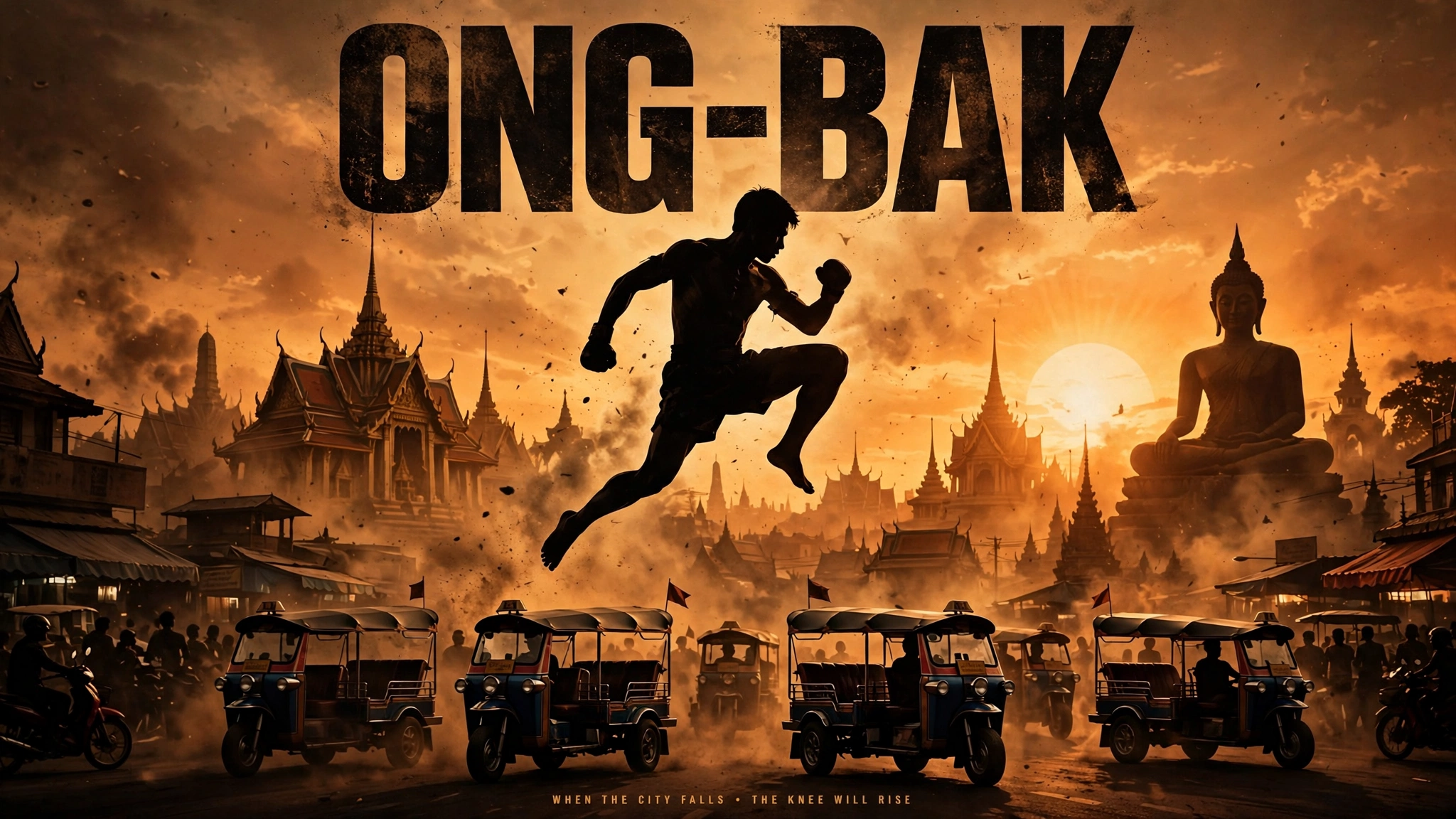
Every generation of martial-arts cinema has a film that resets what audiences believe a human body can do. In 1973 it was Bruce Lee. In the 1980s it was Jackie Chan falling off real buildings. In January 2003, in Thailand, it was a former stuntman named Tony Jaa running across the shoulders of a Bangkok crowd, sliding under a moving truck, and taking on an entire fight club with elbows and knees — advertised, truthfully, as involving no stunt doubles, no wirework and no computer effects. Ong-Bak did not just launch Jaa. It introduced the wider world to Muay Thai — Thailand’s own martial art of fists, elbows, knees and shins — as a screen language, and it did so from a country whose films, at the time, barely travelled at all.
Strip away the legend, though, and an honest Ong-Bak review has to judge what is actually on the screen: a very simple, very old-fashioned quest story, acted modestly, told at a clip, and interrupted every few minutes by action sequences so inventive and so visibly real that, more than twenty years later, they still make modern CGI fight scenes look weightless. The plot of Ong-Bak is a delivery mechanism — but what it delivers is some of the greatest physical filmmaking ever put on screen. This review covers the story, the performers, the stunt craft and the film’s unlikely journey from Bangkok to the world, without spoiling its ending.
| Release date | 21 January 2003 (Thailand) |
| Director | Prachya Pinkaew |
| Writers | Suphachai Sittiaumponpan (screenplay); Prachya Pinkaew, Panna Rittikrai (story) |
| Genre | Martial Arts, Action |
| Language | Thai |
| Runtime | 108 minutes (original Thai version; 105 minutes international version) |
| Budget | Approx. US$1.1 million (widely cited; some older listings give higher figures — see Box Office) |
| Lead cast | Tony Jaa, Petchtai Wongkamlao, Pumwaree Yodkamol |
| Our rating | 8.5/10 |
In the poor, drought-stricken village of Ban Nong Pradu, the temple’s Buddha statue — Ong-Bak, believed to protect the community — is the village’s spiritual heart. When a former villager turned Bangkok criminal saws off the statue’s head to curry favour with a ruthless crime lord, the theft is treated not as a burglary but as a catastrophe. The village chooses its champion: Ting, an orphan raised at the temple and trained in an ancient, dangerous form of Muay Thai he has sworn to use only in defence.
Ting travels to Bangkok with the village’s savings and a name — a former villager, Humlae, now calling himself George, who is supposed to help him. Instead he finds a hustler deep in gambling debts, who sees Ting’s fighting skill as a meal ticket, and George’s streetwise young partner Muay Lek, who survives by petty scams. The trail to the stolen head runs through Bangkok’s underworld of illegal fight clubs, drug money and tuk-tuk chases, and it keeps forcing Ting into the one situation his vows forbid: fighting for money and pride rather than protection. The film’s engine is that tension — a serene village fighter dropped into a corrupt city that wants to buy, bet on or break him — and its set pieces escalate from a market foot-chase through a multi-opponent fight-club gauntlet to a final confrontation built around the statue itself. The ending honours the film’s Buddhist frame rather than its body count, and we will leave its details for you to discover.
Tony Jaa as Ting was not, in 2003, a trained dramatic actor, and the film wisely asks little dialogue of him. What it asks instead is everything else. Jaa — born Panom Yeerum, a stunt performer mentored since his teens by action choreographer Panna Rittikrai — performs with a focused, almost monkish stillness between the explosions, and then moves like no one the camera had ever recorded: leaping splits over vehicles, flying knees, spinning elbows delivered with his full body behind them. Critics at the time, including Variety’s reviewer at Toronto, noted both halves of the bargain — limited as an actor, utterly commanding as a physical presence, with an old-school intensity recalling the genre’s greats. History sided with the second judgement: Ong-Bak won Jaa a Thai Star Entertainment Award for Best Actor and made him, almost overnight, the most talked-about new martial-arts star in the world.
Petchtai Wongkamlao as George (Humlae) — known to Thai audiences as the comedian Mum Jokmok — supplies everything Jaa does not: patter, panic, greed and, eventually, conscience. His fast-talking hustler is the film’s comic engine and its portrait of the city itself, and his gradual thaw towards the village he abandoned gives the story its only real character arc. Pumwaree Yodkamol as Muay Lek brings scrappy energy as the street kid caught between George’s schemes and her own survival, while the villains — a wheelchair-bound crime lord who speaks through an electrolarynx, and his Burmese fighter — are broad types played at exactly the pulp pitch the film wants. Nobody mistakes this for an actors’ showcase. It is a star vehicle in the oldest sense: one extraordinary performer, introduced to the world at full speed.
Director Prachya Pinkaew came from music videos and advertising, and it shows in the film’s restless visual energy — but the true co-author is Panna Rittikrai, Jaa’s mentor and the film’s action choreographer, who had spent years developing a screen style for Muay Boran, the older, more brutal ancestor of ring Muay Thai. Their shared rule, promoted proudly by distributor Sahamongkol and repeated in Variety’s contemporary review, was that the action would use no CGI and no wirework: what you see is what Jaa actually did, with editing and camera placement as the only trickery. The production even adopts the old Hong Kong convention of instantly replaying its most outrageous stunts from a second angle — a flex, essentially, proving to the audience that the leap, the slide, the elbow really happened.
The set pieces repay that confidence. The market chase is a joyful obstacle course of glass panes, carts, barbed wire and kitchen woks that nods openly to Jackie Chan. The fight-club sequence introduces opponent after opponent, each with a different style and a different problem for Ting to solve. The tuk-tuk chase turns Bangkok’s three-wheelers into demolition-derby weapons. Cinematographer Nattawut Kittikhun keeps the camera close and low, letting impacts read, and the editing by Thanat Sunsin and Thanapat Taweesuk respects the choreography instead of chopping it into noise. The craft between the fights is thinner — dialogue scenes are flatly staged, the plot’s joins are visible, and international viewers should know that some foreign versions were trimmed and partly rescored, replacing Thai music with hip-hop; the 108-minute Thai cut is the one to seek out. But as pure action direction, this remains a landmark of economy: a tiny budget, a real city, and a star who was the special effect.
The score is credited to Atomix Clubbing Studio, and in the Thai version it drives the film with propulsive electronic energy layered over traditional Thai textures — functional, contemporary and pitched at the young audience the film courted. It does its best work under the chases and fights, where rhythm matters more than melody, and it knows when to thin out and let the sounds of impact — shin on ribcage, body on concrete — carry the scene. International releases complicate this section of any review: Luc Besson’s EuropaCorp, which acquired the film for much of the world, prepared slightly shortened versions, and some territories received alternate musical material, a common fate for Thai films of the era. None of it changes the film’s sonic identity, which lives in the fights themselves: few action movies have ever made the human body sound this percussive.
What we loved:
What could be better:
The money tells the scale of the upset. Ong-Bak was made for a budget most commonly cited at about US$1.1 million — though we flag that some older reference listings give considerably higher figures (one long-circulated listing states 150 million baht, roughly US$5 million), so the honest statement is that it was, by any version, a very cheap film. In Thailand it became the highest-grossing local film of its year to that point, with Variety reporting around three million admissions and roughly US$7 million at home. The international story is the remarkable part. After a standing ovation in Toronto’s Midnight Madness section, EuropaCorp — Luc Besson’s company — acquired most of Europe, the Americas and Australasia; Besson personally championed the film in France, where it opened to a striking screen average and sold over 440,000 tickets in its first week there. Worldwide, published totals settle at about US$20.1 million (some trackers list US$20.2 million), including roughly US$4.6 million in the United States under the title Ong-Bak: The Thai Warrior — an extraordinary return for a subtitled Thai film with an unknown star, and the commercial foundation for two prequels, Ong-Bak 2 (2008) and Ong-Bak 3 (2010), and for Jaa’s entire international career.
If you care about action cinema at all, this is not optional viewing — it is one of the essential texts. Come for the fights and you will get some of the finest ever filmed: real risk, real impact, and a star performing feats that two decades of CGI have not made any less astonishing. Come expecting a rich drama and you will find a simple fable instead — but a sincere one, in which a quiet young man tries to recover something sacred without becoming the thing his city wants him to be. Ong-Bak is the rare action film whose legend understates it. Watch the Thai cut, turn it up, and count the replays.
Our rating: 8.5/10 — a thin story carried to greatness by the most electrifying martial-arts debut since Jackie Chan, and the film that announced Thai action cinema to the world.
Yes. The film was promoted — and contemporary reviews confirm — as using no stunt doubles for Jaa, no wirework and no CGI in its action sequences. Jaa trained for years under choreographer Panna Rittikrai for the role, and the film’s trademark instant replays of big stunts exist partly to prove their authenticity to the audience.
The original Thai cut runs 108 minutes; the main international version runs about 105 minutes. Some international editions trimmed subplots and replaced parts of the Thai score with hip-hop material for Western markets. The Thai version is generally considered the complete film.
It is his first starring role and his breakthrough. Jaa had worked in the industry for years as a stunt performer and double — he had, for example, stunt-doubled in Mortal Kombat: Annihilation — before Ong-Bak made him a star.
No — despite the numbering, both are prequels, set centuries earlier, with Jaa playing an ancestor-era character. Only the 2003 film tells Ting’s story.
It is widely available on streaming and Blu-ray in most regions, often under the title Ong-Bak: The Thai Warrior or Ong-Bak: Muay Thai Warrior. Availability varies by country, so check your local services — and choose the 108-minute version where you can.