★ LATEST REVIEWS

Our Rating: ★★★★☆ 7/10
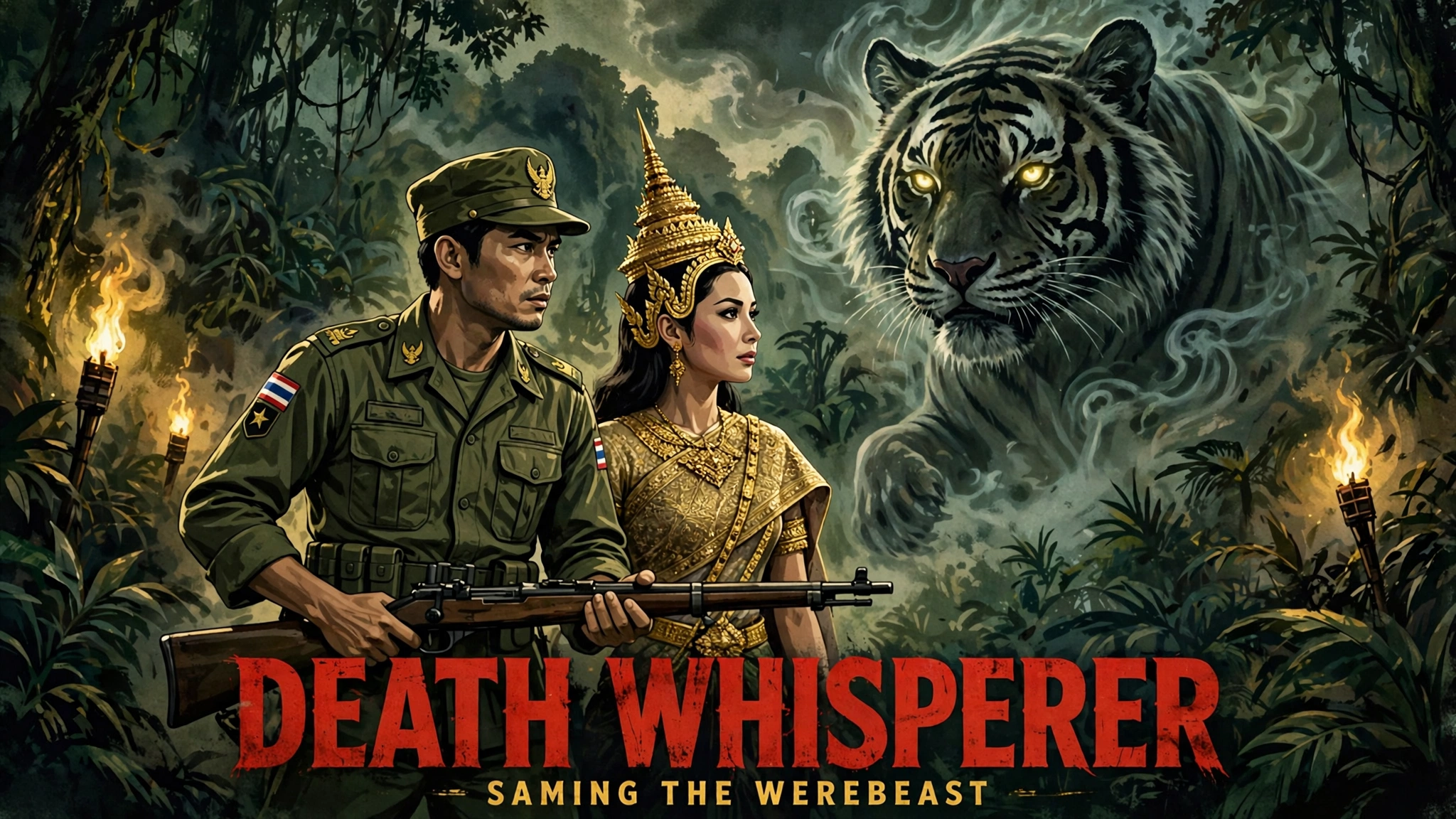
Thai horror has spent the last few years building one of the most successful franchises in Southeast Asian cinema, and Death Whisperer: Saming the Werebeast is its latest expansion. A prequel spin-off to the Death Whisperer trilogy, it trades the trilogy’s family-haunting premise for something wilder: a military search party, a remote jungle, and a legend about a man-eating tiger spirit that can wear a human face. It is a folk-horror adventure with action muscle, and while international coverage of the film is still thin, what has emerged paints a picture of a confident, atmospheric genre piece that knows exactly what its audience wants.
This review is spoiler-free on the film’s later turns. It is based on verified reported facts about the film; where coverage is thin, that is stated plainly rather than filled in.
| Detail | Information |
|---|---|
| Release date | 30 September 2026 (Thailand; some databases list 29 September — see note below) |
| Directors | Narit Yuvaboon, Thanadet Pradit, Chalit Krileadmongkon |
| Writers | Sorarat Jirabovornwisut, Thanadet Pradit, based on Saming Khao Khwang by Krittanon |
| Genre | Supernatural horror, thriller, action |
| Language | Thai |
| Runtime | 111 minutes |
| Lead cast | Nadech Kugimiya, Ongart Cheamcharoenpornkul, Maylada Susri, Wichapas Sumettikul |
| Our rating | 7/10 |
Set in 1960s Thailand, the film follows a military search party sent into the dense jungle of Khao Khwang to find a missing officer. The mission is dangerous enough on its own — remote terrain, wild country, a team under pressure — but the jungle holds something worse than the wilderness. Local legend tells of the Saming, a man-eating tiger spirit that can shed its skin and take human form, hunting by deception as much as by force.
That premise is the film’s great strength, because it turns every encounter into a question: who among the party, or among the people they meet in the jungle, is still human? A rescue mission becomes a survival story, and a survival story becomes a paranoia story, as the soldiers must decide whom to trust while something wearing a familiar face hunts them. The film is positioned as a folk-horror thriller with a strong action component, and its period setting — 1960s uniforms, equipment and attitudes — gives the jungle expedition a texture that a modern setting would not.
Without spoiling the film’s later turns, it is fair to say the story builds toward a confrontation with the spirit itself, and toward the question of what the search party is willing to sacrifice to get out of the jungle alive. The film is a spin-off rather than a direct continuation of the main Death Whisperer trilogy, so newcomers can enter here without having seen the earlier films — though fans of the trilogy will recognise the world and its rules.
Nadech Kugimiya as Yak — Kugimiya, the star of the Death Whisperer trilogy, returns here as Yak, and his presence is the film’s anchor. He brings the same grounded, physical screen presence that made the trilogy a hit: a leading man who looks believable holding a rifle and believable being afraid. In a film built on atmosphere and ensemble tension, his steadiness gives the audience someone to hold onto.
Ongart Cheamcharoenpornkul as Sergeant Paphan, and Maylada Susri as Nampetch — Cheamcharoenpornkul plays the sergeant with the gruff authority the role needs, the professional soldier trying to hold a mission together as it unravels. Susri, as Nampetch, gives the film an important second centre — a character whose knowledge of local belief and local ground matters as much as the soldiers’ firepower. The wider ensemble, including Wichapas Sumettikul as Thewin, Sahajak Boonthanakit as Major Rit and Dan Chupong as Lt. Thap, fills out the search party with distinct personalities rather than anonymous uniforms, which matters in a story where telling people apart — and wondering whether they are still themselves — is the whole game.
Three directors share the credit here — Narit Yuvaboon, Thanadet Pradit and Chalit Krileadmongkon — and the film’s craft reflects a production that knows its genre. The jungle of Khao Khwang is shot as a place of beauty and menace at once: thick canopy, mist, sudden clearings, and a sense that the camera itself is being watched. Kritsadapol Samanukul’s cinematography favours the greens and shadows of the forest, and the creature design leans into the folk-horror idea — a tiger spirit that is most frightening when it looks human.
The action elements are handled with the confidence of a franchise that has learned its audience: the film is listed as horror, thriller and action in equal measure, and the set-pieces are staged to keep the tension moving between dread and release. Where the film is likely to divide viewers is in its balance: folk horror lives or dies on atmosphere, and a film that also wants to be an action adventure must keep both plates spinning. Early database ratings (a 7.0 on one listing, from very few votes) suggest a warm but not ecstatic reception — though with so few votes recorded, that figure should be treated as a placeholder, not a verdict.
One honest caveat, stated plainly: international critical coverage of this film is thin at the time of writing. No major English-language critical consensus exists yet, and no reliable box-office total has been published in the sources checked. This review therefore leans on verified production facts and the film’s premise, and its rating reflects the strength of that premise, the franchise’s track record and the cast — not a critical consensus that does not yet exist.
The score, credited to Banana Sound Studio and Terdsak Janpan, works in the folk-horror register: low drones, forest sounds, and sudden silences that make the jungle feel alive. In a film where the monster may be standing next to you wearing a familiar face, sound design does much of the scaring — a rustle that should not be there, a voice that sounds almost right. The jungle soundscape is the film’s most effective tool, and it is used well.
What we loved:
What could be better:
No reliable box-office figure for Death Whisperer: Saming the Werebeast has appeared in the sources checked for this review, and no budget figure has been published either. Both rows are therefore omitted rather than guessed. What can be said is that the film arrives on the back of a genuinely successful franchise — the Death Whisperer trilogy (2023–2025) was a major Thai box-office story — and that the spin-off’s wide Thai release and immediate database presence suggest a healthy domestic opening. When reliable figures emerge, this section will be worth revisiting; for now, any number quoted elsewhere should be treated with caution.
A note on the release date: Wikipedia lists the Thai theatrical release as 30 September 2026, while several database sources list 29 September 2026. The one-day difference likely reflects premiere-versus-general-release dating or timezone listing practices. This review uses 30 September as the primary date and notes the alternative.
Yes, especially if you enjoy folk horror, jungle survival stories, or Thai genre cinema. Death Whisperer: Saming the Werebeast offers a premise with real teeth — a shape-shifting tiger spirit hunting a military search party — a strong cast, and an atmospheric 1960s setting. It may not yet have the critical footprint of the main trilogy, but as a horror adventure it promises a tense, entertaining night at the cinema, and it opens the franchise’s world in an exciting new direction.
Our rating: 7/10 — A tense, atmospheric folk-horror adventure with a killer premise; the wider verdict is still forming, but the jungle hunt delivers.
Who directed Death Whisperer: Saming the Werebeast?
Narit Yuvaboon, Thanadet Pradit and Chalit Krileadmongkon, from a screenplay by Sorarat Jirabovornwisut and Thanadet Pradit, based on Saming Khao Khwang by Krittanon.
Who stars in Death Whisperer: Saming the Werebeast?
Nadech Kugimiya as Yak, Ongart Cheamcharoenpornkul as Sergeant Paphan, Maylada Susri as Nampetch, with Wichapas Sumettikul, Sahajak Boonthanakit and Dan Chupong in supporting roles.
What is Death Whisperer: Saming the Werebeast about?
A military search party in 1960s Thailand hunts for a missing officer in the jungle of Khao Khwang, where legend says a man-eating tiger spirit called the Saming can take human form.
Is it connected to the Death Whisperer trilogy?
Yes, it is a prequel spin-off to the trilogy (2023–2025), but it tells a standalone story and can be watched without having seen the earlier films.
When was Death Whisperer: Saming the Werebeast released?
30 September 2026 in Thailand, according to Wikipedia; some databases list 29 September 2026.
How much did Death Whisperer: Saming the Werebeast earn at the box office?
No reliable total has been published in the sources checked for this review, so no figure is given here rather than a guess.