★ LATEST REVIEWS

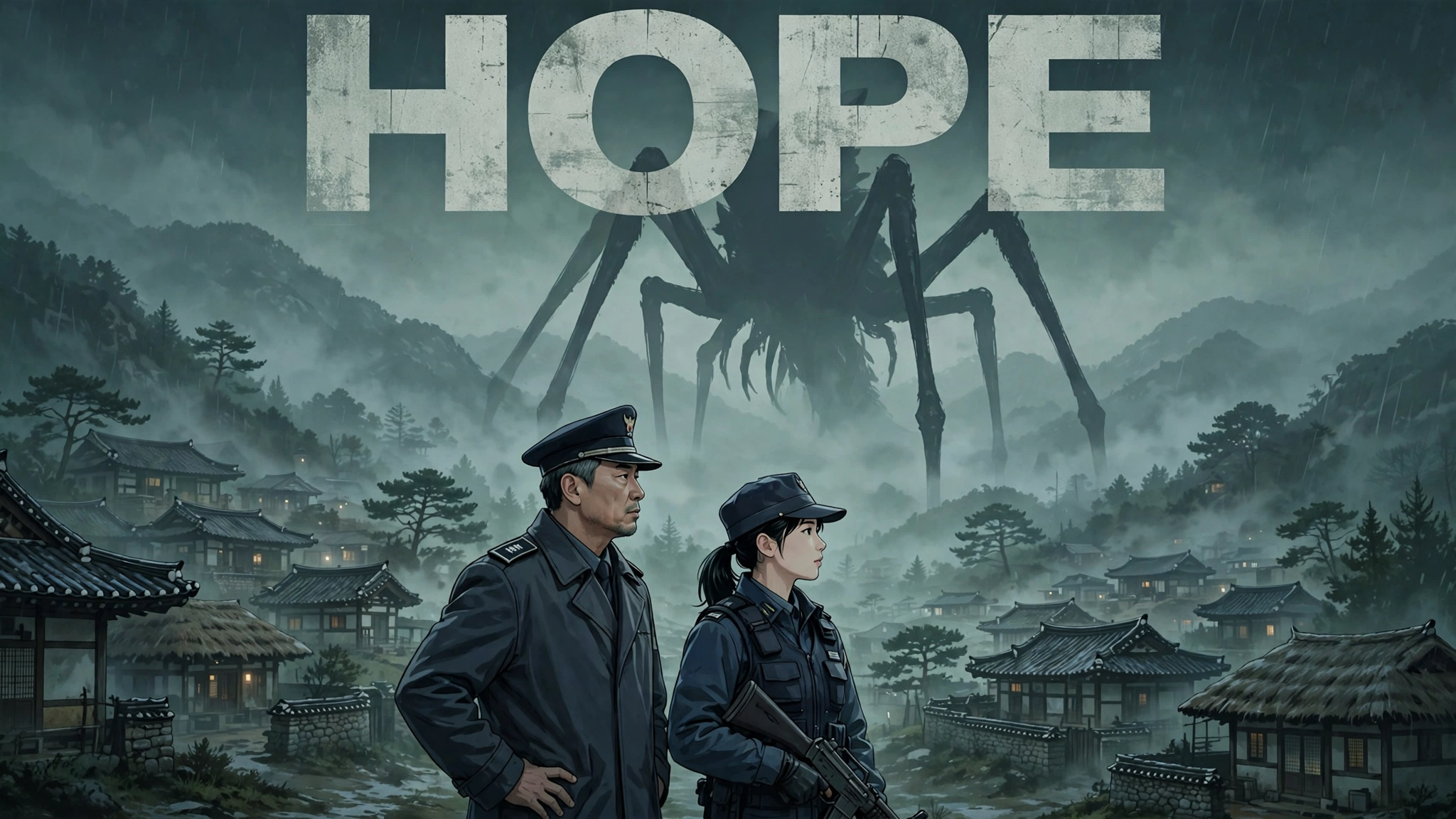
Our Rating: ★★★★☆ 7/10
Ten years after The Wailing left audiences arguing about what they had just seen, Na Hong-jin has returned with something nobody could have predicted: a giant, expensive, gloriously undisciplined monster movie. Hope is a Korean science-fiction thriller about a remote village near the demilitarized zone, a mysterious creature, and a community of heavily armed locals who refuse to run. It premiered in competition at Cannes, opened huge in Korea, divided critics down the middle, and then rolled out around the world through the autumn of 2026 — reaching India and Pakistan on 23 October 2026. It is, by turns, thrilling, funny, exhausting and ridiculous, sometimes within the same ten minutes. It is also the kind of film that deserves to be seen on the largest screen available, if only so its excess feels like a choice rather than an accident.
One honest note on dates before anything else: Hope is not a film that arrived everywhere on one day. It premiered at Cannes on 17 May 2026, opened in South Korea on 15 July 2026, reached North America on 9 September 2026, and continued its international rollout through October and November, with India and Pakistan among its 23 October 2026 markets. This review treats that 23 October date as its release for the audiences reading it here, and notes the earlier dates wherever they matter.
This review is spoiler-free on the creature’s nature and on the film’s final act. The mystery of what is hunting Hope Harbor is the film’s engine, and it deserves to be met fresh.
| Detail | Information |
| Release date | 23 October 2026 (India and Pakistan); premiered at Cannes, 17 May 2026; South Korea, 15 July 2026; North America, 9 September 2026 |
| Director | Na Hong-jin |
| Writer | Na Hong-jin |
| Genre | Science-fiction thriller, monster horror, action |
| Language | Korean (with English-language roles) |
| Runtime | About 157 minutes (some listings give 156 minutes) |
| Budget | About $46 million (one listing; the film has also been promoted as possibly the most expensive Korean film ever made, a claim reviewers repeat without independently confirming) |
| Lead cast | Hwang Jung-min, Zo In-sung, Jung Ho-yeon, Taylor Russell, Cameron Britton, Alicia Vikander, Michael Fassbender |
| Our rating | 7/10 |
Hope Harbor is a sleepy port village near the demilitarized zone, the kind of place where everyone knows everyone and where, as one review drily noted, the elderly residents seem to own enough unregistered firearms to supply a small insurgency. The trouble begins quietly: police chief Bum-seok (Hwang Jung-min) and his cousin Sung-ki (Zo In-sung) investigate a dead cow bearing enormous, inexplicable wounds. The local hunters suspect a tiger wandered down from the North. Then more livestock turn up dead, the town’s streets and buildings are found demolished, and the village’s rookie deputy Sung-ae (Jung Ho-yeon) finds herself at the centre of a fight she never trained for.
The film’s first hour is its triumph. Na stages a breathless, high-velocity chase sequence that critics compared to the scale and pace of Mission: Impossible – Fallout, and he withholds the creature itself until roughly the 49th minute — a long-legged, fast, alien-like giant whose deliberately B-movie look is part of the film’s charm for some viewers and part of its problem for others. The opening stretch works because it is grounded in character: a police chief who knows his village, a deputy learning on the job, hunters who are brave and foolish in equal measure, and a community that responds to an impossible threat the way real communities do — with argument, panic, dark humour and stubbornness.
After that opening hour, the film changes shape, and this is where opinion splits. The chases keep coming — through abandoned buildings, fields, forests, the village itself, and finally the open road — interrupted by short bursts of exposition in which the characters try to understand what the creatures are and what can be done about them. Some viewers will find this escalation exhilarating, a maximalist genre film refusing to slow down. Others will find it numbing, a two-and-a-half-hour film in which the chase becomes the entire movie and the story’s genuinely interesting questions get squeezed into the gaps. Both responses are visible in the critical reception, and both are fair. The film’s second half is also where its international cast — Fassbender and Vikander chief among them — enters the story in earnest, and where the film’s ambitions grow larger than its explanations can comfortably hold.
Hwang Jung-min as police chief Bum-seok — Hwang is the film’s anchor and its most reliable pleasure. Bum-seok is a man who knows his village the way a good chief does — its people, its grudges, its shortcuts — and Hwang plays him with a weary, practical authority that keeps the film’s wildest turns believable. When the film is at its best, it is because Hwang makes you believe that this man would keep going, keep organising, keep protecting his people, long past the point where sense says to run.
Jung Ho-yeon as trainee Sung-ae — Hoyeon, in her first major film role, is widely described as the film’s scene-stealer, and it is easy to see why. Sung-ae is a rookie cop who turns out to be skilled with a rifle, steady under fire and funny under pressure, and Hoyeon plays her with a physical confidence that reportedly required one long firearm action sequence to be filmed eighteen times. Her scenes are the film’s most purely enjoyable ones, and her emergence as its breakout star is the least surprising thing about its reception.
Zo In-sung as Sung-ki — Zo gives the film its second lead and its emotional counterweight: Bum-seok’s cousin, a hunter and a man of action whose loyalty to the village is never in doubt even when his judgement is. His partnership with Hwang is the film’s most lived-in relationship, and their scenes together — arguing, planning, covering each other — give the chaos a human shape.
Michael Fassbender, Alicia Vikander, Taylor Russell and Cameron Britton — The international cast arrives mainly in the film’s later stretches, and their roles are the film’s most debated element. Fassbender and Vikander bring star presence and professionalism to parts that the script does not always know what to do with, while Russell and Britton give the film’s wider conspiracy its human faces. One caveat for readers: some pre-release listings named Taylor Kitsch among the cast, while the widely reported release cast lists Taylor Russell and Cameron Britton; this review uses the latter, release-period listing. None of the international performers is bad. But the film is at its strongest when it stays with its Korean village, and every departure from Hope Harbor costs it a little of its soul.
Na Hong-jin directs like a man who has spent ten years imagining a bigger canvas and refuses to leave any of it unused. The staging is genuinely virtuosic: tracking shots at ground level and from high angles, car chases, foot chases, horseback chases, chases through forests and villages and open roads, all shot by cinematographer Hong Kyung-pyo (whose credits include Parasite) with beautiful, blood-slick lighting and a sense of physical scale that few monster films achieve. Michael Abels’ score pushes the tension without smoothing over the film’s stranger edges, and editor Kim Sun-min keeps the action legible even at its most frantic.
Where the film strains is in its proportions. The story contains enough material for a superb ninety-minute action film, and Na has made a 157-minute one. The creature effects, too, divide opinion sharply: some critics defended the deliberately B-movie design as a knowing choice, while others called the visual effects disastrous and the creatures unintentionally funny. Watching the film, it is possible to hold both views at once — the creature is startling when it first appears, and less convincing the longer it stays on screen. The film’s tone is equally unstable by design: Na has described wanting to make something different from his previous films, and the result mixes Spielbergian suspense, Asian-cinema wildness and Korean dark humour in proportions that shift from scene to scene. At Cannes, where the film competed for the Palme d’Or — the first Korean title to do so since Decision to Leave — it went home without a prize, which feels about right: this is a glorious swing, not a coronation.
Abels’ score leans into dread and momentum, favouring low strings and percussive drive over melody, and it suits a film that rarely stops moving. The sound design does much of the film’s scariest work: the creature’s movement, the gunfire echoing through empty streets, the silence of a village that has gone quiet. There is no showpiece song here, and the film is better for it; this is a score built for tension, not for the charts.
What we loved:
What could be better:
Hope opened in South Korea on 15 July 2026 with the biggest opening weekend of the year there — about 1.5 million admissions — before word of mouth split and the run settled at around 4.55 million admissions. In North America, where Neon opened it on 9 September 2026, it took about $3.2 million in its first weekend and found critics warmer than Korean audiences had been; later reporting described its US rollout as having crossed $7 million, making it the highest-grossing Korean film in the US by that measure. One listing put its worldwide total at about $41.2 million against a budget of about $46 million, though totals from different territories were still moving during the rollout and should be read as reported figures rather than final audited numbers.
In India, where it opened on 23 October 2026 in English, Hindi and Tamil versions, the start was modest: the Hindi version collected about ₹1.19 crore worldwide in its first five days, with about ₹1.04 crore net in India. That limited start, despite the scale of the cast and the genre, says something honest about the film’s commercial position: it is a maximalist Korean blockbuster whose natural audience is the festival and genre crowd, and its box office reflects that rather than the mainstream breakthrough its budget might have hoped for. Whether the sequel Na has spoken of — reportedly set at night and told from the aliens’ side — gets made will depend on financing, and after a mixed commercial run, that financing is not guaranteed.
Yes — on the biggest screen you can find, and with patience for its second half. Hope is not Na Hong-jin’s best film; The Wailing remains that. But it is a thrilling, funny, exhausting piece of maximalist cinema, anchored by Hwang Jung-min and stolen by Jung Ho-yeon, and its opening hour is as good as big-screen action gets. Go in expecting a glorious mess rather than a masterpiece, forgive the film its excesses, and you will have a very good time. Go in expecting a tight thriller and you will check your watch.
Our rating: 7/10 — A huge, undisciplined, often thrilling monster blockbuster that outstays its welcome but earns its spectacle.
What is Hope about?
A Korean science-fiction thriller set in the fictional port village of Hope Harbor near the demilitarized zone, where a police chief, his cousin and a rookie deputy defend their community from a mysterious alien creature.
Who directed Hope?
Na Hong-jin, the director of The Chaser, The Yellow Sea and The Wailing. It is his first film in ten years.
Who stars in Hope?
Hwang Jung-min, Zo In-sung and Jung Ho-yeon lead the Korean cast, with Taylor Russell, Cameron Britton, Alicia Vikander and Michael Fassbender in the international roles.
When was Hope released?
It premiered at Cannes on 17 May 2026, opened in South Korea on 15 July 2026, reached North America on 9 September 2026, and opened in India and Pakistan on 23 October 2026, with further territories following through November.
How long is Hope?
About 157 minutes; some listings give 156 minutes.
How much did Hope earn at the box office?
About 4.55 million admissions in South Korea, over $7 million in the United States, and a reported worldwide total of about $41.2 million — figures that were still moving during the rollout and should be read as reported, not final, numbers.
Is there a sequel to Hope planned?
Na Hong-jin has said a sequel is written, reportedly set at night and told from the aliens’ side, but whether it gets made depends on financing.