★ LATEST REVIEWS

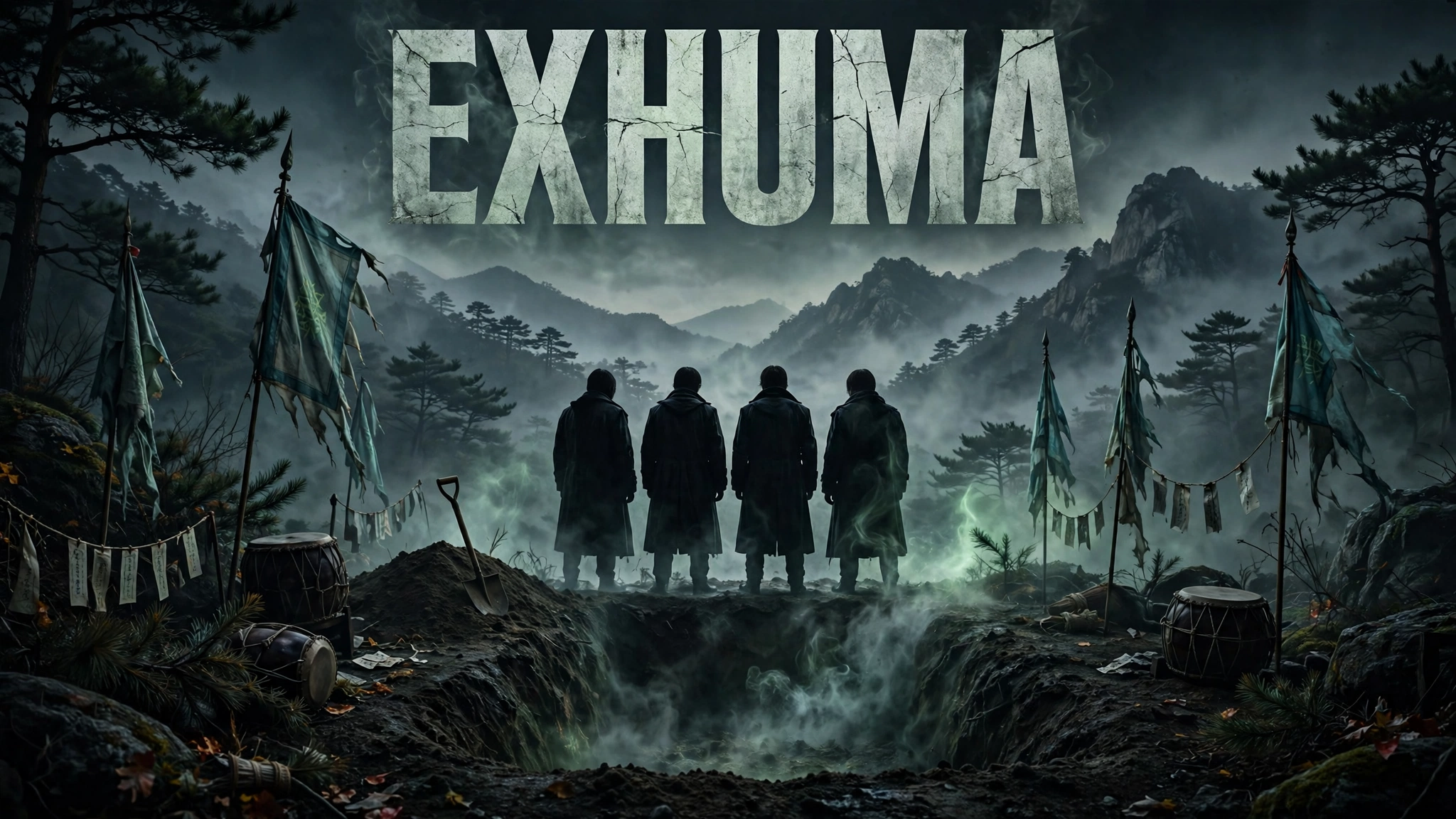
Our Rating: ★★★★☆ 8.5/10
Some horror films scare you with what jumps out of the dark. Exhuma scares you with what is buried underneath it — and with the professionals who are paid, very well, to dig it up anyway. Released in South Korea in February 2024, Jang Jae-hyun’s occult thriller became the year’s defining Korean hit, the first film of 2024 to pass ten million admissions at home and eventually the highest-grossing South Korean release of its year. That commercial story matters, but it is not the interesting one. The interesting one is that a slow, ritual-heavy, deeply Korean film about graves, soil and historical wounds turned into a mainstream event.
An honest Exhuma review has to admit the film asks more of its audience than a typical ghost story. It spends long stretches on procedure — how a grave is chosen, how earth is read, how a ritual is performed — and it trusts that procedure to generate dread. Mostly, that trust pays off handsomely. This review covers the story without spoilers, the four central performances, the craft behind its distinctive atmosphere, and the places where its ambition briefly outruns its storytelling.
| Detail | Information |
|---|---|
| Release date | 22 February 2024 (South Korea); premiered 16 February 2024 at the Berlin International Film Festival |
| Director | Jang Jae-hyun |
| Writers | Jang Jae-hyun |
| Genre | Horror, Mystery, Occult Thriller |
| Language | Korean, English, Japanese |
| Runtime | 134 minutes |
| Budget | $11 million (reported as ₩14 billion) |
| Lead cast | Choi Min-sik, Kim Go-eun, Yoo Hae-jin, Lee Do-hyun |
| Our rating | 8.5/10 |
A wealthy Korean family living in Los Angeles is in quiet crisis. Something is wrong with their newborn son, and medicine has no answer for a baby who will not stop crying or for the strange disturbances gathering around the household’s firstborn sons. They turn, as desperate rich families in Jang’s films tend to do, to specialists of a different kind: Hwa-rim (Kim Go-eun), a renowned young shaman, and her protégé Bong-gil (Lee Do-hyun). Hwa-rim’s diagnosis is swift and unsettling. The family is suffering a “Grave’s Call” — the anger of an ancestor whose resting place is wrong, reaching down the bloodline to make itself heard.
The remedy sounds practical: move the grave. To do it properly, Hwa-rim assembles a small, expensive team. Kim Sang-deok (Choi Min-sik) is a master geomancer, a feng shui expert who reads land the way other men read contracts, and who is saving for his daughter’s wedding. Yeong-geun (Yoo Hae-jin) is a meticulous, devoutly Christian mortician who has handled the dead of the powerful for decades. Together they travel to the ancestor’s burial site — a remote mountainside close to the northern border — and almost immediately Sang-deok wants to walk away. The land itself feels wrong to him. Money talks, a ritual is planned to protect the work, and the coffin comes out of the ground.
What happens next is best discovered cold, but the film’s structure can be described fairly: Exhuma is built in chapters, and its second half opens a door the first half only hints at. The haunting widens from one family’s curse into something older, larger and tied to Korea’s history under Japanese occupation. A second, secret burial is involved. So are questions about who placed what in the earth, and why, generations ago. The film never fully explains its mythology, which will frustrate some viewers, but its refusal to tidy everything up is also what leaves its images lodged in your head on the drive home.
Kim Go-eun as Hwa-rim is the film’s revelation and its engine. Her shaman is young, fashionable, expensive and utterly serious about her work — a professional who negotiates fees in the morning and bargains with spirits at night without treating either as a performance. The centrepiece ritual sequence, in which Hwa-rim performs a ceremonial dance to shield the exhumation, is played with an intensity that reportedly earned Kim the Best Actress prize at the Baeksang Arts Awards, and it is easy to see why. She does not act possession or ecstasy in the usual horror-movie shorthand; she acts concentration, a woman doing a dangerous job correctly while the pressure builds. It is the performance that sells the entire premise.
Choi Min-sik as Sang-deok brings the film its gravitas and its most human warmth. Choi, one of Korean cinema’s defining actors since Oldboy, plays the geomancer as a craftsman-philosopher: he literally tastes soil to judge it, speaks of land as a living trust, and carries a lifetime of compromises in his posture. Sang-deok’s caution gives the film its moral compass. When he says a place is bad, the audience has learned to believe him, which makes his decision to proceed — for money, for family — quietly tragic rather than foolish.
Yoo Hae-jin as Yeong-geun provides both grounding and unexpected humour. His mortician is precise, courteous and a committed Christian working alongside shamans and Buddhists without a flicker of condescension. Yoo finds the dignity in a man whose job is care for the dead, and his steadiness balances the film’s more flamboyant ritual scenes. Lee Do-hyun as Bong-gil, in what was a major film role before his military service, completes the quartet with youthful physicality — tattooed with sutras, drumming, chanting, and serving as Hwa-rim’s right hand. His Bong-gil is devotion in motion, and the generational contrast between the two pairs — old masters, young practitioners — gives the team scenes a warmth that makes the danger matter.
Jang Jae-hyun arrived at Exhuma as Korean cinema’s specialist in religious occult storytelling, following The Priests (2015) and Svaha: The Sixth Finger (2019), and this is plainly his most confident film. His key decision, discussed in interviews around the release, was to favour real locations and practical approaches over studio builds and heavy computer effects wherever possible — actors in genuine makeup for apparitions, real mountainsides, real weather. The result is a horror film that feels damp, cold and physical. Cinematographer Lee Mo-gae shoots Los Angeles in sterile glass and light, then contrasts it with a Korea of mist, dark soil and low cloud, so the journey home feels like a descent into older rules.
The pacing is deliberate and, for horror fans raised on jump-scare rhythms, potentially divisive. Jang lets ritual play out at length — drumming, chanting, the careful choreography of the dig — because the film’s scares depend on understanding what correct procedure looks like, so that you notice the moment something deviates from it. When the frights arrive, they lean on suggestion, reflection, sound and brief, shocking glimpses rather than gore, though the film is not squeamish when violence finally erupts. If there is a craft criticism, it is that the second half’s escalation introduces a large, more literal threat that briefly shifts the film toward creature-feature territory; the shift is bold and culturally specific, but the elegance of the first haunting is hard to match, and a few plot threads — including elements of the family’s fate in America — resolve more thinly than they were set up.
Composer Kim Tae-seong’s score works in close partnership with the film’s sound design, and the two are difficult — in a good way — to separate. Traditional percussion, chanting and ritual instrumentation are woven into the dramatic underscore, so that the ceremonies Hwa-rim performs feel musically continuous with the film’s mounting dread rather than like set pieces dropped into it. Elsewhere the score favours low strings, hollow tones and long silences; Jang understands that a held breath scares longer than a loud sting, and the mix repeatedly lets natural sound — wind, rain, shovels in wet earth — carry scenes. The film won recognition for its technical sound work at the Baeksang Arts Awards, and listening to it, that is no surprise: Exhuma is a film you hear in your chest before you fully see it on screen.
What we loved:
What could be better:
The commercial figures are exceptional, with one caveat about totals. Exhuma was produced for a reported ₩14 billion — about $11 million — and Korean Film Council-based reporting credits it with 11.91 million admissions in South Korea and roughly ₩115 billion in domestic ticket sales, making it the top-grossing Korean film of 2024 and, by profitability analyses published in Korea, the most profitable Korean release of its year, returning several times its production cost. It crossed one million admissions in under three days, two million by its fourth day, and ten million on its 32nd day — the first film to reach that milestone in Korea in 2024, and the first occult film ever to do so there, despite competition from Dune: Part Two.
Worldwide totals vary by tracker: figures around $93.9 million are most commonly cited, while some databases list totals approaching $98 million depending on reporting dates and territories included. The safe summary is a worldwide gross in the mid-$90 millions on an $11 million budget — an extraordinary return for a subtitled, ritual-driven horror film, and proof that local specificity, handled with this much conviction, travels.
Yes — especially if you are tired of horror films that all share the same haunted house and the same three scares. Exhuma offers a different grammar of fear: soil, ancestry, ritual expertise and a past that was buried deliberately and badly. It is patient, atmospheric and acted with total conviction, and its best sequences — the ritual at the graveside above all — are as gripping as anything the genre produced in 2024. Genre newcomers should know it rewards attention rather than half-watching, and its final act will not satisfy viewers who need every thread tied. Everyone else should dig in.
Our rating: 8.5/10 — a rich, physical, culturally rooted occult thriller carried by four superb performances.
Is Exhuma based on a true story?
No. It is an original screenplay by Jang Jae-hyun, but it draws on real Korean practices — shamanic ritual, geomancy (feng shui) in burial-site selection, and professional grave relocation — and on the historical legacy of the Japanese occupation period.
How scary is Exhuma, and is it very gory?
It is primarily atmospheric and suspenseful, relying on dread, sound and brief shocking images rather than constant jump scares. There are violent and bloody moments, particularly in the second half, but gore is not its main tool.
Do I need to understand Korean shamanism to follow it?
No. The film teaches you what you need through the characters’ work — the rituals and rules are explained in action. A little patience in the first half is rewarded as the procedures become the source of the suspense.
Is Exhuma connected to The Priests or Svaha: The Sixth Finger?
Not in plot or characters. They are separate stories, but all three are written and directed by Jang Jae-hyun and share his interest in religion, ritual and the occult, so fans of one will likely enjoy the others.
Where can I watch Exhuma?
It has been released theatrically in many territories and on horror-focused streaming services including Shudder in North America, with wider home release following. Availability varies by region, so check your local services.