★ LATEST REVIEWS

Our Rating: ★★★★☆ 8.0/10
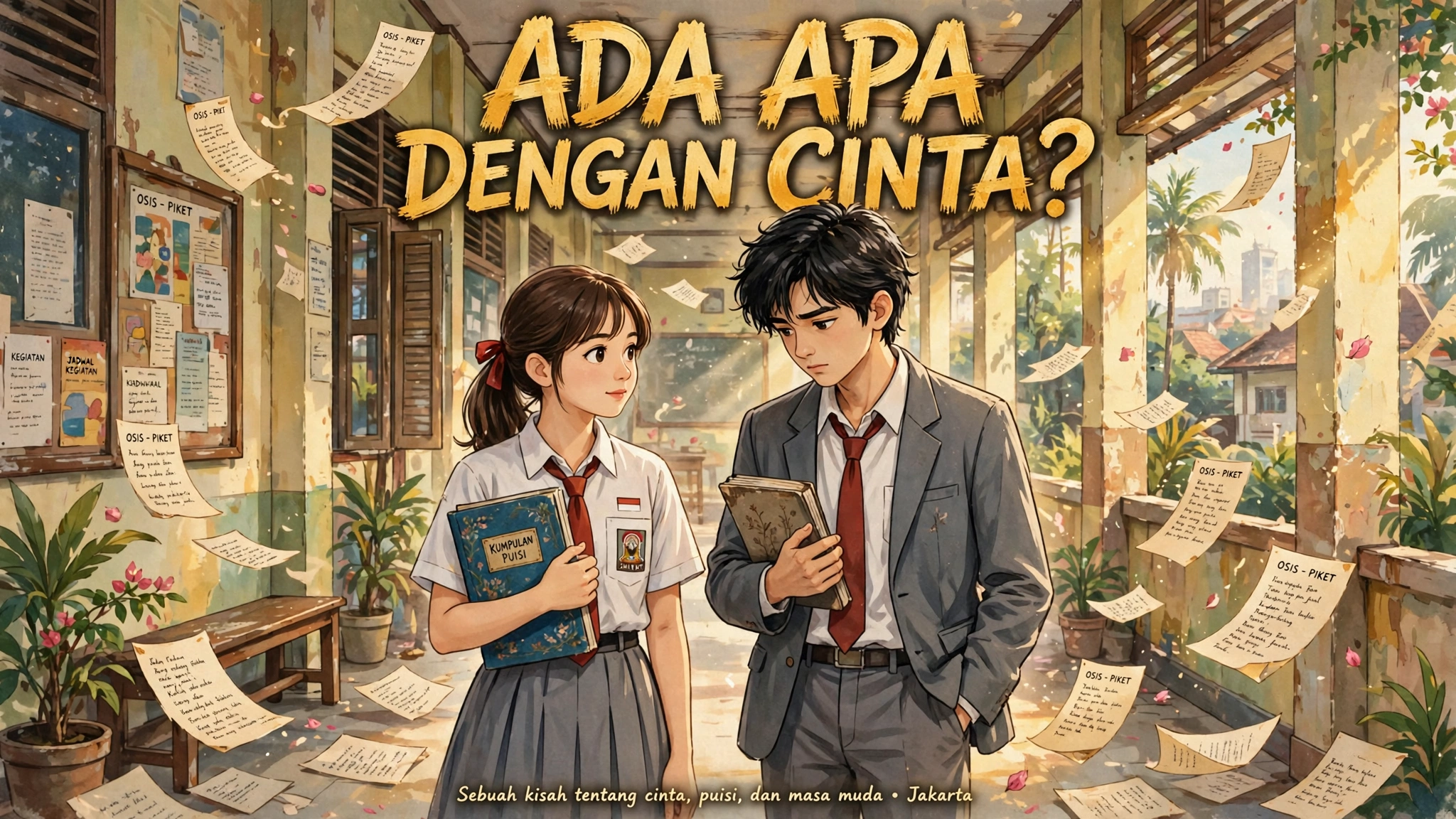
Every film industry has a turning point, and for modern Indonesian cinema it arrived in a school corridor in Jakarta. Ada Apa dengan Cinta? — released internationally as What’s Up with Love? — is a teen romance about a popular schoolgirl poet and the aloof boy who beats her in a poetry competition. That sounds small, and it is, deliberately. Yet when Rudi Soedjarwo’s film opened on 8 February 2002, it sold around 2.7 million tickets, became the most-watched Indonesian film of its time, and is still cited as the film that brought Indonesian audiences back to Indonesian movies after years in the doldrums. It also launched two stars and gave a generation its love story.
The title itself is a piece of wordplay that does not quite survive translation: “Cinta” is both the Indonesian word for love and the name of the heroine. Ask “what’s up with love?” and you are also asking “what’s up with Cinta?” That double meaning runs through the whole film, which is about a girl discovering that love is not a poem she controls but a feeling that rearranges her friendships, her pride and her plans.
It is not a perfect film. Some of its supporting drama leans on melodrama, and its portrait of teenage life is glossier than reality. But its central romance is played with such sincerity, and its Jakarta school world is drawn with such affection, that it remains genuinely charming more than twenty years on. In this review we look at the spoiler-free story, the performances, Soedjarwo’s direction, the era-defining music and the box-office story, and we give an honest verdict.
| Detail | Information |
|---|---|
| Release date | 8 February 2002 (Indonesia) |
| Director | Rudi Soedjarwo |
| Writers | Jujur Prananto, Prima Rusdi |
| Producers | Mira Lesmana, Riri Riza |
| Genre | Romance, Drama, Coming-of-age |
| Language | Indonesian |
| Runtime | 112 minutes |
| Budget | About US$295,000 (some sources cite around Rp 4 billion) |
| Lead cast | Dian Sastrowardoyo, Nicholas Saputra, Titi Kamal, Adinia Wirasti, Ladya Cheryl, Sissy Priscillia |
| Our rating | 8.0/10 |
Cinta is everything a Jakarta high-school girl is supposed to want to be: popular, confident, captain of her circle of five best friends, and the school’s reigning poetry champion. Her world is ordered and affectionate — a loving family, loyal friends who share a diary of confessions, and the annual poetry contest she wins as a matter of course. Then Rangga arrives in her orbit: quiet, solitary, unimpressed by the school’s hierarchies, and — to Cinta’s horror — a better poet than she is. When he wins the contest she expected to win, and then refuses to celebrate the victory in any normal way, she is furious. Fury, in this film’s logic, is the first draft of fascination.
What follows is a romance built on small collisions rather than grand gestures: exchanged poems, misunderstandings, the jealousy of friends who feel their circle breaking, and the pressure of final-year choices about university and the future. Around the central couple, the film gives real weight to the friends’ own troubles — in particular Alya, whose home life is far darker than the group’s cheerful surface suggests. Without revealing how any of these threads resolve, it is fair to say the film’s strength is that it treats teenage feelings as serious without ever forgetting that teenagers are also funny, vain, generous and contradictory.
Dian Sastrowardoyo as Cinta — Sastrowardoyo carries the film with a confidence that makes Cinta’s popularity believable and her vulnerability surprising. She plays the character’s pride without making her unlikable, and her slow surrender to feelings she cannot control is the film’s emotional engine. She won Best Actress at the Indonesian Film Festival for the role, and it is easy to see why: this is star acting that never shows off.
Nicholas Saputra as Rangga — In his debut, Saputra made aloofness look magnetic. Rangga could easily have been a blank — the silent boy who exists to be mysterious — but Saputra gives him a watchful intelligence and a dry, reluctant humour. His chemistry with Sastrowardoyo is the film’s main asset: they argue like people who enjoy arguing, and their quiet scenes together have a tenderness that bigger romantic set-pieces often miss.
The circle of friends — Titi Kamal, Adinia Wirasti, Ladya Cheryl and Sissy Priscillia play Cinta’s four friends as distinct people rather than a chorus, and Ladya Cheryl’s Alya carries the film’s most serious subplot with real feeling. The adult cast, including the girls’ parents and teachers, is warm and unforced, grounding the school world in family life.
Rudi Soedjarwo directs with a lightness and confidence that was rare in Indonesian commercial cinema at the time. Jakarta is shot as a bright, modern, lived-in city — school corridors, bookshops, cafés and family homes rather than tourist landmarks — and the camera stays close to the characters’ faces, trusting the actors to carry scenes that a lesser film would have underlined with music. Roy Lolang’s cinematography is clean and colourful, and the editing keeps the 112 minutes moving briskly, even when the subplot about Alya asks the audience to slow down and feel something harder.
The film’s most distinctive craft choice is its use of poetry. Poems are not decoration here; they are how Cinta and Rangga actually communicate, argue and confess. The verse is woven into the dialogue and the soundtrack so naturally that even viewers who do not care about poetry understand exactly what each poem costs its writer. That is a risky device, and it works because the film believes in it completely.
Melly Goeslaw and Anto Hoed’s score is inseparable from the film’s afterlife. Songs like “Ada Apa dengan Cinta?” became generational anthems in Indonesia, and the music’s mix of pop, balladry and spoken poetry gave the film a sound that felt contemporary without dating badly. The soundtrack did not just accompany the romance; for millions of viewers, it became the romance, played at school events and on the radio for years afterwards. It remains one of the most beloved Indonesian film soundtracks ever released.
What we loved:
What could be better:
Ada Apa dengan Cinta? was made for a reported budget of about US$295,000 — some Indonesian sources cite a figure around Rp 4 billion, which reflects the same low-budget scale in local currency terms of the period — and it earned roughly US$10 million worldwide, an extraordinary multiple. More important than the money was the audience: about 2.7 million tickets sold in Indonesia made it the most-watched Indonesian film of its time, and its success across Asia announced that Indonesian commercial cinema was back. A sequel followed in 2016 with most of the original cast, and a musical reboot was announced in 2025 — proof of how durable Cinta and Rangga’s story has proved.
Its honours included Best Actress, Best Director and Best Original Score at the Indonesian Film Festival, and in a 2007 critics’ survey it was named among the best Indonesian films of all time. That reputation has held: for many Indonesians, this is not just a good teen film but the teen film.
Yes — whether you are revisiting a favourite or discovering Indonesian cinema for the first time. Ada Apa dengan Cinta? is sweet without being empty, romantic without being silly, and it captures something true about first love: that it arrives as a disruption, rearranges your friendships, and leaves you slightly different from who you were. It is also, at under two hours, an ideal starting point for anyone curious about Indonesian film.
Our rating: 8.0/10 — A charming, era-defining teen romance with a central pairing for the ages.
What does Ada Apa dengan Cinta mean?
It translates as “What’s Up with Love?” — and it is also a pun, because Cinta, the heroine’s name, is the Indonesian word for love.
Is Ada Apa dengan Cinta based on a true story?
No, it is an original story, though its school world and Jakarta setting feel closely observed.
Who plays Cinta and Rangga?
Dian Sastrowardoyo plays Cinta and Nicholas Saputra plays Rangga, in the role that made him a star.
Is there a sequel?
Yes, Ada Apa dengan Cinta? 2 was released in 2016 with most of the original cast returning.
How long is the film?
It runs 112 minutes.