★ LATEST REVIEWS

★★★★★ Our Rating: 9/10
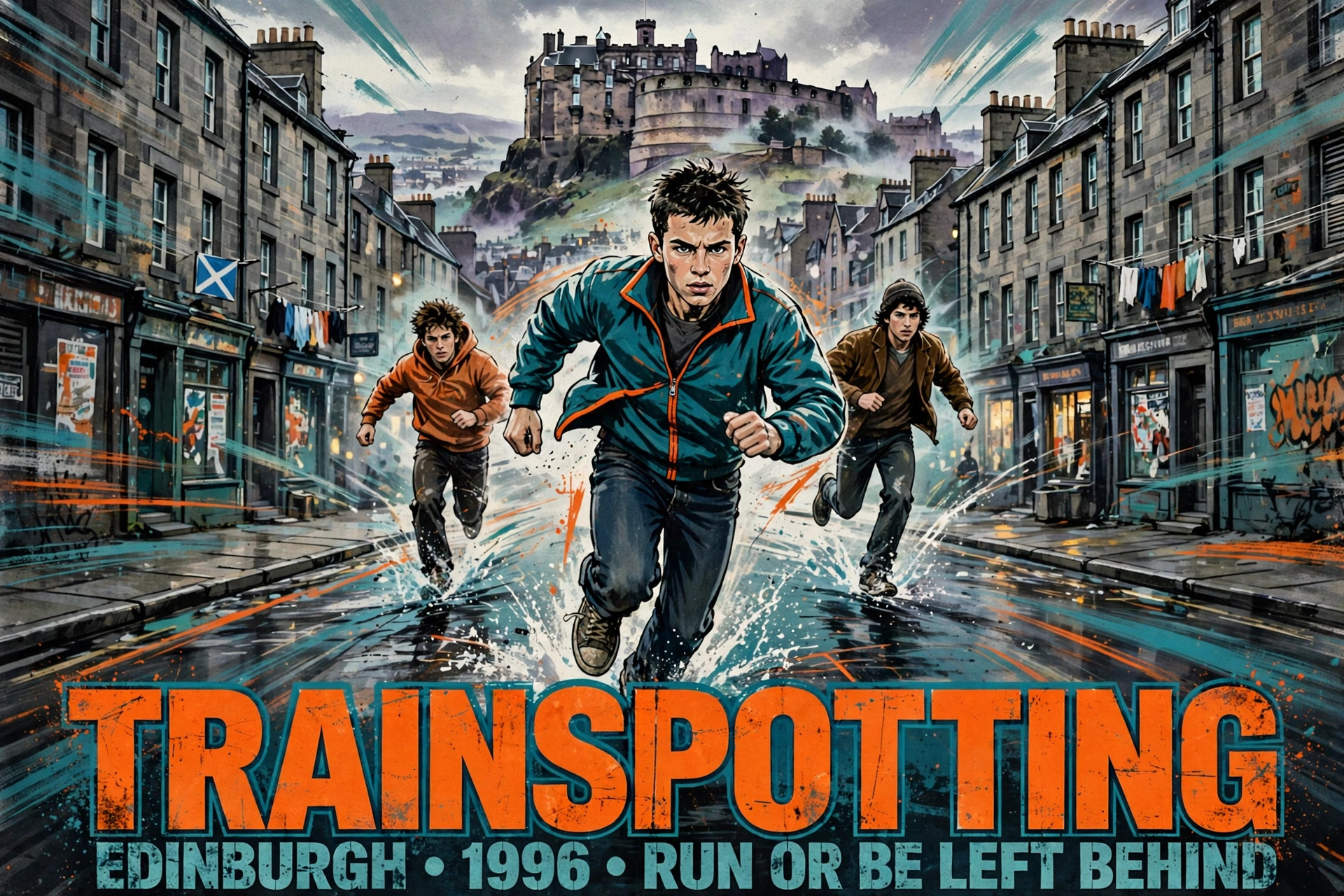
“Choose life.” Two words, delivered at a sprint, over Iggy Pop’s “Lust for Life”, by a skinny young man being chased through Edinburgh for shoplifting — and British cinema in the 1990s had its defining opening. Released on 23 February 1996, Danny Boyle’s Trainspotting turned Irvine Welsh’s ferocious, funny, filthy novel about heroin addicts in Scotland’s capital into the film of a generation. This Trainspotting review comes with the warning up front, because honesty matters more than hype: this is a brilliant film about addiction that contains scenes many viewers will find genuinely distressing. Both halves of that sentence are true, and the film’s power lives in the tension between them.
Nearly thirty years on, Trainspotting is ranked by the British Film Institute among the top British films of the twentieth century, and it still feels electrically alive in a way that safer classics do not. What follows is an attempt to explain why — the performances, the soundtrack that taught a decade how to feel, the craft — and also where the film deliberately makes itself hard to love.
| Detail | Information |
| Release date | 23 February 1996 |
| Director | Danny Boyle |
| Writers | John Hodge, based on Trainspotting by Irvine Welsh |
| Genre | Black Comedy, Crime, Drama |
| Language | English, Scots |
| Runtime | 93 minutes |
| Budget | £1.5 million |
| Lead cast | Ewan McGregor, Ewen Bremner, Jonny Lee Miller, Kevin McKidd, Robert Carlyle, Kelly Macdonald |
| Our rating | 9/10 |
Mark Renton (Ewan McGregor) narrates his own life with the wit of a man who knows exactly how pathetic it is and carries on anyway. He is a heroin addict in Leith, Edinburgh’s port district, in a Scotland of boarded shops, dole queues and no obvious future. His circle is the film: Spud (Ewen Bremner), sweet-natured, terrified and hopelessly addicted; Sick Boy (Jonny Lee Miller), a Sean Connery-obsessed charmer whose philosophy is a licence for selfishness; Tommy (Kevin McKidd), the clean-living friend — football, fitness, an actual girlfriend — who watches the others with pity; and Begbie (Robert Carlyle), who does not take heroin at all and is the most frightening person in the film, a pint-glass psychopath whose addiction is violence itself.
The story moves in loose, brilliant episodes rather than a conventional plot. Renton tries to quit — methodically, comically, buying his supplies of soup, ice cream and Valium like a man preparing for a siege — and relapses. He tries London, where a job and a flat offer the outline of a normal life, and discovers that Edinburgh exports its problems in human form. Around him, the cost of the lifestyle keeps presenting its bill: relationships rot, health collapses, a baby in a squalid flat becomes the centre of the film’s most infamous and harrowing sequence, and Tommy’s story turns into the tragedy that gives the comedy its long, cold shadow. Meanwhile the group drifts towards one last drug deal in London, the kind of score that could free Renton or finish all of them. What he does with that chance — and what it says about whether friendship means anything next to escape — is the ending, and we will leave it exactly where the film puts it.
One clarification for new viewers: almost nothing in the film involves watching trains. The title, taken from Welsh’s novel, refers to a bleak joke about a pointless, compulsive pastime — and, in a key scene at a disused railway station, to the wasted years of men who had nothing better to fill them with.
Ewan McGregor as Mark Renton gave the star-making performance of 1990s British cinema. Gaunt, shaven-headed and narrating with stand-up timing, McGregor makes Renton simultaneously the cleverest person in every room and a complete fool — you understand why people forgive him and why they shouldn’t. His physical commitment, from the sweating misery of withdrawal to the grotesque comedy of the film’s most notorious lavatory scene, never tips into showmanship. The film is unthinkable with anyone else.
Robert Carlyle as Begbie is, simply, one of the great screen monsters — and he never touches the drug the film is about. Carlyle builds Begbie from stillness and sudden eruption: the moustache, the tracksuit, the story in the pub that curdles into violence over a spilled drink. He is terrifying because he is plausible; every British audience of the era recognised a Begbie. Ewen Bremner as Spud provides the film’s heart — his disastrous speed-fuelled job interview is a comic classic, and his gentleness amid the wreckage makes the group’s cruelty to him sting. Jonny Lee Miller as Sick Boy is all peroxide charm and cold theory, a Bond fantasist whose intelligence serves only himself.
Kevin McKidd as Tommy carries the film’s moral weight. Tommy begins as the straight man — healthy, decent, employed in his own skin — and McKidd plays his unravelling with such restraint that it becomes the saddest thread in the film. Kelly Macdonald as Diane, in her film debut, walks off with every scene she is in: Renton’s teenage girlfriend (a storyline that is deliberately uncomfortable, and was written to be) is cleverer than all the boys combined, and Macdonald’s cool self-possession launched a major career from a handful of scenes. Irvine Welsh himself cameos as a dealer, because of course he does.
Danny Boyle’s direction here announced a style British film would imitate for a decade. Working from John Hodge’s Oscar-nominated screenplay — which somehow turns Welsh’s episodic, dialect-heavy novel into 93 minutes of pure forward motion — Boyle shoots addiction as a subjective experience rather than a lecture. Floors tilt and swallow people. A withdrawal sequence becomes full hallucinatory horror. A bedsit, a pub toilet billed as the worst in Scotland, a London bedsit corridor: production design turns squalor stylised, bright and unforgettable, which is itself part of the film’s argument and part of the controversy around it — more on that below.
Brian Tufano’s cinematography gives Edinburgh a look nobody had given it before: not picture-postcard and not miserablist grey, but saturated, low-angled and fast, with freeze frames and racing tracking shots that borrow the language of music videos and make it cinematic. Editor Masahiro Hirakubo is the film’s secret weapon — the cutting is musical, scenes detonating into each other on a line of narration or a drum hit, and the pace never slackens even in dialogue. The craft caveat is the flip side of the style: Boyle makes this world so vivid and funny that the film was accused, loudly, of glamourising heroin. Watching it whole, the accusation is hard to sustain — the film shows addiction’s pleasures honestly for perhaps fifteen minutes and its invoice for the remaining seventy-five — but the style is seductive by design, and viewers should know that the seduction is the trap the film is setting, not an accident.
There is no conventional original score in Trainspotting; instead, Boyle and his team built one of the most celebrated soundtracks in film history out of existing records, and it functions as the characters’ inner weather. Iggy Pop’s “Lust for Life” is the film’s heartbeat — all that frantic energy in pursuit of oblivion — while Lou Reed’s “Perfect Day” plays over the film’s most chilling sequence with an irony that still shocks. Underworld’s “Born Slippy .NUXX”, a pounding club anthem, became inseparable from the film’s closing movement, and the soundtrack album, gathering Iggy Pop, Underworld, Blur, Pulp, Elastica, Brian Eno, Primal Scream and others, sold in the millions and defined the sound of Cool Britannia as much as any Britpop record. The choices are never decorative: classical flourishes, including Bizet, rub against techno and guitar music exactly the way Renton’s intelligence rubs against his circumstances. If you have ever heard “Born Slippy” and seen a sunrise motorway in your head, this film is why.
What we loved:
What could be better:
The figures for Trainspotting are consistently reported and remarkable for their proportions. Produced by Andrew Macdonald for Channel Four Films and Figment Films on a budget of just £1.5 million, the film grossed approximately $72 million worldwide (reported at the time as around £48 million) — close to fifty times its production cost in dollar terms — with a substantial share earned far beyond Britain, including a successful American release that arthouse distributors had considered unlikely for a subtitled-by-accent, heroin-centred Scottish film. The soundtrack albums were major commercial successes in their own right, the film received an Academy Award nomination for Best Adapted Screenplay, and its afterlife has never really paused: it topped polls of the greatest Scottish film ever made, entered the BFI’s top ten British films of the twentieth century, and in 2017 Boyle, Hodge and most of the original cast returned for the sequel T2 Trainspotting. Few £1.5 million productions have bought their national cinema a louder announcement.
If you can handle its content — and please take that condition seriously, because the film does not flinch — then yes, absolutely. Trainspotting is one of the essential British films: funny until it is horrifying, stylish until the style itself becomes an accusation, and anchored by performances that launched a generation of talent. Approach it as a drama with the energy of a thriller and the honesty of a documentary about a specific place and time, not as a period curiosity. Its Edinburgh is gone; the film’s questions about escape, loyalty and wasted youth are not.
Our rating: 9/10 — a defining film of its era; docked only because its deliberate extremes will, by design, shut some viewers out entirely.
Is Trainspotting based on a true story?
No. It is adapted from Irvine Welsh’s 1993 novel, which drew on the atmosphere and drug culture of 1980s Edinburgh and Welsh’s own experiences of that world, but Renton and his friends are fictional characters.
Why is the film called Trainspotting if nobody watches trains?
In Welsh’s novel and the film, trainspotting — a famously obsessive, pointless hobby — is a metaphor for wasted time and compulsion. A scene at a disused station, involving Begbie’s father, gives the title its bleakest meaning.
Does Trainspotting glorify drug use?
This was the central debate on release. The film honestly depicts why heroin attracts its characters, then depicts addiction’s consequences — overdose, disease, death, destroyed families — at length and without relief. Most critics, then and now, read it as a warning delivered in the language of its characters rather than a celebration.
Is there a sequel to Trainspotting?
Yes. T2 Trainspotting (2017), again directed by Danny Boyle from a John Hodge screenplay and loosely drawing on Welsh’s follow-up novel Porno, reunites Renton, Spud, Sick Boy and Begbie twenty years later.
Where can I watch Trainspotting?
It is widely available on streaming, rental and home-video platforms in many regions. Availability varies, so check your local services — and note that it is an adults-only film in most classifications.