★ LATEST REVIEWS

★★★★☆ Our Rating: 7.5/10
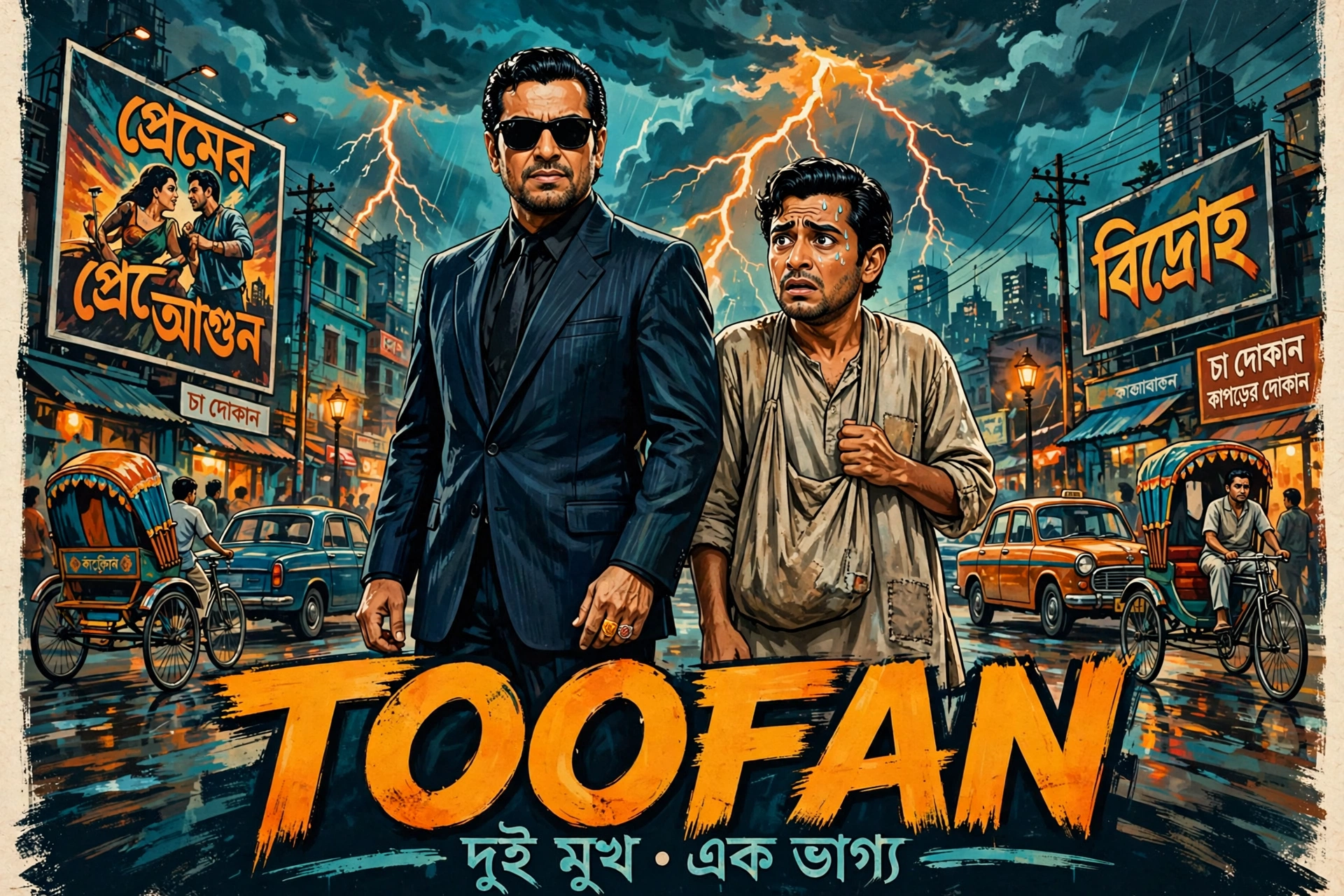
Every film industry has a ceiling — a number everyone assumes a local film simply cannot cross. In Bangladesh, Toofan smashed through it. Directed by Raihan Rafi and released on 17 June 2024 for Eid-ul-Adha, this 1990s-set gangster drama starring Shakib Khan did not just become the biggest Bangladeshi hit of its year; with a reported gross of around ৳56 crore it finished as one of the highest-grossing Bangladeshi films of all time, and the most widely released Bangladeshi film internationally, playing in nearly twenty countries.
Records, as always, raise a question: is the film actually good, or just big? Toofan is a stylish, confident, star-driven crime saga with a clever double-role twist at its centre — and, being honest, a plot that borrows freely from gangster films you have seen before. In this review we go through the story, the performances, the craft, the music and the record run, and give you our unvarnished verdict.
| Detail | Information |
|---|---|
| Release date | 17 June 2024 (Bangladesh) |
| Director | Raihan Rafi |
| Writers | Raihan Rafi; screenplay by Raihan Rafi, Adnan Adib Khan |
| Genre | Action, Crime, Drama |
| Language | Bengali |
| Runtime | 143 minutes |
| Budget | ৳7 crore (reported) |
| Lead cast | Shakib Khan, Mimi Chakraborty, Masuma Rahman Nabila, Chanchal Chowdhury, Misha Sawdagor |
| Our rating | 7.5/10 |
The film is built on two lives that run in parallel through the Bangladesh of the 1990s. In one, a boy from the wrong side of everything grows up hard and hungry, discovering early that violence is the one language the world answers. He rises, crime by crime and betrayal by betrayal, into Toofan — the most feared underworld don in the country, a man whose name alone empties streets, and whose empire draws the attention of the state, rival gangs and one determined CID officer who refuses to be bought or frightened.
In the other life is Shanto, a nobody: a struggling junior artist drifting around film sets, humiliated by directors, dreaming of one day being a hero instead of furniture in the background. Shanto’s only asset is the one thing he did not earn — he looks exactly like Toofan. Through the costume designer Julie, who keeps rescuing his dignity on set, he stumbles toward small chances: a fight master who spots his raw ability, a role as a minor villain, a glimpse of the actress Suchona from across a crowded set.
You can feel the two tracks bending toward each other from the first act, and the film is smart enough not to rush the collision. When the don’s world and the actor’s world finally touch — when powerful men realise that the nobody and the monster share a face — Toofan shifts from rise-of-a-gangster saga into something more playful and dangerous: a story about identity, performance, and what a face is worth in a country run by fear. We will not spoil the turns that follow, except to say the second half plays games the first half only hints at, and the film’s ending was clearly designed to leave audiences demanding more.
Shakib Khan as Toofan and Shanto carries this film on his shoulders, and it is the most interesting work of his long career. As Toofan, he is all stillness and menace — slow walk, lowered voice, violence delivered without hurry — a deliberate reinvention for an actor long associated with romantic hero roles. As Shanto, he flips completely: nervous, eager, physically awkward, a man apologising to the world for existing. The two performances comment on each other beautifully, and the contrast is the film’s best idea, executed well. Occasionally the Shanto act tips into overplaying, and the don’s invincibility is more asserted than dramatised, but as a star performance in a double role, it is commanding — fitting for what was billed as the 250th film of Khan’s career.
Mimi Chakraborty as Suchona, the film’s leading lady within the world of cinema, brings glamour and a lightness the crime story needs, and her pairing with Khan was a major part of the film’s pre-release buzz — this was a notable cross-border casting, with Chakraborty arriving from Kolkata’s industry. Masuma Rahman Nabila as Julie gives the warmer, more grounded performance of the two women: Julie’s decency is the moral counterweight to everything Toofan represents, and Nabila plays her without sentimentality. Chanchal Chowdhury as Akram, the CID officer, appears in what is essentially an extended cameo — and walks away with some of the film’s most applauded scenes. His calm, smiling menace opposite Khan is electric, and the film arguably underuses him; audiences left wanting that duel expanded. Misha Sawdagor, Bangladeshi cinema’s eternal villain, adds veteran weight to the underworld side of the story.
Raihan Rafi has built his reputation on restless, contemporary filmmaking, and Toofan is his biggest canvas: 1990s Dhaka recreated with period cars, costumes and production design that convincingly sell the era without turning into a museum piece. The action is staged with a slickness still rare in Bangladeshi commercial cinema — clean geography, real impact, and a showman’s instinct for the pause before the punch. Cinematographer Tahsin Rahman’s frames give Toofan a mythic, poster-ready quality, all rain, smoke and low angles, while the editing keeps a 143-minute film moving at a pace its length could easily have betrayed.
The honest reservations are about originality and structure. The bones of the don’s rise — the slum childhood, the first killing, the betrayals, the larger-than-life invincibility — will feel familiar to anyone raised on Indian and international gangster cinema; Toofan polishes those beats rather than reinventing them, and there are stretches where style is asked to do the work of writing. The two halves also sit together imperfectly: the underworld saga and the film-world comedy-drama sometimes feel like two good movies taking turns rather than one fully fused film. And the ending’s appetite for a sequel is naked — satisfying as a tease, frustrating as a conclusion.
For a commercial Bengali film, the soundtrack was a genuine event. The music team — Arafat Mohsin, Naved Parvez, Pritom Hasan and Akassh among its credited composers — delivered the rare album where the songs worked both inside the film and far outside it. “Laage Ura Dhura,” featuring Mimi Chakraborty, became an inescapable hit, dominating social media and wedding playlists across Bengal, while the title-driven numbers give Toofan’s entries the swaggering, whistle-worthy punctuation a don film lives on. The background score leans into brass, percussion and menace, and if it occasionally shouts where silence would threaten more, it understands its assignment: this is a film about a legend, and the music never lets you forget it.
What we loved:
What could be better:
The figures here come with the usual caution that applies to Bangladeshi box office reporting, which is not independently audited — but the scale of the success is not in serious dispute. Made on a reported budget of around ৳7 crore, Toofan opened for Eid-ul-Adha on 17 June 2024 across some 129 cinemas in Bangladesh and, according to distributor and press reports at the time, passed ৳25 crore within its first ten days, breaking single-day and cineplex records as it went. The widely reported final gross stands at about ৳56 crore (roughly US$4.6 million), making it the highest-grossing Bangladeshi film of 2024 and, at the time of its run, the second-highest-grossing Bangladeshi film ever made.
Just as significant was the footprint. Toofan released in nearly twenty countries — including India, where it opened on 5 July 2024, and across the Middle East, North America and Australia — the widest international release a Bangladeshi film had ever received, before moving to streaming on Chorki. For an industry often treated as purely local, that mattered: Toofan behaved like a regional blockbuster, not a domestic curiosity.
Yes, if you enjoy star-powered gangster cinema. Toofan is not a reinvention of the genre, and viewers allergic to familiar underworld beats will spot its influences quickly. But as a piece of large-scale Bengali entertainment — a career-peak star turn, real craft in the action and design, songs that became unavoidable, and a double-role hook that pays off — it earns its blockbuster status honestly. It is the rare record-breaker that is also, simply, a fun night at the movies.
Our rating: 7.5/10 — a stylish, swaggering gangster entertainer carried by Shakib Khan’s best performance in years.
Is Toofan based on a true story?
No. Toofan is a fictional don of the 1990s, created for the film by Raihan Rafi. The setting draws on the era’s real underworld atmosphere, but the character and his double are inventions.
Why does Shakib Khan play two roles in Toofan?
The double role is the film’s central device: Toofan the feared gangster and Shanto the struggling junior artist share the same face, and the story is built around what happens when those two worlds collide. Saying more would spoil the second half.
Is Toofan Shakib Khan’s 250th film?
Yes, the film was promoted as the 250th film of Shakib Khan’s career, which added to the event status of its Eid 2024 release.
Will there be a Toofan 2?
The film ends in a way designed to continue the story, and its record-breaking success makes a sequel commercially very likely — but treat any specific date as rumour until the producers officially announce one.
Where can I watch Toofan?
After its theatrical run, Toofan moved to streaming on the Bangladeshi platform Chorki. International availability varies by region, so check Chorki and your local platforms.