★ LATEST REVIEWS

★★★★☆ Our Rating: 8.5/10
There is a scene in The Wild Pear Tree — known in Turkish as Ahlat Ağacı — in which a father and son argue about literature, God, debt and pride for what feels like half an hour, and it is utterly riveting. That is the film in miniature: director Nuri Bilge Ceylan takes the oldest story in the world, a young man returning home and colliding with his father, and tells it with such patience, beauty and intellectual honesty that three hours pass like a long, absorbing conversation you do not want to end.
This is not a film for viewers who need constant plot. It is a film about ideas, about the gap between who we want to be and who our parents made us, and about a landscape — the hills and villages of the Çanakkale region — that seems to hold the whole argument in its light. For the patient viewer, it is one of the great films of recent Turkish cinema.
| Detail | Information |
|---|---|
| Release date | 18 May 2018 (Cannes Film Festival); 1 June 2018 (Turkey) |
| Director | Nuri Bilge Ceylan |
| Writers | Nuri Bilge Ceylan, Ebru Ceylan, Akın Aksu |
| Genre | Drama |
| Language | Turkish |
| Runtime | 188 minutes |
| Box office | approx. $1.7 million worldwide (see Box Office section) |
| Lead cast | Doğu Demirkol, Murat Cemcir, Bennu Yıldırımlar, Hazar Ergüçlü, Serkan Keskin |
| Our rating | 8.5/10 |
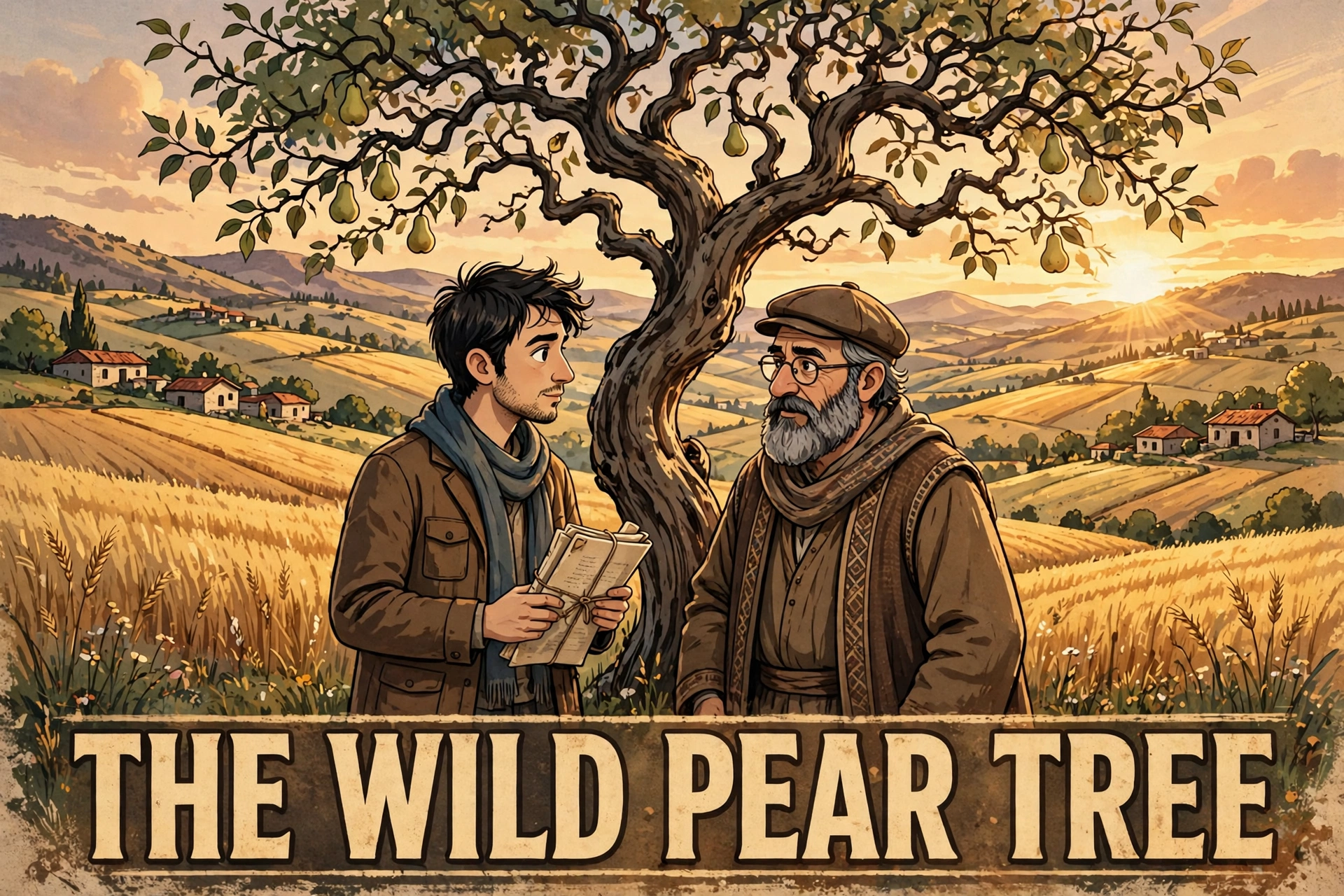
Sinan Karasu (Doğu Demirkol) has just finished university and returned to his hometown of Çan, a small town in northwestern Turkey, with a manuscript in his bag and a plan: he will publish his first book, a collection of essays and stories, and begin his life as a writer. To do it, he needs money, and he spends the film going from door to door — to the mayor, to local businessmen, to anyone who might sponsor a young author’s first book — asking for support that mostly does not come.
Standing in his way, in every sense, is his father Idris (Murat Cemcir), a schoolteacher whose gambling addiction has eaten the family’s money and reputation. Sinan is terrified of becoming his father, and furious at him in equal measure, and the film’s long, winding conversations circle that fear from every angle: is Sinan’s literary ambition just another form of his father’s self-deception? Is the wild pear tree of the title — a lonely, twisted tree that bears bitter fruit — a symbol of the family itself, rooted in poor soil, producing something nobody wants?
Around this central relationship, the film gathers a cast of vivid figures: Sinan’s weary mother Asuman (Bennu Yıldırımlar), who holds the household together; Hatice (Hazar Ergüçlü), a young woman from Sinan’s past whose own choices challenge his ideas about freedom; and a gallery of local writers, imams, booksellers and would-be patrons who each get their own long, memorable scene. The plot, such as it is, is the slow business of growing up: Sinan learning that the world will not fund his dreams on demand, and that his father is a more complicated man than his contempt allows.
This review will not spoil the film’s final passages, which bring father and son to a quiet, ambiguous reckoning. It is enough to say that the ending is one of Ceylan’s finest — an image that reframes everything you thought the film was about.
Doğu Demirkol as Sinan — Demirkol, himself a former stand-up comedian, gives a remarkable performance as a young man who is simultaneously arrogant and insecure, idealistic and snobbish. Sinan is not always likeable — he lectures everyone, quotes writers at people, and treats his hometown with barely disguised contempt — and Demirkol never softens him into a hero. That honesty is what makes the character work: we recognise Sinan’s hunger to escape, and we also recognise how cruel that hunger can be to the people who love him.
Murat Cemcir as Idris — Cemcir is the film’s great surprise. As the gambling-addicted father, he could have been a simple figure of failure; instead he is warm, funny, self-aware and strangely dignified. His Idris knows exactly what he is — a man who has wasted his family’s money on horse racing and cannot stop — and his scenes with Demirkol crackle with a lifetime of love and resentment. The film’s most famous sequence, a long conversation between father and son by a stream, is a masterclass in acting: two men talking past each other, and slowly, almost accidentally, understanding each other.
Bennu Yıldırımlar as Asuman, and the supporting cast — Yıldırımlar gives a quietly devastating performance as the mother who has spent decades managing a household her husband keeps sinking. She says little, but her face says everything about the cost of other people’s dreams. Hazar Ergüçlü is luminous as Hatice, whose conversation with Sinan about faith, freedom and village life is one of the film’s highlights, and Serkan Keskin brings wry charm as Süleyman, a successful local author who represents everything Sinan both envies and despises.
Nuri Bilge Ceylan is one of the great living directors, and The Wild Pear Tree shows why. His camera, operated by the superb cinematographer Gökhan Tiryaki, moves slowly through the Anatolian landscape — golden wheat fields, dusty roads, the single twisted pear tree on a hillside — and finds a visual poetry in ordinary places that few directors can match. The long takes are not showing off; they are the film’s way of thinking. Ceylan lets conversations run to their full, uncomfortable length, because he believes that people reveal themselves in the third minute of an argument, not the first.
The screenplay, by Ceylan, his wife Ebru Ceylan and Akın Aksu, is dense with literary and philosophical argument — about art, religion, fate and free will — and it treats the audience as adults. The film’s dialogue has been compared to a novel, and fairly: this is a film of ideas, argued out loud by people who genuinely disagree. Ceylan’s editing, which he does himself, is patient and musical, letting scenes breathe and then cutting with quiet precision.
One honest caveat: the film is 188 minutes long, and it earns its length only if you are willing to meet it halfway. Viewers who want a tight plot will find long stretches where “nothing happens” — though the film would argue that everything is happening, in the words. The film’s intellectual density can also feel forbidding on a first viewing, and Sinan’s unlikeability is a deliberate barrier for some audiences. These are real demands, and they are the price of the film’s rewards.
The Wild Pear Tree uses music sparingly, and that restraint is part of its power. There is no wall-to-wall score telling you how to feel; instead, the film’s soundscape is the countryside itself — wind, insects, distant dogs, the clink of tea glasses — punctuated by occasional classical and folk music that arrives like a memory. When music does appear, it lands with real weight, because the film has taught you to listen to silence.
What we loved:
What could be better:
The Wild Pear Tree was never going to be a commercial blockbuster — it is a three-hour Turkish art film that competed for the Palme d’Or at Cannes — and its box office reflects that honestly. The worldwide total is reported at approximately $1.7 million, built from modest returns across many territories: about $593,000 in Turkey itself, around $34,000 in the United States from a limited arthouse release, and the remainder from France, Germany and other European markets. The film was also selected as Turkey’s entry for the Best Foreign Language Film at the 91st Academy Awards, though it was not nominated.
One note on figures: no reliable production budget for The Wild Pear Tree is publicly reported, so this review omits the budget row rather than inventing one. The film was produced by a consortium of European and Turkish funders, and its value was never going to be measured in box office — it was measured in Cannes, in critical consensus (94% on Rotten Tomatoes), and in its lasting reputation as one of Ceylan’s major works.
If you love cinema that takes its time and trusts your intelligence, yes — unreservedly. The Wild Pear Tree is a film to watch slowly, preferably in one sitting, preferably without distractions. It will not hand you its meaning; it will argue with you, and you will still be thinking about the argument days later. That is rare, and it is worth three hours of anyone’s life.
Our rating: 8.5/10 — A patient, luminous masterpiece about fathers, sons and the books we write to escape them.
Is The Wild Pear Tree based on a true story?
No, though its writer-director drew on the world he knows: Ceylan grew up in the Çanakkale region where the film is set, and co-writer Akın Aksu brought his own small-town experience to the script.
What does the title mean?
The wild pear tree (ahlat ağacı) is a hardy, twisted tree that grows in poor soil and bears bitter fruit — a symbol in the film for Sinan’s family and for stubborn, unglamorous endurance.
Why is the film so long?
At 188 minutes, it follows Ceylan’s method of letting long conversations play out in full. The length is deliberate: the film believes people reveal themselves slowly.
How long is The Wild Pear Tree?
It runs 188 minutes, about three hours and eight minutes.
Is The Wild Pear Tree suitable for family viewing?
It is a slow, dialogue-driven adult drama with no action or explicit content, but its length and intellectual density make it best suited to adult viewers and older teenagers.