★ LATEST REVIEWS
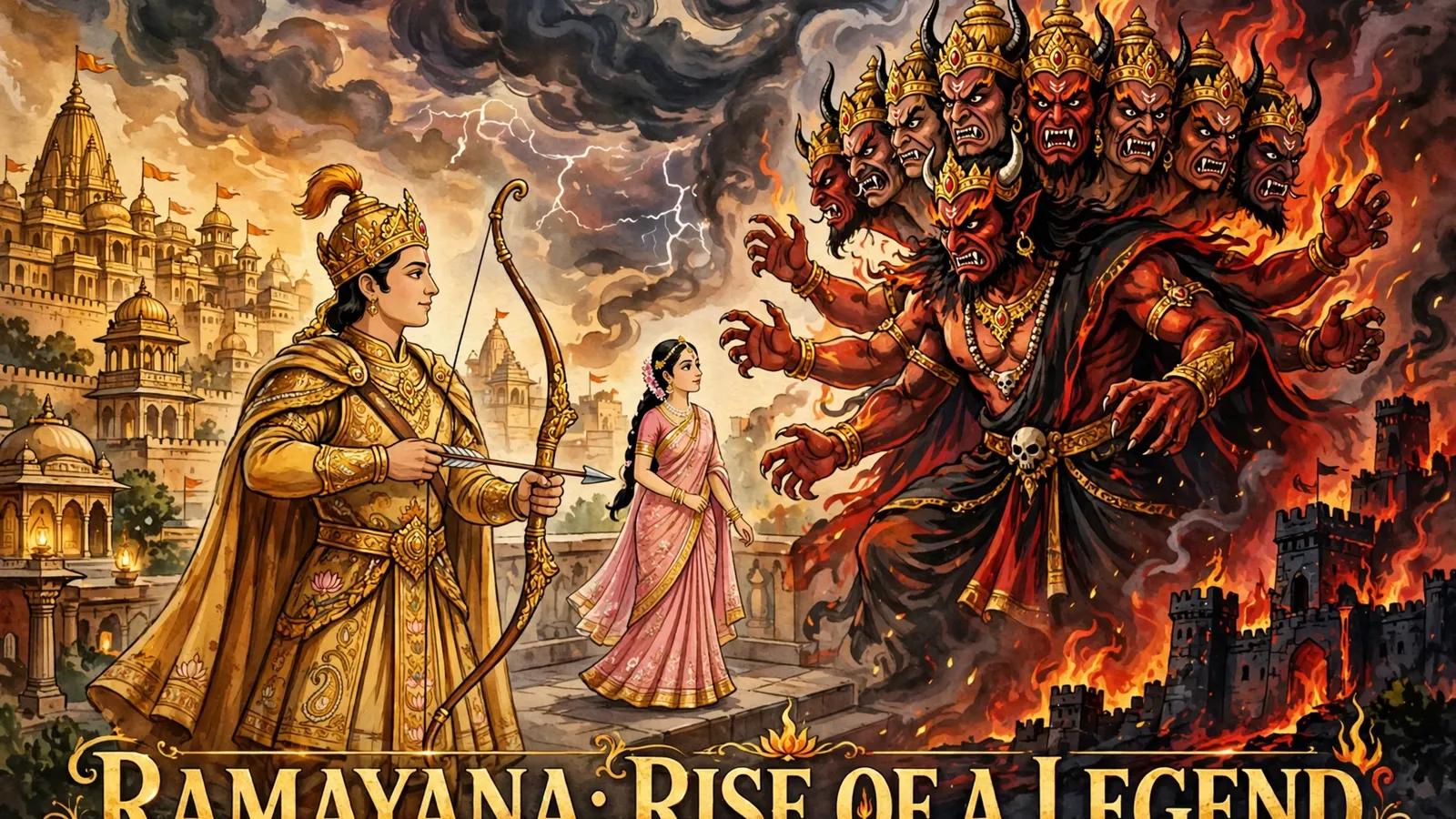
★★★★☆ Our Trailer Rating: 8/10
Please read this first, because it shapes everything that follows: this article rates the trailer only. The film itself has not been released yet, so there is no film rating, no verdict on the finished movie, and no claim here about how the full story will play on screen. What follows is a close look at the second trailer of Nitesh Tiwari’s Ramayana: Rise of a Legend — also billed as Ramayana: Part One — and what that trailer suggests about the film to come. A full review will follow after release.
Few trailers in recent Indian cinema have carried as much weight as this one. The Ramayana is not just a story; it is a living epic, retold across languages, stages, television serials and films for generations, and any new screen version walks into a hall full of memories. The first trailer, released in July 2026, introduced the world. The second trailer, launched at an event in Bengaluru on 15 October 2026 with Ranbir Kapoor, Yash, Sai Pallavi, director Nitesh Tiwari and producer Namit Malhotra in attendance, does something sharper: it puts the two poles of the epic face to face. On one side stands Rama, calm and resolute. On the other stands Ravana, a force of fire and fury. The trailer’s central promise is that contrast, and on that measure it delivers handsomely.
| Detail | Information |
|---|---|
| Release date | 5 November 2026 worldwide (makers’ announcement); some listings show 6 November — see the release-date note below |
| Director | Nitesh Tiwari |
| Producer | Namit Malhotra (Prime Focus Studios), in association with DNEG and Yash’s Monster Mind Creations |
| Also billed as | Ramayana: Part One |
| Genre | Mythological epic, action, drama |
| Language | Hindi, Tamil, Telugu, Kannada and Malayalam in India; international release via Sony Pictures |
| Runtime | Reported at 3 hours 15 minutes (US PG-13 listing); to be confirmed at release |
| Music | Hans Zimmer and A. R. Rahman (reported) |
| Lead cast in the trailer | Ranbir Kapoor (Rama), Sai Pallavi (Sita), Yash (Ravana), Sunny Deol (Hanuman), Ravie Dubey (Lakshman), Kunal Kapoor (Indra) |
| Trailer rating | 8/10 (trailer only — not a film rating) |
The makers have announced 5 November 2026 as the worldwide release date, and the trailer campaign itself carries that date, including the line “In theaters on November 5” in the international promotion. Some listings, however, show 6 November 2026, which appears to reflect local opening days in certain territories rather than a different date from the makers. Readers should treat 5 November 2026 as the makers’ stated date and check local listings, since a one-day difference of this kind is common for a global release. This article follows the makers’ announcement.
The second trailer opens by establishing the scale of its world before it settles on any single character. We are told, in the trailer’s narration, that this is a time when men walked among gods and evil rose out of darkness. That single line does a great deal of work: it tells a newcomer that this is mythic history rather than fantasy invention, and it tells a familiar viewer that the film intends to treat the epic with gravity rather than irony.
Ravana arrives first in force. Yash’s Ravana is introduced as a ruler born of fire and fury, a king so powerful that even the gods are made to bow before him. The trailer’s most talked-about new sequence shows exactly that: Kunal Kapoor’s Indra, king of the gods, rides his celestial white elephant Airavata into confrontation with Ravana, and Ravana strikes the great animal down. In the accompanying television spot, Ravana declares that before him, every head will bow. It is a bold, even shocking image — the trailer deliberately shows a villain humbling heaven itself — and it establishes the stakes in a single blow. If the gods cannot stop this man, the trailer asks, who can?
The answer, of course, is Rama. Ranbir Kapoor’s Rama is presented in deliberate contrast: not as a god descending in glory, but as a man chosen by destiny. The trailer’s defining line, repeated across the campaign, is that humanity’s one hope is “not a god, but a man — Rama.” Rama himself warns that if he does not stop Ravana, the world will fall, and adds that this is just the beginning. The phrasing matters: this is Part One of a two-part epic, with Part Two planned for Diwali 2027, and the trailer is honest about that. It does not pretend the whole story fits in one film.
Between these two poles, the trailer threads moments of tenderness and wonder. We see glimpses of Rama and Sita’s relationship, played by Ranbir Kapoor and Sai Pallavi, giving the spectacle an emotional centre. We see the Pushpaka Vimana, Ravana’s celestial flying chariot, rendered as a grand airborne palace rather than a mere vehicle. And we see Jatayu, the great bird who confronts Ravana in an attempt to protect Sita: in the international cut, the sequence is longer, showing Jatayu attacking the Pushpaka Vimana and lifting Ravana into the air. These are not throwaway effects shots. Each one is a famous beat of the epic, chosen to signal to the audience that the film-makers know the story they are handling.
Other glimpses reward a careful watch. The international trailer shows Ravana in prayer before a massive idol of Lord Shiva, flames rising around him as he lifts his hand — a striking image of devotion twisted into menace, and a reminder that Ravana’s power in the epic is inseparable from his devotion. There is also a brief fight between Ravana and Vivek Oberoi’s Vidyutjihva, the demon prince, with a glimpse of Kumbhakarna watching. These details suggest a film that is building a whole world of secondary figures, not just two leads.
Everything in this section is a trailer-based expectation, not a fact about the unseen film. Trailers are cut to excite, and the full film may handle its material differently.
What the trailer suggests, first, is a film of genuine visual ambition. Reports on the second trailer note a marked improvement in visual effects over the first, with cleaner colour grading and more controlled imagery, and trade observers quoted in coverage described the new footage as justifying the film’s massive budget. Co-producer Yash was reported at the Bengaluru launch as saying the two-part project’s budget runs to around ₹4,000 crore including global marketing — a figure that should be treated as a makers’ claim rather than an audited number, but which explains the scale on screen. If the finished film matches the trailer’s polish, it could set a new visual benchmark for Indian mythological cinema.
Second, the trailer suggests a thoughtful dramatic strategy: keep Rama human. By framing Rama as a man rather than a god, the film-makers are betting that audiences will connect with duty, doubt and resolve rather than with divine invulnerability. That is a brave choice for a sacred story, and it is also a risky one — it asks viewers to accept a Rama who struggles rather than one who simply triumphs. The trailer handles this gracefully, but only the full film can show whether the balance holds across three hours.
Third, the trailer suggests that Part One will end before the story’s most famous battle. Reports from the launch noted that, in keeping with the epic’s geography, the two leads share no direct physical confrontation in Part One, saving their clash for Part Two. If that holds, viewers should go in expecting a film of rising threat and preparation rather than a final showdown — and judge Part One on its own terms, not as an incomplete half.
What the trailer cannot prove is equally important. It shows very little of Sunny Deol’s Hanuman or Ravie Dubey’s Lakshman beyond their presence in the ensemble, so their weight in the film remains unknown. It does not reveal how the film will handle the epic’s most sensitive passages, or how its pacing will sustain a reported runtime of over three hours. And no trailer can prove that spectacle will serve story rather than swallow it. Those questions belong to the full review.
Ranbir Kapoor as Rama — The trailer gives Kapoor the quietest and hardest job: stillness. His Rama is calm, measured and resolute, a man carrying a burden rather than displaying power. The contrast with Yash’s fire is the trailer’s engine, and Kapoor’s restraint makes it work. Whether that restraint deepens over a full film is the question the trailer leaves open.
Yash as Ravana — If the trailer has a breakout force, it is Yash. His Ravana is fierce, commanding and physically imposing, and the trailer builds its most memorable images around him: the toppling of Airavata, the Shiva prayer wreathed in flame, the declaration that every head will bow. Reports note that Sharad Kelkar lends his voice to the character in the Hindi version. On trailer evidence alone, Ravana threatens to steal the film — which, for this story, may be exactly right.
Sai Pallavi as Sita — The trailer uses Sita sparingly but pointedly, centring her relationship with Rama and her peril at Ravana’s hands, including the Jatayu rescue attempt. Pallavi’s presence gives the epic its emotional stakes; the trailer suggests Sita is written as a person, not a prize, but the footage is too brief to judge the full portrayal.
The wider ensemble — Kunal Kapoor’s Indra is the trailer’s surprise new face, and his humbling at Ravana’s hands sets the film’s scale. Arun Govil as Dasharath, Lara Dutta as Kaikeyi, Sheeba Chaddha as Manthara and Anupam Kher as Jatayu (in voice or presence, as credited in character-poster coverage) round out a cast chosen visibly for familiarity and gravitas. Sunny Deol’s Hanuman and Ravie Dubey’s Lakshman are confirmed in the ensemble, though the trailer keeps them in reserve — a deliberate choice that leaves something for the film itself to reveal.
The most discussed technical element of the second trailer is its visual effects. Where the first trailer drew criticism for uneven effects, the second has been widely described as cleaner, grander and more confident, with elaborate sets, detailed costumes and large-scale action staged for IMAX and premium large formats. The colour palette moves between the golden warmth of Ayodhya and the fiery, shadowed grandeur of Lanka, and the trailer cuts between those worlds to underline the moral contrast at the story’s heart.
The music deserves special mention. The score is reported to be a collaboration between Hans Zimmer and A. R. Rahman, and the second trailer leans heavily on it: deep drums, conches and string swells woven into modern orchestral arrangements. Coverage of the trailer singled out the background score as one of its biggest highlights, and on the evidence of the trailer that praise is fair — the music gives the images a mythic weight that effects alone could not. It remains to be seen how the two composers’ styles blend across a full score, but the trailer’s sound is genuinely rousing.
One honest caveat: a trailer is a highlight reel. The improved effects in selected shots do not guarantee uniform quality across a three-hour film, and some observers noted that debate about individual effects shots continued even after the second trailer’s release. The trailer earns its excitement; it does not remove all doubt.
What works:
What to watch in the full film:
As a piece of promotion, the second trailer is a considerable achievement. It corrects the first trailer’s weaknesses, announces its villain with authority, and gives its hero a compelling dramatic idea. It leaves the audience wanting the film, which is precisely a trailer’s job — and it does so without pretending to be the film itself. Our trailer rating reflects that achievement, and nothing more.
Our Trailer Rating: ★★★★☆ 8/10 — A grand, confident trailer that corrects its predecessor and sets up a genuinely exciting clash. This rates the trailer only; the full review will follow after release.
When does Ramayana: Rise of a Legend release?
The makers have announced 5 November 2026 worldwide. Some listings show 6 November, likely reflecting local opening days in certain territories; check local listings closer to release.
Is Ramayana: Rise of a Legend the same as Ramayana: Part One?
Yes. The film is billed internationally as Ramayana: Rise of a Legend and is the first part of a planned two-part epic, with Part Two planned for Diwali 2027.
Who plays Rama, Sita and Ravana?
Ranbir Kapoor plays Rama, Sai Pallavi plays Sita and Yash plays Ravana. Sunny Deol plays Hanuman and Ravie Dubey plays Lakshman.
Who composed the music?
The score is reported to be a collaboration between Hans Zimmer and A. R. Rahman.
Will there be a full review after release?
Yes. This article rates the trailer only, and a full review will follow once the film has released and can be judged as a complete work.