★ LATEST REVIEWS

★★★★★ Our Rating: 9/10
The title sounds like a scam, and in a sense it is one — the hero’s own. How to Make Millions Before Grandma Dies, known in Thai as Lahn Mah (“grandma’s grandchild”), is built on one of the least sympathetic premises imaginable: a broke young man volunteers to care for his dying grandmother because he wants her house. And yet this modest Thai family drama, made by a first-time feature director with two first-time film leads, became the highest-grossing Thai-language film in worldwide history, reduced audiences across Asia to public tears — cinemas in the Philippines famously handed out tissues, and viewers posted videos of themselves crying as a social-media trend — and carried Thailand further into the Academy Awards than any Thai film had ever gone.
So this How to Make Millions Before Grandma Dies review has an unusual job: explaining how a film with no stars in the conventional sense, no romance, no spectacle and a 79-year-old woman at its centre out-performed every action epic and horror hit its industry could offer. The answer is not a twist. It is honesty — about money, about families, about the difference between caring for someone and caring for what they will leave you — delivered in scene after scene that Thai, Indonesian, Singaporean, Filipino and eventually Western audiences recognised as their own lives. It is not a perfect film. Its middle is leisurely and its sentiment is engineered. But its best scenes are as truthful as popular cinema gets.
| Detail | Information |
|---|---|
| Release date | 4 April 2024 (Thailand) |
| Director | Pat Boonnitipat |
| Writers | Thodsapon Thiptinnakorn, Pat Boonnitipat |
| Genre | Comedy Drama, Family Drama |
| Language | Thai, Teochew |
| Runtime | 125 minutes |
| Budget | Approx. US$1 million (commonly listed; not officially confirmed — see Box Office) |
| Lead cast | Putthipong “Billkin” Assaratanakul, Usha Seamkhum, Sanya Kunakorn, Sarinrat Thomas, Pongsatorn Jongwilas, Tontawan Tantivejakul |
| Our rating | 9/10 |
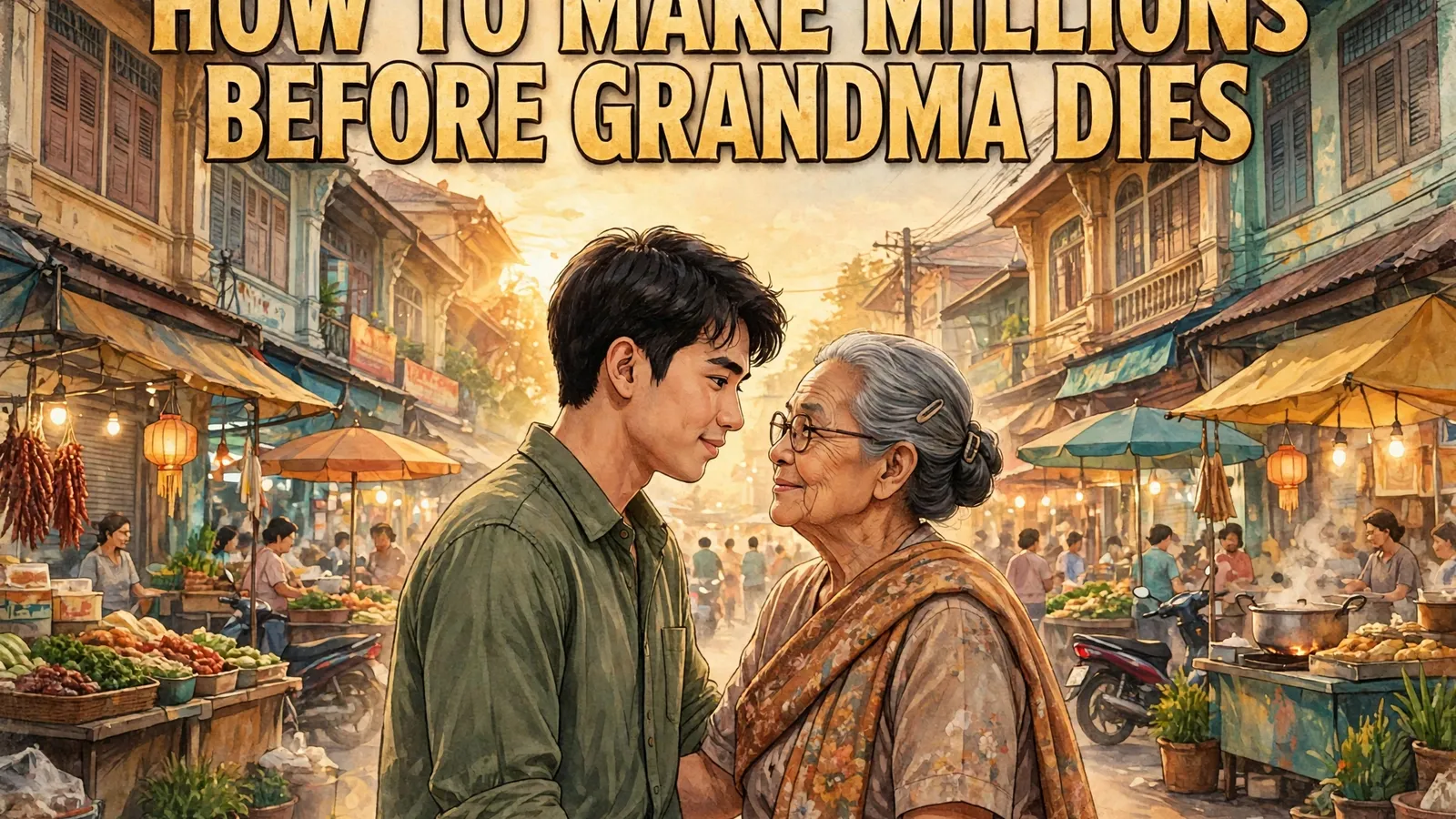
M is a university dropout drifting through life as an aspiring game streamer, watching his savings and his twenties run out together. His maternal grandmother, Mengju — Amah — is a formidable 79-year-old widow of Thai-Chinese stock who sells congee in Bangkok’s Talat Phlu district and rules her family with a raised eyebrow. When Amah is diagnosed with terminal cancer, and the family quietly agrees she should not be told the full truth, M notices something at another family funeral: his cousin Mui devoted herself to caring for a wealthy grandfather — and inherited the bulk of his estate. M does the arithmetic that this film will spend two hours dismantling, and volunteers to move in as Amah’s full-time carer.
Amah is nobody’s sweet little grandmother. She is sharp-tongued, superstitious, frugal to the bone and entirely capable of seeing through a performance — which means M’s project of being seen to be devoted becomes a genuine education in actually being it: the early-morning market runs, the congee stall, the baths, the hospital queues, the rituals of a Thai-Chinese household in Talat Phlu. Around the pair, the film builds its real subject — a family system. Amah’s three adult children orbit at different distances: Kiang, the wealthy stockbroker son; Sew, M’s mother, who gives her time without keeping accounts; and Soei, the youngest, whose visits have a habit of coinciding with his needs. Each of them, the film suggests, is running M’s calculation in a different currency. We will not describe how the inheritance question resolves, or what Amah has quietly been doing with her money since M was a small boy. The film’s final movement recontextualises everything before it, and it should be allowed to arrive unspoiled.
Usha Seamkhum as Mengju (Amah) gives what may be the most celebrated first performance in Thai cinema history. Cast at 78 through a modelling agency after the director saw her audition, having never acted in a film before, she does not perform grandmotherliness — she simply refuses, scene by scene, to be sentimentalised. Her Amah is vain, funny, terrified, unfair and wise in rotation, sometimes within a single line, and her stillness gives the film its authority. When she finally allows herself to be frail, the effect on an audience is physical. The production’s gamble — Pat Boonnitipat has said he wanted someone with no preconceptions about acting, who simply believed the story — produced a performance no trained star could have faked.
Putthipong “Billkin” Assaratanakul as M matches her with the discipline of a singer-star determined to disappear. Billkin, one of Thailand’s most popular young performers, undertook a year of workshops with the director, altered his walk and speech, and plays M’s early scenes with a slouching, screen-lit evasiveness that makes his gradual awakening legible without a single speech about it. The role’s difficulty is that M must change almost entirely in behaviour rather than dialogue — arriving earlier, noticing more, asking for less — and Assaratanakul charts it beautifully. Around them, Sanya Kunakorn as Kiang and Pongsatorn “Phuak” Jongwilas as Soei embody two familiar species of adult child — the one who pays and the one who takes — without caricature, while Sarinrat Thomas as Sew, M’s mother, quietly becomes the film’s moral benchmark: the family member whose care was never a transaction. Tontawan Tantivejakul as Mui, in her feature debut, makes the cousin’s apparent mercenary wisdom unexpectedly complicated.
For a feature debut, Pat Boonnitipat’s direction is strikingly patient. Developed from Thodsapon Thiptinnakorn’s screenplay — itself rooted in caring for his own grandmother during the pandemic, and reworked with Pat over some two years of daily writing sessions that folded in both men’s families — the film shoots Bangkok’s Talat Phlu, one of the city’s old Thai-Chinese communities, as a real working neighbourhood of markets, shrines, railways and shophouses rather than a postcard. Cinematographer Boonyanuch Kraithong favours natural light, unhurried frames and the clutter of an actual lived-in house; editor Thammarat Sumethsupachok lets conversations run past the point a commercial editor would cut, which is where this film’s truth lives — in the extra seconds of an old woman deciding whether to answer.
The approach has costs. At 125 minutes the film’s middle is deliberately, sometimes excessively, unhurried, and viewers raised on faster cutting may feel the congee-stall routines repeat. A subplot or two resolves more neatly than life does, and the film is not above arranging its coincidences for maximum emotional effect. But the restraint pays compound interest: because the film has refused to push, the moments where feeling finally breaks the surface — a pomegranate kept back for the right grandchild, a conversation in a hospital corridor — land with a force that louder films cannot buy. Pat has said he set out to make audiences reflect on their own families rather than be told what to feel; the box office suggests he succeeded on a continental scale.
Jaithep Raroengjai’s score is a model of understatement: gentle piano and strings used so sparingly that many viewers will remember the film as almost unscored, which is precisely its achievement. The emotional heavy lifting is done by the soundscape of the world itself — market noise, temple ritual, trains through Talat Phlu, the clatter of the congee stall — and the score enters mainly to underline transitions in M’s understanding rather than to instruct the audience to cry. When the music does swell, late in the film, it does so over images the audience has been allowed to earn, and the effect is closer to release than manipulation. It is the sound of a film that trusts its material, and its restraint is a large part of why its sentiment reads as earned rather than extracted.
What we loved:
What could be better:
The figures here are estimates, and we present them as such, because tallies shifted as the film kept playing. The headline most commonly cited is an estimated US$73.8 million worldwide — which made the film, on release, the highest-grossing Thai-language film of all time internationally, a remarkable summit for a family drama. Earlier in its run, producer GDH reported around ฿2 billion (roughly US$58 million) at the international box office, and the later, larger total reflects continued play across Asia and Western markets; readers should treat all of these as the film’s own industry-reported estimates rather than audited figures. At home it took about ฿339 million (roughly US$12.3 million) in Thailand in the most-cited final tally — passing ฿100 million in its first five days and ฿250 million inside two weeks — becoming GDH’s biggest domestic film even though another Thai title later passed it in the 2024 domestic chart. Abroad, it broke record after record for a Thai film: more than 3.5 million admissions in Indonesia, making it the most successful Asian film ever released there at the time; the highest-grossing Thai film ever in Singapore, Malaysia, the Philippines and Myanmar; around US$14.8 million in China; and, per GDH, more than ten million viewers worldwide. Its cultural footprint matched the numbers: Thailand selected it as the country’s entry for Best International Feature Film at the 97th Academy Awards, and in December 2024 it became the first Thai film ever to reach the category’s fifteen-film shortlist, chosen from 85 submissions — though it did not advance to the final five nominees. The budget line deserves its own flag: US$1 million is the commonly listed figure, but GDH has not officially confirmed a production budget and some databases list none at all, so we show it as approximate only.
Yes — with tissues, and ideally before your next phone call home. How to Make Millions Before Grandma Dies is that rare crowd-pleaser whose popularity is itself the least interesting thing about it; what matters is that its popularity was earned by observation, patience and a debut performance from a 78-year-old newcomer that would grace any career. It asks an uncomfortable question — what is care worth, and who in your family is keeping score? — and answers it without villains, in a Bangkok neighbourhood most world cinema never visits. If its pace asks something of you, give it. Few films repay the gift this generously.
Our rating: 9/10 — a funny, devastating and beautifully observed family drama that turned a cynical premise into the most beloved Thai film ever made.
Is How to Make Millions Before Grandma Dies based on a true story?
Not on one specific true story. Co-writer Thodsapon Thiptinnakorn drew the idea from caring for his own grandmother during the COVID-19 pandemic and from a family dispute over inheritance and caregiving, and director Pat Boonnitipat folded in his own experience — his grandmother, who helped raise him, was diagnosed with late-stage cancer in 2004. The film is a composite of both men’s families.
Did the film really make the Academy Awards shortlist?
Yes. It was Thailand’s official submission for Best International Feature Film at the 97th Academy Awards and, in December 2024, became the first Thai film in history to reach the fifteen-film shortlist, from 85 national submissions. It was not among the final five nominees.
Who plays the grandmother, and was she really a first-time actress?
Usha Seamkhum, cast at 78 after being discovered through a modelling agency she had joined following a seniors’ dance competition. It was her first film role — as it was, in a leading capacity, for her co-star Putthipong “Billkin” Assaratanakul, a famous singer making his feature lead debut.
What does the Thai title, Lahn Mah, mean?
Lahn Mah (หลานม่า) translates roughly as “grandma’s grandchild” or “the grandchild of grandma” — a title that quietly tells you whose story the film believes it is.
Where can I watch How to Make Millions Before Grandma Dies?
It reached Netflix in Thailand and several Southeast Asian markets in September 2024, and in most Western countries including the UK and US in April 2025, with disc releases in North America from Well Go USA. Availability varies by region, so check your local services.