★ LATEST REVIEWS

★★★★☆ Our Rating: 7.5/10
Few films are as easy to explain and as hard to shake off as The Platform. One setting, one rule, one devastating idea: what if a society literally fed its richest first and its poorest last — and everybody knew their turn at the top would come? The Spanish dystopian thriller, known at home as El hoyo (“The Hole”), premiered at the Toronto International Film Festival on 6 September 2019, opened in Spain that November, and then reached the world through Netflix on 20 March 2020 — landing, by pure accident of timing, in the middle of the first pandemic lockdowns, when its story of hoarding, selfishness and fragile solidarity felt less like fiction than like the news.
It became one of Netflix’s most talked-about non-English films and the surprise word-of-mouth hit of that strange spring. In this review we look at how well the film actually works once the initial shock wears off: the strength of its central metaphor, the performances, the direction that keeps a single concrete room gripping for 94 minutes, and the ending that has divided audiences ever since.
| Detail | Information |
|---|---|
| Release date | 6 September 2019 (Toronto premiere); 8 November 2019 (Spain); 20 March 2020 (Netflix worldwide) |
| Director | Galder Gaztelu-Urrutia |
| Writers | David Desola, Pedro Rivero (story by David Desola) |
| Genre | Horror, Science Fiction, Thriller |
| Language | Spanish |
| Runtime | 94 minutes |
| Lead cast | Iván Massagué, Zorion Eguileor, Antonia San Juan, Emilio Buale, Alexandra Masangkay |
| Our rating | 7.5/10 |
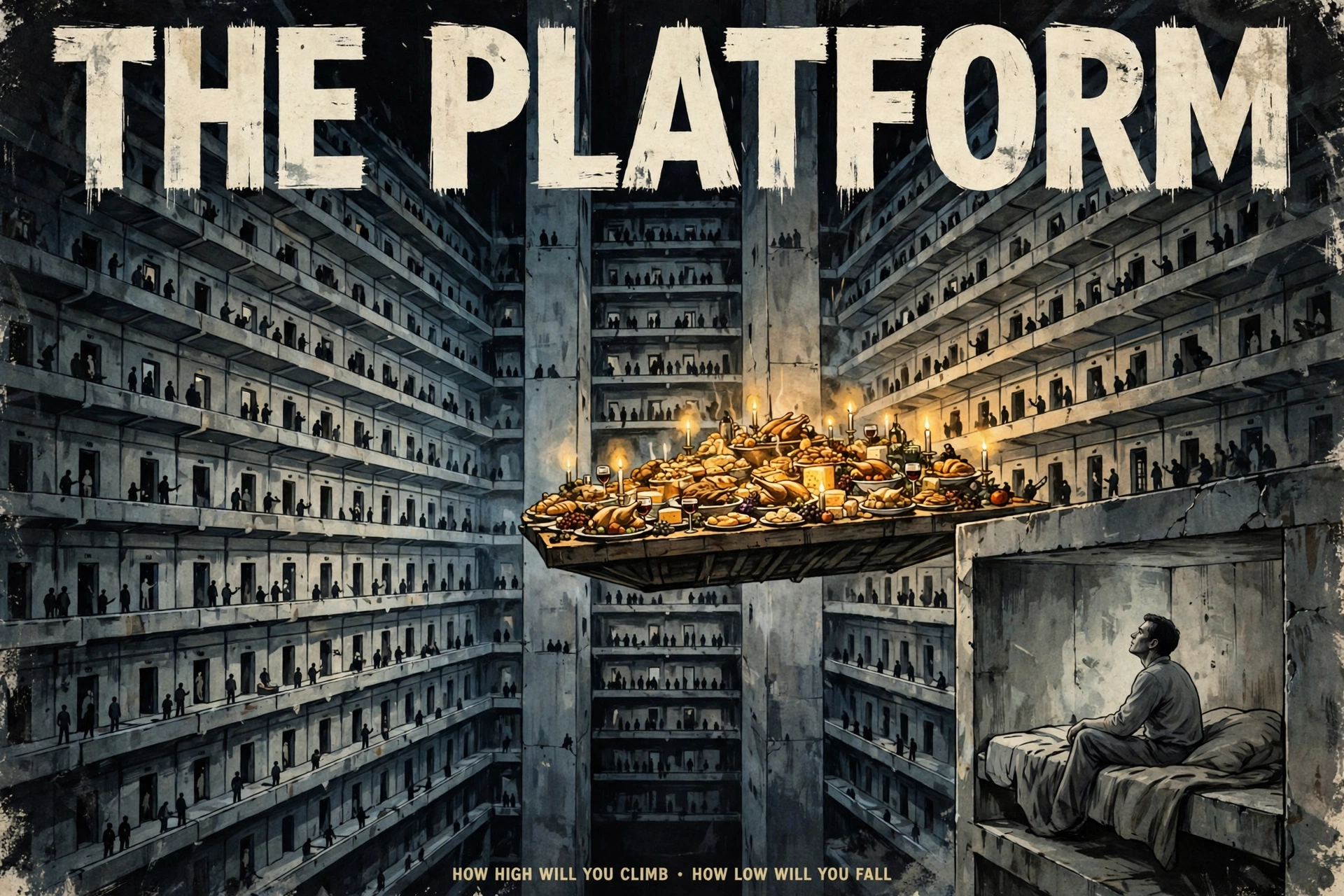
Goreng wakes up in a bare concrete cell. In the middle of the floor is a rectangular hole; through it, above and below, he can see identical cells stacked in a tower that goes down further than anyone can count. He is here voluntarily — he signed up for a six-month stay in exchange for an accredited diploma, and he was allowed to bring one object: a copy of Don Quixote. His cellmate, an older man named Trimagasi, who brought a self-sharpening knife, explains the system with the patience of a man who has explained it many times.
Once a day, a platform loaded with food — an elaborate banquet prepared to perfection by chefs at the top — descends through the hole, stopping for two minutes at each level. The prisoners on the upper levels feast. By the time the platform reaches the lower levels, there is nothing left but broken glass and bones, and below a certain point, there is nothing at all. No one polices how much anyone takes. The only rule is gravity. And every month, the prisoners are gassed, moved, and wake up on a completely different level — a man who starved on level 171 may wake up gorging on level 6, and the film is fascinated by what that does to his soul.
Goreng begins as an idealist: surely, he argues, if everyone ate only what they needed, the food would reach the bottom. The film tests that belief with increasing cruelty, through new cellmates, rumours of a mysterious woman who rides the platform down each month searching for her child, and Goreng’s slow education in what hunger does to principle. Where it all leads — and whether the Administration running the facility can be sent a message it cannot ignore — is the question the final act sets out to answer.
Iván Massagué as Goreng carries the film, and his arc from clean, reasonable volunteer to something far harder and stranger is the spine of the whole piece. Massagué plays the early scenes with an almost naive openness — Goreng genuinely believes reason will work — which makes his gradual transformation disturbing rather than triumphant. It is a physical performance too: the weight loss, the exhaustion and the feverish intensity of the later scenes convince completely.
Zorion Eguileor as Trimagasi walks away with many of the film’s best scenes. His catchphrase delivery, his folksy explanations of the tower’s unwritten etiquette, and the cheerful amorality with which he describes what survival requires down below are funny, horrifying and weirdly likeable all at once. Trimagasi is the system’s perfect product — a man who has stopped asking whether the tower is fair and only asks where he is in it — and Eguileor makes him unforgettable.
Antonia San Juan as Imoguiri, an official of the Administration who enters the tower believing in its stated ideals, provides the film’s conscience and some of its saddest material, while Emilio Buale as Baharat, a prisoner determined to climb towards the top by sheer effort and optimism, gives the final third its energy and its commentary on faith. Alexandra Masangkay as Miharu, the woman of the platform, says very little and needs to say very little; her silence is its own storyline.
This is director Galder Gaztelu-Urrutia’s feature debut, and it does not look like one. Shooting almost entirely inside a single set, he and cinematographer Jon D. Domínguez keep the film visually alive through shifting angles, colour temperature and the slow accumulation of filth: clean white cells at the top of a story arc, smeared and bloodied concrete at the bottom. The vertical shaft itself, seen stretching up and down into darkness, becomes one of modern cinema’s great images of a rigged system — you can literally see your place in the world.
The production design deserves special praise. The banquet platform is photographed with almost pornographic lushness at level zero — gleaming hams, perfect pastries, whole roasted animals — so that its later appearance as a trampled wreck of shells and grease becomes the film’s argument in a single visual rhyme. The sound design, all grinding machinery, distant screams and echoing concrete, does much of the horror work; the worst things in the film are often heard from floors you never see.
Aránzazu Calleja’s score is spare, tense and deliberately uncomfortable, built from low strings, metallic textures and long stretches of near-silence broken by the clank and hum of the approaching platform. It functions less as music than as the tower’s nervous system. The film also uses the famous recording of “My Way” in a darkly ironic placement that underlines its theme of self-justification. Nothing here is meant to be beautiful, and that restraint is correct — a lush score would betray the material.
What we loved:
What could be better:
The Platform had only a limited theatrical life in Spain in late 2019, where it won festival attention — including the People’s Choice Award in Toronto’s Midnight Madness section and major honours at Sitges — rather than blockbuster money, and Netflix does not publish conventional box office figures for it. Its real success was measured in attention: Netflix reported it among its most-watched non-English titles of its release period, it topped streaming charts in dozens of countries during lockdown, and its cultural footprint was large enough that Netflix commissioned a sequel, The Platform 2, released in 2024. For a debut feature shot largely in one room, that is a remarkable commercial legacy.
If you have the stomach for it, yes. The Platform is not flawless — its last stretch swaps clarity for symbolism, and viewers who need their endings explained will leave annoyed. It is also grim in a way that lingers. But as a piece of lean, angry, brilliantly designed genre filmmaking it earns its reputation: 94 minutes, one idea, no wasted scene, and a central metaphor flexible enough that audiences around the world each recognised their own society in the tower. Few films of 2019 said as much with as little.
Our rating: 7.5/10 — a lean, brutal and genuinely thought-provoking debut that sticks in the mind long after it ends.
Is The Platform based on a true story?
No. It is an original allegory written by David Desola and Pedro Rivero. Its themes — inequality, hoarding and trickle-down economics — are drawn from real social debates, but the tower and its story are fictional.
How gory is The Platform?
Very. It contains cannibalism, graphic violence and disturbing imagery, and is intended for adult audiences. Viewers sensitive to gore should approach with caution.
What does the ending of The Platform mean?
The ending is intentionally open to interpretation and suggests that the real hope — or the message that matters — lies in protecting the most vulnerable rather than persuading those at the top. Director and cast have offered their own readings, but the film is designed for the audience to argue about it.
Is there a sequel to The Platform?
Yes. The Platform 2, also directed by Galder Gaztelu-Urrutia, was released on Netflix in 2024 and is set in the same facility with new characters.
Where can I watch The Platform?
The film is a Netflix title and is available on Netflix in most countries, in Spanish with subtitles and in dubbed versions.