★ LATEST REVIEWS

★★★★★ Our Rating: 9.5/10
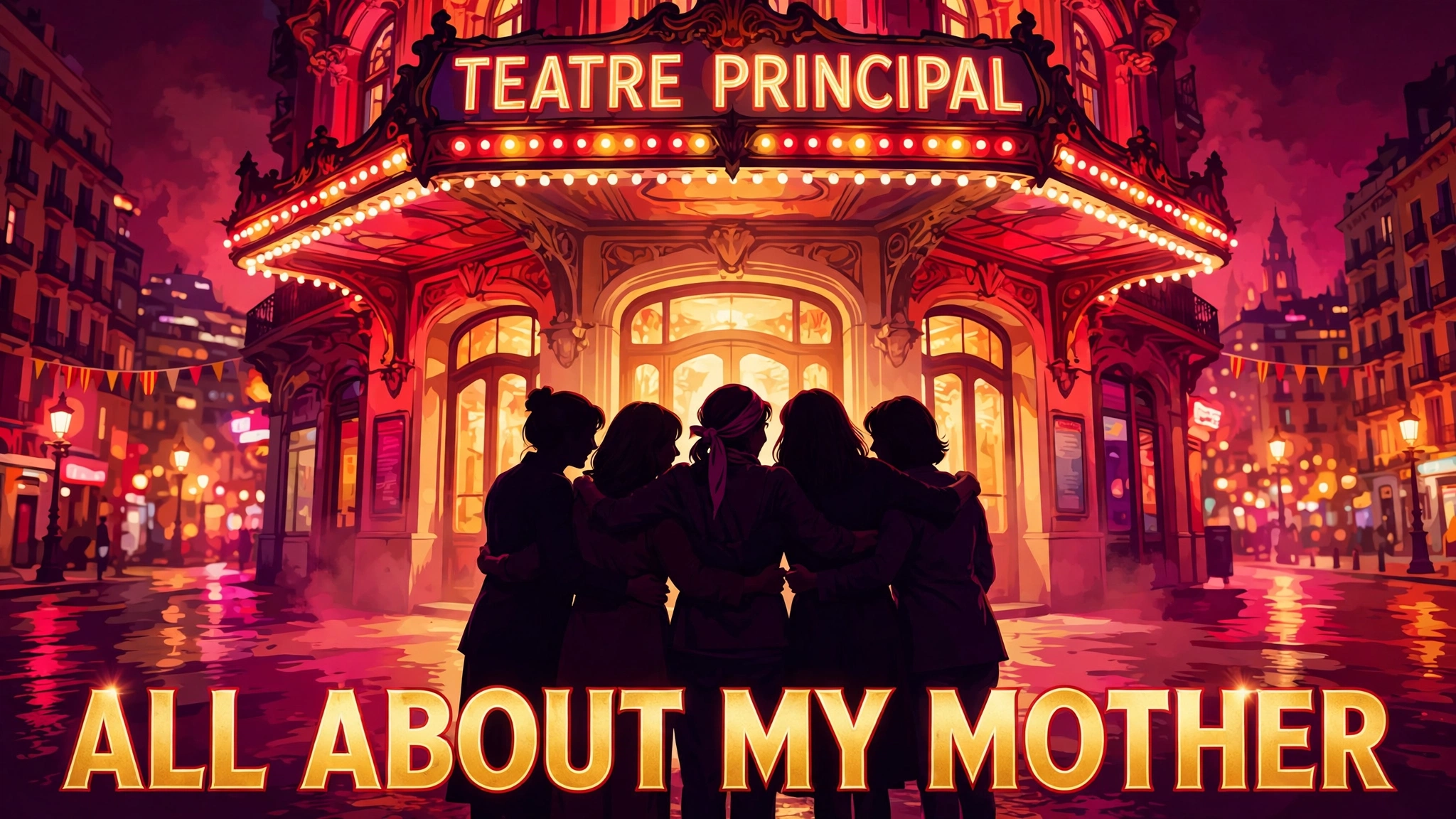
Pedro Almodóvar had been Spanish cinema’s great provocateur for two decades before he made All About My Mother — the director of outrageous, candy-coloured comedies about desire in all its forms. This All About My Mother review is about the film in which the provocateur grew, in public, into something else: a melodramatist of the first rank, capable of handling grief, AIDS, faith, sex work, theatre and motherhood in a single story without dropping any of them, and without ceasing for one scene to be funny. It won the Academy Award for Best Foreign Language Film, and it is the film even people who think they do not like Almodóvar tend to love.
Its dedication, shown at the end, tells you everything about its intentions: to all actresses who have played actresses; to all women who act; to men who act and become women; to all the people who want to be mothers; to his mother. That is not a marketing line. The film is a love letter addressed, seriously, to every kind of woman, and to the families people build when the families they were given are not enough.
We keep this review spoiler-free about the turns of its final act. The film begins with a loss that is part of its famous premise rather than a twist, and we describe that premise below because it is impossible to discuss the film at all without it. What Manuela finds in Barcelona, what becomes of the people she gathers around her, and where the story finally leaves her — those we leave for your viewing, which we cannot recommend warmly enough.
| Detail | Information |
|---|---|
| Release date | 16 April 1999 (Spain) |
| Director | Pedro Almodóvar |
| Writers | Pedro Almodóvar |
| Genre | Drama, Melodrama |
| Language | Spanish, Catalan, English |
| Runtime | 104 minutes (101 minutes, US cut) |
| Budget | 600 million pesetas (approx. $5 million) |
| Lead cast | Cecilia Roth, Marisa Paredes, Penélope Cruz, Candela Peña, Antonia San Juan, Rosa Maria Sardà, Eloy Azorín, Toni Cantó |
| Our rating | 9.5/10 |
Manuela works in Madrid in organ transplantation, coordinating the hardest conversation in medicine: asking the newly bereaved to donate the organs of someone they have just lost. She is good at it, and compassionate, and she carries her own secret grief-shaped knowledge — she is raising her teenage son Esteban alone, and Esteban has never been told who his father is. Esteban wants to be a writer. He is keeping a notebook, and its title, borrowed from a film he loves, is “All About My Mother”.
On Esteban’s birthday, Manuela takes him to the theatre to see A Streetcar Named Desire, starring the actress Huma Rojo, whom he idolises. After the performance, in the rain, Esteban runs after Huma’s taxi hoping for an autograph — and is killed by a car. It is one of the most devastating sequences Almodóvar has ever filmed, and it transforms Manuela, in a single night, from the professional who asks other families for organs into the mother being asked. She signs.
Then she does the only thing left that makes sense to her. She quits her job, leaves Madrid, and travels to Barcelona to find the father Esteban never met — a person now living as Lola — and to tell them that they had a son, and that he is dead. Barcelona was Manuela’s city once, before she fled it pregnant and alone, and returning means re-entering a world she sealed off eighteen years earlier: her old friend Agrado, a trans sex worker of magnificent humour and loyalty; the theatre again, and Huma Rojo herself, now performing in the same city; and Sister Rosa, a young nun from a wealthy family who works with the city’s most marginalised women and who is carrying troubles of her own.
Around Manuela, an improvised family assembles — actresses, nuns, sex workers, addicts, mothers and children of every description — and the film becomes what its title promised: a story about motherhood in every sense in which the word can be survived. Who these people become to each other, and what the final stretch asks of Manuela, we will not say. The surprises here are not plot twists in the thriller sense; they are acts of grace, and they should arrive unannounced.
Cecilia Roth as Manuela gives one of the great performances in European cinema. Roth, an Argentine actress who had worked with Almodóvar in his early, wilder years, plays Manuela as a woman held together by usefulness: she is the competent one, the helper, the friend who will hold the bag, fetch the prescription, take the job, forgive the debt. Grief in most films is played as collapse; Roth plays it as a discipline problem, and it devastates precisely because Manuela keeps functioning while something irreparable shows through her eyes in every scene. She won the Goya Award for Best Actress, and her final stretch of the film — a masterclass in underplaying — is the standard against which screen grief is measured in Spanish cinema.
Antonia San Juan as Agrado walks away with every scene she enters, and the film needs her to. Agrado — the name means, roughly, “agreeable” — is Manuela’s Barcelona past made flesh: a trans woman and sex worker whose armour is a wit so fast it functions as a philosophy. Her famous monologue, delivered to a theatre audience when a performance is cancelled, itemising the cost of her own authenticity with prices attached, drew applause in cinemas — it is one of the most quoted speeches in Spanish film. San Juan plays the comedy at full voltage and then, without changing key, lets you see the price of the life underneath it.
Marisa Paredes as Huma Rojo, the grand stage diva, and Candela Peña as Nina, her younger co-star and lover, caught in addiction, form the film’s theatrical heart. Paredes gives Huma vanity, discipline and a slow-blooming decency — a woman who has played Blanche DuBois so long that performance and life have blurred, and who discovers she is capable of real loyalty after all. Peña, all nerves and need, makes Nina’s chaos painful rather than decorative. Penélope Cruz as Sister Rosa, in the role that announced her to the world before Hollywood called, is luminous in a different register: shy, stubborn, quietly funny, her Rosa’s faith expressed not in speeches but in where she chooses to stand and whom she chooses to help. Rosa Maria Sardà as Rosa’s mother and Eloy Azorín as Esteban complete a cast without a weak link; Azorín has only the opening act, and he makes a whole remembered son out of it.
Almodóvar directs melodrama the way other directors direct thrillers: with total technical command placed at the service of feeling. The film’s design is his mature style in full flower — production design and costumes saturated with the reds and warm tones that have become his signature, interiors arranged like paintings, Barcelona photographed as a city of second chances rather than postcards. Brazilian cinematographer Affonso Beato gives the film a glowing, theatrical warmth that never tips into kitsch, because the camera’s behaviour is classical: it holds faces, trusts actors, and reserves its most expressive move — a slow push towards a person deciding something — for the moments that matter.
The structure is a quiet marvel. The film is full of doublings that Almodóvar never underlines in dialogue: Manuela, the transplant coordinator, must make the donation decision herself; Manuela, an amateur actress in her youth, ends up back inside a theatre, inside the very play that frames her loss; mothers keep failing and succeeding at motherhood in configurations the script keeps rearranging. Theatre excerpts from A Streetcar Named Desire and the ghost of All About Eve — the source of the title — are woven through the story as commentary, not decoration. This is writing of the highest order disguised as soap opera, and part of the film’s historical importance is that critics finally said so in those terms.
The honest caveat: Almodóvar’s coincidences are operatic, and they are deliberate. People meet who should not meet; the city behaves like a village. Viewers who demand documentary realism from drama will call this contrivance. Everyone else will recognise it as the grammar of melodrama — a form this film handles as confidently as any since the golden age of Douglas Sirk, to whom it knowingly nods.
Alberto Iglesias, Almodóvar’s defining musical collaborator, provides a score of unusual tenderness: strings and piano that move like the film itself, warm on the surface and inconsolable underneath, never once instructing the audience to cry — the writing does that unaided. Iglesias won wide recognition for this work, and listening to the score away from the film is a short education in how melodrama should be underscored: present, lyrical, and always one step behind the emotion rather than one step ahead of it.
Around the score, Almodóvar builds a soundtrack of voices and places — the Argentine bandoneón colours of Dino Saluzzi, Senegalese singer Ismaël Lô’s “Tajabone”, which accompanies one of the film’s most quietly joyful passages — and the soundscape of Barcelona itself. Above all there is the theatre: the amplified hush of an audience, Blanche DuBois’s lines arriving from stage after stage, in city after city, like a refrain the characters cannot escape. Music in this film is not accompaniment. It is another member of the chosen family.
What we loved:
What could be better:
The figures for this production are well established. All About My Mother was made for about 600 million pesetas — roughly $5 million — and grossed approximately $67.8 million worldwide, reported in most sources as about $68 million. For a Spanish-language melodrama about grief, trans women, nuns and theatre, released in 1999, that is an exceptional result, and it made the film by some distance the biggest international success of Almodóvar’s career to that point.
The awards campaign tells the same story of conquest. The film won the Academy Award for Best Foreign Language Film, the Golden Globe in the same category, and BAFTA Awards for Best Film Not in the English Language and Best Director. At Cannes, Almodóvar won Best Director. At home it took six Goya Awards including Best Film, Best Director and Best Actress. For Spanish cinema it was a watershed: proof that a film could be utterly local — Barcelona streets, Catalan and Spanish woven together, a sensibility unmistakably Almodóvar’s — and simultaneously become the world’s film. Penélope Cruz’s path to international stardom runs directly through it.
Yes — this is the Almodóvar film to start with, and for many viewers it remains the Almodóvar film to measure all the others by. All About My Mother will make you laugh in the middle of grief and grieve in the middle of laughter, often inside the same scene, and it will leave you thinking about the families people build when life breaks the ones they were issued. If you love melodrama, theatre, great ensemble acting or simply films about women made with total love and total craft, it is essential viewing.
Our rating: 9.5/10 — Almodóvar’s most generous film: a masterpiece of melodrama, carried by one of the finest ensembles in European cinema.
Did All About My Mother win an Oscar?
Yes. It won the Academy Award for Best Foreign Language Film at the 72nd Academy Awards, in addition to the Golden Globe for Best Foreign Language Film and two BAFTA Awards, including Best Director for Pedro Almodóvar.
What is the original Spanish title of All About My Mother?
It is Todo sobre mi madre. The English title echoes All About Eve, the classic film about theatre and actresses that Almodóvar references directly — Esteban has recently watched it, and its influence runs through the story.
Is All About My Mother based on a true story?
No, it is an original screenplay by Almodóvar. It does, however, grow out of a scene in his earlier film The Flower of My Secret (1995), which showed doctors being trained to ask grieving families about organ donation — the profession he gives Manuela here.
Who gives the famous monologue about authenticity in the film?
Agrado, played by Antonia San Juan. Faced with a cancelled theatre performance, she offers the audience the story of her life instead, listing what her transformation has cost her with unforgettable humour. It is one of the most celebrated scenes in Spanish cinema.
Is All About My Mother a good first Almodóvar film?
It is widely considered the best entry point. It has his colour, humour and theatricality, but its emotional story is his most accessible and universal. From here, most viewers continue happily to Volver and Talk to Her.