★ LATEST REVIEWS

★★★★★ Our Rating: 9/10
Found-footage horror has a credibility problem, and it had one even in 2007. For every film that made the camera feel necessary, a dozen made it feel like a gimmick kept alive by characters who would obviously have put the camera down and run. This [REC] review is about the great exception — the lean, ferocious Spanish film that understood the format better than almost anything before or since, and used seventy-eight minutes to show the rest of the world how it should be done.
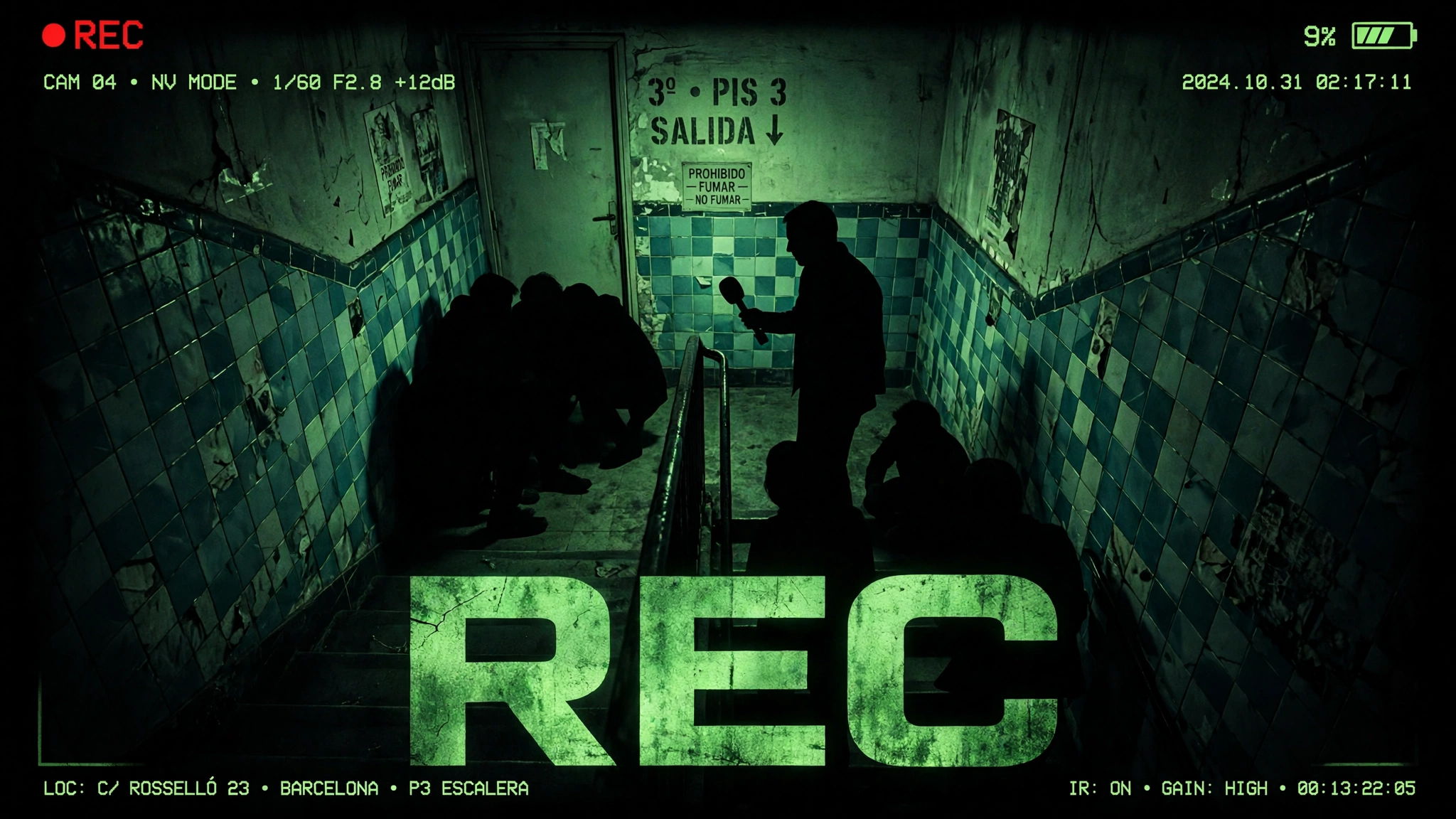
Jaume Balagueró and Paco Plaza, co-directing, start with the most ordinary assignment in television: a reporter killing time on a night shift with a local fire crew, hoping for something — anything — to happen. Something happens. By the time authorities seal the apartment building the crew has entered, [REC] has become a machine for generating dread out of architecture: one lobby, one stairwell, a handful of flats, and nowhere whatsoever to go. It launched a franchise, inspired an American remake within a year, and is still routinely named among the scariest films of the century.
A note on spoilers, because this film deserves the courtesy: [REC] is best experienced knowing almost nothing beyond the premise above. We describe the setup, the craft and the performances here, and we discuss the nature of its famous final stretch only in the vaguest terms. We do not reveal what is found at the top of the building, what the authorities know, or how it ends. Keep it that way for yourself, too — avoid detailed plot summaries before your first viewing.
| Detail | Information |
|---|---|
| Release date | 23 November 2007 (Spain) |
| Director | Jaume Balagueró, Paco Plaza |
| Writers | Jaume Balagueró, Paco Plaza, Luiso Berdejo |
| Genre | Horror, Found Footage, Thriller |
| Language | Spanish |
| Runtime | 78 minutes |
| Budget | $2 million |
| Lead cast | Manuela Velasco, Ferrán Terraza, Jorge-Yamam Serrano, Pablo Rosso, David Vert, Vicente Gil, Martha Carbonell, Carlos Vicente |
| Our rating | 9/10 |
Ángela Vidal is a television reporter for a late-night programme that fills the small hours with slices of working life — the kind of show, as she cheerfully admits to camera, that airs while the city sleeps. Tonight she and her cameraman Pablo are shadowing a Barcelona fire station, and the shift is living down to expectations: a tour of the trucks, an interview in the dormitory, a cat rescue discussed in tones of deep seriousness. Ángela keeps joking, to Pablo and to us, that she is praying for an emergency call, just to have something worth broadcasting.
The call, when it comes, sounds reassuringly dull. An elderly woman is reportedly trapped and screaming inside her flat in a residential building, and police have asked the fire brigade to help break in. Ángela and Pablo ride along. In the lobby they find the building’s residents gathered in nightclothes — families, an elderly couple, a mother with a sick little girl — annoyed, curious and only mildly concerned. Two firefighters go up with the police. And then, from upstairs, something happens that changes the temperature of the entire film in seconds.
What follows is escalation handled with pitiless logic. People are hurt. Help does not arrive, because help, in the form of the authorities outside, has decided on a different policy: the building is sealed, plastic-sheeted and quarantined, with everyone inside — residents, firefighters, police and one television crew — ordered to stay put while officials in protective suits decide what the outbreak in front of them actually is. The residents turn on each other, on the authorities’ spokesman, and on the camera itself. And Ángela, whose professional instinct and personal survival instinct point in the same direction for once, gives Pablo the instruction that becomes the film’s refrain: record everything.
That is as far as we go. What the infection is, where it began, what waits in the penthouse the residents keep mentioning, and what the camera finally sees in the dark — those are the film’s to show you, in real time, exactly as they were shown to everyone who made it a word-of-mouth phenomenon in 2007.
Manuela Velasco as Ángela Vidal is the film’s indispensable asset. Velasco was herself an experienced television presenter, and the casting is a masterstroke: her to-camera brightness in the opening stretch — the practised smile, the coaxing interview technique, the gentle mockery of a dull shift — is the real professional article. That is precisely what makes its collapse so frightening. As the night disintegrates, Velasco takes Ángela from presenter to witness to something close to a war reporter in a stairwell, and finally to a person running on a single instruction: keep recording. She won the Goya Award for Best New Actress for this performance, an almost unheard-of honour for a horror lead, and she earns it in every scene. The fear in this film is credible because hers is.
Pablo Rosso as Pablo has the strangest acting job in the film: he is the camera. We hear him, we feel his breathing and his flinches, we see his hands and his light — and his decisions about where to point the lens are the film’s editing, its rhythm and often its scares. Rosso was also the film’s cinematographer, which means the performance and the photography are literally the same work. Ferrán Terraza as Manu, the senior firefighter, brings the calm, decent authority of a man whose profession is entering other people’s emergencies, and his slow loss of that calm is one of the film’s most human measures of how bad things have become.
The ensemble of residents deserves collective praise, because found footage dies when supporting players sound like actors. Martha Carbonell, Vicente Gil, Jorge-Yamam Serrano, David Vert and Carlos Vicente build a lobby full of recognisable neighbours — suspicious, quarrelsome, protective of their own — and the production famously withheld parts of the script and some scares from the cast to capture genuine startlement. You can feel that method in the group scenes: interruptions overlap, arguments spiral the way real arguments in a crisis do, and nobody waits politely for their cue to panic.
Balagueró and Plaza’s direction is a masterclass in using limitation as fuel. The film was shot in a real Barcelona apartment building, largely in sequence, and presented as a single unbroken feed from Pablo’s camera — in reality, of course, carefully constructed from extended takes, hidden cuts and rehearsed choreography that the audience is never invited to notice. Because everything we see must be motivated by what a cameraman would film, the framing itself tells the story: what Pablo cannot bring himself to look at, we are shown late; what he whips towards, we experience as a jolt in our own bodies.
The directors’ discipline about light deserves particular respect. The camera’s own lamp and, later, its night-vision mode are not stylistic trimmings; they are the only reasons we can see at all, and the film rations them ruthlessly. Whole passages are played in near-blackness lit by a swinging beam, and the celebrated final stretch — which we will not describe — is built on that economy. Sound design does similar work: the film has no non-diegetic hiding places, so every scream through a wall, every thud from the floor above, every burst of official loudspeaker Spanish lands unprocessed and immediate.
The honest criticism of [REC] is the honest criticism of its genre. The premise requires Pablo to keep filming in moments when filming is close to indefensible, and the film’s answer — Ángela’s journalistic insistence, and the argument that the recording is evidence the outside world must see — persuades most viewers and will never persuade all of them. Viewers allergic to handheld camerawork should also be warned fairly: although [REC] is far steadier and more purposeful than most found footage, it is still a film designed to feel like a camera in a running man’s hands.
There is no composed score in [REC], and importing one would have been vandalism. A horror film selling itself as recovered footage cannot have an orchestra commenting on it; the second a string sting arrived, the documentary spell would snap. Instead, the film’s music is the building itself, mixed with dreadful clarity: door buzzers, stairwell echoes, a television murmuring in an empty flat, the wet sound of violence one room away, and above all the human voice at every register from lobby grumbling to screaming.
That absence is also a tactical weapon. Conventional horror scores tell you when to be afraid and, just as usefully, when you may relax. [REC] offers no such contract. Its quiet passages are never certified safe by musical reassurance, so the audience stays braced for the full seventy-eight minutes — which is a large part of why a film this short leaves viewers so thoroughly wrung out. When the soundtrack of a horror film is mostly breathing — Pablo’s, and by the end, yours — the filmmakers have done sound design exactly right.
What we loved:
What could be better:
For a low-budget horror title, the documentation here is unusually good. [REC] was produced for about $2 million and earned roughly $32.5 million worldwide at the box office — some trackers put the final cumulative total a little lower, around the $29–30 million range depending on the territories and reissues counted, but every source agrees on the story: a return of well over ten times its production cost, achieved largely through word of mouth.
Its commercial afterlife was even bigger than its gross. It won two Goya Awards from its Spanish industry, including Velasco’s acting prize, took major genre honours at festivals including Sitges, and was remade in Hollywood as Quarantine (2008) — a film that follows it very closely, which tells you how un-improvable the original’s shape was judged to be. Three Spanish sequels followed between 2009 and 2014. Perhaps most significantly, [REC] arrived the same era as The Orphanage and consolidated a golden age for Spanish horror: proof that the industry could produce genre films that dominated the world’s fright conversation on craftsmen’s budgets.
Yes — if you watch horror at all, this is close to obligatory. Watch it in Spanish with subtitles, in the dark, in one unpaused sitting, knowing as little as possible beyond what this review has told you. [REC] is the rare found-footage film that sceptics cite as the exception, a short, sharp demonstration that the format’s limits are actually its weapons. If shaky camerawork genuinely makes you unwell, that is the one respectable reason to sit it out; everyone else should expect to be scared properly, by professionals.
Our rating: 9/10 — found footage done flawlessly: the scariest 78 minutes Spanish cinema has ever produced.
Is [REC] really filmed in one take?
No — it is edited to feel like one continuous camera feed, using long takes, hidden cuts and careful choreography. That illusion, sustained for 78 minutes, is one of its great technical achievements.
What does the title [REC] mean?
It is the record indicator on a video camera — short for “record”. The styling, with brackets and a dot, mimics the display on Pablo’s camera, which is the only viewpoint the film ever gives us.
Is [REC] the same film as Quarantine?
Quarantine (2008) is the American remake and follows the original very closely, scene for scene in places. Most critics and horror fans regard [REC] as the superior version, and we agree — start with the original.
How scary is [REC] compared with other found-footage films?
It is consistently ranked among the scariest found-footage films ever made, and among the scariest Spanish films. Its intensity comes from escalation and confinement rather than gore alone, though viewers should expect strong violence.
Do I need to watch the [REC] sequels?
They are not required. [REC] 2 (2009) continues the story directly and is well regarded; the later sequels divide opinion. This first film stands completely on its own as a single night’s footage.