★ LATEST REVIEWS

Our Rating: ★★★★★ 9.5/10
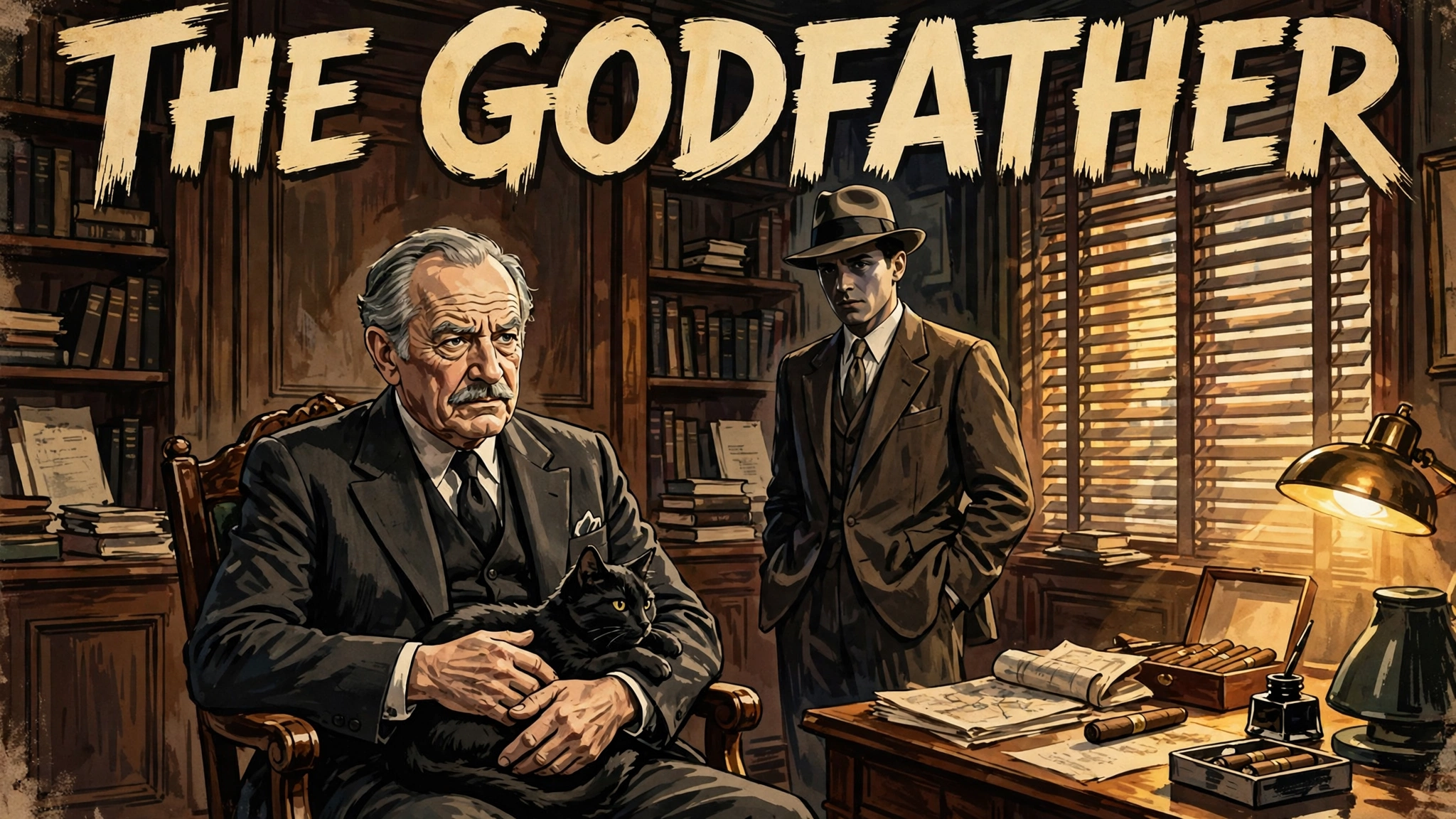
There are films you admire and films you live with. The Godfather is the second kind. More than fifty years after its release, Francis Ford Coppola’s adaptation of Mario Puzo’s bestselling novel remains the standard against which crime films — and arguably all American films — are measured. It is a story about a mafia family, yes, but it is really a story about fathers and sons, loyalty and betrayal, power and its price, told with a patience and richness that modern blockbusters rarely attempt.
It is also, famously, a film that almost did not happen the way we know it. The studio doubted Coppola, doubted Marlon Brando, and doubted Al Pacino. Coppola fought for all three, and the result is one of the great vindications in cinema history. This review looks at why the film still matters, what it does better than almost anything else, and where even a masterpiece shows its age.
| Detail | Information |
|---|---|
| Release date | 14 March 1972 (premiere); 24 March 1972 (United States) |
| Director | Francis Ford Coppola |
| Writers | Mario Puzo, Francis Ford Coppola; based on the novel by Mario Puzo |
| Genre | Crime, Drama |
| Language | English (with some Italian) |
| Runtime | 175 minutes |
| Budget | $6–7 million |
| Lead cast | Marlon Brando, Al Pacino, James Caan, Robert Duvall, Diane Keaton, Richard Castellano, Sterling Hayden |
| Our rating | 9.5/10 |
The film opens in 1945, at the wedding of Connie Corleone, daughter of Don Vito Corleone, head of one of New York’s most powerful crime families. In his darkened study, away from the celebration, the Don receives visitors asking for favours, and in those first scenes Coppola establishes everything the film is about: family as both refuge and prison, respect as currency, and violence as a tool that is used sparingly and therefore terribly.
Vito’s youngest son, Michael, is the family’s outsider — a war hero who has deliberately stayed out of the family business and plans a legitimate life with his girlfriend, Kay. Around him are his brothers: the hot-headed Sonny, who seems born to inherit the empire, and the gentle, overlooked Fredo. When Vito refuses to back a rival’s drug trade, a chain of violence is set in motion that forces the family into war, and Michael, the son who wanted nothing to do with it, is drawn step by step into its centre.
This review will not reveal the film’s famous set pieces or its devastating final movement. It is enough to say that the story spans a decade, from 1945 to 1955, and that its true subject is transformation: how a decent young man becomes the thing he once rejected, and how a family that claims to protect its own ends up consuming them.
Marlon Brando as Vito Corleone — Brando’s performance is one of the most imitated in film history, and imitation has dulled how radical it was. His Don is not a shouting gangster but a soft-spoken, almost weary patriarch, with a gravelly whisper, a fondness for his grandchildren and a terrifying calm. Brando makes power look like patience: he rarely raises his voice because he rarely needs to. He won the Academy Award for Best Actor, and famously declined it, but the performance needs no award to justify itself. It is the centre of gravity around which the whole film turns.
Al Pacino as Michael Corleone — If Brando is the film’s soul, Pacino is its spine. His Michael begins as the clean-cut outsider, polite and distant at his sister’s wedding, and Pacino charts his hardening in small, chilling increments: a look held a second too long, a voice growing quieter as his authority grows. It is a performance of extraordinary restraint, and it makes Michael’s journey believable rather than melodramatic. Pacino was nominated for Best Supporting Actor, a categorisation that still puzzles film historians given that he is plainly the film’s co-lead.
James Caan as Sonny, Robert Duvall as Tom Hagen, Diane Keaton as Kay — Caan is volcanic as Sonny, all impulse and appetite, and his energy makes Michael’s coldness stand out all the more. Duvall is quietly superb as Tom Hagen, the family’s adopted son and consigliere, the calm professional who holds the business together. Keaton gives Kay a clear-eyed decency that matters enormously: she is the audience’s way into the family’s moral cost, the outsider who slowly realises what she has married into. The supporting cast, including Richard Castellano as the affable Clemenza and Sterling Hayden as a corrupt police captain, has no weak link.
Coppola’s direction is a masterclass in patience. He shoots the Corleone world in the shadowy, amber-lit style created by cinematographer Gordon Willis — so dark, in places, that contemporary studio executives worried audiences would not be able to see the film. That darkness is the point. It gives the family home the feel of a church and a fortress at once, and it makes the bursts of daylight — the wedding, the Sicilian countryside — feel like a different world, a lost innocence.
The film’s structure is equally confident. Coppola lets scenes breathe: a wedding that runs for half an hour, a family dinner that tells you more about power than any shootout, a baptism intercut with violence in one of the most famous editing sequences in cinema. The famous word is “operatic”, and it fits: Nino Rota’s score, with its mournful trumpet theme, gives the story a tragic grandeur that lifts it above genre. The film is long — 175 minutes — but it earns its length, because every scene builds character rather than merely advancing plot.
One honest caveat: the film’s portrayal of women is limited by its era and its subject. Kay and Connie matter, but they are seen largely through the men’s story, and the film’s world is overwhelmingly male. That is partly faithful to the world it depicts, but modern viewers will notice it, and it is worth saying plainly.
Nino Rota’s score is inseparable from the film’s identity. The main theme, played on a lonely trumpet, is at once tender and menacing — a love theme for a family built on crime. Rota’s music never tells the audience how to feel in a simple way; it deepens the ambiguity, making moments of family warmth feel haunted and moments of violence feel mournful. The score was controversially ruled ineligible for the Academy Award for Best Original Score because part of it had been used in an earlier film, but its place in film history is beyond dispute. The mandolin, the accordion, the Sicilian folk colours — all of it builds a world that feels old, rooted and doomed.
What we loved:
What could be better:
The Godfather was made on a budget reported as $6–7 million, depending on the source — a modest sum even for 1972, and one of the great bargains in film history. Its box-office total is similarly reported as a range, roughly $250–291 million worldwide across its original release and later re-releases, with most sources clustering around $246–270 million. Whichever figure is used, the conclusion is the same: it was the highest-grossing film of its time, a cultural phenomenon that saved Paramount Pictures and made the mafia film a prestige genre. It won three Academy Awards, including Best Picture, Best Actor for Brando and Best Adapted Screenplay, from ten nominations, and it remains near the top of almost every all-time greatest-films list.
Yes — and if you have seen it before, watch it again. The Godfather rewards rewatching like few films do: you notice new details in the performances, new ironies in the dialogue, new shadows in the photography. It is not a perfect film — no film is — but its flaws are small beside its achievements. It is a tragedy about power dressed as a crime epic, and it understands something most crime films never grasp: that the most dangerous thing about the mafia is not its violence but its offer of belonging, and the price it charges for it.
Our rating: 9.5/10 — A towering masterpiece that has lost none of its power in half a century.
Is The Godfather based on a true story?
No. It is based on Mario Puzo’s 1969 novel, which is fictional, though it draws on the general history of organised crime in America.
Do I need to watch the sequels?
The first film stands alone. Part II (1974) is widely considered equally great and deepens Michael’s story, while Part III (1990) is more divisive.
Why did Marlon Brando refuse his Oscar?
Brando declined the Best Actor award as a protest against Hollywood’s portrayal of Native Americans, sending activist Sacheen Littlefeather to decline it on his behalf.
How long is The Godfather?
It runs 175 minutes, about two hours and fifty-five minutes.
Is The Godfather suitable for younger viewers?
It contains strong violence and adult themes, and is best suited to mature teenagers and adults.