★ LATEST REVIEWS

★★★★☆ Our Rating: 7.5/10
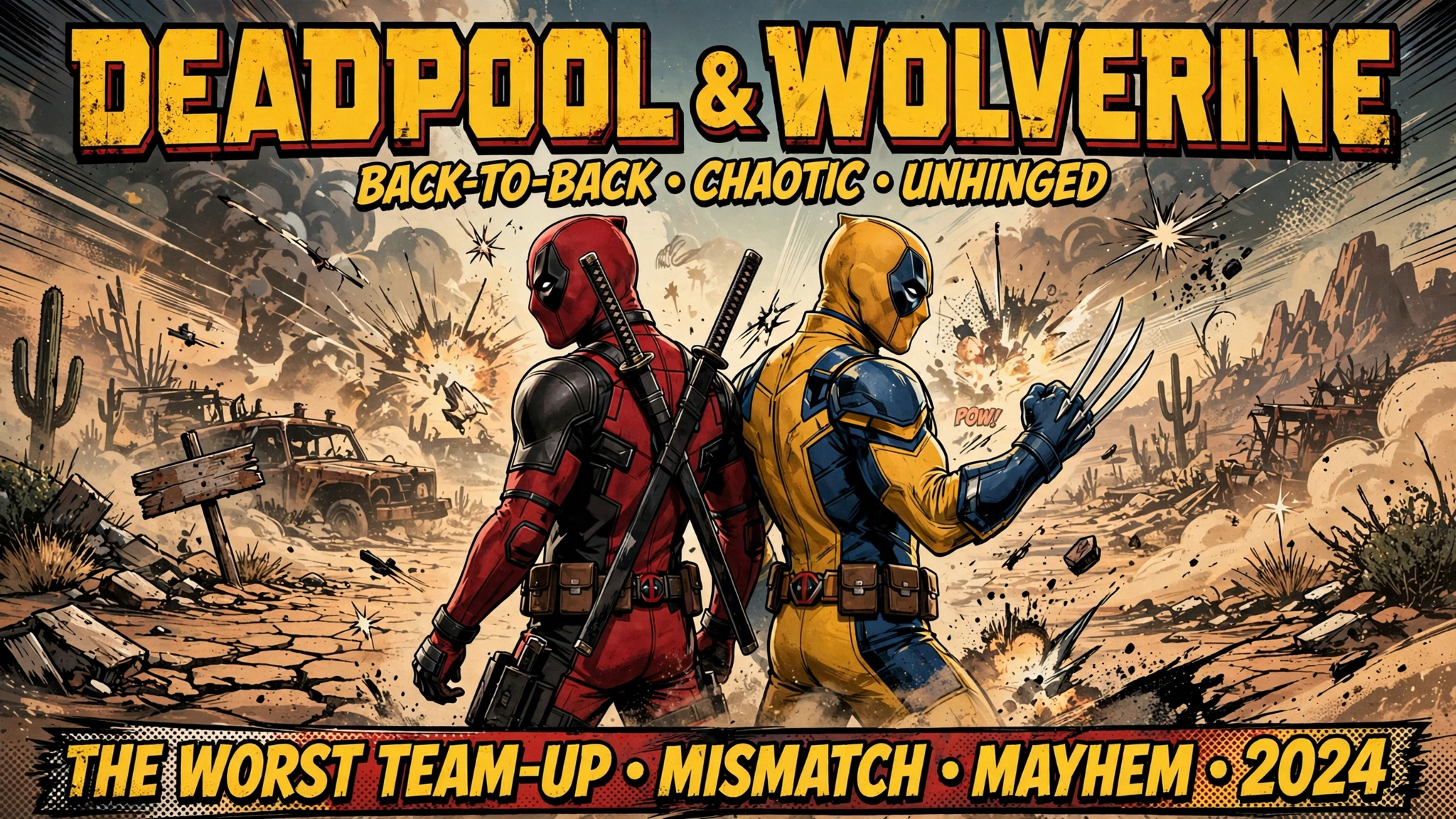
There is a version of this film that should not work at all. It has to serve as a third Deadpool film, as Hugh Jackman’s return after the widely loved farewell of Logan, as a bridge between the old Fox Marvel films and the Marvel Cinematic Universe, and as a multiverse story in an era when audiences were openly tired of multiverse stories. That is a lot of corporate and creative luggage for one comedy to carry. The surprise is how often Deadpool & Wolverine turns that luggage into the joke itself — and how much genuine affection for these characters sits underneath the swearing, the needle drops and the cameo parade.
The other surprise is Jackman. Reynolds’ Deadpool act is well established by now: motor-mouthed, self-aware, far more insecure than he pretends to be. Bringing back Wolverine risked feeling like a stunt. Instead, the film’s best material comes from the friction between a man who talks to cover every feeling and a man who has buried his feelings under failure and drink. When the film remembers that pairing is its real asset, it is very entertaining indeed.
It is also, honestly, a messy film. The plot is overcomplicated, the villain’s scheme is thinner than the heroes’ banter, and viewers with no investment in twenty years of Marvel films will feel stretches of it pass them by. In this review we break down the spoiler-free story, the performances, the craft, the music and the extraordinary box-office run of the first R-rated MCU film, without giving away its parade of surprises.
| Detail | Information |
|---|---|
| Release date | 26 July 2024 (United States) |
| Director | Shawn Levy |
| Writers | Ryan Reynolds, Rhett Reese, Paul Wernick, Zeb Wells, Shawn Levy |
| Genre | Action, Comedy, Superhero |
| Language | English |
| Runtime | 128 minutes |
| Budget | $200 million (reported production budget; later production filings suggest a higher final cost — see Box Office) |
| Lead cast | Ryan Reynolds, Hugh Jackman, Emma Corrin, Morena Baccarin, Rob Delaney, Leslie Uggams, Matthew Macfadyen |
| Our rating | 7.5/10 |
Wade Wilson has tried to build a quieter life. The mercenary work is behind him, the relationship with Vanessa has stalled, and he is selling cars badly while wearing a hairpiece nobody is polite enough to mention. What he wants, underneath the jokes, is to matter — to be part of something larger than his own small, disappointed routine. That wish collides with the Time Variance Authority, the bureaucracy introduced in Loki, which informs him that his universe is dying because its anchoring figure, Logan, died in Logan. Wade is offered a place in the main MCU timeline, but at a price he is not willing to pay: everyone he loves stays behind to fade away.
His solution is pure Deadpool. If his universe needs a Wolverine, he will go and find one — any one — across the multiverse. What he drags back is described, with some justification, as the worst Wolverine available: a Logan who failed his own world, carries that failure in every scene, and wants absolutely nothing to do with Wade’s rescue mission. The two are thrown together into the Void, the dumping ground at the end of time where discarded people and variants are sent, ruled over by a powerful and deeply unsettling figure with a personal connection to a familiar hero.
From there the film becomes a road movie through franchise history: two men who cannot stand each other, travelling through the remains of older Marvel eras, arguing, fighting and slowly revealing why each of them believes he is beyond saving. This section will not name the returning faces, repeat the cameo list or describe the ending. It is enough to say the emotional destination is simpler than the machinery used to reach it: Wade learning what he is actually willing to sacrifice, and Logan deciding whether a failed life can still produce one meaningful act.
Ryan Reynolds as Wade Wilson / Deadpool — Reynolds is, by this point, inseparable from the role, and the performance has both the strengths and the limits that implies. His timing remains superb, especially in the rapid asides and in his needling double act with Jackman, and he plays Wade’s desperation to be chosen by the Avengers with a neediness that is funny and a little sad. The downside is familiarity: there are moments when Deadpool’s commentary feels like a routine being performed rather than a character thinking, and the film leans on him to explain or excuse plot turns with a wink. Still, nobody else could anchor this tone.
Hugh Jackman as Logan / Wolverine — Jackman is the film’s trump card. Returning seven years after Logan, he does not simply recreate the earlier performance. This variant is looser, drunker, crueller in argument and openly ashamed of himself, and Jackman plays that self-contempt with complete conviction even when everything around him is a gag. Crucially, he can also go completely still and let two decades of history with this character do the work. His scenes of confession give the third act a weight the script alone does not earn. And yes, finally seeing him in the yellow suit lands — because Jackman treats it as character, not cosplay.
Emma Corrin as Cassandra Nova — Corrin gives the film its most distinctive villain performance: soft-spoken, playful and quietly terrifying, with a physicality in their power scenes that is genuinely unsettling. Cassandra is underwritten in motive compared to her presence — the performance is more memorable than the plan she is given — but Corrin ensures she never feels like a placeholder between action scenes.
Matthew Macfadyen as Mr. Paradox and the supporting cast — Macfadyen is excellent value as a smiling TVA middle manager whose politeness masks complete moral flexibility; he gets some of the film’s driest laughs. Morena Baccarin returns as Vanessa with warmth but limited material, Rob Delaney remains effortlessly likeable as Peter, and Leslie Uggams steals her brief scenes as Blind Al. The returning ensemble is used sparingly, which is a shame for fans of the earlier films, but it keeps the focus where it belongs: on the two names in the title.
Shawn Levy directs for pace, clarity and actor chemistry rather than visual authorship, which is mostly the right call for this material. The action highlight is an extended single-take-style corridor-and-wasteland brawl late in the film, staged with real energy and a clear sense of geography, and the opening sequence — a fight built around a very unconventional weapon and a perfectly chosen pop song — announces the film’s tone with total confidence. The hand-to-hand work between the two leads is also well sold: because both characters heal, their fights can be brutal, inventive and funny at once without losing stakes entirely, though that same healing factor does drain tension from some later set pieces.
Visually, the film is uneven. The Void gives production designer Ray Chan and the effects teams a playground of giant discarded monuments and franchise debris, and some of those images are genuinely striking. Elsewhere, certain digital environments look flat and brightly generic in the way many recent large-scale productions do, and the climax relies on familiar glowing machinery. Cinematography by George Richmond favours readability over mood, which suits the comedy but means the film rarely looks as dangerous as it talks.
Editing keeps a plot-heavy 128 minutes moving briskly, and the film is at its best in two-hander scenes where Levy simply lets Reynolds and Jackman play. Where the craft wobbles is in transitions between the emotional story and the franchise housekeeping: expository stops at the TVA feel like they belong to a different, more dutiful film, and the rhythm dips whenever the story pauses to explain timelines instead of letting its odd couple argue their way forward.
Rob Simonsen’s score does solid, largely self-effacing work, blending heroic Marvel brass with scruffier textures that suit its two leads, and it steps forward effectively in Jackman’s more serious scenes. But as with the earlier Deadpool films, what audiences remember is the licensed music — and here the choices are doing heavy narrative lifting. The opening set piece is choreographed to *NSYNC’s “Bye Bye Bye” with a precision that turns a joke into a genuine action highlight, and Madonna’s “Like a Prayer” is used, repeatedly and increasingly sincerely, as the film’s unlikely emotional anthem. That progression — from ironic needle drop to sincere accompaniment — mirrors the film’s own arc rather neatly.
The soundtrack’s raid on several decades of pop is clearly calculated for singalong recognition, and occasionally it plays like a playlist in search of a scene. More often, though, the songs are placed with a showman’s instinct. Levy comes from a background where musical timing matters, and the big cues are cut into the action rather than pasted over it, which is why they play in cinemas like punchlines and climaxes at the same time.
What we loved:
What could be better:
The commercial story is unambiguous: this was a phenomenon. Deadpool & Wolverine grossed about $1.338 billion worldwide, becoming the highest-grossing R-rated film of all time on its release and one of the biggest earners of 2024 — a remarkable result for a film built on two characters from a studio era many assumed was closed.
On budget, honesty requires a range rather than a single tidy figure, which is why our Quick Facts flags the issue instead of presenting one number as settled. Trade reporting at release commonly put the production budget at around $200 million. Later UK production filings, however, reported much higher costs — figures of roughly $533.7 million gross and about $429 million net have been documented — reflecting how the film’s cost was accounted across its UK shoot and incentives. Sources therefore conflict substantially, and the $200 million figure should be read as the widely reported headline budget, not the final word. Even against the highest of those cost figures, a $1.338 billion gross, plus home entertainment and streaming value, made the film a major commercial success and a badly needed unambiguous hit for Marvel Studios.
If you have any history with these characters, yes. Deadpool & Wolverine is not the tightest superhero film ever made — it is arguably not even the tightest Deadpool film, with the first movie’s simpler story still the cleaner piece of writing. What it is, is a big, generous, very funny piece of event entertainment whose two stars understand their roles to the bone, and which treats the Fox era it is closing with more affection than mockery. Jackman’s performance alone justifies the ticket for long-time X-Men viewers.
If you are new to all of this, the film is a harder recommendation: you will enjoy the leads and the action, but a meaningful share of its jokes and emotional beats are callbacks you have not been set up for. For everyone in between, this is a crowd-pleaser that knows exactly what crowd it is pleasing.
Our rating: 7.5/10 — A messy, overstuffed, highly entertaining reunion carried by two stars at the top of their game.
Do I need to watch Logan and the earlier Deadpool films first?
It helps a great deal. Deadpool (2016) and Deadpool 2 (2018) set up Wade’s world, and Logan (2017) is directly referenced. Familiarity with Loki also helps with the TVA material.
Is Deadpool & Wolverine part of the MCU?
Yes. It is the 34th film in the Marvel Cinematic Universe and the first Deadpool film produced by Marvel Studios, following Disney’s acquisition of Fox.
Why is Deadpool & Wolverine rated R?
For strong bloody violence, pervasive language and sexual references — the same adult tone as the earlier Deadpool films, kept intact despite the move to Marvel Studios and Disney distribution.
Is Hugh Jackman’s Wolverine the same one who died in Logan?
No. Jackman plays a variant of Logan from another universe, which is how the film uses him without undoing the ending of Logan.
Where can I watch Deadpool & Wolverine, and how long is it?
It runs 128 minutes. It has been available on Disney+ and on digital purchase and rental stores in most regions, though availability varies by country, so check your local services.