★ LATEST REVIEWS

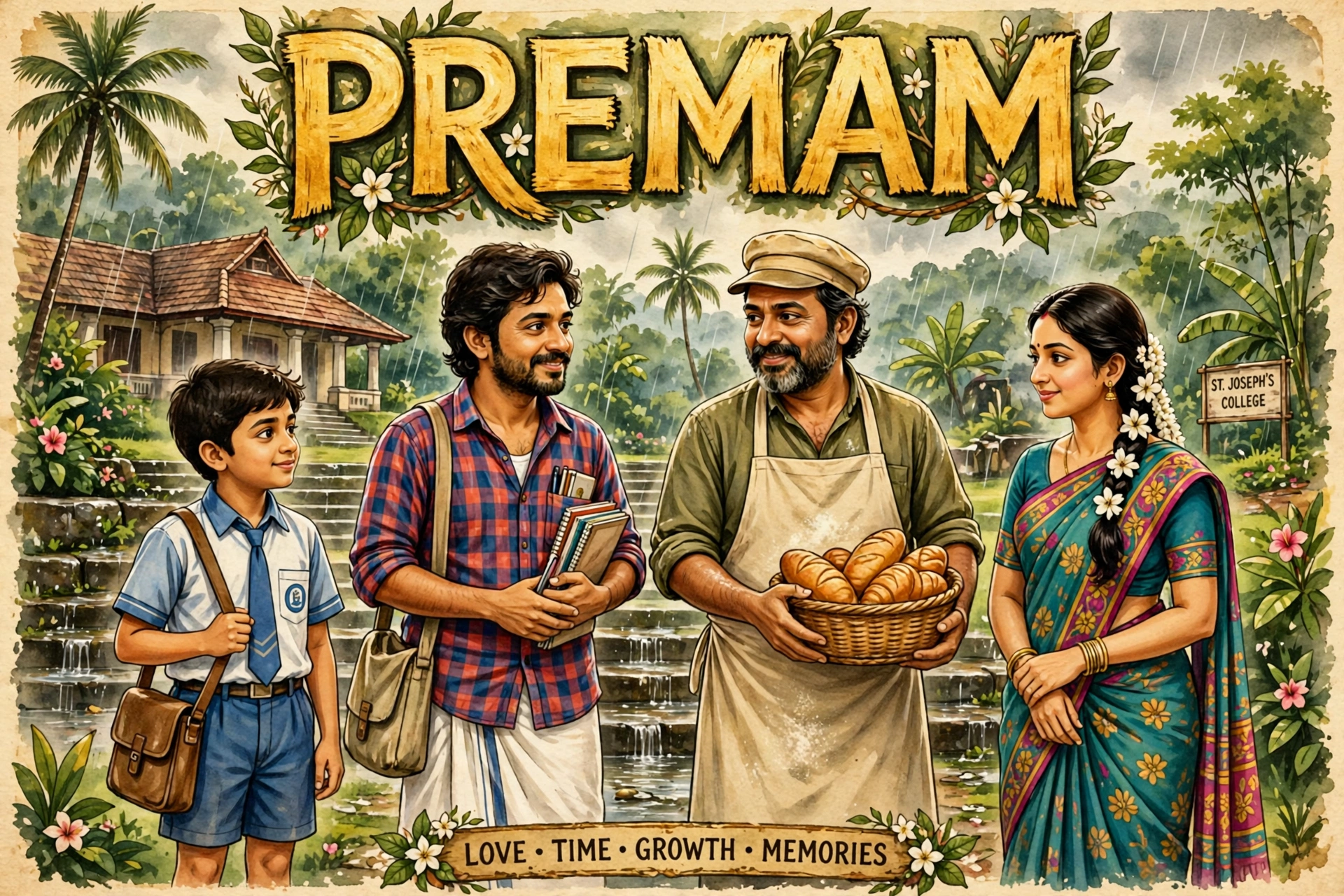
★★★★☆ Our Rating: 8.5/10
Some films succeed. A smaller number become a season in people’s lives. Any honest Premam review has to start there, because Alphonse Puthren’s 2015 Malayalam coming-of-age romance did not merely run in cinemas — it lived in college canteens, wedding playlists, hairstyles and phone ringtones for years afterwards. Released on 29 May 2015, made on a modest budget with a cast full of newcomers, it told the simplest possible story: a boy loves, loses, loves again, loses again, and grows up in between. Nothing about that summary sounds revolutionary, and yet almost nobody who was young in Kerala in 2015 remembers that summer without this film attached to it.
This review looks at the original Malayalam film — not the 2016 Telugu remake that borrowed its name and much of its plot. The original’s magic is specific: a specific town, a specific river, a specific looseness in the way scenes are allowed to breathe. It is also, judged coldly, an uneven film, with a third act that does not match the first two and a romanticisation of following girls around that has aged awkwardly. Both things are true, and a fair review should hold them together: Premam is a flawed film that is also, in stretches, close to perfect at what it attempts.
| Detail | Information |
| Release date | 29 May 2015 |
| Director | Alphonse Puthren |
| Writers | Alphonse Puthren |
| Genre | Romance, Comedy, Drama |
| Language | Malayalam |
| Runtime | 156 minutes |
| Budget | ₹4 crore |
| Lead cast | Nivin Pauly, Sai Pallavi, Madonna Sebastian, Anupama Parameswaran |
| Our rating | 8.5/10 |
George David (Nivin Pauly) grows up in Aluva, a riverside town in Kerala, and the film follows him in three distinct chapters of his life, each organised around a woman and each filmed in a noticeably different emotional register.
In the first chapter George is a sixteen-year-old school student, all nervous energy and borrowed confidence, hopelessly smitten with Mary (Anupama Parameswaran), the most admired girl in the neighbourhood. With his loyal friends Shambu (Shabareesh Varma) and Koya (Krishna Shankar) trailing behind him, he cycles after her, rehearses conversations he never manages to have, and lives in terror of her famously strict father. It is puppy love played for gentle comedy, and it ends the way most schoolboy certainties end — though the manner of its ending is one of the film’s sweetest small jokes, which we will not spoil.
The second chapter finds George at college, older, bearded and affecting a swagger he has not quite earned. Into his campus walks Malar (Sai Pallavi), a young lecturer from Tamil Nadu, and the film shifts key entirely. What develops between student and teacher is sketched in glances, dance rehearsals and long, unhurried conversations; it is the section of the film that audiences fell hardest for, and the section whose turn — involving an accident and a cruel twist of memory — still divides viewers between those who find it moving and those who find it contrived. We will say only that George’s luck in love does not improve.
The third chapter meets George near thirty, running a café with an old friend, his romantic history apparently behind him. Then Celine (Madonna Sebastian) re-enters his life — a face from the first chapter, now grown — carrying complications of her own, including an engagement that is making her miserable. Whether George finally gets the ending his younger selves kept missing is, of course, the question the film saves for its close.
Nivin Pauly as George carries the film across roughly fifteen years of a life, and his great achievement is that the three Georges feel like one person photographed at different ages rather than three performances. The schoolboy is all elbows and panic; the college student hides the same insecurity under facial hair and attitude; the café owner has finally learned to be quiet. Pauly was already popular before Premam, but this film fixed his screen image for a generation — the black shirt and beard from the college chapter became a genuine fashion wave among young men in Kerala.
Sai Pallavi as Malar is the film’s phenomenon. In her first major film role, appearing with minimal make-up and complete disregard for conventional glamour, she steals every scene she is in — not by force, but by ease. Malar teases, teaches, dances and gently outclasses everyone around her, and Pallavi plays her with a naturalism that made the character feel less written than discovered. Her dance sequence became instantly iconic, and the performance launched one of the most admired careers in modern South Indian cinema.
Anupama Parameswaran as Mary has the least screen time of the three leads and uses it perfectly: her Mary is less a character than an atmosphere, the whole aching weather of being sixteen, and the film wisely keeps her slightly out of reach. Madonna Sebastian as Celine has the hardest job — arriving in the final act, after the audience’s heart is already committed elsewhere — and she responds with warmth and a lightness that keeps the third chapter afloat even when its plotting creaks.
The supporting cast is a small army of future familiar faces. Shabareesh Varma as Shambu and Krishna Shankar as Koya form one of Malayalam cinema’s great friendship duos, funnier and more loyal than the hero often deserves. Vinay Forrt as Vimal Sir, the lecturer hopelessly pursuing Malar with terrible English and total sincerity, and Soubin Shahir as the physical-training teacher Shivan Sir, supply comedy that has been quoted ever since.
Alphonse Puthren wrote, directed and edited the film, and that triple control explains both its virtues and its indulgences. As a director he trusts ordinary moments to an unusual degree: a walk to a bus stop, a rehearsal, a shared snack can run long, because he understands that first love is mostly made of waiting and watching, not events. As an editor he is playful — freeze frames, sudden musical punctuation, comic sound effects borrowed from the language of cartoons — and in 2015 that restlessness felt like a new grammar for Malayalam romance. The same freedom occasionally lets scenes drift past their natural end, particularly in the final chapter, where the film seems reluctant to let its hero go.
Anend C. Chandran’s cinematography gives Aluva a golden, river-lit softness that matches George’s memory of these years; the film looks the way nostalgia feels, which is precisely the point. Production design is modest and lived-in — school uniforms, cramped homes, a real college campus — and the film’s famous low budget is visible only as authenticity. Nothing looks expensive, and nothing needs to.
If the craft has a weak joint, it is the screenplay’s handling of perspective. The women in George’s life are vividly performed but seen almost entirely through his longing; Malar, especially, is given just enough interior life to make us want more than the film provides. And the first chapter’s comedy of boys following a girl around town — played innocently, and received innocently in 2015 — sits less comfortably now, a reminder that the film is a period piece about its own moment as much as about George’s youth.
Rajesh Murugesan’s soundtrack is not decoration on this film; it is half the storytelling. The songs were released before the film and built its audience in advance, and several of them became generational anthems. “Malare,” sung by Vijay Yesudas, is the centrepiece — a melody of such unforced sweetness that it effectively became Malar’s introduction to the world, and it won Yesudas the Filmfare Award South for Best Male Playback Singer. “Aluva Puzhayude,” sung by Vineeth Sreenivasan, turns the town’s river into a character, while the rougher, friendlier numbers carried by Shabareesh Varma’s lyrics and voice give the boys’ world its texture.
Just as important is Murugesan’s background score, which shifts flavour with each chapter — playful plucks for school days, fuller romantic themes for the college section, a more settled warmth for the café years. The score knows when to underline a joke and, crucially, when to leave a silence alone. Few Malayalam albums of the decade are as complete, and Apple Music’s selection of it among 2015’s best Malayalam albums was no courtesy nod.
What we loved:
What could be better:
The figures for Premam need a caveat that applies to much Malayalam box-office reporting of its period: there was no single official tracker, and published totals vary. The production budget is consistently reported at about ₹4 crore. For collections, contemporary and reference sources place the worldwide gross in a broad range — some estimates settle near ₹60 crore, while Wikipedia and several later reports cite about ₹73 crore, and a few trade listings go higher still. Reports differ, and the honest summary is this: on a ₹4 crore budget the film returned many times its cost, became the highest-grossing Malayalam film of 2015, and set longevity records that mattered as much as money — a run of about 175 days in Kerala and more than 300 days in Tamil Nadu, extraordinary for a film in another state’s language. It collected major awards too, including seven wins at the South Indian International Movie Awards and a place in The Hindu’s list of the top 25 Malayalam films of the decade. Whatever the exact crore, Premam was a phenomenon, not merely a hit.
Yes — especially if you have ever been sixteen, or twenty, or convinced that one particular person was the whole point of a particular year. Premam understands that young love feels enormous from inside and slightly comic from outside, and it holds both views at once, which is a rarer skill than it sounds. Go in knowing the final chapter cannot match what precedes it, and that the film’s heart belongs to its middle. What precedes it, and that middle, are enough to justify its reputation many times over.
Our rating: 8.5/10 — an imperfect romance that a generation remembers as perfect, because the parts that matter most genuinely are.
Is Premam based on a true story?
No. It is an original screenplay by Alphonse Puthren, though its school and college episodes draw on the texture of ordinary Kerala student life, which is why so many viewers feel it mirrors their own youth.
Who plays Malar in Premam, and was it her debut?
Sai Pallavi plays Malar. It was her first major film role, and it made her an overnight star; she won the Filmfare Award South for Best Female Debut for the performance.
Is the Telugu Premam the same film?
The 2016 Telugu film of the same name is a remake of this Malayalam original, following the same three-chapter story. Most admirers consider the 2015 original the definitive version.
How long is Premam, and in which language was it made?
The film runs 156 minutes and was made in Malayalam. Subtitled versions are widely available, and its appeal has travelled far beyond Malayalam-speaking audiences.
Where can I watch Premam (2015)?
The film streams on major platforms in many regions with subtitles. Availability changes over time, so check your local services.