★ LATEST REVIEWS

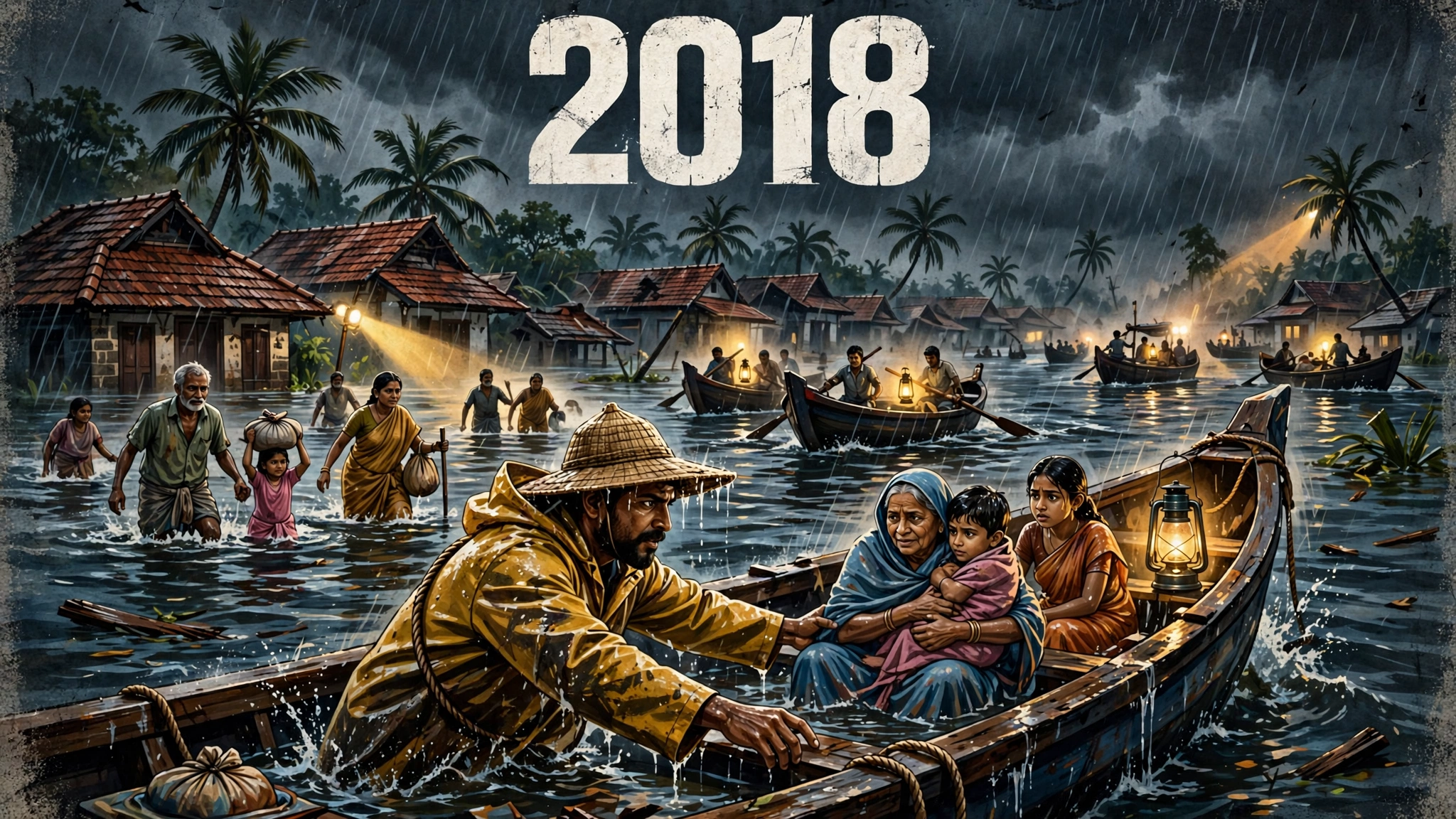
Our Rating: ★★★★☆ 8.5/10
In August 2018, Kerala lived through the worst flooding in nearly a century. Rain fell for days, rivers burst their banks, hillsides slid, and whole towns went under water. More than 400 people died, and over a million were displaced. Yet the story the world remembers is not only one of disaster — it is one of rescue: fishermen who drove their boats inland, strangers who opened their homes, young men and women who formed human chains in chest-deep water. Jude Anthany Joseph’s 2018: Everyone Is a Hero is the film of that fortnight, and it is a rare disaster movie that earns its emotion honestly, because the heroism it celebrates actually happened.
Released on 5 May 2023, the film became the highest-grossing Malayalam film of its time and India’s official submission to the 96th Academy Awards. It has no single star hero, no songs interrupting the tension, and no villain except the water itself. What it has is scale, sincerity and a cast of familiar Malayalam faces playing ordinary people — a taxi driver, a fisherman, a television reporter, a former soldier, a young couple, a policeman — whose small decisions add up to something enormous. It is occasionally melodramatic and its sprawling cast means some characters get less room than they deserve, but as a communal epic it is genuinely moving.
| Detail | Information |
|---|---|
| Release date | 5 May 2023 (India) |
| Director | Jude Anthany Joseph |
| Writer | Akhil P. Dharmajan |
| Genre | Disaster Drama |
| Language | Malayalam |
| Runtime | 150 minutes |
| Budget | ₹26 crore (director’s figure; some trackers list ₹20–24 crore) |
| Lead cast | Tovino Thomas, Kunchacko Boban, Asif Ali, Vineeth Sreenivasan, Aparna Balamurali, Lal, Kalaiyarasan |
| Our rating | 8.5/10 |
The film opens in the days before the deluge, introducing its people in the ordinary rhythms of Kerala life. Anoop, played by Tovino Thomas, is a young man who has left the army under a cloud and is trying to rebuild his life; Sethupathi, played by Kunchacko Boban, is a taxi driver with a family to support; Nixon, played by Asif Ali, is a young man dreaming of a life abroad; and a fisherman named Mathachan, played by Kalaiyarasan, watches the sea with the wariness of a man who knows water. There are reporters, policemen, a couple on the edge of marriage, and families who have lived beside the same river for generations.
Then the rain comes, and does not stop. Joseph stages the disaster in waves: first the jokes about heavy rain, then the worry, then the water in the streets, then the water in the houses, then the roofs. This review will not reveal the fate of any individual character, but the film’s structure is its strength — it cuts between its many threads so that the audience feels the flood as a shared experience, not as one hero’s adventure. The rescue sequences, many shot in real water with large crowds, are genuinely thrilling, and the film’s most powerful moments are quiet ones: a stranger’s hand in the dark, a boat arriving where no boat should be, a family refusing to leave a home that is already drowning.
The title’s claim — everyone is a hero — is the film’s thesis, and it is argued through accumulation rather than speeches. No one character saves the day. The day is saved, inch by inch, by hundreds of people doing the next right thing.
Tovino Thomas as Anoop — Tovino, fresh off Minnal Murali, plays a very different kind of hero here: a flawed, guilt-ridden young man rather than a superhero. His arc — from a man running from his past to a man running towards danger for others — is the film’s emotional spine, and he plays it with restraint, letting the character’s shame and courage show in small gestures rather than big speeches. It is one of his most mature performances.
Kunchacko Boban as Sethupathi — Boban brings warmth and decency to the taxi driver whose ordinary life becomes extraordinary. He is the film’s everyman anchor: a husband, a father, a worker, and the kind of man who helps because helping is what you do. His scenes with his family give the disaster its domestic stakes.
Asif Ali, Vineeth Sreenivasan, Aparna Balamurali and Lal — Asif Ali plays Nixon, whose dreams of emigration collide with the flood in ways that are both comic and poignant; Vineeth Sreenivasan is effective as a television journalist trying to report a story that is swallowing his own town; Aparna Balamurali brings energy and feeling to her role; and Lal, as a senior figure, lends gravitas. Kalaiyarasan, as the fisherman Mathachan, is a quiet standout — his community, the fishermen who became Kerala’s most celebrated rescuers in real life, are given the dignity and screen time they deserve.
The size of the cast is both a strength and a weakness. On the one hand, the film genuinely feels like a society, not a cast list. On the other, some characters — particularly in the romantic subplots — are sketched rather than developed, and a few emotional beats rely on the audience’s knowledge of the real events rather than on the film’s own writing. But the ensemble’s sincerity carries it through: nobody here is phoning in a disaster-movie performance.
Jude Anthany Joseph, who lived through the floods himself, directs with a documentarian’s eye for detail and a populist’s sense of spectacle. The film’s greatest technical achievement is its water: rather than relying entirely on digital effects, Joseph shot many sequences in real water with real crowds, and the result is viscerally convincing. The audience feels the cold, the current and the weight of the rain. The cinematography captures both the beauty of Kerala — green, lush, rain-washed — and its transformation into a drowned landscape, and the editing manages a huge cast and multiple locations without losing momentum for long stretches.
The film’s sound design deserves special mention: the rain is a constant presence, rising from patter to roar, and the score by Nobin Paul underlines the emotion without drowning it. Joseph’s staging of the rescue set pieces — boats threading through flooded streets, helicopters over rooftops, human chains in the current — is confident and clear, and the film’s scale is remarkable for its budget. If there is a craft criticism, it is that the film occasionally tips into the melodramatic register of mainstream Malayalam cinema — swelling music over a slow-motion rescue, a speech that states what the images have already shown — but given the subject, most audiences will forgive it.
Nobin Paul’s music is deliberately restrained for a film of this scale. There are no big song-and-dance interruptions, which is exactly right: this is not a film that should stop for a romantic number while the water rises. Instead, the score works as emotional weather, swelling in the rescue sequences and receding in the intimate scenes. A few songs appear in the early, pre-flood portions of the film, establishing the characters’ normal lives, and their lightness makes the coming darkness hit harder. The background score’s restraint is one of the film’s most mature choices, and it trusts the audience to feel without being instructed.
What we loved:
What could be better:
2018 was a genuine box-office phenomenon, and its numbers tell a story almost as dramatic as the film’s. The budget is a matter of some dispute, which is why our Quick Facts carries a note: director Jude Anthany Joseph himself has stated in interviews that the film cost ₹26 crore, including the salaries of 129 actors and the enormous costs of shooting in water, while some databases list lower figures of ₹20–24 crore. We have used the director’s own figure as the primary one, since it comes from the filmmaker, while noting the lower tracker figures.
On earnings, the trajectory is clearer. The film opened strongly on 5 May 2023, crossed ₹100 crore within weeks, and went on to become the highest-grossing Malayalam film ever at that point. Trade reports put its early total at around ₹117 crore in the first month, while the director later stated that the film had earned more than ₹200 crore overall, with over ₹175 crore from theatres alone — a figure consistent with its record-breaking run and its status as the industry’s biggest hit. The dubbed Tamil, Kannada and Hindi versions arrived late, which the director has said cost the film some additional business, but the Malayalam original’s success was already historic. It was also selected as India’s official submission for Best International Feature at the 96th Academy Awards, though it did not make the final shortlist — an honour that, for a disaster film with no major stars in the conventional sense, says much about its impact.
Yes — and watch it with the knowledge that the heroism on screen is not invented. 2018 is a disaster film with a soul, a communal epic that honours the people it depicts without turning them into saints. It is long, it is emotional, and at times it is harrowing, but it is also one of the most rewarding Malayalam films of recent years. For viewers outside Kerala, it is an introduction to a cinema that can mount a disaster epic with sincerity and scale; for viewers inside Kerala, it is a memorial and a thank-you.
Our rating: 8.5/10 — A flood epic of rare sincerity: ordinary people, real water, real heroism.
Is 2018 based on a true story?
Yes. It is based on the devastating Kerala floods of August 2018, and many of its episodes — especially the fishermen’s rescue missions — are drawn from real events, though the individual characters are fictionalised composites.
Was 2018 really India’s Oscar submission?
Yes. It was selected as India’s official submission for Best International Feature Film at the 96th Academy Awards (for 2023 films). It did not advance to the final shortlist of nominees.
How long is 2018?
It runs 150 minutes, about two and a half hours, and is in Malayalam with subtitles available on streaming platforms.
Where can I watch 2018?
It is available on SonyLIV and other streaming platforms in many regions, though availability varies by country, so check your local services.
Is 2018 suitable for children?
The film contains intense flood and rescue sequences and scenes of distress that may upset younger viewers. It is best suited to older children and adults, ideally watched with family discussion afterwards.