★ LATEST REVIEWS

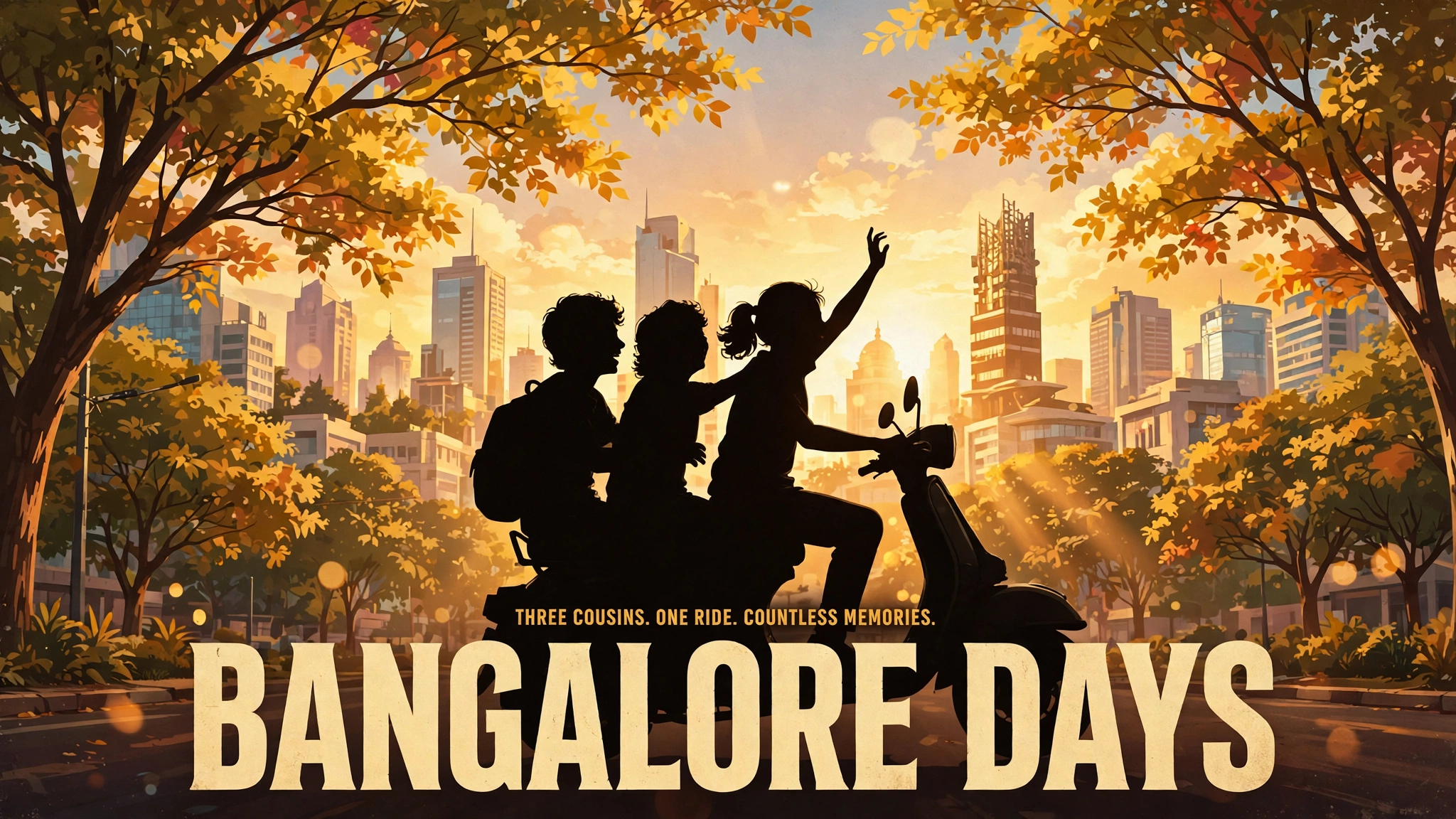
★★★★☆ Our Rating: 8.5/10
There are films you admire, and films you move into. Bangalore Days, released on 30 May 2014, is firmly the second kind. Written and directed by Anjali Menon, this Malayalam coming-of-age drama assembled the young cast that would define a generation of Kerala cinema — Dulquer Salmaan, Nivin Pauly, Nazriya Nazim, Fahadh Faasil and Parvathy Thiruvothu — and sent their characters to Bangalore with suitcases full of childhood promises. What happened next in real life mirrored the film: it became one of the biggest Malayalam hits of its time, ran for months, crossed language barriers with subtitled prints, and settled permanently into the affections of everyone who was young, homesick or in love in 2014.
Its premise could hardly be simpler. Three cousins who grew up swearing they would live together one day get their wish, in a city none of them fully understands, at exactly the age when childhood wishes stop being protection. Around that premise Menon builds a film about marriage, divorce, grief, disability, ambition and the strange second childhood of moving to a big city — and somehow keeps it light on its feet for most of its considerable length.
Honesty matters here too. At 171 minutes the film is long, its final act reaches for more resolutions than it needs, and one or two subplots resolve with a tidiness the messier middle had promised to avoid. But its warmth is not a trick. It is built scene by scene, performance by performance, and a decade of rewatching has not worn it out.
| Detail | Information |
|---|---|
| Release date | 30 May 2014 |
| Director | Anjali Menon |
| Writers | Anjali Menon |
| Genre | Romance, Comedy, Drama, Coming-of-Age |
| Language | Malayalam |
| Runtime | 171 minutes |
| Budget | ₹8 crore |
| Lead cast | Dulquer Salmaan, Nivin Pauly, Nazriya Nazim, Fahadh Faasil, Parvathy Thiruvothu, Isha Talwar |
| Our rating | 8.5/10 |
Divya (Nazriya Nazim), Krishnan, known to everyone as Kuttan (Nivin Pauly), and Arjun, known as Aju (Dulquer Salmaan), are cousins raised in Kerala in the kind of extended-family warmth where summers blur into one long memory. As children they promise that adult life will not separate them. Adult life, predictably, has other ideas, until Bangalore gathers them back into one flat and one shared adventure.
Divya arrives through marriage. A bright graduate whose own ambitions were politely set aside, she has wed Das (Fahadh Faasil), a polished corporate professional who seems, to her alarm, like a stranger wearing a husband’s name: distant, orderly and emotionally unreachable. Kuttan arrives through work, a software engineer who dreams, unfashionably, of the simple village life his colleagues are escaping, and who falls for Meenakshi (Isha Talwar), an air hostess whose modern life both thrills and unsettles him. Aju arrives by choice. A bike mechanic and motocross enthusiast with a fractured family behind him, he is the group’s free spirit, and his story turns when he hears a voice on the radio: Sarah (Parvathy Thiruvothu), a radio jockey who uses a wheelchair and possesses more clarity about life than anyone else in the film.
How these three stories unfold, what Das is carrying behind his silence, and whether the cousins’ city idyll can survive growing up, the film takes its time revealing. Nothing in it depends on a twist, and everything depends on whether you have come to care about these people. Most viewers, very quickly, have.
Dulquer Salmaan as Aju: Salmaan plays the cousin everyone wishes they had: funny, disreputable, loyal to the bone and quietly bruised. His easy physical comedy hides the film’s most affecting arc, a young man learning that the freedom he boasts about has also been his hiding place. His scenes with Parvathy Thiruvothu are the film’s romantic peak, played with a directness that never once turns Sarah’s wheelchair into a lesson.
Nivin Pauly as Kuttan: Pauly takes the least glamorous cousin and makes him the film’s comic engine and, unexpectedly, its moral centre. Kuttan is conservative, homesick and terrified of the city, and Pauly finds the sweetness inside his fussiness. He won the Kerala State Film Award for Best Actor for this performance, shared honours for a year that announced him as a star who could also act, and the narration, delivered in his voice, gives the film’s storytelling warmth.
Nazriya Nazim as Divya: Nazim, still a teenager during filming, carries the film’s most difficult material: a young bride discovering, week by week, that her marriage may be an arrangement between two families rather than a life with a person. She plays Divya’s brightness dimming and then, admirably, reasserting itself on new terms, and she won the Kerala State Film Award for Best Actress for it. Her chemistry with the cousins is the film’s bedrock.
Fahadh Faasil as Das does the hardest, quietest work in the film, playing a man whose coldness has a history the film reveals late. Faasil underplays beautifully, so that small changes in Das register like weather shifts. Parvathy Thiruvothu as Sarah is superb: brisk, funny, unsentimental, a character written and played as a person first. Isha Talwar as Meenakshi, Parvathy’s and Dulquer’s supporting players, and a warm bench of parents, colleagues and friends, including a delightful cameo energy from Nithya Menen in the film’s framing memories, complete a cast with no wasted place.
Anjali Menon’s direction is the film’s real star. She had already written Ustad Hotel and directed the admired Manjadikuru, and here she manages a multi-strand, star-filled film without letting any strand starve. Her great gift is transitions: the film moves between Kerala and Bangalore, past and present, comedy and grief, on cuts that feel like memory rather than structure. She also writes the best kind of film dialogue, lines that sound overheard rather than composed, and she directs her young cast toward naturalism at a moment when Malayalam mainstream acting could still tip into declamation.
Sameer Thahir’s cinematography gives the two worlds distinct light: Kerala in soft, green, familial tones, Bangalore brighter, wider and full of glass, traffic and possibility. The city is romanticised, openly, but it is the romanticism of twenty-somethings seeing it for the first time, which is the characters’ view rather than a tourist board’s. Editor Praveen Prabhakar keeps a long film moving, though even his skill cannot fully disguise that the last half hour resolves three films’ worth of endings.
The length deserves a frank word. At 171 minutes, Bangalore Days asks a lot, and a leaner cut, particularly in the Kuttan romance and some repeated beats of Divya’s marital sadness, would have sharpened it. Yet the looseness is also the pleasure: this is a film designed to be lived in, and its fans would not surrender the extra scenes for anything.
Gopi Sunder’s soundtrack was a phenomenon in its own right and remains one of the most loved Malayalam albums of the 2010s. “Ente Kannil Ninakkai,” sung by Nazriya Nazim herself with Sunder, became Divya’s signature and a wedding-season standard. “Thumbi Penne,” sung by Siddharth Menon, carries the cousins’ high spirits, while “Aethu Kari Raavilum,” sung by Haricharan, supplies the album’s romantic ache. “Namma Ooru Bengaluru” is the film’s love letter to its city, noisy and affectionate, and the wedding number “Maangalyam” launches the film with pure festivity, chorus and all.
Sunder’s background score matches the film’s emotional mobility, shifting from guitar-led lightness for the flat-sharing comedy to fuller, more wistful themes as the stories deepen. A word of balance: the score occasionally leans on its most popular melodies once too often, and the songs, delightful as they are, contribute to the runtime. But few viewers in 2014 experienced that as a flaw, and the album’s endurance, still streamed and sung a decade later, suggests the film’s instincts were right. Anjali Menon won the Kerala State Film Award for Best Screenplay, and the music is part of how that screenplay breathes.
What we loved:
What could be better:
The numbers, as reported at the time and in later reference summaries, tell a clear story even allowing for the era’s informal tracking. Bangalore Days was made on a budget most commonly reported at about ₹8 crore, with some contemporary coverage putting it nearer ₹8.5 crore. It released in about 205 theatres across India on 30 May 2014, then described as the biggest release a Malayalam film had received, and its worldwide gross is generally estimated at around ₹45 crore, with some reports going toward ₹50 crore. Treat the higher figures as trade estimates, as no single official tracker existed.
What is not in dispute is the shape of the success. It became one of the highest-grossing Malayalam films up to that point, ran for 100 days in Kerala and Chennai, played for two months in Hyderabad, and, crucially, expanded the market for subtitled Malayalam cinema outside Kerala. It was remade in Tamil as Bangalore Naatkal in 2016, and its success helped convince producers across South India that a young, urban, ensemble Malayalam film could be a national event.
Yes, and clear an evening for it. Bangalore Days is the definitive feel-good Malayalam film of its generation: long, sunny, beautifully acted and smarter about love and family than its poster promises. Come for the cousins, stay for Sarah and Das, and forgive the final act its extra endings, because by then the film has earned your indulgence many times over.
Our rating: 8.5/10 — A warm, funny and enduring coming-of-age classic that made a generation feel seen.
Is Bangalore Days based on a true story?
No. It is an original screenplay by Anjali Menon, though its portrait of young Malayalis building a life in Bangalore draws on a very real migration shared by thousands of Kerala families.
Did Bangalore Days win any major awards?
Yes. It won three Kerala State Film Awards: Best Actor for Nivin Pauly, Best Actress for Nazriya Nazim and Best Screenplay for Anjali Menon, alongside many popular awards for its cast and music.
How long is Bangalore Days and in which language was it made?
The film runs 171 minutes and was made in Malayalam. Subtitled prints were a major part of its release outside Kerala and helped it find a pan-Indian audience.
Was Bangalore Days remade?
Yes. It was remade in Tamil as Bangalore Naatkal in 2016, directed by Bhaskar. The 2014 Malayalam original remains the widely loved version.
Where can I watch Bangalore Days?
It streams on major platforms in many regions, including JioHotstar. Availability varies, so check licensed services in your country and use legal sources only.