★ LATEST REVIEWS

★★★★★ Our Rating: 9.5/10
Most love stories are about people trying to keep something. Portrait of a Lady on Fire is about two people who know from very early on that they cannot keep it — and who decide, with open eyes, what they will do instead of keeping it: they will remember it properly. That single decision gives Céline Sciamma’s film its extraordinary emotional shape. It is one of the most acclaimed films of the last decade, and for once the acclaim feels too small for the object it describes.
This Portrait of a Lady on Fire review comes with a promise and a warning. The promise: we will not spoil the film’s final scenes, which include some of the most celebrated closing images in modern cinema. The warning: this is a quiet film. There is no villain twirling anything, no dramatic rescue, almost no music until the music matters more than anything in the world. Its drama is built from looking and being looked at, from a hand, a page number, a dress catching light. If that sounds like too little, trust that hundreds of festival audiences who sat in stunned silence as the credits rolled would tell you it is, somehow, everything.
Premiering at Cannes in May 2019, the film won the Queer Palm — the first film directed by a woman to do so — and Best Screenplay for Sciamma. It went on to be named among the best films of its year by critics all over the world, and its reputation has only grown since. What follows looks at its story, its two central performances, its remarkable craft and music, and its box office, all without dismantling its ending.
| Detail | Information |
|---|---|
| Release date | 19 May 2019 (Cannes premiere); 18 September 2019 (France) |
| Director | Céline Sciamma |
| Writers | Céline Sciamma |
| Genre | Romance, Drama, Period Drama |
| Language | French, Italian |
| Runtime | 120 minutes |
| Budget | €4.8 million |
| Lead cast | Noémie Merlant, Adèle Haenel, Luàna Bajrami, Valeria Golino |
| Our rating | 9.5/10 |
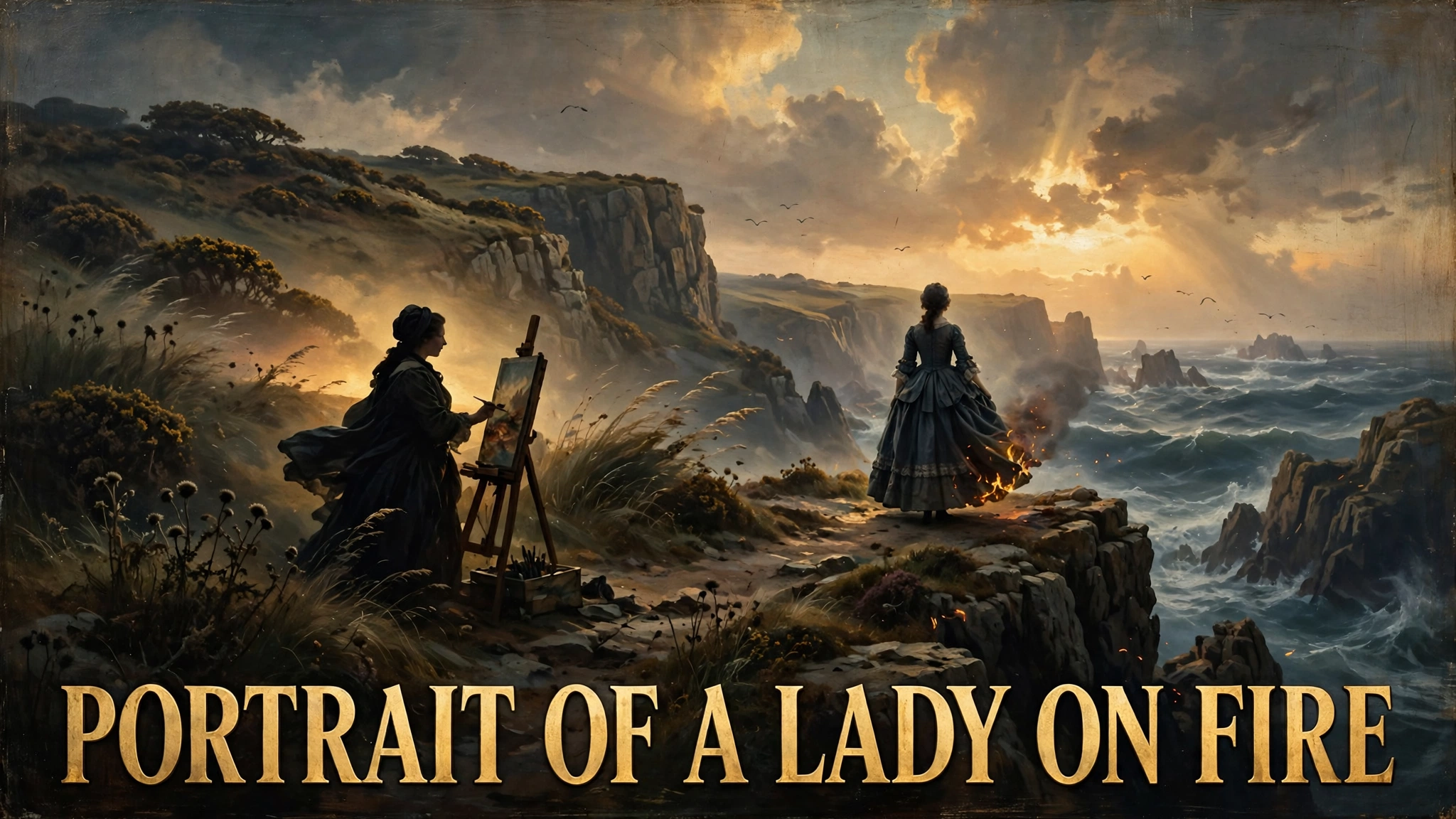
Brittany, 1770. Marianne, a painter trained by her father, is brought by boat to a stark house on a windswept island to complete a delicate commission. A countess wants a portrait of her daughter Héloïse, who has recently left a convent after the death of her sister. The portrait has a purpose Héloïse despises: it will be sent to a nobleman in Milan, and if he approves of what he sees, she will be married to him. A previous painter was dismissed because Héloïse refused to sit for him at all — she will not pose for the image that sells her.
So Marianne is given a cover story. She is presented to Héloïse as a hired companion for walks, and she must study her subject during the day — the shape of her face, her hands, the way she holds herself against the wind — and paint in secret at night, from memory. It is an impossible working method and an ethically queasy one, and the film knows it: Marianne is, in effect, spying on a woman in the name of art and of another man’s marriage market.
What neither woman’s situation has accounted for is time together. Walking the cliffs, talking about music and myth and freedom, the painter and her subject begin to see each other — really see each other, in a century and a household that gives women very few chances to be seen as they are. The countess’s absence on a trip grants them a handful of days in a house shared mainly with Sophie, the young maid, and in that suspended time the professional deception curdles into something Marianne must confess, and something neither woman can undo.
We will stop there. The film’s second half, the work of art that gives it its title, and its closing movements are things to discover in sequence and in silence. What can be said safely is that the story is structured as a memory — Marianne telling it, years later, to her own students — and that this framing is not decoration. Remembering, accurately and completely, is the film’s whole philosophy of love.
Noémie Merlant as Marianne carries the film’s point of view, and her performance is a study in disciplined attention. Marianne is a professional in a man’s world, holding her status by competence and self-control, and Merlant plays her intelligence first — you watch her think, measure, memorise. When feeling breaches that discipline it does so in increments, a softened glance held half a second too long, and because the performance has been so composed, those increments land like confessions. She must also convincingly be an artist, and she is: her handling of brush and charcoal, and the authority with which she discusses her craft, never wavers.
Adèle Haenel as Héloïse gives a performance of withheld fire that the title quietly describes. Héloïse begins as an outline — a hood, a turned back, short answers — because that is all Marianne is allowed to have, and Haenel lets us feel a full person pressing against those limits. As trust grows she reveals wit, anger, an unexpected laugh, and a clear-eyed understanding of exactly what her life is to be used for. Her great subject is the unfairness of being looked at without being known, and her scenes of turning the tables — of looking back, and demanding to be painted truthfully — give the film its spine. Both leads were nominated for major awards for this work; together they create what may be the defining screen partnership of their generation of French cinema.
Luàna Bajrami as Sophie, the young servant, is far more than support. Sophie’s own storyline — handled with a frankness that still startles — widens the film from a romance into a portrait of women’s solidarity across class, and Bajrami plays her with a directness that beautifully offsets the leads’ containment. Some of the film’s warmest images belong to the three women together, and they depend on her. Valeria Golino as the Countess appears briefly but decisively: she is not a monster, only a mother operating the only system she knows, and Golino’s worldly regret makes the film’s critique sadder and fairer than a villain could have.
Sciamma directs like a painter, which critics have said so often it risks sounding like a slogan — until you watch the film and see how literally true it is. Working with cinematographer Claire Mathon, she shot on digital in high resolution specifically to get skin, fabric and candlelight to behave the way they do in eighteenth-century painting: luminous, tactile, unhurried. Nearly every frame of this film could be hung. The compositions use doorways, mirrors, bonfires and the hard horizontal of the sea to talk about freedom and enclosure without a word of dialogue doing the work.
The most radical craft decision is the near-total absence of a conventional score, discussed below, but the second most radical is the editing rhythm. Sciamma and editor Julien Lacheray let glances run their full natural length. The film’s suspense — and it is genuinely suspenseful — comes from tiny questions of craft and conduct: has she noticed being watched? Will the portrait be truthful or merely pleasing? What will happen when the deception is confessed? A lesser film would inflate these into melodrama. This one trusts you to understand that, inside these women’s lives, nothing could be larger.
If there is a fair criticism, it is that the film’s perfection of surface can, for some viewers, create a slight chill of the museum — everything is so composed that one or two early passages feel more admired than felt. Most audiences find the emotion floods in well before the midpoint, and the closing stretch is famous precisely for how completely the composure breaks. But viewers who need plot incident every few minutes should be warned honestly: this film’s incidents are a page turned, a number memorised, a piece of music finally heard.
For most of its two hours, Portrait of a Lady on Fire has no score at all — a decision Sciamma made so that the audience would live inside the same soundscape as the women: wind, sea, fire, footsteps, the scratch of charcoal, dresses on stone floors. Music therefore exists in the film only as something its characters make or hear, and the film rations it to two great events. The first is a nighttime festival scene in which women sing an a cappella piece built from a Latin phrase, composed for the film by Para One and Arthur Simonini, who are credited with the music. Rising around a bonfire, overlapping, rhythmic, almost pagan, it is one of the most electric sequences in recent cinema — and it is where the title finds its image.
The second is Vivaldi. Héloïse, who has been kept from music, describes longing to hear an orchestra, and Marianne plays her a storm movement from The Four Seasons on a harpsichord, describing the music as she plays. The full orchestral version is saved for the end of the film, in a context we will not describe, where it detonates with a force that no amount of conventional underscoring could have earned. This is the lesson of the film’s sound design: silence is not the absence of music. It is music’s price being raised, scene by scene, until a single piece can carry a whole love story on its back.
What we loved:
What could be better:
The production figures are solid and consistent across the main trackers. The film was made for about €4.8 million — a modest sum for a period production with this level of craft — and its worldwide theatrical total is most commonly reported at around $11.8 million, with some databases listing somewhat lower figures depending on how later releases and reissues are counted. By the standards of a subtitled, slow-burning period romance with no stars then known to mainstream international audiences, that is a clear success, and its life since cinemas — in streaming, teaching and repertory screenings — has been far larger than the initial gross suggests.
The commercial story is inseparable from the critical one. Alongside the Cannes Queer Palm and Best Screenplay prize, the film won Best Cinematography honours in several critics’ polls, was chosen as France’s submission campaign centrepiece of its year (France ultimately submitted another title for the Oscars, a decision debated ever since), and placed near the top of countless decade-best lists. It made Merlant and Mathon internationally sought-after and confirmed Sciamma, already admired for Water Lilies, Tomboy and Girlhood, as one of the defining European directors of her era. Few €4.8 million films are still gaining new devoted audiences years later; this one demonstrably is.
Yes — and watch it the way it asks to be watched: in one sitting, in the dark, without a phone, letting its quiet accumulate. Portrait of a Lady on Fire is a romance, a ghost story without ghosts, and the finest film ever made about the ethics and ecstasy of looking at another person. If you love painting, music, Brittany weather or love stories that treat their audience as adults, it is essential. If you need speed and plot machinery, approach it on a patient evening — many sceptics have been converted by its final fifteen minutes alone.
Our rating: 9.5/10 — a luminous, perfectly controlled masterpiece that earns every one of its silences, and then breaks your heart with a piece of music.
What is Portrait of a Lady on Fire about, in one sentence?
In 1770s Brittany, a woman painter must secretly paint the wedding portrait of a young aristocrat who refuses to sit for it, and the two women fall in love during the days the portrait takes.
Did Portrait of a Lady on Fire win prizes at Cannes?
Yes. At the 2019 Cannes Film Festival it won the Queer Palm — the first film directed by a woman to win it — and Céline Sciamma won Best Screenplay.
Why is there so little music in Portrait of a Lady on Fire?
Céline Sciamma deliberately withheld a conventional score so that music would exist only inside the story. That makes its two great musical events — the women’s bonfire chorus and the Vivaldi — overwhelming when they finally arrive.
What does page 28 mean in Portrait of a Lady on Fire?
It is a small, private detail between the two main characters connected to a book and a sketch. Explaining more would spoil one of the film’s most beloved touches, so we recommend discovering it in the film itself.
Is Portrait of a Lady on Fire a sad film?
It is a film about a love with an expiry date known in advance, so it is deeply moving — but its philosophy is remembrance rather than despair. Most viewers describe the ending as overwhelming and uplifting at once.