★ LATEST REVIEWS

★★★★★ Our Rating: 9.5/10
There is a joke that runs through La Haine like a fuse. A man falls from a tall building and, as he passes each floor, he reassures himself: so far, so good; so far, so good. The point, as one character explains, is not the fall itself. It is the landing. Mathieu Kassovitz built an entire film around that idea, and nearly thirty years after it premiered at Cannes, the landing still has not stopped feeling inevitable — or avoidable, which is what makes it so painful to watch.
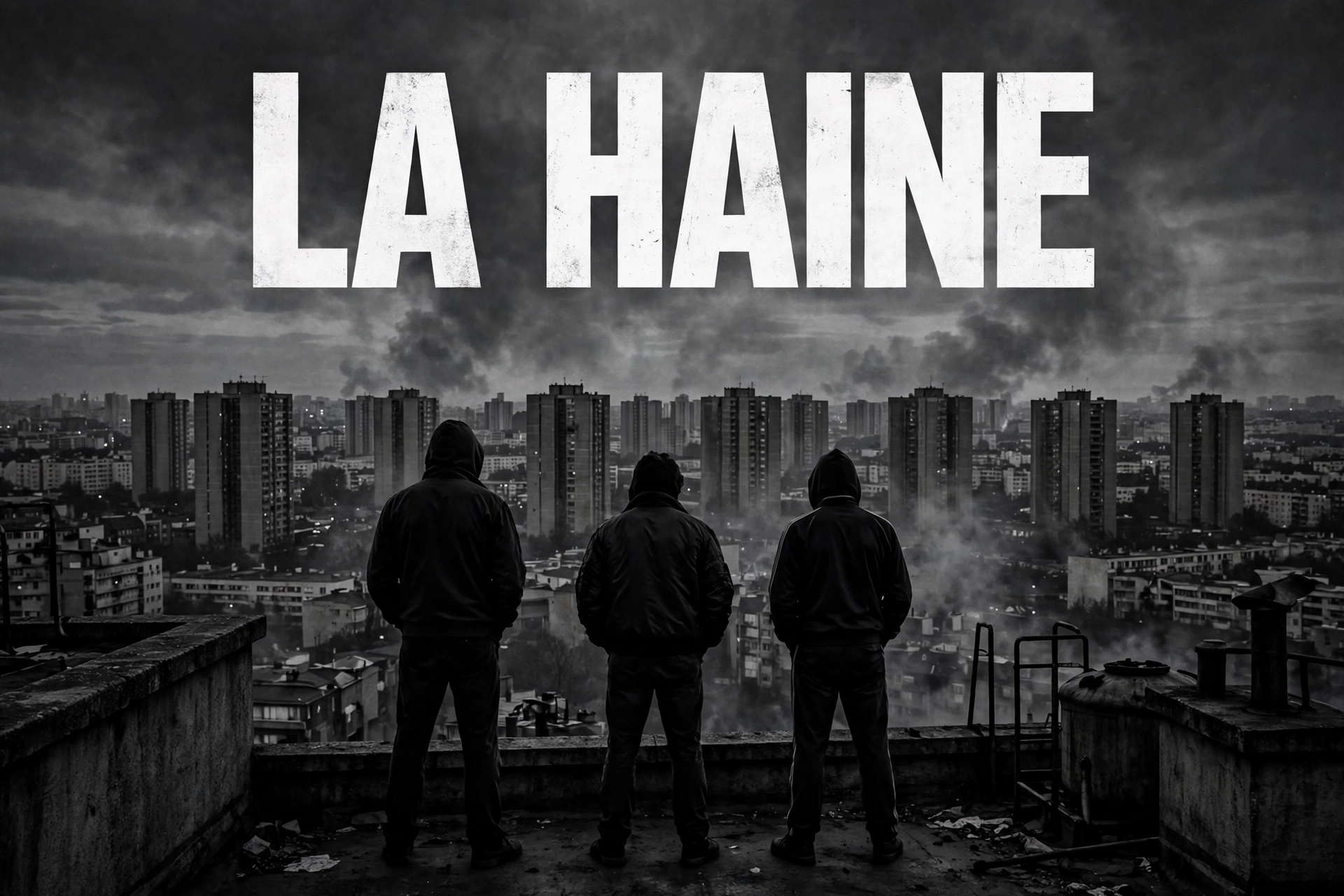
This La Haine review is about a film that should not still feel this current. Shot in stark black and white in the housing estates outside Paris, following three young friends through roughly twenty-four hours after a riot, it arrived in 1995 as a furious dispatch from a France that polite cinema preferred not to look at. Kassovitz, who was in his late twenties at the time, won Best Director at Cannes for it, and the film took the César for Best Film the following year. Those prizes matter less than this: it changed what French cinema could look like and who it was allowed to be about.
We are keeping this review spoiler-free about its final minutes, even though the ending is famous. The film earns its power through accumulation rather than surprise, and a first viewing deserves to arrive at that last stretch the way the characters do — tired, wrung out, and unsure whether anything has really changed. What follows is an account of the story, three career-making performances, the craft, the music, and the money, without giving away how the fall ends.
| Detail | Information |
|---|---|
| Release date | 27 May 1995 (Cannes premiere); 31 May 1995 (France) |
| Director | Mathieu Kassovitz |
| Writers | Mathieu Kassovitz |
| Genre | Drama, Social Thriller |
| Language | French |
| Runtime | 98 minutes |
| Budget | €2.6 million |
| Lead cast | Vincent Cassel, Hubert Koundé, Saïd Taghmaoui |
| Our rating | 9.5/10 |
The night before the film begins, there was a riot in the estate where Vinz, Hubert and Saïd live. Their friend Abdel, a young man from the neighbourhood, was arrested and beaten so badly in police custody that he now lies in hospital in a coma. During the chaos, a police officer lost a handgun — a .44 Magnum — somewhere in the estate. Vinz, the most volatile of the three, has found it.
Vinz is Jewish, restless and obsessed with the idea of respect. He talks constantly about what he will do if Abdel dies, and he rehearses tough-guy lines in the bathroom mirror in a scene that openly nods to Taxi Driver — except that Vinz, for all his posturing, is a kid from the estates performing a film he has seen, not a man with a plan. Hubert, whose family came from Benin, is the moral centre of the group. He is a small-time dealer who wants out — his boxing gym, the one constructive thing he had built, was burned down in the riot — and he keeps repeating the line that gives the film its title: hatred breeds hatred. Saïd, of North African descent, is the joker and the go-between, loud, funny and forever trying to lower a temperature he also cannot resist raising.
The film follows the three as they drift. There is very little plot in the conventional sense, and that is deliberate. A ticking on-screen clock marks the hours as they hang around rooftops and stairwells, argue about nothing and everything, travel into central Paris to collect a debt and visit an art gallery, miss the last train home, and encounter a series of policemen, skinheads, strangers and storytellers. Kassovitz was partly inspired by real cases of young men dying in police custody in France in the early 1990s, and the film never lets you forget the news playing in the background of these lives — the hospital updates, the television reports, the sense that Abdel’s fate is being decided somewhere else by people who will never know his name.
What we will not describe is the final sequence. Know only that everything the film has shown you — the gun, the exhaustion, the jokes, the humiliations, the small kindnesses — is present in it, and that the famous refrain about the falling man returns with a weight it did not have at the start.
Vincent Cassel as Vinz gives the performance that made him a star, and it remains startling. Vinz is not written as a monster or a victim; he is a young man who has absorbed every violent film and insult of his environment and turned them into a costume that does not fit him. Cassel plays both layers at once — the swagger is real and so is the fright underneath it. Watch him in moments when the group is simply laughing: Vinz is warm, loyal, almost sweet, and the tragedy of the character is that he cannot see that version of himself as the true one. It is a star-making turn because it refuses to make its most dangerous character its least human.
Hubert Koundé as Hubert has the hardest job and does it the most quietly. Hubert sees the cycle clearly — he says so, repeatedly — and clarity does not save him from being inside it. Koundé plays him as a man conserving energy: economic with words, physically still where the others fidget, his frustration showing in glances and silences rather than speeches. His scenes involving his family and his burned gym give the film its clearest picture of what the estate costs the people trying hardest to leave it honestly. If Vinz is the film’s spark, Hubert is its conscience, and Koundé never lets conscience become self-righteousness.
Saïd Taghmaoui as Saïd supplies most of the film’s comedy and much of its heart. Saïd teases, provokes, mediates and performs, often within a single conversation, and Taghmaoui’s timing is superb — the trio’s overlapping, slang-heavy banter feels caught rather than written, which is a tribute to all three actors and to a script built from how young men actually talk when nobody important is listening. But Saïd is not comic relief in the shallow sense. He is the friend who believes the day can still be talked back to normal, and as the hours pass, Taghmaoui lets that belief fray in ways that quietly raise the stakes for everyone.
Around them, Kassovitz fills the margins with brief, vivid encounters — a washroom attendant with a grim, funny story from his youth that becomes one of the film’s most quoted scenes; gallery staff and party-goers in central Paris whose polite world sits a train ride and a universe away; family members glimpsed in kitchens and hallways. Nobody in this film is set dressing, and that generosity matters: the estate is presented as a whole society, not a backdrop for three case studies.
Kassovitz directs with a virtuosity that would be showing off if it were not so clearly in service of the material. The film is shot in black and white by cinematographer Pierre Aïm, a decision that does several things at once. It drains the estate of any postcard colour and gives the concrete towers a sculptural, almost abstract bleakness. It connects the fiction to the news footage of real unrest that opens the film. And it gives La Haine a timelessness that has protected it: fashion and slang date, but these images could be yesterday.
The camera rarely sits still because the characters cannot. It glides, circles and swoops — most famously in a sequence where it seems to float away from a rooftop gathering and drift over the estate as a DJ cuts between songs from an open window — yet it can also lock down for long, uncomfortable conversations and let embarrassment or menace do the work. Kassovitz, who co-edited the film with Scott Stevenson, cuts the day into episodes separated by that pitiless clock, and the structure creates a strange double sensation: nothing is happening, and disaster is approaching. Both feelings are true to the lives on screen.
Honesty demands one craft reservation. A handful of the director’s flourishes — a sudden zoom here, a fantasy beat there — flirt with music-video flash, and a few viewers find the bravura style at odds with the social realism of the subject. In our judgement the tension is productive more often than not: the style is how these young men see themselves, cinematic and larger than their surroundings, while the black-and-white photography keeps showing us the surroundings as they are. The gap between those two views is, in a sense, the film.
There is no conventional composed score in La Haine, and there could not be. The film’s music is the music of the estate itself: hip-hop and reggae and raï leaking from windows, cars and headphones, chosen with the help of the French rap group Assassin, who are credited with the music. Most celebrated is the rooftop sequence in which Cut Killer, playing himself at his turntables, mixes Édith Piaf’s “Non, je ne regrette rien” with rap in real time — old France and new France forced into the same track, blasted across the towers. It is exhilarating and pointed at once, one of the great needle-drops in European cinema.
Elsewhere, Kassovitz trusts diegetic sound: stairwell echoes, distant sirens, trains, the particular hush of central Paris at night that the three visitors from the suburbs so obviously do not belong to. The absence of an emotional score is a moral choice as much as an aesthetic one. The film will not tell you when to feel sorry for these young men or when to fear for them. It presents the day and lets the day accuse.
What we loved:
What could be better:
The figures here are well documented for a European film of this period. La Haine was made for about €2.6 million — a modest budget even in 1995 — and grossed around $15.3 million worldwide, several times its cost. In France it drew audiences far beyond the arthouse circuit and stayed in cultural conversation for months, helped by its Cannes triumph and by a debate that reached the political mainstream: the film was screened for members of the French government, and then Prime Minister Alain Juppé was reported to have required his staff to see it.
Its commercial story cannot be separated from its awards story. Best Director at Cannes in 1995, Best Film at the Césars, and a release in the United States under the title Hate established Kassovitz and his three leads internationally. Cassel and Taghmaoui went on to major careers at home and in Hollywood. But the most telling measure of the film’s reach is simpler: lines from it entered everyday French speech, its poster became an icon, and every subsequent French film about the banlieues — good or bad — has been reviewed in its shadow.
Yes, without qualification — this is essential cinema, and not in the dutiful, eat-your-vegetables sense. La Haine is gripping, frequently very funny, visually thrilling and finally devastating, and it achieves all of that while being, at bottom, a film about young men killing time. Watch it if you care about French cinema, about how cities divide, or simply about what three great young actors and a fearless director can do with one day, one estate and one terrible idea carried in a waistband.
Our rating: 9.5/10 — a masterpiece of anger and craft that has not lost a degree of its heat in thirty years.
What does the title La Haine mean, and where does it come from?
La Haine means “Hatred”. The title comes from Hubert’s line in the film, “La haine attire la haine” — hatred breeds hatred — which sums up the cycle of violence the story examines.
Is La Haine based on a true story?
It is fiction, but Kassovitz has said he was moved to write it by real cases in early-1990s France in which young men from the suburbs died in or after police custody. The riots, the estate and the three friends are created for the film.
Why is La Haine in black and white?
Kassovitz and cinematographer Pierre Aïm shot it in black and white to give the estate a stark, sculptural look, to link the story visually with news footage, and to keep the film from dating the way colour images of 1995 fashion might have. It is now one of the film’s signature features.
Did La Haine win awards at Cannes?
Yes. At the 1995 Cannes Film Festival, Mathieu Kassovitz won the Best Director prize. The film later won Best Film at France’s César Awards.
Is La Haine suitable for younger viewers?
It contains strong language throughout, drug references, and scenes of menace and police violence, though it is not a graphically gory film. It is generally rated for older teens and adults, and it is widely taught in schools and universities with that context in mind.