★ LATEST REVIEWS

Our Rating: ★★★★☆ 8.5/10
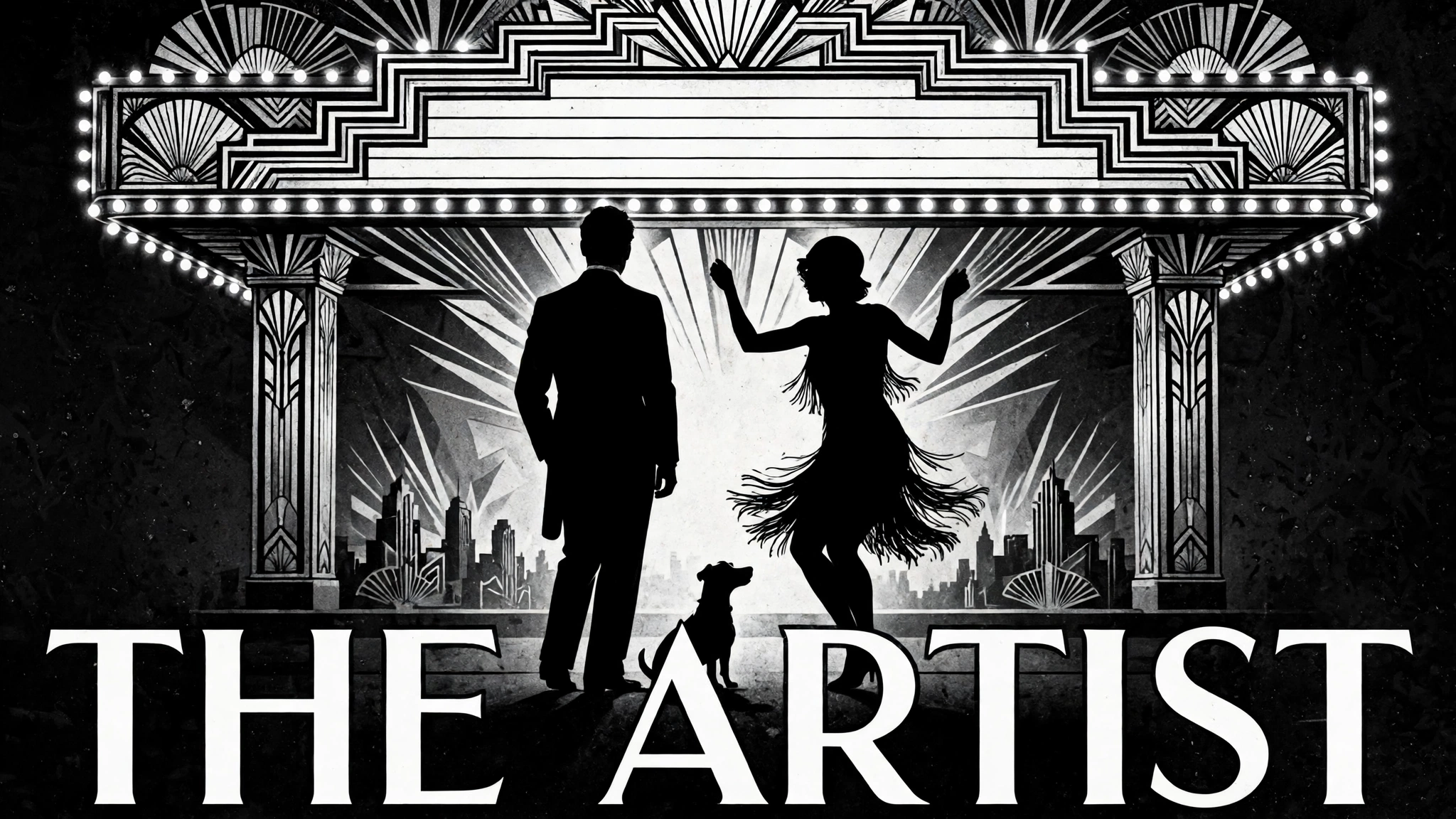
In 2011, a French director made a film with almost everything modern cinema had abandoned: black-and-white images, a boxy 1.33:1 frame, intertitle cards instead of dialogue, and no spoken words until its final moments. By every commercial rule, The Artist should have been a festival curiosity. Instead it became a worldwide hit, and in February 2012 it won five Academy Awards from ten nominations — including Best Picture, the first French film ever to take that prize. More than a decade later, this The Artist review asks the fair question: was it a gimmick that charmed an nostalgic Academy for one season, or is it genuinely a lovely film? The honest answer is that it is a little of the first and a great deal of the second.
Michel Hazanavicius set out to make a love letter to silent-era Hollywood, and the surprise of The Artist is how little it feels like a museum piece. It moves. It jokes. It breaks your heart a little, on schedule, with the confidence of the old studio craftsmen it is honouring. This review covers the story, the extraordinary physical performances, Ludovic Bource’s Oscar-winning score — which in a silent film is not background music but the dialogue itself — and where the film’s charm has limits.
| Detail | Information |
|---|---|
| Release date | 12 October 2011 (France); premiered 15 May 2011 at Cannes |
| Director | Michel Hazanavicius |
| Writers | Michel Hazanavicius |
| Genre | Romance, Comedy Drama |
| Language | Silent (English intertitles) |
| Runtime | 100 minutes |
| Budget | $15 million |
| Lead cast | Jean Dujardin, Bérénice Bejo, John Goodman, James Cromwell, Penelope Ann Miller, Uggie the dog |
| Our rating | 8.5/10 |
Hollywood, 1927. George Valentin is one of the biggest stars in the world: handsome, athletic, adored, and never more than a raised eyebrow away from a laugh. His films are swashbuckling adventures, his partner on and off screen is his devoted little dog, Jack, and his studio boss, Al Zimmer, indulges his every whim. Then, outside a premiere, a young fan literally bumps into him. Her name is Peppy Miller, the newspapers get their photograph, and with Valentin’s amused encouragement her career begins.
The timing is cruel. The film industry is about to be overturned by talking pictures, and Zimmer is converting the studio to sound. Peppy, young and adaptable, rises with the new technology. Valentin, proud and frightened, refuses to speak on screen, insists the talkies are a fad, and pours his own money into one last silent epic. What follows is a classic rise-and-fall told in mirror image: two careers crossing on the way past each other, a marriage quietly expiring at a breakfast table, an auction room, a pawnshop, and a star who once filled every room learning what it feels like to be forgotten by an industry that never stops moving.
We will not spoil the ending, except to say the film earns its final movement and that its one famous spoken moment is perfectly chosen. The plot is deliberately familiar — it echoes Singin’ in the Rain and A Star Is Born — because Hazanavicius wants the pleasure to come not from surprise but from execution, the way a standard becomes a standard again each time a great musician plays it.
Jean Dujardin as George Valentin won the Academy Award for Best Actor — the first French actor ever to win in that category — and the Cannes Best Actor prize before it, and it is easy to see why. Without dialogue, acting becomes physical precision: posture, timing, the exact tilt of a smile as it curdles into humiliation. Dujardin has a face made for the silent camera, all teeth, eyebrows and wounded vanity, but the performance deepens as Valentin falls. His best scene may be a dressing-room moment in which he confronts his own reflection and everything it no longer promises — played entirely without words, and devastating.
Bérénice Bejo as Peppy Miller has the warmer and in some ways harder role. Peppy must be ambitious without becoming the villain of George’s story, and Bejo plays her as a woman whose love and whose career point in opposite directions. A scene in Valentin’s dressing room, where she mimes an embrace with his coat while he watches unseen, tells you everything about her that intertitles never could. She was Oscar-nominated for supporting actress, though the role is plainly a co-lead.
The supporting cast is stocked with expressive American character players used exactly right. John Goodman as Al Zimmer bellows and blusters in pantomime like a born silent comic. James Cromwell as Clifton, Valentin’s chauffeur and last loyal employee, gives the film its quiet conscience; his face in the later reels does the work of pages of dialogue. Penelope Ann Miller as Doris, Valentin’s wife, makes a small role count — her frozen smiles chart the death of a marriage years of therapy could not summarise faster. And then there is Uggie as Jack, the Jack Russell terrier who steals every scene he enters and won the Palm Dog at Cannes. It sounds like a joke until you watch him: the dog’s timing is genuinely superb, and the film’s most suspenseful sequence belongs to him.
Hazanavicius and cinematographer Guillaume Schiffman did not simply shoot a modern film and strip the colour out. The Artist was photographed to behave like a late-1920s production: a slightly squarer frame, carefully managed contrast so skin glows the way it did on old stock, period lighting, and camera movement that honours the grammar of the era while quietly using every modern refinement underneath. Schiffman won the César and was Oscar-nominated; the craft team around him — production designer Laurence Bennett, costume designer Mark Bridges, who won the Oscar — builds a Hollywood of polished studio floors, art-deco dressing rooms and cavernous sound stages that feels remembered rather than researched.
The direction’s cleverness shows most in its two famous sound jokes. In a nightmare sequence, Valentin suddenly hears the world — a glass clinks, a feather lands like a bomb, crowds laugh — while his own voice produces nothing: the talkies arrive inside his head as horror. Later, the film’s single line of spoken dialogue lands like a thunderclap precisely because you have spent a hundred minutes in silence. These are not gimmicks pasted onto a homage; they are the story told in form.
The film’s limits live here too. Hazanavicius is so faithful to his template that the middle section follows the fall-of-the-star formula beat for beat, and viewers who know Singin’ in the Rain will see some turns coming from a long way off. A sequence built partly around borrowed music (discussed below) has also divided audiences since release. But judged as pure visual storytelling — can you follow every emotion, every plot point, every joke, with the sound of voices removed? — the craft is close to flawless.
In a silent film, the score is not decoration. It is the dialogue, the sound design and half the acting, all at once — and Ludovic Bource’s music for The Artist is one of the great modern film scores precisely because it accepts that responsibility for almost the entire 100 minutes without letting the film sag. Bource, who had scored Hazanavicius’s OSS 117 comedies, wrote a full romantic orchestral score in the spirit of the late silent era and the early sound years: swooning strings for the love story, bright, brassy pastiches for Valentin’s adventure films-within-the-film, and darker, lonelier piano writing as the star’s world empties out. He won the Academy Award, the Golden Globe, the BAFTA and the César for it, and the score is the main reason the film plays to audiences who have never seen a silent movie in their lives.
One honest controversy belongs in any complete review. For a key late sequence, the film uses a portion of Bernard Herrmann’s score for Alfred Hitchcock’s Vertigo (1958), the famous “Scène d’amour.” Vertigo star Kim Novak publicly objected in January 2012 in very strong terms, saying the film should have stood on its own music. Hazanavicius and Bource described the borrow as an act of homage, and Herrmann is credited — but the anachronism is real, and viewers who know Vertigo may be pulled out of the film at exactly the moment it wants them most absorbed. It is the one musical decision in The Artist that still sparks argument, and both reactions are understandable.
Around those poles, the period songs and dance numbers complete the illusion, and the finale’s tap sequence — the two stars finally sharing the screen in the sound era, through dance, the one language both of them always spoke — is scored and staged as pure release.
What we loved:
What could be better:
For a black-and-white silent film in the age of 3D blockbusters, the commercial story is remarkable. The Artist cost about $15 million — some financial databases list the production budget a touch higher, around $16 million — and earned roughly $133.4 million worldwide. Roughly a third of that came from North America, an extraordinary result for a French production with no conventional dialogue, powered by festival prizes, critics and one of the most effective awards-season campaigns of its era after The Weinstein Company acquired it.
The awards haul completed the story: ten Academy Award nominations and five wins — Best Picture, Best Director for Hazanavicius, Best Actor for Dujardin, Best Original Score for Bource and Best Costume Design for Mark Bridges. It also won three Golden Globes from six nominations, including Best Motion Picture – Musical or Comedy. Whether it is the best film of 2011 is a fair debate; that it was the year’s great cinematic event is not.
Yes — and watch it properly, on the biggest screen you have, phone away, lights down, the way its silence demands. The Artist is not the deepest film ever to win Best Picture, and this review has not pretended otherwise. But it is a film of real joy and real craft, a reminder that cinema spoke fluently for three decades before it ever opened its mouth, and that a raised eyebrow from Jean Dujardin can still say more than a page of exposition. Newcomers to silent film could not ask for a kinder doorway in.
Our rating: 8.5/10 — a beautifully executed love letter to old Hollywood, carried by two star performances and a score that does the talking.
How many Oscars did The Artist win?
It won five Academy Awards from ten nominations: Best Picture, Best Director (Michel Hazanavicius), Best Actor (Jean Dujardin), Best Original Score (Ludovic Bource) and Best Costume Design. It was the first French film to win Best Picture, and Dujardin was the first French winner of Best Actor.
Is The Artist completely silent?
Almost. It is a black-and-white film presented in the silent style, with intertitles instead of dialogue and a continuous orchestral score. Sound effects appear in one famous dream sequence, and there is a brief spoken moment at the very end.
Who composed the music for The Artist, and why does it matter so much?
Ludovic Bource composed the score. In a silent film the music performs the job dialogue normally does — signalling emotion, rhythm and even unspoken thoughts — so Bource’s score is effectively a lead performer in the film.
Is The Artist based on a true story?
No. George Valentin and Peppy Miller are fictional, though Valentin’s predicament reflects the real fate of many silent stars whose careers ended when talking pictures arrived at the end of the 1920s.
Where can I watch The Artist?
It is available on various streaming and rental platforms and on Blu-ray. Availability varies by region, so check your local services.