★ LATEST REVIEWS

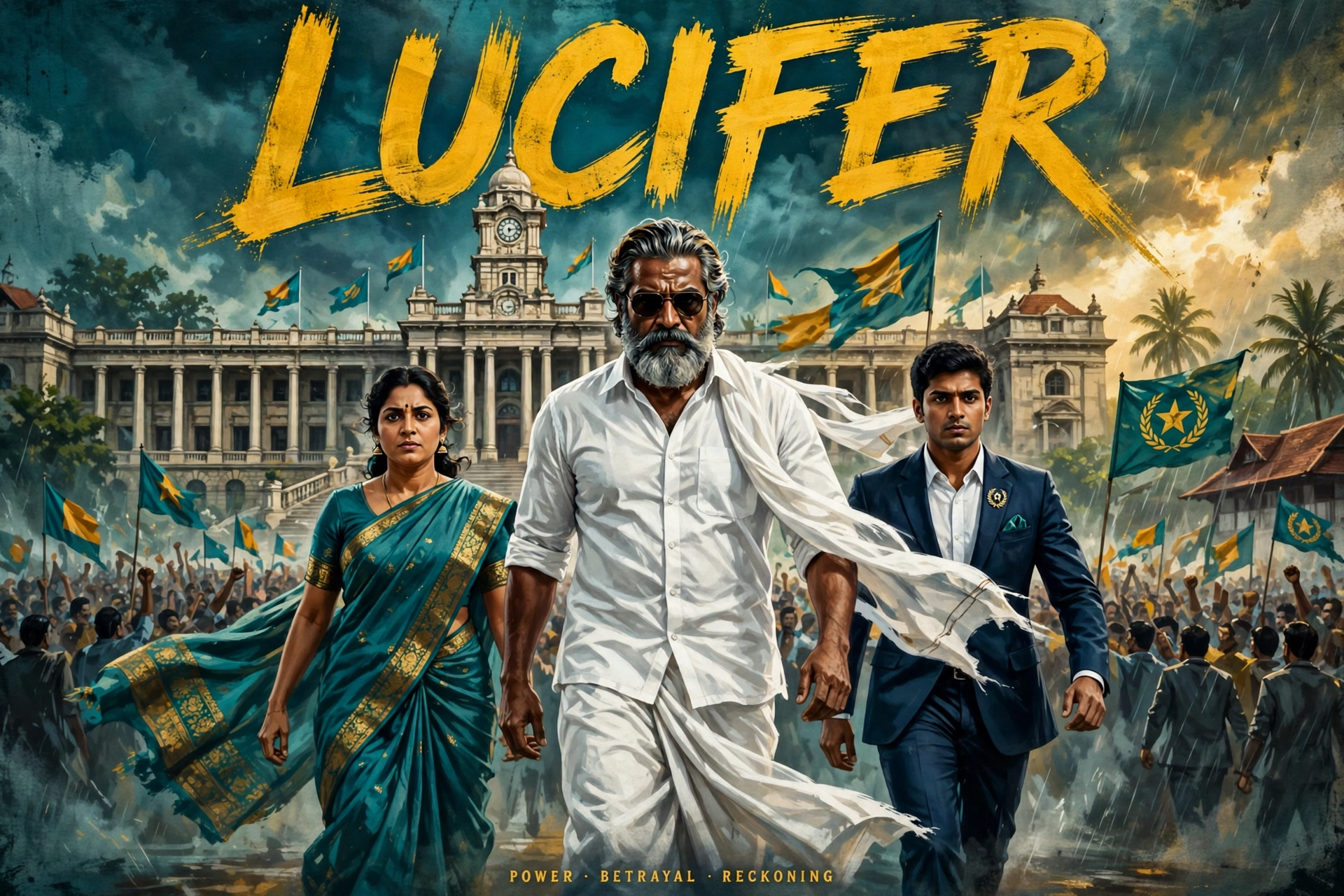
★★★★☆ Our Rating: 7.5/10
Every Lucifer review has to reckon with two films at once: the political thriller Murali Gopy wrote, and the star vehicle Prithviraj Sukumaran built around Mohanlal. Released on 28 March 2019 as Prithviraj’s directorial debut, the film arrived with a simple, potent promise — a beloved veteran actor, playing a man of total mystery, in a story about who really holds power when a political dynasty cracks. It became one of the biggest Malayalam hits of its time, launched a franchise, and left audiences quoting its punch dialogues in the lobby. It also runs close to three hours, loves its own slow-motion entrances, and sometimes mistakes withholding information for depth. Both films, the gripping one and the indulgent one, are in there.
This is a review of the 2019 Malayalam original, the first instalment of what its makers now call the Lucifer universe. Judged as a mass entertainer with a political spine, it largely delivers: atmosphere, star presence and a genuinely interesting villain problem carry it over a middle stretch that sags and a climax that explains more than it needs to. Judged as a political drama, it is smarter than most star vehicles and less brave than its reputation suggests. That balance is worth unpicking.
| Detail | Information |
| Release date | 28 March 2019 |
| Director | Prithviraj Sukumaran |
| Writers | Murali Gopy |
| Genre | Political Thriller, Action, Drama |
| Language | Malayalam |
| Runtime | 174 minutes |
| Budget | ₹30 crore |
| Lead cast | Mohanlal, Prithviraj Sukumaran, Manju Warrier, Tovino Thomas, Vivek Oberoi |
| Our rating | 7.5/10 |
The film opens with the death of P. K. Ramdas, a towering veteran leader who has dominated his party and his state’s politics for decades. His passing leaves three kinds of vacuum at once: a party without a chief, a family without a centre, and a network of money and favours without a keeper. Queuing around the empty chair are his daughter Priyadarshini (Manju Warrier), principled but politically untested; his son Jathin (Tovino Thomas), returning from abroad with a reformer’s shine; and, circling both, Bobby (Vivek Oberoi), the late leader’s son-in-law — a polished corporate operator whose business empire is quietly entangled with international drug money and who intends to convert the family’s political inheritance into something far more profitable and far uglier.
Standing slightly apart from all of them, watching, is Stephen Nedumpally (Mohanlal) — Ramdas’s trusted lieutenant, a man with a church-linked public image, a past nobody can fully account for, and a loyalty to the old leader that the family alternately leans on and resents. As Bobby’s plans advance — involving media manipulation, staged outrage and pressure on every weak joint in the party — Stephen begins, calmly and without raising his voice, to dismantle them. Who Stephen really is, who funds his counter-moves, and what the debt between him and Ramdas actually consists of are questions the film guards carefully, releasing answers in fragments: a visitor here, a phone call there, the enigmatic figure of Zayed Masood (Prithviraj Sukumaran) appearing at the edges of the frame. To say more would spoil the architecture; Lucifer is built as a slow reveal wearing the clothes of a political thriller.
Mohanlal as Stephen Nedumpally gives a performance built almost entirely out of stillness. For long stretches he does little more than sit, listen and remove his sunglasses at significant moments — and it works, because the film’s whole design depends on the audience believing that this quiet man is the most dangerous person in every room. This is star charisma used as a narrative device: the less Stephen explains himself, the more powerful he seems. The trade-off is real, though. Stephen is more monument than man, and viewers hoping for the emotional interiority of Mohanlal’s great dramatic roles will find the film deliberately refuses it.
Manju Warrier as Priyadarshini has the film’s most human part and plays it with contained grief and intelligence. Her arc — from mourning daughter to someone who must learn what her father’s world actually ran on — gives the political plot a face, and her scenes with Mohanlal have a wary warmth that the film could have used more of. Vivek Oberoi as Bobby, making his Malayalam debut, is a genuinely effective antagonist: soft-spoken, entitled, amused by his own cleverness, and all the more menacing for never needing to shout. If the performance occasionally tips into smugness, the character is written that way.
Tovino Thomas as Jathin brings fresh energy to the idealist son, though the screenplay keeps him more symbol than person until late. Indrajith Sukumaran as Govardhan, a conspiracy-minded commentator watching the crisis from the margins, functions as a Greek chorus with a YouTube channel, and lands some of the film’s sharpest lines. Prithviraj Sukumaran as Zayed Masood appears briefly and effectively — a director casting himself as the mystery’s locked door. Veterans Saikumar, Kalabhavan Shajohn and Baiju Santhosh fill the party machinery with believable weight.
For a first-time director, Prithviraj Sukumaran shows striking command of scale. Lucifer was shot across Kerala and in locations as far apart as Mumbai, Bengaluru, Lakshadweep and Russia, and it looks like the big film it intends to be: Sujith Vaassudev’s cinematography favours wide frames, crowded compositions and a muted, granite palette that suits a story about institutions rather than individuals. Set pieces — a funeral that becomes a show of strength, confrontations staged in public squares, a rain-soaked action sequence — are mounted with patience and clarity. The much-discussed slow-motion hero shots are effective in moderation; the film does not always use them in moderation.
Murali Gopy’s screenplay is the film’s real engine and its real argument. Gopy writes politics as a system — media, money, faith networks and family honour all trading favours — rather than as a contest of speeches, and the film is at its best when it watches that system move: a news channel changing its line, a loyalist changing his price. Where the script falters is in its dependence on postponement. Stephen’s hidden identity is teased so insistently, across so many near-reveals, that the eventual disclosures carry franchise ambitions more than emotional payoff, and the closing stretches spend considerable energy setting up a mythology the present film has not quite earned. Samjith Mohammed’s editing keeps the large cast legible across 174 minutes, though few viewers will feel the film needed all of them; twenty minutes of tightening would have sharpened the second half considerably.
Deepak Dev’s score does heavy lifting, and mostly does it well. The background music is built on dark, pulsing motifs that turn committee rooms and corridors into arenas, and the film’s signature themes announce Stephen the way themes in classic star vehicles always have — as an argument that this man matters before he has done anything. Songs are used sparingly and functionally: “Raftaara” supplies pace and attitude, “Kadavule Pole” leans into the devotional irony surrounding Stephen’s public image, and “Empuraane,” voiced by Usha Uthup, plays as a knowing wink at the title’s mythology.
The score’s flaw is volume of use rather than quality. Scenes that might have generated tension from silence or performance are sometimes scored into submission, and the constant underlining flattens a few confrontations that a quieter hand would have made colder and better. Still, as star-vehicle scoring goes, this is confident, memorable work that substantially builds the film’s mood.
What we loved:
What could be better:
Malayalam box-office reporting for 2019 was still largely unofficial, and Lucifer is a case study in why caution matters: published worldwide totals vary widely, with current reference listings estimating about ₹129 crore while many contemporary and later trade reports cite figures around ₹175 crore, and some fan and trade claims run higher still. Reports differ, and no single number should be quoted as exact. What is not in dispute is the shape of the run. Made on a reported budget of about ₹30 crore — large for Malayalam cinema at the time — the film crossed the ₹50 crore mark within days, became the fastest Malayalam film of its era to pass successive milestones according to contemporary reporting, performed exceptionally overseas, and finished as one of the highest-grossing Malayalam films ever up to that point. It was later dubbed into other languages, remade in Telugu as Godfather (2022), and followed by the sequel L2: Empuraan in 2025 — the clearest possible evidence that, commercially, Stephen Nedumpally was only the beginning.
Yes, with expectations set correctly. Come for a slow-burn political thriller executed as a star spectacle — a film that respects your intelligence in its systems and flatters its hero in its style. Mohanlal devotees will find the monument performance they were promised; political-drama fans will find more substance than most big-ticket entertainers bother with, wrapped around a mystery that is finally more interesting as an idea than as a set of answers. It is overlong and occasionally in love with itself, but its best passages have a granite confidence Malayalam big cinema rarely attempts.
Our rating: 7.5/10 — a stylish, substantial star vehicle whose scale and villain outlast its padding and franchise teasing.
Is Lucifer (2019) Prithviraj Sukumaran’s first film as director?
Yes. Lucifer was his directorial debut, after a long acting career. He also appears in the film in the pivotal, secretive role of Zayed Masood.
Do I need to know Kerala politics to enjoy Lucifer?
No. The party and personalities are fictional, and the story works as a general tale of succession, money and media power. Viewers familiar with Kerala’s political culture will catch extra texture, but nothing essential is locked behind it.
Is Lucifer connected to L2: Empuraan?
Yes. Lucifer is the first part of a planned series; L2: Empuraan (2025), again directed by Prithviraj with Mohanlal returning as Stephen, continues the story and expands the mythology this film sets up.
Is Lucifer suitable for family viewing?
It is a political action thriller with violence, drug-trade themes and intense confrontations, carrying a U/A certification in India. It suits older teens and adults better than young children.
Where can I watch Lucifer (2019)?
The Malayalam original streams on major platforms in many regions, with dubbed and subtitled versions available. Availability changes over time, so check your local services.