★ LATEST REVIEWS

★★★★★ Our Rating: 9/10
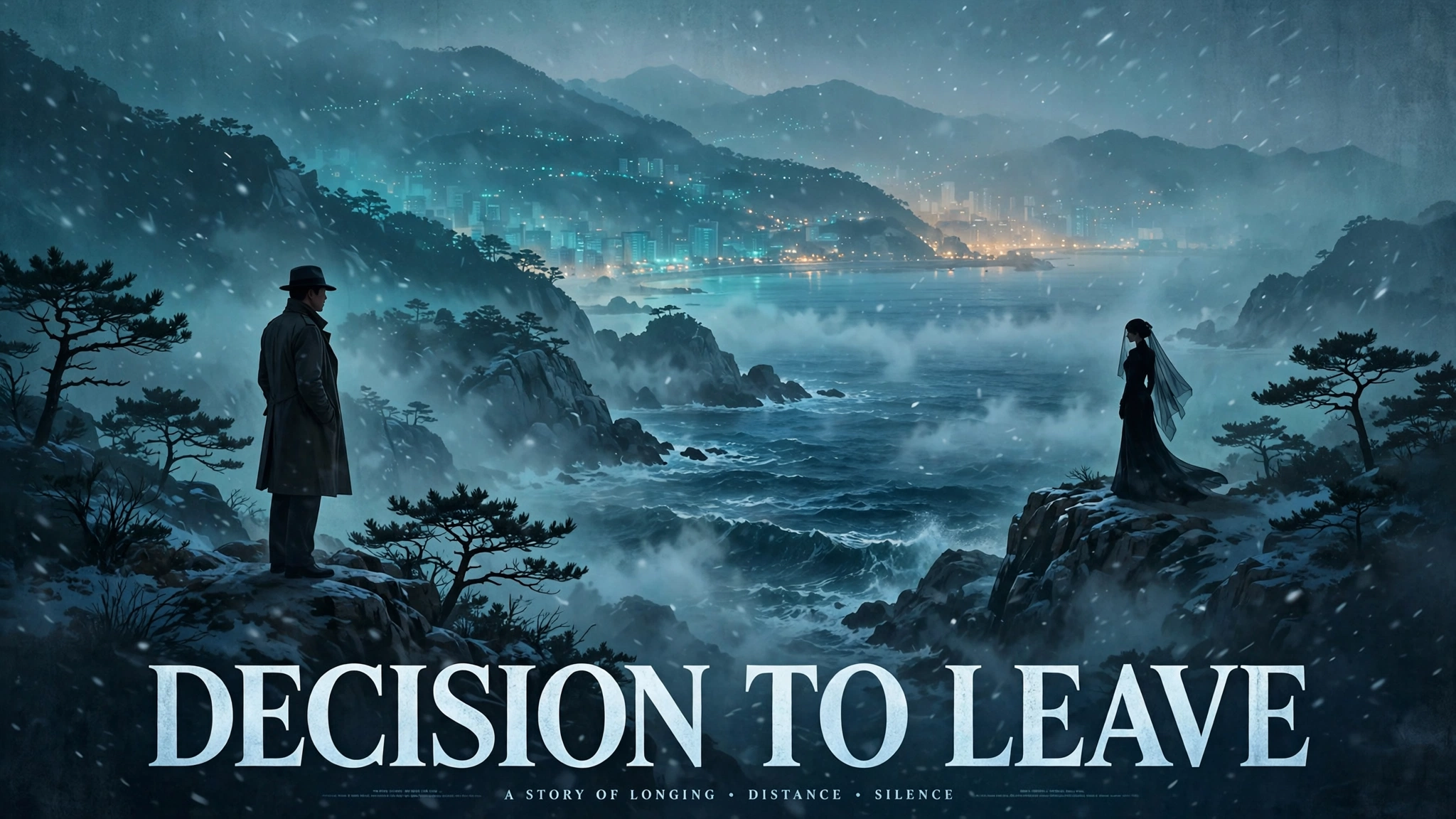
Park Chan-wook built his international reputation on shock — the hammer corridor in Oldboy, the lush erotic gamesmanship of The Handmaiden. Decision to Leave, his eleventh feature and his first in six years, is shocking in the opposite direction: it is quiet, patient and almost unbearably restrained, and it hurts more than most of his violent films ever did. Premiered in competition at Cannes on 23 May 2022, where Park won Best Director, and released in South Korea on 29 June 2022, this romantic mystery takes the oldest shape in noir — a detective, a dead man, a widow who may be lying — and rebuilds it as a love story told almost entirely through surveillance footage, text messages and things neither person can quite say.
The premise sounds like a thriller, and for its first hour the film happily behaves like one. A retired immigration officer is found dead at the foot of a mountain he loved to climb. The detective assigned to the case is meticulous, sleepless and decent. The widow is calm in a way that makes everyone in the police station uneasy. But anyone expecting a whodunit with a killer twist should recalibrate early. The real mystery in Decision to Leave is not who did what on that mountain. It is how a professional man dismantles his own life, politely, procedure by procedure, for a woman he is supposed to be investigating — and whether she is dismantling hers for him, or simply using him as one more tool of survival.
This Decision to Leave review is deliberately spoiler-free, because the film’s final movement depends on revelations of feeling rather than of plot, and those deserve to be met cold. What can be discussed freely is why this became one of the most acclaimed films of 2022, what Tang Wei and Park Hae-il achieve together, and the honest limitations that keep a small number of viewers at arm’s length from a film many others consider a masterpiece.
| Detail | Information |
|---|---|
| Release date | 29 June 2022 (South Korea); premiered 23 May 2022 at Cannes |
| Director | Park Chan-wook |
| Writers | Park Chan-wook, Jeong Seo-kyeong |
| Genre | Mystery, Romance, Thriller |
| Language | Korean, Mandarin |
| Runtime | 138 minutes |
| Budget | ₩13.5 billion (about $11 million) |
| Lead cast | Tang Wei, Park Hae-il, Lee Jung-hyun, Go Kyung-pyo, Park Yong-woo |
| Our rating | 9/10 |
Busan detective Jang Hae-jun (Park Hae-il) is the kind of policeman other officers gently mock for his standards. He dresses well for stakeouts, cooks properly even when eating alone in a car, and suffers from an insomnia so complete that he seems to live half his life in the blue dark of other people’s windows. His marriage is not unhappy so much as geographically defeated: his wife Jung-an (Lee Jung-hyun) works at a nuclear power plant in Ipo, and the couple meet mainly at weekends, in a relationship maintained by routine and phone calls.
Into this carefully managed loneliness falls a case, literally. Ki Do-soo, a retired immigration officer in his sixties, is found dead below a mountain peak. Accident, suicide or murder — the evidence can be arranged to support any of the three. Hae-jun interviews the dead man’s much younger wife, Song Seo-rae (Tang Wei), a Chinese immigrant who works as a carer for elderly people. She receives the news of her husband’s death with a composure that strikes the police as wrong. She does not perform grief. She even, at one point, almost laughs — and then explains herself in Korean that is fluent but slightly, revealingly, translated, the language of a woman who learned the tongue partly from television dramas and a translation app.
Hae-jun begins watching her. Officially, it is surveillance of a suspect: her late-night routines, her visits to the elderly women she cares for, her small apartment, her ice cream eaten alone. Unofficially — and the film makes the slippage unmistakable without ever announcing it — the stakeouts become the most intimate relationship in his life. He records her habits with a tenderness no husband in the film manages. He brings her expensive sushi because the police meal allowance, in his hands, becomes a love language. When the case reaches its official conclusion, neither of them is freed by it. Time passes, circumstances change, a second death enters the story, and the two meet again in a different city under worse conditions — but how that second movement unfolds, and what each of them has decided about the other by then, is exactly what this review will not spoil. Go in knowing only this: every important thing in Decision to Leave is said in the wrong language, at the wrong time, or into a machine.
Tang Wei as Seo-rae gives the defining performance of her career since Lust, Caution. Seo-rae is written as an enigma, and a lesser actor would play her as one — all mystery and lowered eyes. Tang Wei does the opposite. She plays a practical woman solving practical problems: an immigrant widow with no money, no family, a dead husband who marked his possessions — and, the film implies, his wife — with his initials. Her Korean, delivered with deliberate care and occasional machine-translated stiffness, becomes the film’s central instrument. When Seo-rae speaks through her translation app, the slight delay and flat electronic voice let her hide inside her own sentences. Tang Wei lets you watch a woman deciding, line by line, how much truth she can afford. Her stillness is never emptiness; it is budgeting.
Park Hae-il as Hae-jun has the harder, quieter job, and he is superb. Hae-jun is a good man whose goodness is a kind of armour: politeness, procedure, insomnia treated as a professional tool. Park plays the erosion of that armour in miniature — a detective who starts recording his surveillance notes like love letters, who cooks for a suspect’s photograph, whose professionalism collapses not in a dramatic confrontation but in a single act of evidence-handling that the film presents, rightly, as the most romantic and most damning gesture in his life. Park Hae-il never begs for sympathy, which is why the final act’s portrait of a man who has traded sleep, marriage and career for an unresolvable feeling lands so hard.
The supporting cast is used with Park Chan-wook’s usual precision. Lee Jung-hyun as Jung-an refuses to make the wife a obstacle or a fool — her cheerful, statistical approach to marriage makes the couple’s distance sadder, not simpler. Go Kyung-pyo as Soo-wan, Hae-jun’s younger partner, supplies the film’s dry comedy and its moral echo, a detective who actually sleeps, eats and loves in the normal way, showing the audience the life Hae-jun has declined.
This is the most formally beautiful film of Park Chan-wook’s career, and the most disciplined. Working with cinematographer Kim Ji-yong, Park builds the film out of impossible viewpoints: the camera watches from inside a dead man’s closing eye, from within a phone screen, from the bottom of a fish tank, from a drone’s godlike height above the mountain — and every flourish is motivated by the story’s obsession with watching and being watched. The editing, by Kim Sang-bum, is where the film quietly becomes revolutionary. Stakeout scenes dissolve into imagined presence: Hae-jun is suddenly standing inside Seo-rae’s apartment as he visualises her movements from her messages, two people sharing a room that exists only in his longing. Transitions slide between cities and months on a gesture or a wave of sea water, so that the whole film feels like a memory being edited by someone who cannot sleep.
Just as striking is what Park withholds. There is almost no violence, no sex scene, none of the baroque cruelty of his earlier work. The erotic charge is relocated into hands applying lip balm, a wall of case photographs, a phone held like a confession booth. Honest criticism should note the cost of all this control: the second movement is denser and slightly more convoluted than the first, introducing a new husband and a new case that some viewers will need a second viewing to fully map, and the film’s glacial politeness can read as coldness if you meet it in the wrong mood. But the craft is never decoration. Every mirror, translation and double meaning — the title itself is a phrase about breaking up that behaves like a clue — is doing emotional work.
Composer Jo Yeong-wook, Park’s collaborator since Oldboy, provides a score built on strings, piano and a recurring sense of circular motion — music that keeps returning to its starting point the way the characters keep returning to each other. The most famous musical choice is borrowed: Mahler’s Fifth Symphony, and in particular the atmosphere of longing attached to it, colours the film’s later passages, connecting Decision to Leave to the great tradition of doomed screen romance that runs through Visconti. Just as important is the film’s use of a Korean pop ballad, Jung Hoon-hee’s “Mist”, performed in the film in a version sung partly in Chinese by Tang Wei herself — a song about a love obscured like a landscape in fog, which is about as exact a description of this film as criticism could manage. Between score, song and the recurring sounds of sea, wind and phone notifications, the sound design constructs a world where modern technology carries ancient emotions, slightly delayed and translated, but unmistakable.
What we loved:
What could be better:
The film’s commercial story matches its scale. Made for a reported ₩13.5 billion — roughly $11 million — Decision to Leave was pre-sold to an exceptional 192 territories before release, and went on to gross about $21.7 million worldwide according to Box Office Mojo’s tally, with roughly $2.2 million of that from North America. In South Korea it drew close to 1.9 million admissions — respectable rather than spectacular, in a summer dominated by action sequels, and the film was always built for a different kind of success: the Cannes Best Director prize, South Korea’s submission for Best International Feature at the 95th Academy Awards, and a long afterlife on streaming and in critics’ polls of the decade’s best films. Doubling a modest budget while becoming one of the defining art-house titles of its year is, by any honest accounting, a hit — just a quiet one, like everything else about it.
Yes — if you like films that trust you to feel your way through a story rather than be led by it, this is essential viewing, and one of the finest films of the decade. If you come for the pleasures of a neatly solved mystery or the intensity of Park Chan-wook’s earlier work, be warned that the pleasures here are quieter, sadder and more durable: the beauty of a perfectly composed shot, the ache of a sentence delivered through a phone, the recognition that the most dangerous thing two people can do is understand each other completely and still not be able to stay together.
Our rating: 9/10 — Park Chan-wook’s gentlest film and one of his greatest: a noir where the crime is solvable and the love is not.
Is Decision to Leave based on a true story?
No. The film is an original screenplay by Park Chan-wook and Jeong Seo-kyeong, drawing on the traditions of Korean noir and classic detective fiction rather than a specific real case. Its Busan locations are real, and its portrayal of police work — stakeouts, mountain rescue procedures, interview technique — is deliberately realistic, but Jang Hae-jun and Song Seo-rae are inventions.
Does the film have a big twist ending?
It has a devastating final movement rather than a twist in the conventional thriller sense. The facts of the case are largely settled before the end; what lands in the closing scenes is the emotional consequence of decisions the two leads made much earlier. It is the kind of ending that reframes everything you thought you understood about their relationship without changing a single plot fact — which is why spoiler warnings for this film are unusually important.
Why does Seo-rae use a translation app to talk to Hae-jun?
Because she is a Chinese immigrant speaking Korean as a second language, and because Park Chan-wook uses the app as a central metaphor. Seo-rae’s translated Korean is often more poetic, more careful and more revealing than fluent speech would be — a language learned partly from television, delivered with a machine’s delay, that lets her control exactly how much she gives away. The app is funny, practical and heartbreaking by turns, and it becomes the film’s most original love language.
Is Decision to Leave violent or explicit like Oldboy and The Handmaiden?
No — strikingly, it is not. There is almost no on-screen violence and no explicit sex scene. The film’s intensity comes from glances, phone calls, withheld information and the slow revelation of what two people mean to each other. It is far more suitable for a mature, patient audience than Park’s earlier reputation might suggest, though its themes — adultery, suicide, obsession — make it adult viewing rather than family viewing.
Where can I watch Decision to Leave?
The film is available on Mubi in North America, the UK and several other territories, and on various rental and purchase platforms depending on your region. Check your local listings, as availability rotates between services.