★ LATEST REVIEWS

Our Rating: ★★★★☆ 8.5/10
Imagine a city where a rich criminal never has to see the inside of a prison cell, because for the right price another man will serve the sentence wearing his name. That unsettling idea is the engine of Aynabaji, released on 30 September 2016, and it turned Amitabh Reza Chowdhury’s big-screen directorial debut into a sensation that Bangladeshi audiences queued for in record numbers.
This Aynabaji review covers the original Bengali crime thriller, and the verdict comes early: it is one of the smartest, best-acted Bangladeshi films of its decade — a thriller with a genuinely original premise, a career-peak central performance, and a portrait of Dhaka that stays with you. Its flaws are real, mainly length and a romance that does not always pull its weight, but they do not stop it from being essential viewing for anyone curious about modern Dhallywood at its best.
| Detail | Information |
|---|---|
| Release date | 30 September 2016 |
| Director | Amitabh Reza Chowdhury |
| Writers | Gousul Alam Shaon (story); Anam Biswas, Gousul Alam Shaon, Rezaul Karim Refath (screenplay) |
| Genre | Crime, Thriller, Drama |
| Language | Bengali |
| Runtime | 146 minutes |
| Budget | Approx. ৳1.7 crore (reported; see Box Office note) |
| Lead cast | Chanchal Chowdhury, Masuma Rahman Nabila, Partha Barua, Lutfur Rahman George, Brindabon Das |
| Our rating | 8.5/10 |
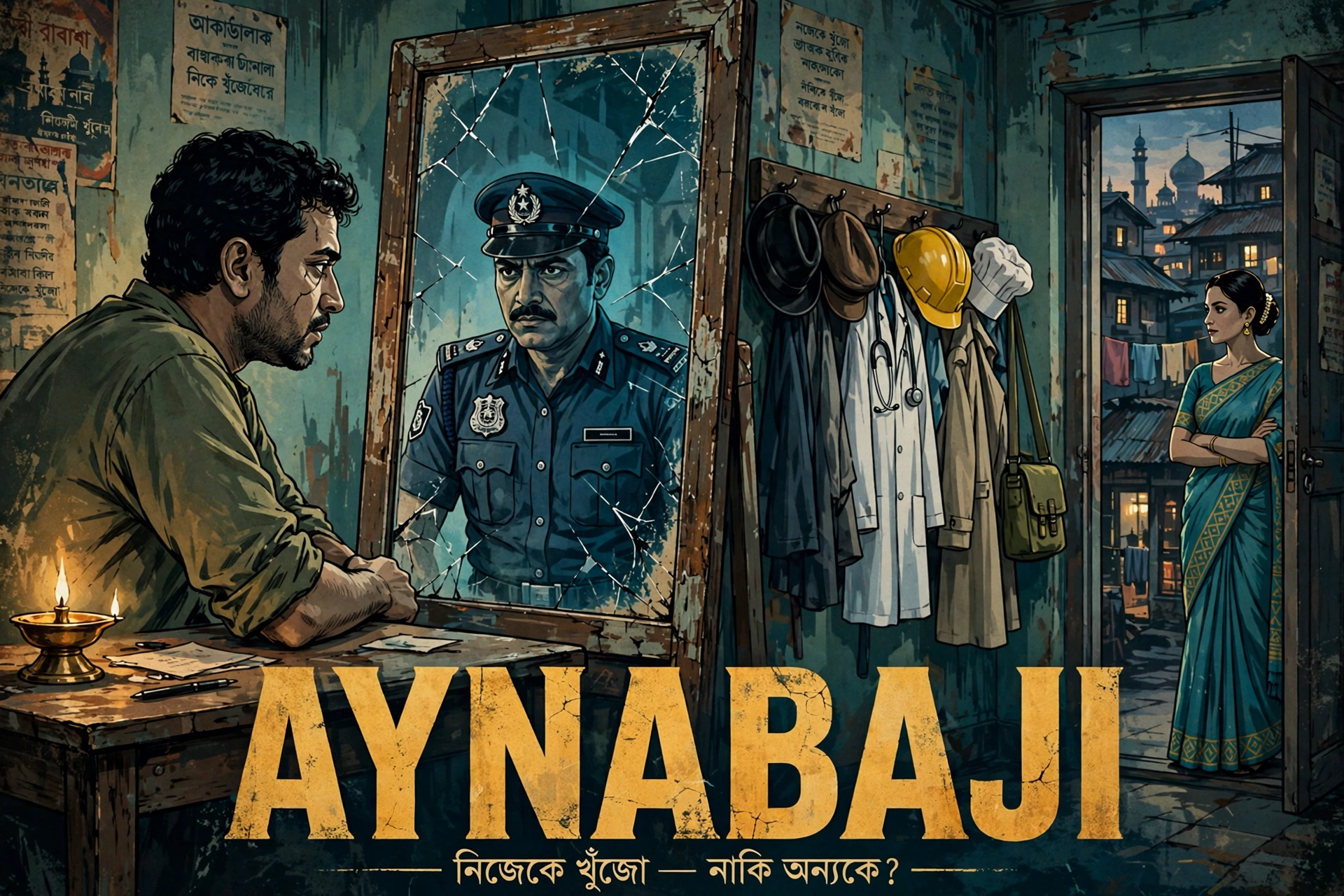
Sharafat Karim Ayna — played by Chanchal Chowdhury — is a gifted, failed actor who found a darker use for his talent. “Ayna” means mirror, and that is exactly what he sells: powerful, wealthy men facing prison hire him, through fixers in a corrupt system, to take their place behind bars. He studies each client’s walk, speech and habits until he can inhabit the man, serves the sentence until bail or influence frees “him”, collects his money, and disappears back into the anonymity of Dhaka. Years earlier, family necessity pushed him into this work; by the time we meet him, pride in his craft keeps him in it. He is, in his own mind, giving the performances of his life — to an audience of guards and fellow prisoners.
Two people begin to crack that carefully anonymous life from opposite sides. One is Hridi, a warm, grounded young woman who becomes his neighbour and then, slowly, something more; around her, Ayna is tempted for the first time to be only himself. The other is Saber, a stubborn crime reporter who notices patterns in who goes to prison and who walks free, and starts pulling at a thread he does not yet understand.
Then Ayna accepts — under heavy pressure — one last and very different assignment, connected to a powerful and dangerous client, and the mirror game stops being a game. What follows is the film’s gripping second half, and we will protect its twists here as the film deserves: this is a thriller whose surprises are earned by character, not pasted on, and audiences who have avoided spoilers for a decade should keep that gift. Know only that the stakes rise from money to survival, that everyone investigating Ayna is also, in some way, investigating the system that created him, and that the title’s mirror reflects the audience too: in a city where identity itself can be bought, what is any of us really worth?
Chanchal Chowdhury as Ayna delivers one of the great performances in modern Bangladeshi cinema. The role asks him to play a man playing other men — multiple distinct identities within one film, each with its own posture, voice and energy — without ever letting the audience lose sight of the lonely actor underneath. He manages both. Watch how his body changes with each assumed life, and then how, in private moments, it all falls away into ordinariness. This was the role that completed his journey from Monpura‘s beloved romantic lead to the defining screen actor of his generation in Bangladesh, and the National Film Award for Best Actor was richly deserved.
Masuma Rahman Nabila as Hridi brings openness and emotional directness to a part that could have been merely functional. Hridi has to make the audience believe that a man who lives as other people might risk everything for a life of his own, and Nabila’s unguarded warmth does most of that work. If the writing gives her less agency than the men around her — a genuine weakness — her performance at least gives Hridi a felt inner life.
Partha Barua as Saber is excellent as the reporter: rumpled, obsessive, morally serious without being sanctimonious. His investigation gives the film its procedural spine, and Barua plays Saber as a man whose decency is itself a kind of stubbornness. Among the supporting cast, Lutfur Rahman George is convincingly oily as a businessman on the wrong side of the law, Brindabon Das brings unexpected tenderness to prison guard Labu Mia, and Gousul Alam Shaon — who also wrote the story — appears effectively within the machinery of the racket itself. Brief guest appearances, including Arifin Shuvoo as a police officer, add star texture without derailing the story.
Amitabh Reza Chowdhury arrived from a celebrated career in television commercials, and Aynabaji has the confidence of a director who has been rehearsing for years. His boldest choice is tonal: he treats an outlandish premise with complete realism. There are no winks, no stylised heist-movie tricks. The exchanges between criminal and double are shown with procedural plainness — and that plainness is the point, because it makes the corruption feel like routine business in this city rather than a movie invention.
Rashed Zaman’s cinematography, which won the National Film Award, gives Dhaka a double life of its own: glittering towers and choked lanes, neon and dust, a city forever reflecting itself in glass and water. Old Dhaka in particular has rarely been filmed with this much love and this little sentimentality. Iqbal Ahsanul Kabir’s editing keeps a complicated, multi-strand story legible, though honest criticism requires saying that the film is long — at 146 minutes, some sequences, particularly in the romantic track, restate feelings already established, and a tighter cut could have added real punch. The pacing wobbles; the grip, mostly, does not.
The music of Aynabaji comes from several hands — including Indradip Dasgupta, Shayan Chowdhury Arnob, Habib Wahid, Fuad and the band Chirkutt — and that variety suits a film about a city of shifting identities. The best-known songs work on two levels at once. “Dhire Dhire Jaw Na Somoy”, sung by Habib Wahid with Shreya Ghoshal, gives the romance its most tender expression. Chirkutt’s “Duniya” captures the shrugging philosophy of the street, while “Alu Piyaj er Kabbo”, performed by Shaan, adds playful local flavour. There is also a lovely piece of self-reference for Bangladeshi film fans: at one point Ayna sings a few lines of “Nithua Pathare”, the signature song of Monpura — a quiet nod linking Chowdhury’s two landmark roles.
The background score matters as much as the songs. In the prison and investigation passages it stays low and tense, built from texture rather than melody, and the film knows when to trust ambient city sound — traffic, crowds, cell doors — over music entirely. A couple of song placements do slow the thriller’s momentum, which is part of the length problem noted above, but as an album and as atmosphere, the music is a clear strength.
What we loved:
What could be better:
As with all Bangladeshi releases, these numbers come with a clear caution: they are press-reported figures, not independently audited accounts, and reports differ. The most commonly cited reference figures put the budget at around ৳1.7 crore and the total box office at around ৳5.13 crore; some secondary sources quote noticeably different totals in both directions, so those figures should be read as a reported range rather than exact accounts.
What no report disputes is the scale of the hit. Aynabaji recorded extraordinary advance sales at Dhaka’s multiplexes, ran with near-total occupancy in its opening weeks — one widely reported figure put occupancy above 98 percent in its first three weeks at key venues — and logged a record number of shows for a Bangladeshi film in its first ten days. It travelled to the Marché du Film at Cannes, won Best Film at the Seattle South Asian Film Festival, and swept seven Bangladesh National Film Awards, including Best Director, Best Actor, Best Screenplay, Best Cinematography and Best Editing. By any measure — money reported, awards, or sheer cultural footprint — it was the Bangladeshi film event of 2016.
Unreservedly, yes. If you watch one modern Bangladeshi thriller, make it this one. Come for the premise, stay for Chowdhury, and forgive the film its extra twenty minutes: the portrait of a man who has played everyone except himself is worth every one of them. Viewers new to Bengali cinema will find it completely accessible with subtitles, and thriller fans anywhere will recognise a story that could only have come from this city, told this well.
Our rating: 8.5/10 — an original, gripping and beautifully shot Dhaka thriller built around one of the finest lead performances in Bangladeshi cinema.
Is Aynabaji based on a true story?
No. It is an original story by Gousul Alam Shaon. Its premise is fictional, though it is rooted in very real public anxieties about money, influence and unequal justice.
What does “Aynabaji” mean?
“Ayna” is Bengali for mirror, and the title evokes the mirror game — Ayna’s trade of reflecting other men’s identities back at the world so perfectly that the system cannot tell the difference.
How many characters does Chanchal Chowdhury play in Aynabaji?
He plays Ayna himself plus the series of criminals Ayna impersonates — commonly described as around six distinct looks and personas across the film, each with its own manner and voice.
Did Aynabaji win major awards?
Yes. It won seven Bangladesh National Film Awards, including Best Director for Amitabh Reza Chowdhury, Best Actor for Chanchal Chowdhury, Best Screenplay, Best Cinematography and Best Editing, and was named Best Film at the Seattle South Asian Film Festival.
Where can I watch Aynabaji (2016)?
The film has streamed on platforms including Hoichoi in many regions, alongside other Bangladeshi services. Availability changes over time, so check your local listings.