★ LATEST REVIEWS

Our Rating: ★★★★☆ 8/10
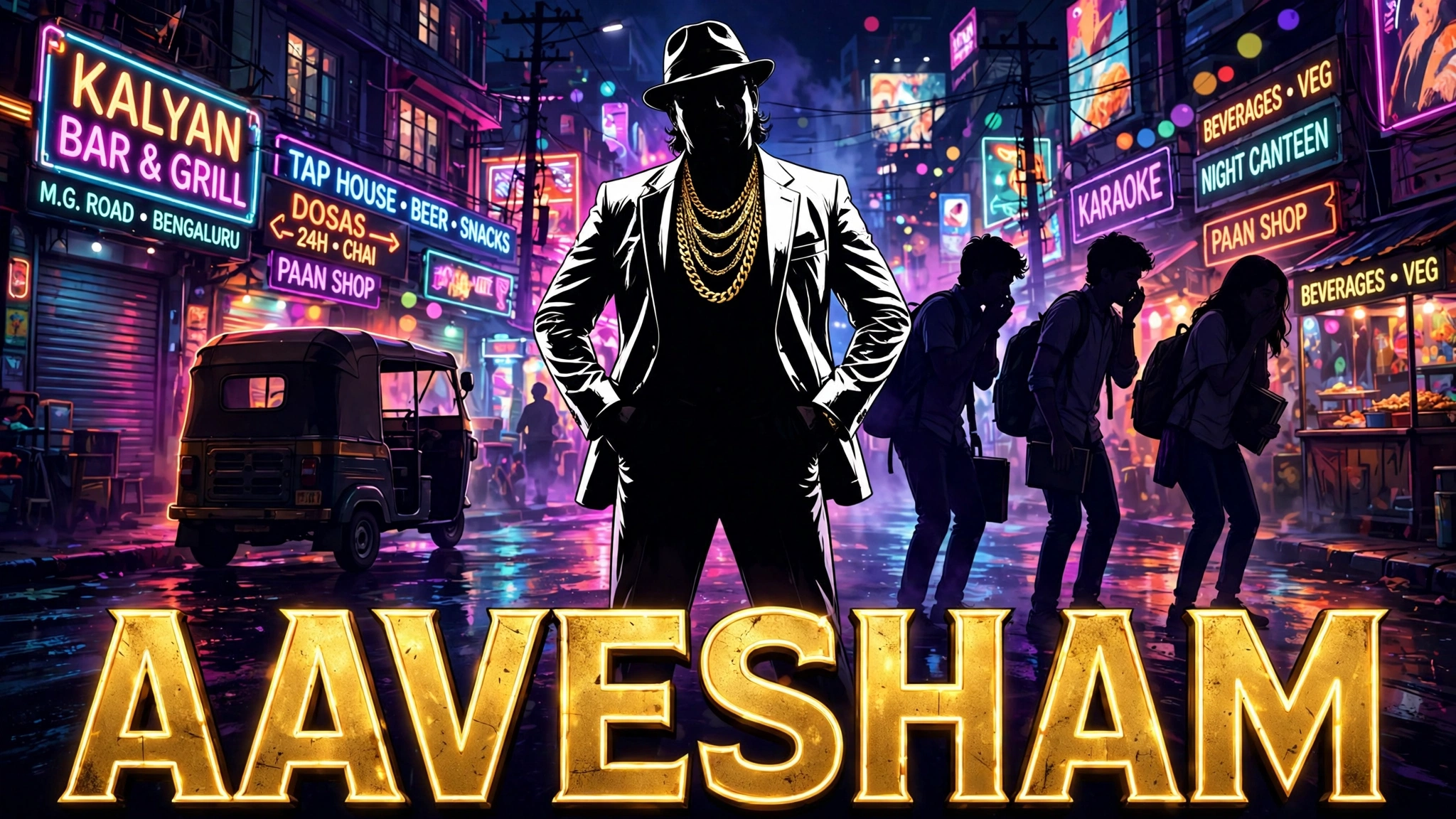
There is a moment, fairly early in Aavesham, when you realise the film is not really about its plot at all. It is about a presence. A man in spotless white, dripping gold chains, speaking a rapid-fire mix of Malayalam and Kannada, laughing too loudly, loving too intensely and frightening everyone in the room without raising a hand — that man is Ranjith “Ranga” Gangadharan, and Fahadh Faasil plays him like an actor who has been waiting his whole career for permission to be this loud. Released on 11 April 2024, during the Eid and Vishu weekend, Jithu Madhavan’s gangster action comedy became one of the defining Malayalam hits of a remarkable year for the industry.
Madhavan arrived with a reputation already forming: his debut, the horror-comedy Romancham, had shown he understood young male friendship, hostel humour and the comedy of ordinary boys stumbling into extraordinary trouble. Aavesham — the title roughly means excitement or frenzy — takes that same energy and plugs it into a gangster story. Three college boys, a feared Bengaluru don, and a friendship that is equal parts blessing and trap: the ingredients are simple, and the film knows it. What it sells instead is momentum, performance and a soundtrack that refuses to leave your head.
This review looks at the story without spoiling its late turns, Fahadh’s barnstorming central performance, the craft behind the madness, Sushin Shyam’s chart-dominating music, and the box office run that turned a mid-budget comedy into a blockbuster — plus an honest account of where the film’s thin plot and long runtime start to show.
| Detail | Information |
|---|---|
| Release date | 11 April 2024 |
| Director | Jithu Madhavan |
| Writers | Jithu Madhavan |
| Genre | Action, Comedy, Gangster |
| Language | Malayalam (with Kannada) |
| Runtime | 159 minutes |
| Budget | ₹30 crore |
| Lead cast | Fahadh Faasil, Hipzster, Mithun Jai Sankar, Roshan Shanavas, Sajin Gopu, Mansoor Ali Khan, Midhutty |
| Our rating | 8/10 |
Aju (Hipzster), Bibi (Mithun Jai Sankar) and Shanthan (Roshan Shanavas) arrive in Bengaluru from Kerala to study aeronautical engineering. They choose a private hostel for the freedom it promises, and for a short while the film is a cheerful campus comedy — new city, new rules, the small thrill of living away from home. Then they cross Kutty (Midhutty), a violent senior whose idea of ragging goes far beyond a joke. Humiliated and beaten, the boys — Aju in particular — decide that the only answer to a bully is a bigger power standing behind them.
So they go looking for a gangster, the way other students might look for a part-time job: bar to bar, name to name, until they find Ranga. Ranga is a Malayali-Kannadiga don of fearsome reputation and completely unpredictable temperament, attended at all times by his loyal, deadpan lieutenant Ambaan (Sajin Gopu), whose lovingly exaggerated stories of Ranga’s past exploits may or may not be true. To the boys’ astonishment, Ranga does not just agree to help them. He adopts them. He feeds them, parties with them, parades them around his world and treats their small college problem with the full machinery of his empire.
That is where the comedy turns clever. The boys wanted a weapon they could point at Kutty and then put away. What they get is a relationship — needy, generous, suffocating and increasingly dangerous — that begins to swallow their studies, their freedom and their sense of who they are becoming. Ranga, for his own lonely reasons, cannot understand why anyone would want to leave. And when a figure from Ranga’s past, his former boss Reddy (Mansoor Ali Khan), enters the picture with old scores to settle, the boys find themselves trapped between the don they used and the don they betrayed him to. How that trap closes — and what Ranga does when he finally loses his patience — is the film’s final-act pleasure, and we will not spoil it here.
Fahadh Faasil as Ranga gives the kind of performance that reorganises a film around itself. Fahadh built his reputation on restraint — on interior, minimalist acting in films where a flicker across his face does the work of a monologue. Ranga is the opposite of all that, and the shock of it is the point. He is theatrical, childish, tender and terrifying, often within a single scene: dancing one minute, wounded the next, telling stories about himself with the pride of a schoolboy and the menace of a man who has genuinely done terrible things. What keeps it from becoming mere mimicry or volume is the loneliness Fahadh keeps visible underneath. Ranga’s love for the boys is real, and so is the damage that made him need it so desperately. It is, as several critics noted at release, the actor’s first full-blooded masala turn — and he does not miss.
Sajin Gopu as Ambaan is the film’s second engine and, in some scenes, its funniest performer. Ambaan narrates Ranga the way a devotee narrates a god — every anecdote taller than the last — and Sajin Gopu’s utter sincerity while telling obvious whoppers is a masterclass in comic deadpan. He also gives the film its bridge between worlds: through Ambaan, the audience learns how Ranga’s empire actually sees itself.
The three newcomers carry more of the film than audiences sometimes credit. Mithun Jai Sankar as Bibi is the emotional centre among the boys — the one whose family we glimpse, whose conscience troubles him first, and whose choices steer the final act. Hipzster as Aju, the instigator, and Roshan Shanavas as Shanthan, the quieter friend, complete a trio whose chemistry feels genuinely like hostel friendship: affectionate, cowardly and competitive in exactly the right proportions. Midhutty as Kutty makes the bully hissable without turning him into a cartoon, and Mansoor Ali Khan as Reddy brings old-school villainous weight to the later portions, giving Ranga a past that feels physically present in the room.
Jithu Madhavan directs for energy above all else, and mostly he gets away with it. The film’s first half is a model of how to build a star entry in stages — Ranga is talked about, mythologised by Ambaan, glimpsed, and only then fully unleashed — so that when Fahadh finally takes over the screen, the film has earned the eruption. Madhavan also understands Bengaluru as a character: the bars, garages, rented houses and college gates are shot as a real, lived-in migrant city, not a postcard, and the Malayali-student experience of it — the freedom and the vulnerability together — is the film’s most honest texture.
Sameer Thahir’s cinematography keeps the frames colourful and mobile, favouring prowling movement in the party and fight sequences that matches Ranga’s restlessness. Vivek Harshan’s editing maintains a breathless clip through the first two-thirds; the Holi fight sequence, in particular, is cut and choreographed with a joy that had theatres erupting. The honest criticism is length and repetition. At 159 minutes — the censor-certified cut ran slightly shorter, at around 157 minutes — the middle stretch circles the same situation (the boys revel, the boys panic, Ranga escalates) more times than the thin plot needs, and a leaner second act would have made the finale hit even harder. The film’s structure is essentially a hangout that turns into a thriller, and viewers who need plot density throughout may feel the sag before the payoff arrives.
If the film has a co-star besides Sajin Gopu, it is Sushin Shyam’s music. The soundtrack — nine tracks, written largely with lyricist Vinayak Sasikumar and performed with a host of independent artists — was built as a party that occasionally darkens into a threat, and it worked exactly as designed. “Illuminati” became a genuine phenomenon, the kind of track that escaped the film into reels, weddings and college festivals across Kerala and beyond; “Jaada”, “Galatta” and “Mathapithakkale” each carried a different flavour of the film’s Bengaluru-Kerala mix. Crucially, the score is not decoration. Ranga’s entrances, his dances and his sudden silences are all musically choreographed, and Sushin Shyam’s background work knows when to drop everything out so that a change in Fahadh’s expression can land like a gunshot. Few Malayalam soundtracks of recent years have been this inseparable from their film’s identity.
What we loved:
What could be better:
The trade picture is unusually clear for a Malayalam release, with one qualification noted below. Produced on a widely reported budget of ₹30 crore — some trade reports put the all-in figure higher once prints and publicity are counted, which is why you will occasionally see numbers in the ₹50 crore range quoted for total cost — Aavesham grossed over ₹156 crore worldwide, with some trackers settling around ₹154 crore depending on how final overseas collections are tallied. Either way, the shape of the achievement is not in dispute: the film earned roughly five times its production budget, finished as the third-highest-grossing Malayalam film of 2024, and sits among the highest-grossing Malayalam films of all time. It did this in a year when Malayalam cinema was producing hit after hit, and it held its screens even after arriving on streaming — arriving on Amazon Prime Video on 9 May 2024, less than a month after its theatrical opening — because audiences kept treating it as a group outing rather than a one-time watch. Word of mouth, repeat youth audiences and the soundtrack’s separate life did what marketing alone rarely can.
Yes — especially with company. Aavesham is a theatre film that survives the television perfectly well, because its pleasures are performance, music and momentum rather than spectacle alone. Watch it for Fahadh Faasil doing something nobody thought he would do this well, for Sajin Gopu’s myth-making, and for the rare gangster comedy that understands its monster is also its most wounded character. Go in knowing the plot is slight and the runtime generous; come out, very probably, humming “Illuminati” and quoting Ambaan.
Our rating: 8/10 — a riotous, star-powered entertainer carried by a performance for the ages, even if its story runs thinner than its running time.
Is Aavesham connected to Romancham?
No. Despite sharing director Jithu Madhavan and actor Sajin Gopu, and despite early reports calling it a spin-off, Madhavan clarified that Aavesham is a standalone film with no story connection to Romancham.
Is Aavesham based on a true story?
No. Ranga and the events around him are fictional creations of Jithu Madhavan, though the Bengaluru student-hostel setting is drawn from recognisable real life.
What does the title Aavesham mean?
Aavesham is a Malayalam word meaning excitement, frenzy or passionate enthusiasm — a fair one-word summary of both Ranga and the film built around him.
Is Aavesham suitable for family viewing?
It is certified U/A. It contains stylised gangster violence, drinking and strong language in places, so it is best suited to older teens and adults rather than young children.
Where can I watch Aavesham?
It streamed on Amazon Prime Video after its theatrical run, with a Hindi version released on Disney+ Hotstar. Availability varies by region, so check your local services.