★ LATEST REVIEWS

★★★★★ Our Rating: 9/10
Most horror films ask one question: what is the monster? The Wailing asks a much crueller one: how would you know? Na Hong-jin’s third feature, released in South Korea on 12 May 2016 and screened out of competition at Cannes the same month, begins as a bumbling rural police comedy, mutates into a murder mystery, then into a shamanic horror film, then into something for which genre labels stop working — a story about a father who must choose whom to believe, with his daughter’s life as the price of choosing wrong, in a world where every expert, every priest and every instinct may be lying to him.
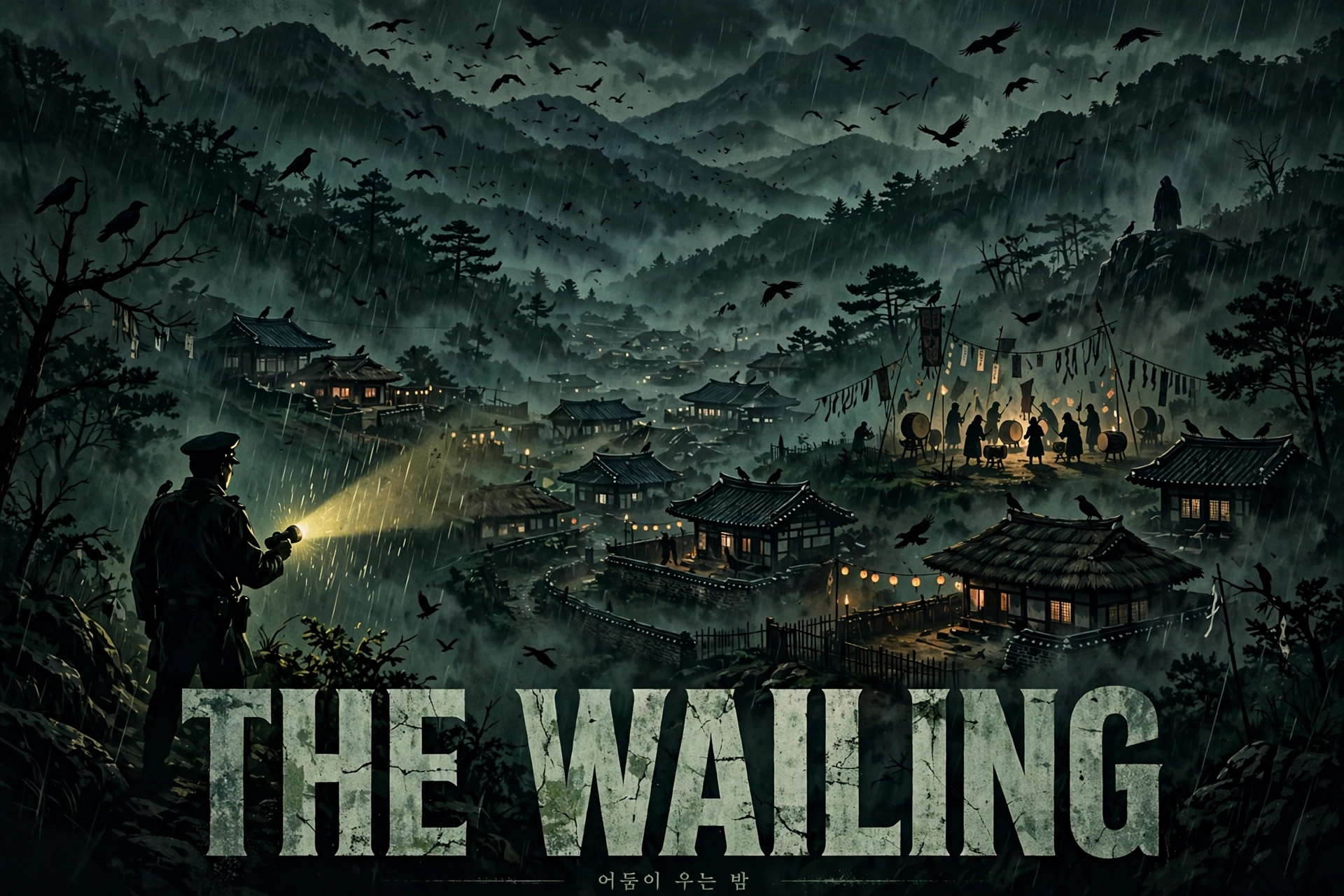
The setting is Gokseong, a real county in South Korea’s Jeolla province whose Korean name happens to sound like the word for wailing or lamentation — a pun the film earns completely. A stranger has recently arrived in the village. Then the sickness starts: villagers break out in boils and madness, and begin murdering their own families. The local police, led by an officer who would rather be fishing, are hopelessly out of their depth. What follows across 156 minutes — a running time this review will argue is fully justified, while admitting it will test some viewers — is widely regarded as one of the greatest horror films of the twenty-first century, and this review will not spoil the reason why. The film’s final act turns on an act of interpretation — a decision about trust — and describing it would be theft.
What can be said openly is this: The Wailing is a film about the failure of every system humans build to explain evil. Medicine fails. Police procedure fails. Christianity fails, shamanism fails, folklore fails, fatherhood itself nearly fails. Whether anything succeeds is the question the film leaves burning in your hands as the credits roll.
| Detail | Information |
|---|---|
| Release date | 12 May 2016 (South Korea); screened at Cannes in May 2016 |
| Director | Na Hong-jin |
| Writers | Na Hong-jin |
| Genre | Horror, Mystery, Thriller |
| Language | Korean, Japanese |
| Runtime | 156 minutes |
| Budget | $8 million |
| Lead cast | Kwak Do-won, Hwang Jung-min, Chun Woo-hee, Jun Kunimura, Kim Hwan-hee |
| Our rating | 9/10 |
Officer Jong-goo (Kwak Do-won) is not a hero. He is late for work, frightened of corpses, henpecked by his mother, outrun by rumours and deeply attached to an easy life in his quiet mountain village. When the first murder scene is called in — a man has slaughtered his family and sits catatonic, covered in boils, eyes milky — Jong-goo’s investigation consists largely of being overwhelmed in several directions at once. More deaths follow, each preceded by the same derangement, and the village fastens on an explanation: the sickness began when a Japanese stranger (Jun Kunimura) moved into a house in the hills. No one knows him. A hunter claims to have seen him in the woods, eyes glowing red, eating a deer raw. A young woman named Moo-myeong (Chun Woo-hee) — literally “no name” — appears at a crime scene, throws stones, vanishes, and later tells Jong-goo the stranger is no man at all.
Na Hong-jin plays this opening stretch partly for comedy — genuine, character-based comedy about inadequate men with clipboards facing the abyss — and the tonal gamble is the film’s masterstroke, because it makes the audience share the village’s fatal error: underestimating what is happening until it is far too late. The turn comes when the sickness enters Jong-goo’s own house. His young daughter Hyo-jin (Kim Hwan-hee), the centre of his life, begins to change — the appetite, the language, the violence simmering under her skin. At that moment The Wailing stops being a mystery about a village and becomes a race run by a desperate father through competing supernatural claims. A famous shaman, Il-gwang (Hwang Jung-min), is hired at ruinous expense and announces his own confident diagnosis. A young Catholic deacon is recruited to translate and to help. Rituals are performed; confrontations are staged; evidence is found that seems damning, then seems planted.
This review will go no further into the plot, and specifically will not discuss the film’s final scenes, the stranger’s true nature, or Moo-myeong’s identity — the three subjects the entire internet argues about. Know only that the last half-hour converts everything before it into a single unbearable question addressed to Jong-goo and, through him, to you: with everyone claiming to protect the child and everyone contradicted by someone else, what does a father do? The film’s title stops being about the village. It is the sound the audience makes.
Kwak Do-won as Jong-goo delivers one of the great performances in Korean cinema, in his first leading role. Kwak — a familiar supporting face from The Attorney and Na’s own The Yellow Sea — builds Jong-goo from comedy upward: the shambling lateness, the fear, the appetite, the whining, are never a joke at the character’s expense but a measurement of what an ordinary man actually has to fight the supernatural with. As Hyo-jin sickens, Kwak strips the comedy away layer by layer until what remains is pure animal desperation — a father bellowing at doctors, shamans, gods and suspects with the same helpless rage. It is a performance of total emotional exposure, and the film’s climax is unbearable largely because Kwak has made you believe this man completely.
Hwang Jung-min as Il-gwang is electric in a completely different register. Hwang, one of Korea’s most reliable stars, plays the shaman as a slick modern professional — designer clothes, expensive car, total confidence, a man who treats exorcism as a premium service industry. His centrepiece is a ritual sequence of drumming, dancing and sacrificial frenzy, cross-cut by Na with a parallel ceremony elsewhere, that ranks among the most intense passages in modern horror — and Hwang’s terrifying conviction in it makes the film’s doubts cut deeper, because if this man is wrong, or worse, then charisma itself is a trap. Jun Kunimura as the stranger gives a performance of almost total withholding: a weathered Japanese screen legend playing a man who fishes, photographs, keeps to himself and may be the devil — Kunimura lets suspicion do all the acting, which is precisely the film’s point about how evil is identified, and by whom.
Chun Woo-hee as Moo-myeong performs the film’s most difficult balancing act in its smallest amount of screen time, appearing at edges and thresholds like a figure in a folktale, her youth and plain white clothing carrying meanings the film deliberately refuses to settle. And Kim Hwan-hee as Hyo-jin, a child actor at the centre of a gruelling production, is simply astonishing — funny and natural in the early scenes, then frightening and heartbreaking as the sickness takes her, delivering lines no child should have to deliver with a conviction that anchors the whole film’s stakes in one small, suffering person.
Na Hong-jin spent years developing this film after The Chaser (2008) and The Yellow Sea (2010), and the control shows in every sequence. His camera, guided by cinematographer Hong Kyung-pyo, renders Gokseong as a place of saturated green mountains, endless rain and mud — beautiful, fertile and rotting all at once, a landscape where things grow wrong. The production design fills the stranger’s house and the village homes with accumulating, tactile detail, so that when the film produces its famous room of evidence — photographs, belongings, a shrine of other people’s lives — the horror is documentary rather than decorative.
Structurally, Na is doing something almost no mainstream horror attempts: he keeps changing the film’s genre and its rules. Police procedural, folk tale, possession film, zombie outbreak, theological debate — each framework explains the events for a while and then fails, and the audience is put through exactly the villagers’ experience of grabbing at explanations. The set pieces are extraordinary: the paired rituals edited into a duel of gods; a chase through rain and forest that produces the film’s most shocking single image; a sequence involving a reanimated corpse that manages to be terrifying and absurd and tragic in the same minute. The honest criticisms are real but minor. At 156 minutes the film is long, and its middle passage — Jong-goo’s investigations circling the stranger — repeats beats some viewers will feel. The tonal shifts, from slapstick to atrocity, will alienate a portion of any audience no matter how deliberate they are. And Na’s refusal to confirm an interpretation, in a film this full of evidence arranged like a court case, is either its genius or its cheat depending on the viewer. This review stands with the majority verdict: the ambiguity is the subject, not an evasion — but anyone who needs horror to conclude should be warned that The Wailing ends with a question mark carved in stone.
The score, by Jang Young-gyu and Dalpalan, is built from Korean traditional instrumentation — percussion above all — woven into modern horror scoring, so that the film’s sound world belongs to its village rather than to a Hollywood template library. The shamanic ritual music is not background at all but a weapon wielded inside the story: drums and bells performed at punishing intensity as Il-gwang works, answered by the film’s unnerving silences and by the sounds of rain, thunder and crows that function as Gokseong’s permanent chorus. Jang and Dalpalan understand that this is a film about competing signals — every faction in the story arrives with its own sound, its own ritual noise claiming authority — and the mix keeps the audience, like Jong-goo, straining to decide which sound is the true one.
What we loved:
What could be better:
Produced for a reported $8 million, The Wailing opened at number one in South Korea — dethroning Captain America: Civil War in the process — and, powered by some of the strongest word of mouth in Korean box office history, reached roughly 6.88 million admissions at home according to Korean Film Council figures. Worldwide totals are most commonly reported around $51.3 million, with some trackers listing figures just under $50 million depending on the territories and reporting period counted; either way, the film returned many times its production cost and became a substantial international success for a subtitled, two-and-a-half-hour horror film with no internationally famous stars. Its Cannes screening triggered sales across major territories, and its reputation has only grown since — it now sits permanently on lists of the greatest horror films ever made, an afterlife worth far more than its opening weekend.
Yes — with one condition: watch it in one sitting, in the dark, and do not look up a single explanation beforehand. The Wailing is that rare horror film that grows scarier the longer you think about it, because its subject is not a demon but the moment a loving father, surrounded by confident liars, has to decide. If you finish it arguing about what really happened, the film has worked exactly as intended.
Our rating: 9/10 — a towering achievement of folk horror and the most unsettling film about faith, doubt and fatherhood that modern Korean cinema has produced.
Is The Wailing based on a true story?
No. It is an original screenplay by Na Hong-jin, drawing on Korean shamanism, Catholic demonology, folklore and police-procedural conventions. The village name, Gokseong, is a real county, and its sound — like the word for lamentation — is a deliberate wordplay.
Do we ever find out what the stranger really is?
The film provides evidence for several readings and confirms none of them outright. That refusal is the film’s central design: the horror lies in Jong-goo having to act without certainty. Going in expecting a definite answer is the one sure way to be frustrated.
How scary and how violent is The Wailing?
Very atmospheric and increasingly disturbing, with sudden violence, murder aftermaths, possession behaviour and one corpse sequence that is hard to forget. It is frightening through dread and implication far more than through gore, but it is absolutely not a film for the faint-hearted or for children.
Why is The Wailing so long, at 156 minutes?
Because it is effectively four films in sequence — comedy-procedural, mystery, possession horror and theological tragedy — and Na Hong-jin needs the audience to live inside each one before it collapses. Most viewers who commit to it find the final hour flies.
Where can I watch The Wailing?
It streams on horror and general platforms in many territories and is widely available on home video with subtitles. Availability varies by region, so check your local services.