★ LATEST REVIEWS

Our Rating: ★★★★★ 9.5/10
Every con film promises that nothing is what it seems. The Handmaiden keeps that promise three times over, then adds something most con films never attempt: genuine emotional stakes underneath the machinery. Park Chan-wook’s 2016 erotic psychological thriller relocates Sarah Waters’ Victorian novel Fingersmith to Korea under Japanese colonial rule, and in doing so makes the story sharper, stranger and more beautiful than a faithful adaptation could have been. It premiered in competition at Cannes, won the BAFTA for Best Film Not in the English Language, and has settled into the small group of modern thrillers that critics describe, without much argument, as a masterpiece.
Any honest The Handmaiden review must also be clear about what kind of film this is. It is an adult work — an erotic thriller with explicit material and disturbing themes, handled here professionally and discussed in this review in terms of story, performance and craft rather than detail. It is also, beneath that surface, a film about women escaping the men who script their lives. This review covers its three-part story without spoiling its turns, its remarkable lead performances, Park’s meticulous direction, and the few places where its length and coldness may test its audience.
| Detail | Information |
|---|---|
| Release date | 1 June 2016 (South Korea); premiered 14 May 2016 at the Cannes Film Festival |
| Director | Park Chan-wook |
| Writers | Park Chan-wook, Jeong Seo-kyeong; based on the novel Fingersmith by Sarah Waters |
| Genre | Erotic Psychological Thriller, Drama, Romance |
| Language | Korean, Japanese |
| Runtime | 144 minutes (theatrical cut); 168 minutes (extended cut) |
| Budget | ₩10 billion (approximately $8.8 million) |
| Lead cast | Kim Min-hee, Kim Tae-ri, Ha Jung-woo, Cho Jin-woong |
| Our rating | 9.5/10 |
In 1930s Korea, under Japanese occupation, a young pickpocket named Sook-hee (Kim Tae-ri) is recruited for the most ambitious job of her life. A swindler posing as a Japanese count, Fujiwara (Ha Jung-woo), wants her placed inside a grand, isolated estate as handmaiden to Hideko (Kim Min-hee), a Japanese heiress who lives under the control of her domineering uncle Kouzuki (Cho Jin-woong). Sook-hee’s task is to win the lady’s trust and steer her toward eloping with the “Count”, after which Hideko is to be robbed of her inheritance and disposed of in an asylum. Sook-hee, raised among thieves and forgers, accepts the role with professional cheer.
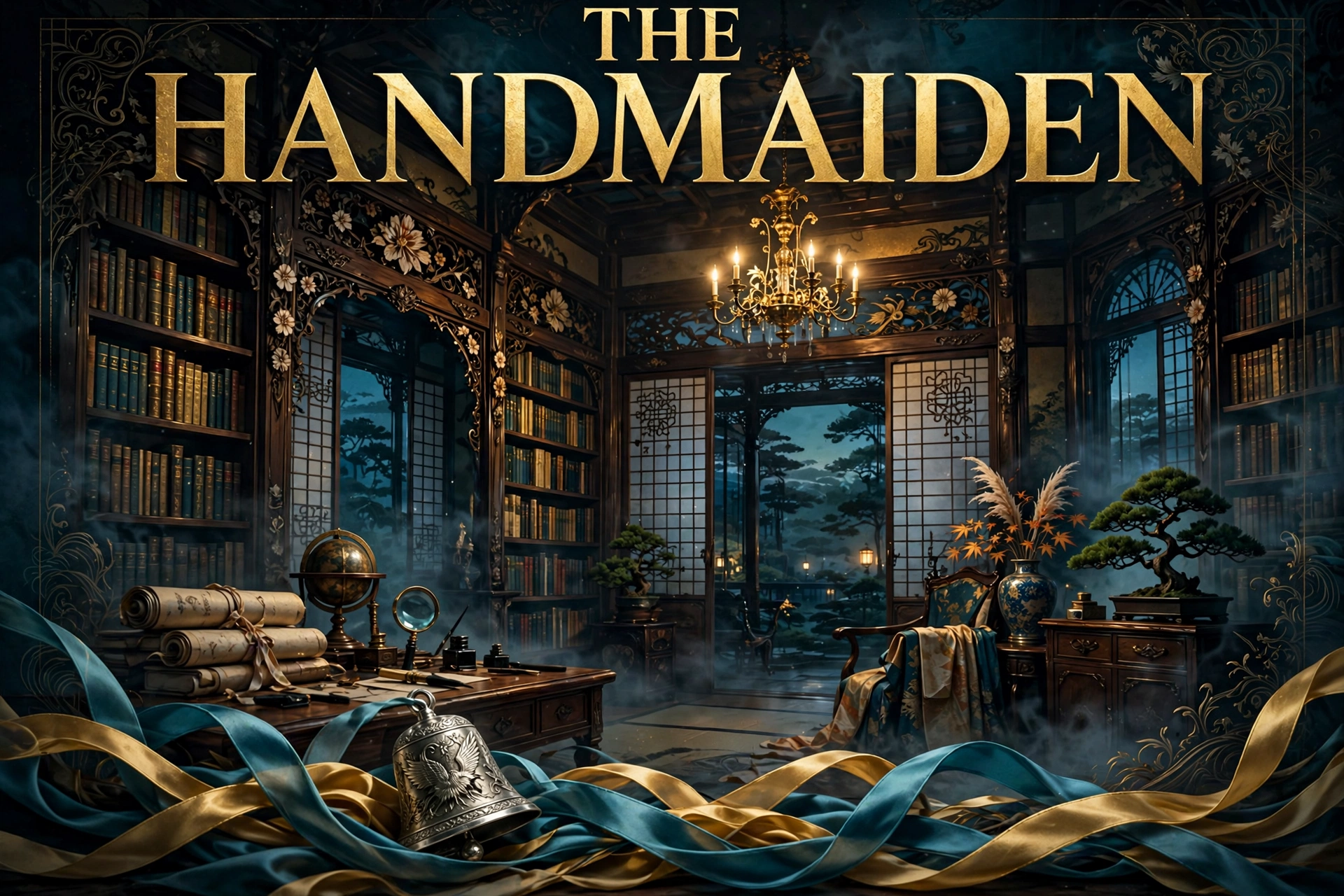
The estate itself is the first warning that this story has layers. It is a hybrid house — part English country manor, part Japanese residence — with a famous library where Hideko is forced to perform readings for her uncle’s guests, and where her childhood has left marks the film reveals slowly. As Sook-hee settles into service, the simple geometry of the con begins to wobble. Affection, pity and desire complicate a job that required none of them, and the film — structured in three parts — begins to replay events from new perspectives, each pass revising what the audience thought it understood about who is deceiving whom.
To say more would be theft, because The Handmaiden‘s plot is one of its great pleasures: a clockwork of reversals that still leaves room for character. What can be said safely is that the film’s final movement reframes the entire story thematically. This is not only a film about a fortune. It is about who gets to author a woman’s life — an uncle, a con man, a society — and what it costs to seize that authorship back. The colonial setting is not decoration, either: language itself becomes a tool of power and deception, with Korean and Japanese switching places as masks throughout.
Kim Tae-ri as Sook-hee was, remarkably, a newcomer chosen from a huge open casting search, and she plays opposite veterans as if she had been doing it for years. Her Sook-hee is quick, funny, physically nimble and morally flexible — a professional liar whose face nonetheless keeps betraying her. Kim gives the character a street survivor’s alertness and, as the con deepens, a dawning horror at her own role in it. It remains one of the great debut performances in modern Korean cinema.
Kim Min-hee as Hideko has the harder assignment: a character who must be plausible in several contradictory versions as the film’s perspective shifts. Her Hideko begins as a fragile, sheltered figure in gloves and formal dress, and Kim calibrates the performance so carefully that later revelations recontextualise, rather than contradict, what she showed earlier. It is precise, brave work in a demanding role, and the chemistry between the two leads — conspiratorial, tender, wary — is the film’s true special effect.
Ha Jung-woo as Count Fujiwara plays the con man with silky self-satisfaction, a performance that understands the character’s charm and his rottenness are the same quality. Ha never asks for sympathy, which makes his scenes crackle with risk. Cho Jin-woong as Uncle Kouzuki is the film’s cold centre: soft-spoken, cultivated and monstrous, a collector whose obsession with rare books and control extends to every person in his house. Cho plays him without melodrama, and is more frightening for it. Together the four create a quartet in which everyone is performing — for money, for safety, for survival — and the film keeps asking which performance is most honest.
Park Chan-wook directs with the total control that has defined his work since Oldboy, but the register here is different: luscious rather than brutal, patient rather than explosive. Cinematographer Chung Chung-hoon frames the estate as a dollhouse of secrets — corridors, screens, gardens and that extraordinary library — and the camera glides and peers with a curiosity that mirrors the characters’ spying on one another. The production design, which won wide international recognition, fuses English and Japanese architecture to make the house itself a portrait of its owner: a Korean who has built his identity out of other cultures’ prestige, and imprisoned his niece inside it.
The three-part structure is the craft decision everything else serves. Park replays sequences from altered viewpoints, adding a glance here, a whispered aside there, so that information itself becomes the film’s action. Editing by Kim Jae-bum and Kim Sang-bum keeps these repetitions fresh rather than repetitive — a genuine achievement at 144 minutes. If there is a criticism, it is that the film’s perfection can feel airless in stretches; Park’s control is so complete, and his sympathy so carefully rationed, that some viewers will admire the film more than they feel it, particularly in a middle section where the plot’s gears are most visible. Others will argue that the emotional payoff, when the machinery finally serves the characters instead of trapping them, lands precisely because of that earlier chill.
Jo Yeong-wook, Park’s long-standing composer, gives the film a score of strings, piano and period flavour that plays a double game of its own. On the surface it is romantic and elegant, suiting the estate’s polished surfaces; underneath, its repetitions and swells accompany manipulation as often as sincerity, so the audience learns to distrust even the music’s beauty. The score’s restraint matters as much as its lushness — Park leaves key confrontations dry and lets performance carry them — while the sound design makes small objects significant: footsteps on gravel, fabric, and a small bell whose meaning the film transforms entirely. It is refined, intelligent work that supports the film’s themes instead of merely decorating them.
What we loved:
What could be better:
For an adults-only, subtitled, two-and-a-half-hour erotic thriller, The Handmaiden performed impressively. Produced for ₩10 billion — about $8.8 million — it drew 4,290,099 admissions in South Korea according to the Korean Film Council (KOFIC), a major result for a film rated for adults only in its home market and one of the strongest Korean openings for director Park Chan-wook. KOFIC’s cumulative domestic gross figures vary somewhat between reporting snapshots, roughly between $23.6 million and $26.2 million, a discrepancy readers should note rather than resolve by picking the largest number.
Worldwide totals likewise form a range across trackers — commonly cited figures run from about $35 million to $38.8 million. The honest summary is a global gross in the high-$30 millions on a sub-$9 million budget: a clear commercial success, before its long afterlife in awards and home viewing. Its honours include competition selection at Cannes, the BAFTA for Best Film Not in the English Language — the first Korean film to win that award — and multiple prizes at the Asian Film Awards. Few films of its kind have combined this level of critical prestige with this level of popular reach.
If you love thrillers built like precision instruments — and you are an adult comfortable with an adult film — this is essential viewing, one of the defining Korean films of its decade. Go in knowing as little as possible, forgive the opening stretch its patience, and let the structure do its work. Viewers who prefer warmth to elegance, or who are put off by explicit material and dark subject matter, should choose something else without regret; the film does not soften itself, and it is not trying to.
Seen on its own terms, The Handmaiden is a triumph of direction, design and performance in which every reversal also reveals character. It is beautiful, unsettling and, in its final accounting, unexpectedly humane about the people its plot has spent two hours deceiving us with.
Our rating: 9.5/10 — a masterfully constructed, visually sumptuous thriller with two career-defining lead performances.
Is The Handmaiden suitable for all audiences?
No. It is an adult erotic psychological thriller, rated for adults only in South Korea (19) and unrated or adults-only in many other markets. It contains explicit adult content, disturbing themes including coercion and confinement, and some violence. It is intended strictly for adult viewers; this review discusses it in non-explicit, professional terms.
Is The Handmaiden based on a book?
Yes. It adapts Sarah Waters’ 2002 novel Fingersmith, moving the setting from Victorian Britain to 1930s Korea and Japan under colonial rule and changing significant elements of the story. Knowing the novel does not spoil the film’s later turns.
Do I need to watch the extended cut?
No. The 144-minute theatrical cut is the complete, definitive experience for most viewers. The 168-minute extended cut adds character detail and is best saved for a second viewing if you love the film.
Is The Handmaiden a horror film?
No, though it contains unsettling and gothic elements. It is best described as an erotic psychological thriller and drama with a con-artist plot, from the director of Oldboy and Thirst.
Where can I watch The Handmaiden?
It is available on major streaming platforms and on Blu-ray in many regions, in both theatrical and extended versions. Availability and age restrictions vary by country, so check your local services.