★ LATEST REVIEWS

Our Rating: ★★★★☆ 7.5/10
Every Thai audience already knew how this story ends. The legend of Mae Nak Phra Khanong — the devoted wife who dies in childbirth while her husband is away at war, and whose spirit refuses to leave him — has been told for generations and filmed many times. So when director Banjong Pisanthanakun retold it in 2013 as a horror-comedy, with the husband, Mak, at the centre instead of the ghost, the gamble was not the plot. It was the tone: could Thailand’s most famous ghost story be funny, romantic and frightening in the same scene? This Pee Mak review answers as more than a billion baht of ticket-buyers did — yes, mostly, and irresistibly.
Our verdict: as horror, Pee Mak is gentle; as comedy, it is frequently very funny; and as a love story, it lands an emotional ending that tougher films would envy. It became the highest-grossing Thai film of all time on release, and its secret is not originality — it is warmth, plus four of the best comic sidekicks in Thai cinema history.
| Detail | Information |
|---|---|
| Release date | 28 March 2013 (Thailand) |
| Director | Banjong Pisanthanakun |
| Writers | Nontra Khumvong, Banjong Pisanthanakun, Chantavit Dhanasevi |
| Genre | Horror, Comedy, Romance |
| Language | Thai |
| Runtime | 115 minutes |
| Budget | Approx. $1.8 million |
| Lead cast | Mario Maurer, Davika Hoorne, Pongsathorn Jongwilas, Nattapong Chartpong, Auttarut Kongrasri, Kantapat Permpoonpatcharasook |
| Our rating | 7.5/10 |
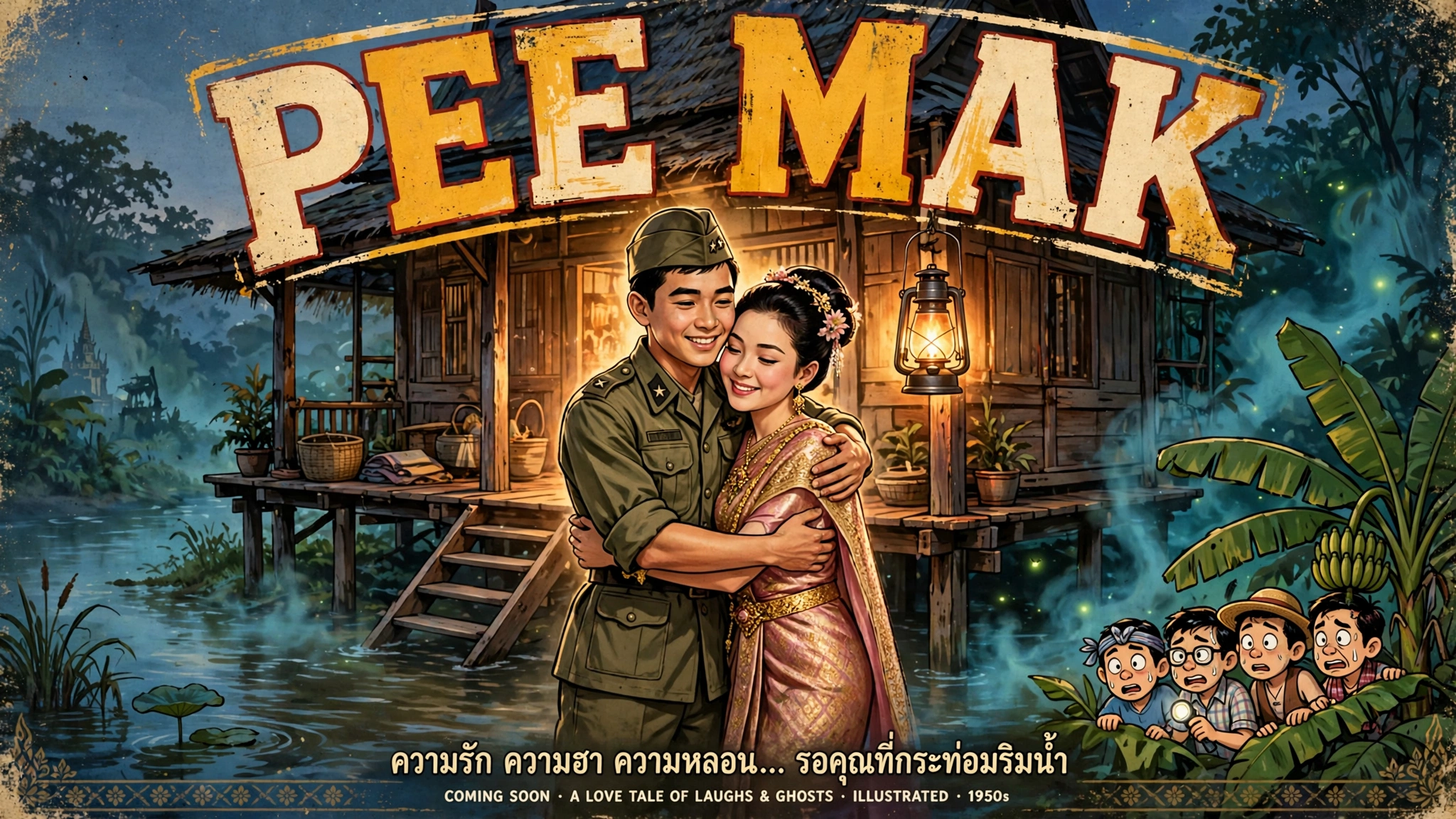
In the early Rattanakosin era, young Mak (Mario Maurer) is called away to fight in a war, leaving behind his pregnant wife Nak (Davika Hoorne) in their home in Phra Khanong, along the canals outside Bangkok. The fighting is miserable, and Mak survives it in large part because of the four fellow soldiers who become his brothers: Ter (Nattapong Chartpong), Puak (Pongsathorn Jongwilas), Shin (Auttarut Kongrasri) and Aey (Kantapat Permpoonpatcharasook) — a bickering, cowardly, devoted quartet who save his life and accept his invitation to stay at his home while they recover and figure out their futures.
The homecoming is blissful. Nak is beautiful, devoted, and waiting with their baby son. The house is happy. There is only one problem, and the whole village knows it: the neighbours will not visit, will not trade, will barely speak — because, they whisper, Nak died in childbirth while Mak was away, and the woman in that house is a ghost. The four friends, arriving as outsiders, begin to collect the evidence themselves: strange behaviour, impossible sights, a house the locals treat as cursed ground. Everything they find points one way, and none of them can work out how to tell a man who adores his wife that his wife is dead.
The film plays this as farce and mystery at once. The friends’ investigations are elaborate, terrified and consistently disastrous; the village’s fear is both a joke and, the film insists, a fact; and Mak’s refusal to see what is in front of him is played first as comedy, then, increasingly, as the story’s emotional question. Is he a fool who cannot see — or the only person looking properly? The traditional legend ends one famous way; this telling keeps the destination but changes its meaning entirely, and we will not spoil how.
Mario Maurer as Mak was already one of Thailand’s biggest young stars, and this role shows why. Mak is written as lovably dim — slow to understand, quick to love — and Maurer plays the dimness without contempt, so the character’s devotion reads as purity rather than stupidity. That choice is what the entire ending stands on: when the film asks you to take Mak’s feelings seriously after two hours of laughing at him, Maurer’s sincerity makes it work.
Davika Hoorne as Nak carries the film’s trickiest balance. She must be a convincing romantic lead, a figure who can turn frightening in a single shot, and — hardest of all — sympathetic in a story where the village’s terror of her is justified. Hoorne manages all three registers, often within one scene, and brings a stillness that contrasts beautifully with the frantic energy around her. Her Nak is not a monster with a tragic backstory; she is a wife whose love outlasted her life, and the film is on her side.
The four friends — Nattapong Chartpong as Ter, Pongsathorn Jongwilas as Puak, Auttarut Kongrasri as Shin and Kantapat Permpoonpatcharasook as Aey — are the film’s comedy engine and, frankly, its main event for long stretches. The quartet had worked with Banjong before on his horror anthologies, and their shared timing shows: they improvise, overlap, panic in chorus and divide every classic trait among them — the self-appointed leader, the coward, the fool, the skeptic. Thai audiences recognised them as a beloved unit, and their scenes of escalating, terrified investigation are where the film’s biggest laughs live. If the comedy has a weakness, it is structural: the four are so entertaining that Mak and Nak’s quieter scenes sometimes feel like pauses between the friends’ routines, rather than the other way round.
Banjong Pisanthanakun came to this film as one of the architects of modern Thai horror — he co-directed Shutter (2004) and made segments of the hit anthologies 4bia and Phobia 2 — and his genre instincts are all over Pee Mak in the best way. He knows exactly how a ghost scene is supposed to feel, which means he knows exactly where to place the joke: the scares are staged sincerely, built with patience and shadow, and then punctured by the friends’ reactions at the precise moment of maximum tension. Comedy made by a horror director turns out to be scarier, and funnier, than either genre usually manages alone.
The period production is handsome for the film’s modest budget. The riverside village, wooden houses on stilts, canal boats and torchlit interiors build a storybook past that suits a folktale, and the ghost effects are used sparingly and practically where possible, so they age better than an effects-heavy production would. The editing keeps a brisk farce rhythm in the investigation scenes while allowing the romantic passages their slower, golden light.
Honest craft caveats: the film’s middle section leans hard on repeated variations of one comic situation — the friends discovering something, panicking, and failing to convince Mak — and the repetition, however well performed, flattens the pacing for a stretch. Some of the humour is also broadly slapstick in a local register that subtitles cannot fully carry; international viewers will enjoy these scenes, but Thai audiences are demonstrably laughing at more of them.
The music, credited to Chatchai Pongpraphaphan together with Hualampong Riddim, performs the same balancing act as the direction. Traditional Thai textures and gentle romantic themes underline Nak and Mak’s scenes, while the score leans into classic horror grammar — hushed strings, sudden accents — for the hauntings, entirely straight-faced, so the comedy can supply the release. That discipline matters: a score that winked at the audience would deflate both the scares and the love story. Instead, the music treats Nak’s longing as sincerely as any melodrama, which is why the film’s final movement can pivot to genuine emotion without changing its musical language at all. It is not a score you will remember as themes; it is one you remember as feeling.
What we loved:
What could be better:
The scale of the success is beyond dispute, even if the precise total depends on which count you use. Pee Mak was made for approximately $1.8 million and became the highest-grossing Thai film of all time on its release, more than tripling the previous record held by The Legend of Suriyothai. Contemporary reporting, repeated by the studio and press across Asia, put its worldwide revenue at more than 1 billion baht — roughly $33 million at the time — with a reported 16 million tickets sold, and noted it as the first Thai film released in every Southeast Asian country. Some international box-office databases, however, list a lower tracked theatrical total of around $20.9 million, and reports differ on what the higher figure includes beyond tracked cinema grosses. We therefore describe it honestly as reports ranging from about $21 million in tracked listings to over 1 billion baht (about $33 million) in the widely reported total. What no source disputes is the ranking: in Thailand and across the region, this modest ghost comedy out-grossed every Thai film before it, and it held that crown for years. Few films anywhere have returned their budget this many times over.
Watch it — with the right expectations, which are these: do not come for a horror film that will keep you awake, because that is not what this is, and do not come for a slick modern comedy, because its pleasures are warmer and broader than that. Come for a beautifully performed folktale that makes you laugh for two hours and then, quite unfairly, makes you care. Horror-comedy is the hardest tone in cinema to hold, and Pee Mak holds it with a sincerity most attempts never find. Judged as the crowd-pleaser it set out to be, it is a triumph; Thailand did not make it the country’s biggest film by accident.
Our rating: 7.5/10 — a funny, tender, record-breaking crowd-pleaser; mild as horror, mighty as heart.
Is Pee Mak based on a true story?
It is based on the Mae Nak Phra Khanong legend, one of Thailand’s most famous folktales, traditionally said to derive from events in the nineteenth century. The film’s version, told from Mak’s perspective with a comic tone, is a new retelling, not a historical account.
Is Pee Mak scary?
Mildly. It has genuine ghost-story atmosphere and a few well-built scares, but its dominant modes are comedy and romance. Most viewers who avoid hard horror will manage it comfortably; young children may still find Nak’s ghost scenes unsettling.
Do I need to know the Mae Nak legend to enjoy Pee Mak?
No. The film explains its premise clearly and plays fair with newcomers. Knowing the legend adds a layer — you will appreciate how boldly the film changes the story’s usual emphasis — but it is not required.
Is Pee Mak suitable for family viewing?
Broadly, yes: it is a mainstream crowd-pleaser with gentle scares, slapstick comedy and a love story at its centre, and no graphic content. Parents of very young children should expect a few ghostly images.
Why was Pee Mak such an enormous hit in Thailand?
It combined a story every Thai viewer grew up with, two of the country’s biggest young stars, a beloved comic quartet, and a director trusted by horror audiences — then told the legend as a funny, romantic film entire families could attend together. Word of mouth did the rest.