★ LATEST REVIEWS

Our Rating: ★★★★☆ 8.5/10
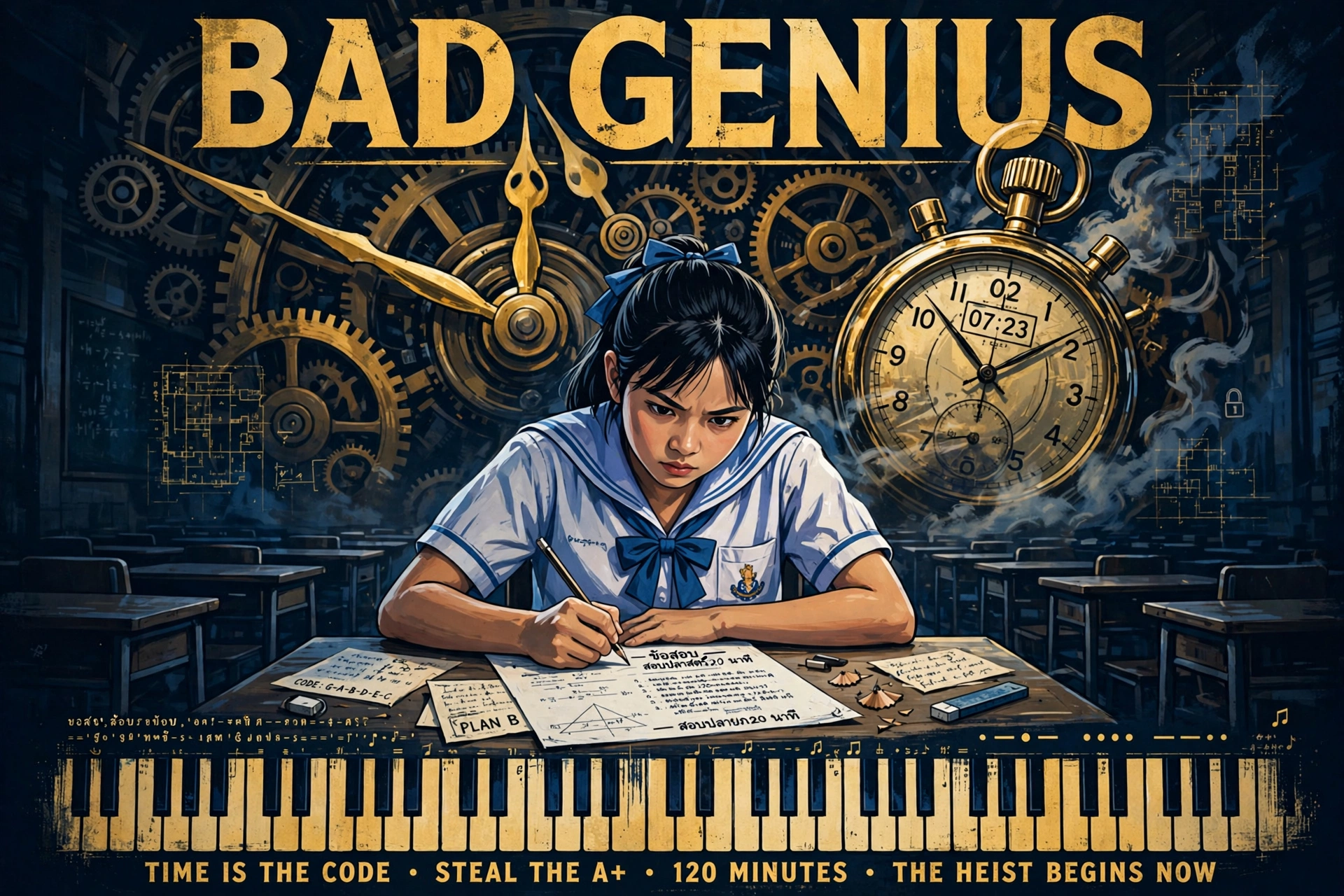
Every heist film needs three things: an impossible target, a crew with complementary skills, and a plan so precise it has to be rehearsed like music. Bad Genius has all three — except the target is a test paper, the crew are schoolchildren in uniform, and the loot is measured in exam grades and envelopes of cash. This Bad Genius review covers the original 2017 Thai film, directed by Nattawut Poonpiriya, which became the highest-grossing Thai film of its year at home and then did something no Thai film had done before: it conquered China’s box office.
Our verdict up front: this is one of the most purely entertaining thrillers of the last decade, and one of the smartest. It generates more tension from a girl erasing a pencil mark than most action films manage with a bomb, and underneath the fun it is quietly furious about money, class and who the education system is really built for. A heist film, a school drama and a social critique walk into an exam hall — and all three leave with top marks.
| Detail | Information |
|---|---|
| Release date | 3 May 2017 (Thailand) |
| Director | Nattawut Poonpiriya |
| Writers | Nattawut Poonpiriya, Tanida Hantaweewatana, Vasudhorn Piyaromna |
| Genre | Heist, Thriller, Drama |
| Language | Thai |
| Runtime | 130 minutes |
| Lead cast | Chutimon Chuengcharoensukying, Chanon Santinatornkul, Teeradon Supapunpinyo, Eisaya Hosuwan |
| Our rating | 8.5/10 |
Lynn (Chutimon Chuengcharoensukying) is a scholarship student with a perfect academic record and a widowed father, a schoolteacher, whose income cannot stretch to the extras her elite Bangkok school quietly expects families to pay. She is, by every account, the cleverest person in any room she enters — including the rooms full of teachers.
Her entry into crime is small and almost kind. Her new friend Grace (Eisaya Hosuwan), wealthy, warm-hearted and academically drowning, begs for help before an exam, and Lynn helps her — once — in the moment, with an improvised method for passing an answer that is as elegant as it is risky. Grace’s boyfriend Pat (Teeradon Supapunpinyo), rich, charming and ruthlessly commercial, immediately sees what Grace cannot: this is not a favour, it is a business. Their wealthy classmates will pay serious money for guaranteed answers, and Lynn’s cut could pay every fee her father struggles with, and more.
Lynn builds the operation the way she builds everything: brilliantly, systematically, with rehearsed signals and contingency plans, treating the exam hall like a casino floor and the invigilators like security cameras to be mapped and beaten. But a scheme like this needs a second genius to scale up, and the only one available is Bank (Chanon Santinatornkul), another scholarship student, a boy with a photographic memory and a fierce, principled refusal to cheat — whose family’s poverty is even sharper than Lynn’s. Persuading Bank becomes the film’s moral centre of gravity.
The final movement raises the stakes from school exams to an international university-admissions test, administered across time zones, with a fortune on the table and zero margin for error. We will not describe how the plan works or whether it succeeds — discovering the mechanics, in the theatre of the film’s editing, is the whole joy of it. It is enough to say the last act plays like Ocean’s Eleven staged in a silent room full of desks, and it will leave your palms sweating. The film was inspired by real news reports of organised cheating on international admissions tests in Asia, and it keeps that uncomfortable plausibility throughout: nothing here requires a superpower, only genius, nerve and desperation.
Chutimon Chuengcharoensukying as Lynn gives one of the great debut performances in modern Asian cinema — this was her first feature film, after a modelling career, and she acts like a veteran. Her Lynn is not a rebel or a show-off; she is a logician, and Chutimon plays the character’s intelligence as a physical quality: still, watchful, calculating behind her eyes while adults talk past her. The performance deepens as the money grows — watch how Lynn’s confidence curdles into something colder, and how the actress lets the girl’s loneliness show through the competence. The film’s entire structure stands on her, and she never wobbles.
Chanon Santinatornkul as Bank has the hardest role: the honest boy. Bank’s refusal to cheat is not priggishness but survival — a scholarship is all he and his mother have — and Chanon plays his principles and his poverty as the same wound. His scenes with Chutimon carry the film’s real emotional charge, two brilliant poor kids regarding each other across a moral line both understand completely. Teeradon Supapunpinyo as Pat is perfectly cast as entitlement with a smile: funny, generous with money that is not his, and casually certain the rules are for other people. Eisaya Hosuwan as Grace, the operation’s unwitting founder, plays warmth and dimness without ever becoming a caricature — her friendship with Lynn is the film’s saddest casualty, and Eisaya makes you feel its cost.
Thaneth Warakulnukroh as Lynn’s father deserves special mention. In a handful of scenes he builds a complete man: proud, gentle, teaching other people’s children while quietly failing to afford his own daughter’s schooling. What Lynn does, she does in his name — which is what makes the film’s judgment of her so complicated, and so good.
Nattawut Poonpiriya directs Bad Genius as if it were an action film, and that decision is the film. Working with cinematographer Phaklao Jiraungkoonkun, he shoots exam halls like heist locations: sweeping moves down aisles of desks, inserts of pencils, erasers, watches and wandering invigilators’ eyes, every classroom mapped as carefully as any bank vault in the genre. The camera’s energy tells you how to feel — this is not homework, this is a robbery conducted in whispers.
Editor Chonlasit Upanigkit is the film’s co-author in all but credit. The cheating sequences are cross-cut like safecracking scenes, interlocking Lynn’s actions, her clients’ reactions and the authorities’ patrol patterns into clockwork suspense, and the final act’s editing — juggling continents, time zones and a dozen moving parts — is a genuine tour de force that never confuses the audience about where anyone is or what is at stake. Just as impressive is the restraint elsewhere: family dinners and school corridors are allowed to breathe at natural speed, so the audience feels the gear-change when an operation begins.
The craft has one honest weakness, and most critics noted it: the final stretch, after the heist mechanics conclude, reaches for a moral resolution that is tidier and more sentimental than the sharp, cynical film before it has quite earned. It does not spoil the experience, but you can feel the machinery soften. Until then, the film’s discipline is remarkable for a second feature.
The score is credited to Hualampong Riddim, the studio of composer Vichaya Vatanasapt, whose work here won Thailand’s Suphannahong National Film Award for best original score — and it is easy to hear why. The music treats studying as training and exams as combat: ticking, metronomic figures that turn the sound of a clock into a threat, piano motifs that nod to the classical pieces Lynn uses as part of her system, and surging rhythmic builds under the operations that make a silent classroom feel like a getaway route. Crucially, the score knows when to vanish. The tensest moments are often near-soundless — paper, pencil, breath — so the audience leans into the same fragile quiet the cheaters are hiding inside. It is the rare thriller score that is both propulsive and invisible, exactly as required.
What we loved:
What could be better:
The verified shape of the story is remarkable. At home, Bad Genius opened at number one, held the top spot for two weeks, and finished with 112.15 million baht in Thailand — roughly $3.3 million — making it the highest-grossing Thai film of 2017. That, however, was only the overture. Released across Asia, it broke Thai-film records territory by territory, and in China it became a phenomenon, grossing more than $30 million and becoming, at the time, the most successful Thai film ever released there. Worldwide, reported totals stand at approximately $44.6 million — an extraordinary return for a subtitled, star-free school thriller with no action, no romance plot and no franchise behind it. (A production budget is not reliably published for this film; figures circulating on low-quality listings could not be verified, so we do not print one.) Its success proved something the industry had doubted: that a high-concept Asian genre film, sold on premise and word of mouth, could travel the whole region. Remakes followed, including India’s Farrey (2023) and an American version in 2024 — the sincerest form of box-office flattery.
Absolutely — this is the rare thriller that an entire family of film tastes can agree on: too ingenious for caper fans to resist, too humane for drama audiences to dismiss, and too pointed about money and meritocracy to forget afterwards. You do not need to know Thai cinema, enjoy school stories or care about exams. You only need to enjoy watching a brilliant plan meet a room full of things that can go wrong. Students, especially, should watch it twice: once for the thrill, and once for the warning woven through it.
Our rating: 8.5/10 — a top-of-the-class heist thriller: ingenious, humane and quietly angry, let down only by a slightly soft final grade.
Is Bad Genius based on a true story?
It is inspired by real events — news reports of organised cheating on international university admissions tests in Asia — but Lynn, Bank and the specific scheme are fictional creations of the filmmakers.
Is Bad Genius the same as the 2024 American film of the same name?
No. This review covers the original 2017 Thai film. The 2024 English-language version is a remake of it, as is the 2023 Hindi film Farrey.
Does Bad Genius have a sequel?
There is no direct film sequel. A Thai television adaptation, Bad Genius: The Series, aired in 2020, retelling and expanding the story with a new cast.
Is Bad Genius suitable for family viewing?
Mostly, yes. There is no graphic content; the themes — cheating, bribery and academic pressure — are moral rather than explicit, and it can spark genuinely useful conversations with teenagers. Younger children will simply find it less gripping.
Why was Bad Genius such a hit in China?
Its subject is universal across Asia: high-stakes exams that decide futures, intense family investment in results, and sharp inequality in access to tutoring. Chinese audiences recognised their own exam culture on screen, and word of mouth did the rest.