★ LATEST REVIEWS

Our Rating: ★★★★☆ 8.5/10
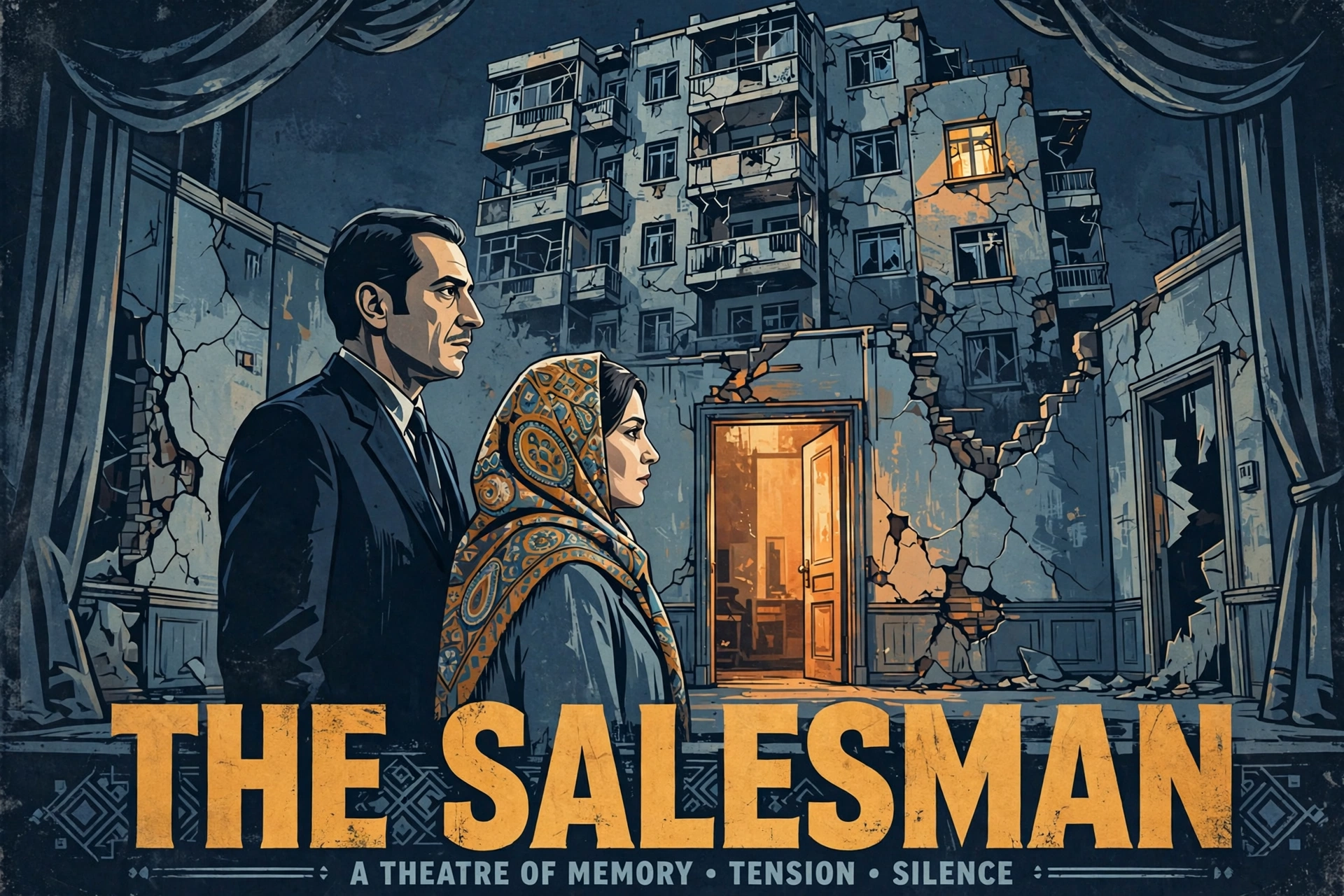
A building cracks in the opening minutes of The Salesman, and nothing in the film that follows is ever structurally sound again. Asghar Farhadi’s 2016 Iranian-French drama, released in Persian as Forushande, won him his second Academy Award for Best Foreign Language Film and gave Shahab Hosseini the Best Actor prize at Cannes — yet it remains, for some viewers, the more divisive of his two Oscar winners, admired for its craft and argued about for its choices.
This The Salesman review takes a position: it is a superb, unsettling film — not quite the equal of A Separation, because no film easily could be, but a rigorous and quietly devastating study of trauma, wounded pride and revenge, in which Farhadi once again refuses to let either his characters or his audience off easily. Its discomforts are deliberate, though one of them — the way the story handles its central victim — is worth debating honestly, and we will.
| Detail | Information |
|---|---|
| Release date | 21 May 2016 (Cannes); 31 August 2016 (Iran) |
| Director | Asghar Farhadi |
| Writers | Asghar Farhadi |
| Genre | Drama, Thriller |
| Language | Persian |
| Runtime | 125 minutes |
| Lead cast | Shahab Hosseini, Taraneh Alidoosti, Babak Karimi, Farid Sajjadi Hosseini, Mina Sadati |
| Our rating | 8.5/10 |
Emad (Shahab Hosseini) and Rana (Taraneh Alidoosti) are a young Tehran couple, teachers and amateur theatre people, currently performing as Willy and Linda Loman in a local production of Arthur Miller’s Death of a Salesman. When construction work next door leaves their apartment building literally splitting apart, they must evacuate in a hurry. A fellow actor, Babak (Babak Karimi), finds them a flat — available quickly because its previous tenant left just as suddenly, abandoning a roomful of belongings she keeps promising to collect.
The neighbours are evasive about that previous tenant. Gradually it becomes clear that she was a woman who received many male visitors, and that the building wanted her gone. Then, one night after a performance, Rana goes home alone. Expecting Emad, she leaves the door on the latch and steps into the shower. Someone else comes through that door — a man who apparently believed the flat was still the previous tenant’s, and who found Rana there instead. Farhadi does not show the assault. What he shows is Emad coming home to blood on the stairs, an empty flat, and neighbours who have already taken his wife to hospital.
Rana survives, with stitches, trauma and a terror of being alone in the flat she cannot explain away. She does not want the police involved; scandal, in her world, is a second injury. Emad agrees — outwardly. Inwardly, he begins an investigation of his own, using what the intruder left behind, and the film becomes a slow tightening of two opposing needs: Rana’s need for the event to recede so she can live again, and Emad’s need to find the man and make him pay, a need he calls justice and the film quietly examines as something else — shame, helplessness, and pride wearing the mask of love. We will not describe how his search ends. The final act, staged back where the couple’s story began, is one of Farhadi’s most morally excruciating constructions, and its last exchanges between husband and wife are best encountered cold.
Shahab Hosseini as Emad won Best Actor at Cannes for this performance, and the award makes sense: he has to play a likeable, intelligent, modern man descending, step by reasonable step, into obsession, without ever becoming a movie villain. His Emad is genuinely tender with his students and genuinely frightening in his silences at home, and the horror of the performance is that both are the same man. Hosseini charts how humiliation curdles into cruelty while never asking for the audience’s excuse.
Taraneh Alidoosti as Rana carries the harder and, frankly, less rewarded role. Rana’s trauma is not played as melodrama but as fracture: panic at the shower door, fury at being managed, sudden collapses and equally sudden attempts at normality, including returning to the stage to play Linda Loman while barely holding herself together. Alidoosti makes Rana’s refusal of the “perfect victim” script completely believable — she will not perform her pain for Emad’s benefit or ours, which is precisely what makes some viewers impatient with her and what makes the performance true.
Farid Sajjadi Hosseini is crucial in the final act in a role we cannot discuss in detail without spoilers; his work there is pitiable and unbearable in exactly the proportions Farhadi needs. Babak Karimi as Babak brings evasive, good-natured guilt to the friend whose half-truths helped set the trap, and Mina Sadati as Sanam adds warmth and social texture within the theatre company. The ensemble scenes — backstage teasing, neighbourly gossip — are played with the lived-in ease that is a Farhadi signature.
The play-within-the-film is not decoration. Farhadi chose Death of a Salesman because its themes — a man’s dignity collapsing, a wife watching it happen, the lies a family tells itself to survive — mirror his story, and he cross-cuts between stage and apartment until the two spaces start commenting on each other: Emad applying Willy Loman’s make-up while becoming a man Linda would no longer recognise. It is the most openly symbolic device in any Farhadi film, and mostly it works, though it occasionally underlines a parallel the audience has already understood.
Hossein Jafarian’s cinematography continues the director’s house style — mobile, observant, built from doorways, stairwells and half-seen rooms — with one addition: the theatre’s artificial spaces let Farhadi compose more formally, and the contrast between stage artifice and domestic reality becomes part of the meaning. Hayedeh Safiyari’s editing again paces a dialogue-driven story like a thriller, withholding the assault itself entirely and letting its consequences do the work. The opening evacuation, shot in urgent long takes as the building groans and cracks, is the most physically dynamic sequence of Farhadi’s career. If the film has a structural weakness, it is a middle section where Emad’s detective work proceeds in small, repetitive increments; the tension holds, but less inexorably than in A Separation.
As in A Separation, Farhadi treats conventional scoring as a form of manipulation he would rather avoid, so The Salesman is another film carried largely by sound rather than music: the groan of a damaged building, theatre audiences murmuring, Tehran traffic, and silences inside a marriage. Sattar Oraki again provides the credited music, used sparingly — a sombre presence at key transitions and around the closing passages rather than a running emotional commentary.
The theatre scenes add a second, cleverer layer of “score”: the sounds of the production itself — stage cues, applause, the Lomans’ dialogue bleeding into real corridors — blur into the couple’s offstage life, so that Arthur Miller’s words sometimes seem to be narrating Emad and Rana before the characters catch up. It is a subtle effect, and it reinforces Farhadi’s central point without a single manipulative string swell: these two people know, from the play they perform nightly, exactly how pride destroys a household. Knowing changes nothing. That is the tragedy.
What we loved:
What could be better:
Reporting on this film’s money requires care, because the commonly cited figures measure different things. In Iran, The Salesman was a major commercial hit, reported at around 16.1 billion toman at the Iranian box office — a figure drawn from Iranian reporting and frequently cited in reference sources. Internationally, the most widely used tracker, Box Office Mojo, puts the worldwide total at roughly $6.95 million, a tally built mainly from its tracked international releases and not directly comparable with the Iranian toman figure, which it does not simply duplicate; exchange rates and reporting coverage explain most of the apparent gap, and readers should treat the two numbers as different lenses on the same success rather than rivals. No reliable, widely published production budget exists for the film, which is why this review omits the Budget row rather than inventing one. What is certain is the prestige ledger: Best Screenplay and Best Actor at Cannes, then the Academy Award for Best Foreign Language Film — Farhadi’s second Oscar, which he did not collect in person, boycotting the ceremony in protest at the United States travel ban affecting Iranians, and sending a statement that was read to one of the night’s loudest ovations.
Yes — with the right expectations. This is not a revenge thriller in the commercial sense; it is a film about what the desire for revenge does to the person who nurses it and to the person in whose name it is nursed. Watch it after A Separation if you can, because the conversation between the two films — about truth there, about honour here — is one of the richest in modern cinema. Expect to be made uncomfortable, expect to argue about Emad afterwards, and expect the final scene to follow you home.
Our rating: 8.5/10 — a rigorous, superbly acted moral thriller that falls only just short of its director’s own masterpiece.
Did The Salesman win the Oscar?
Yes. It won the Academy Award for Best Foreign Language Film at the 89th Academy Awards, Asghar Farhadi’s second win after A Separation. Farhadi boycotted the ceremony in protest at the US travel ban, and his statement was read on stage by Anousheh Ansari.
Is The Salesman connected to Death of a Salesman?
Yes, deliberately. Emad and Rana are performing Arthur Miller’s play in the film, with Emad as Willy Loman and Rana as Linda. Farhadi uses the play’s themes of dignity, pride and family self-deception as a mirror for the couple’s story.
Does the film show the assault on Rana?
No. Farhadi keeps the attack off-screen entirely. The film is about the aftermath — Rana’s trauma and Emad’s response to it — rather than the act itself.
Is The Salesman as good as A Separation?
By most critical consensus, it is a small step below — which still places it among the finest dramas of its decade. It won Best Screenplay and Best Actor at Cannes and the Oscar for Best Foreign Language Film.
Where can I watch The Salesman (2016)?
The film is available on arthouse streaming services and on disc in many regions, with subtitles. Availability changes over time, so check your local services.