★ LATEST REVIEWS

Our Rating: ★★★★☆ 7.5/10
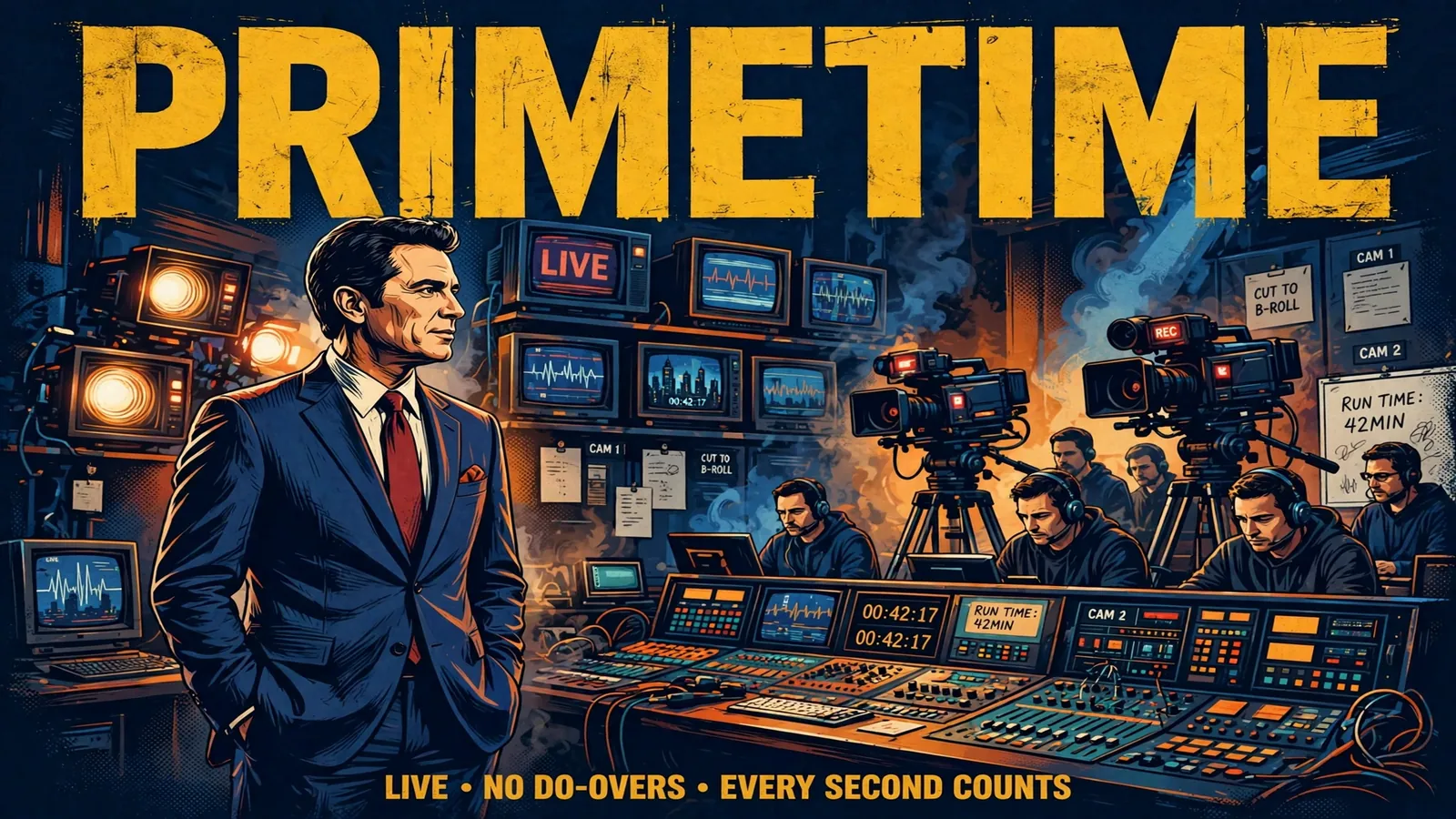
There is a particular kind of unease that only reality television can produce: the feeling of watching something you know you should not enjoy, and enjoying it anyway. Primetime lives inside that feeling for its full 109 minutes and refuses to let the audience off the hook. Lance Oppenheim’s drama follows Chris Hansen, the host of Dateline NBC’s To Catch a Predator, at the moment his sting-operation show moves into a primetime slot and the pressure to deliver bigger catches, bigger ratings and bigger confrontations starts to eat the people making it. Robert Pattinson plays Hansen as a man made of polished surfaces — the calm voice, the steady gaze, the practised question — and the film’s great achievement is showing how thin those surfaces are.
This review is spoiler-free on the film’s final stretch. What matters here is not a twist but a question the film keeps asking: when catching wrongdoers becomes entertainment, who is the show really serving?
| Release date | 30 October 2026 (UK cinemas); premiered at the Venice International Film Festival on 5 September 2026; US cinemas from 25 September 2026. |
| Director | Lance Oppenheim |
| Writer | Ajon Singh, based on “Tonight on Dateline This Man Will Die” by Luke Dittrich |
| Genre | Biographical crime drama |
| Language | English |
| Runtime | 109 minutes |
| Lead cast | Robert Pattinson, Merritt Wever, Skyler Gisondo, Phoebe Bridgers, Matthew Maher, Bokeem Woodbine, Anna Faris, Jonathan Lipnicki |
| Our rating | 7.5/10 |
The premise is drawn from real television history. In the mid-2000s, To Catch a Predator turned police sting operations into a ratings phenomenon: decoys posing as teenagers arranged meetings online, the target arrived at a house rigged with hidden cameras, and Hansen walked in with a chair, a transcript and a camera crew. Primetime picks up the story as the segment graduates to a primetime slot, going head-to-head with the era’s biggest entertainment, and the machinery behind it has to work harder than ever. Hansen’s producer Andie (Merritt Wever) keeps the operation moving; the decoy team, led by Xavier (Matthew Maher), runs the online chats; and every week the show needs another arrival, another confrontation, another moment that will hold an audience through the ad break.
Oppenheim, a documentary filmmaker by background, is fascinated by the gap between what the cameras show and what happens when they stop. The sting house sequences are staged with queasy precision — the low-grade hidden-camera look, the long waits, the awkward small talk before Hansen’s entrance — while the office scenes show a team increasingly unsure whether they are running a public service or a hit show. The film builds, without ever turning into a lecture, toward the real-life sting operation that ended in tragedy, and it handles that material with restraint: no sensationalism, no re-enacted spectacle, just the slow understanding that a system built on escalation eventually escalates past anyone’s control.
The film’s one structural wobble is a detour into Hansen’s private life and marriage that several critics found less compelling than the newsroom and sting-house material. It is not badly played, but it pulls focus from the sharper question — what the show does to the people who make it — toward a more familiar portrait of a workaholic husband. The final act also shifts its centre of gravity in a way that surprised some reviewers, reframing whose story this really is. That choice is defensible, even brave, but it means the film’s ending lands as a moral judgement rather than a dramatic climax, and viewers expecting a courtroom-style payoff may find it deliberately unsatisfying.
Robert Pattinson as Chris Hansen — This is Pattinson at his most controlled, and possibly his most unsettling. His Hansen is all surface charm and broadcast polish: the measured voice, the reasonable questions, the air of a man who believes his own decency. What makes the performance linger is what leaks through the polish — the hunger for a bigger moment, the irritation when a sting goes flat, the vanity of a man who has confused being watched with being right. Reviewers repeatedly singled out the uncanny precision of the impersonation, but the performance goes beyond mimicry: Pattinson makes Hansen’s self-deception feel human rather than monstrous, which is far more disturbing.
Merritt Wever as Andie — Wever is the film’s quiet engine. As the producer who keeps the operation running, she gives the film its most grounded moral register: efficient, dryly funny, loyal to her team, and increasingly aware of the cost of what they are doing. Her scenes with Pattinson carry the film’s central tension without ever spelling it out.
Skyler Gisondo, Matthew Maher and the ensemble — Gisondo brings nervous energy to the production team, Maher is excellent as the decoy operation’s front man, and Bokeem Woodbine, Phoebe Bridgers, Anna Faris and Jonathan Lipnicki fill out a newsroom that feels like a real workplace rather than a backdrop. Nobody here is a hero or a villain in full; that is the point.
Oppenheim shoots the mid-2000s in sickly, heterogeneous textures — grainy hidden-camera footage against slick broadcast polish, flat office light against the staged domesticity of the sting house — and the contrast does much of the film’s moral work before a word is spoken. Cinematographer David Bolen keeps the camera close and restless in the sting sequences, so the audience feels trapped in the same rooms as everyone else, while Ari Balouzian’s score stays low and queasy rather than telling you how to feel. The period detail is exact without being showy: the chunky phones, the chat-room interfaces, the sense of a media world just discovering that cruelty scales.
Where the film strains is in its balance. At 109 minutes it is tightly cut, but the marriage subplot and a few office digressions dilute the sting-house tension that is the film’s strongest material. The Irish Times called Pattinson “splendidly icy” while finding his Hansen too hooded to stand as a full portrait; there is truth in that too. The film is more interested in the system than the man, and viewers who want a definitive biography will find a deliberately incomplete one. But as an examination of how entertainment eats ethics, it is precise and genuinely uncomfortable.
Balouzian’s score works almost subliminally — low pulses under the sting sequences, flat silence in the confrontations — and the sound design does the rest: the hum of the control room, the click of hidden cameras, the awful ordinariness of a suburban house wired for a television event. Nothing here is built to be remembered, and that is a strength: the film wants you to sit with discomfort, not hum a theme on the way out.
What we loved:
What could be better:
Primetime arrived in UK cinemas on 30 October 2026 as the week’s big talking point, following its Venice premiere and London Film Festival run, and its coverage — reviews in the national press, think-pieces about reality television, arguments about its subject — has outstripped what a film of this scale usually earns. No verified UK opening gross was available at writing time, and this review reports none rather than guessing. What is clear is the film’s cultural footprint: it is the rare mid-budget drama that people argue about after leaving the cinema, and that argument is exactly what Oppenheim seems to want.
Yes, if you can handle discomfort without easy villains. Primetime is not a biopic and not a thriller in the usual sense; it is a study of a machine — a television show, a newsroom, a man’s ambition — that kept needing more, and of the moment when more became too much. Pattinson is superb, Wever is superb, and the film’s refusal to tell you what to think is its bravest quality. Go in expecting to argue about it afterwards. That is the film working as intended.
Our rating: 7.5/10 — A chilling, superbly acted examination of reality TV’s moral bargain, slightly weakened by a detour into domestic life but essential viewing for anyone who has ever wondered why we watch.
What is Primetime about?
It dramatises the rise of Dateline NBC’s To Catch a Predator as it moves into a primetime slot, following host Chris Hansen and his production team as ratings pressure mounts on their sting operations.
Who plays Chris Hansen in Primetime?
Robert Pattinson, in a performance widely praised for its icy precision, alongside Merritt Wever as producer Andie and Skyler Gisondo in the production team.
Who directed Primetime?
Lance Oppenheim, the documentary filmmaker, from a script by Ajon Singh based on Luke Dittrich’s article “Tonight on Dateline This Man Will Die”.
When was Primetime released?
It premiered at Venice on 5 September 2026, opened in US cinemas on 25 September 2026, and arrived in UK cinemas on 30 October 2026. Some UK listings give 28 October for previews; 30 October is the nationwide date used here.
How long is Primetime?
109 minutes.
Is Primetime based on a true story?
Yes, it is based on the real To Catch a Predator television segment and the events surrounding its most consequential sting operation, though characters and scenes are dramatised.
Is Primetime suitable for younger viewers?
It carries a 15 certificate in the UK, reflecting its adult subject matter and language, and suits adult viewers.