★ LATEST REVIEWS

★★★★★ Our Rating: 9/10
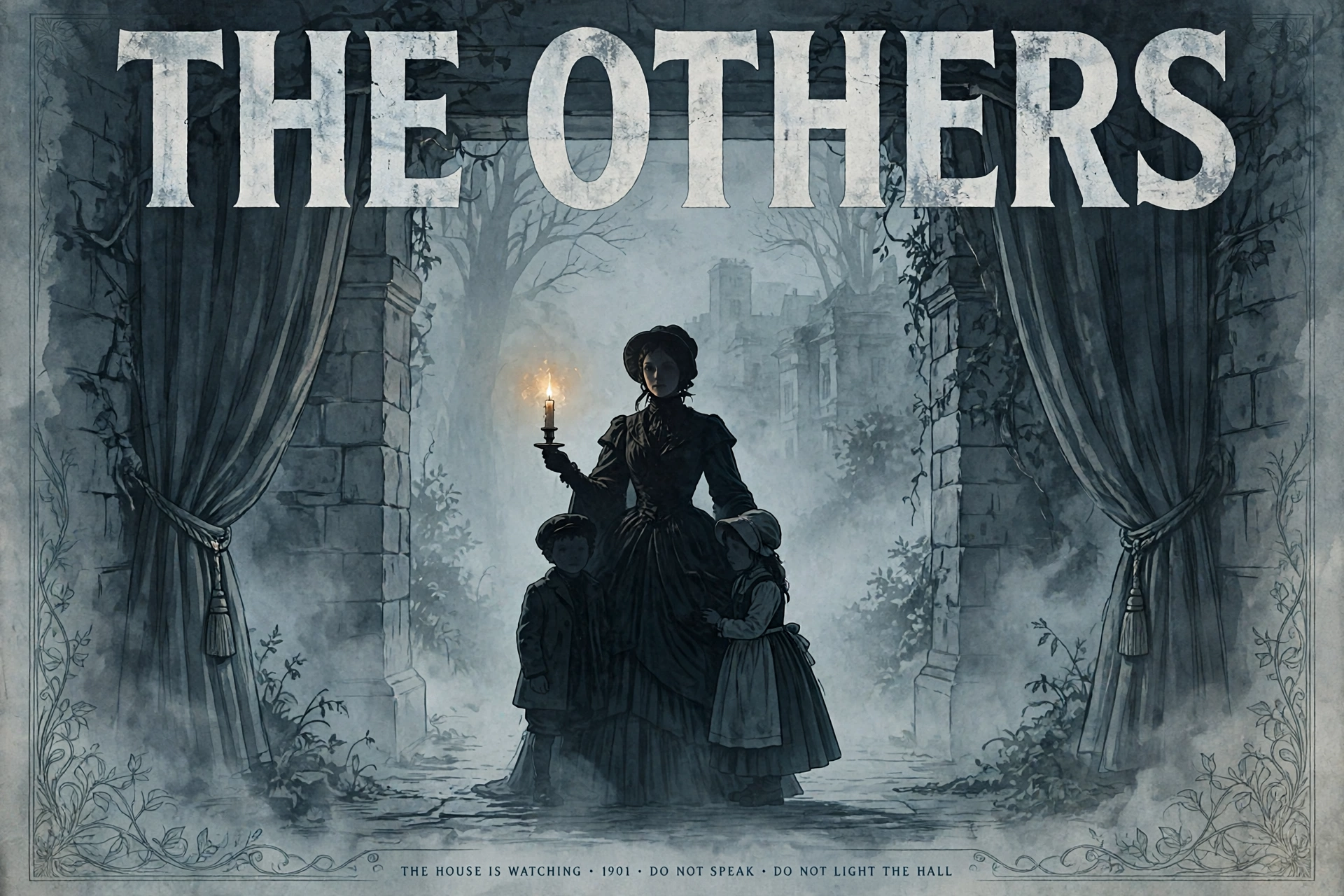
There is a particular kind of horror film that does not need a single drop of blood to keep you awake. This The Others review is about the finest example of its generation: Alejandro Amenábar’s 2001 Spanish, English-language gothic chiller, a film built entirely from darkness, silence, locked doors and a mother’s absolute certainty that she is protecting her children. Released the year after ghost stories returned to the centre of popular cinema, it quietly outclassed most of its rivals — and it did so with candlelight.
A warning before anything else, and it applies to this whole review: The Others depends on its secrets more completely than almost any film we cover. We will describe only its premise and its craft, never its turns. If you have somehow remained unspoiled for more than twenty years, guard that luck carefully, read nothing else about the plot anywhere, and simply watch it. What follows is written to be safe for you — a discussion of why the film works that reveals nothing of what it is hiding.
| Detail | Information |
|---|---|
| Release date | 10 August 2001 |
| Director | Alejandro Amenábar |
| Writers | Alejandro Amenábar |
| Genre | Horror, Mystery, Thriller |
| Language | English |
| Runtime | 104 minutes |
| Budget | $17 million |
| Lead cast | Nicole Kidman, Fionnula Flanagan, Christopher Eccleston, Alakina Mann, James Bentley |
| Our rating | 9/10 |
Jersey, in the Channel Islands, 1945. The Second World War has just ended, and in a large, isolated manor house surrounded by fog and gardens, Grace Stewart (Nicole Kidman) is raising her two children alone while waiting for word of her husband, who went to fight in France and has not returned. The children, Anne (Alakina Mann) and Nicholas (James Bentley), suffer from a rare condition that makes sunlight dangerous to them — a form of extreme photosensitivity. The house is therefore run by strict rules: curtains stay drawn, rooms stay dim, and no door may be opened until the previous one has been closed and locked, so that light can never flood in uninvited.
Grace’s previous servants have vanished without explanation, and she is relieved when three new ones arrive at the house as if in answer to her advertisement: Mrs Bertha Mills (Fionnula Flanagan), the elderly housekeeper; Mr Tuttle (Eric Sykes), the gardener; and Lydia (Elaine Cassidy), a young woman who does not speak. They claim to have worked in the house before. Grace, stiff, devout and exhausted, lays down the rules.
Then the disturbances begin — small ones. Sounds with no source. A piano heard in a locked room. Anne insists she has seen people in the house: a boy, a family, an old woman. Grace, whose Catholic faith and iron discipline govern everything, refuses at first to entertain what her daughter describes. But the incidents accumulate, and a woman who has built her entire life on controlling this dark, sealed house begins to feel something inside it that she cannot control.
That is the setup, and it is all we will give you. Where the story travels from there, what the servants know, and what Grace discovers — about the house and about everything she believes — is the film’s to tell, not ours. Know only that the premise above is played completely fairly, that attentive viewers are given everything they need, and that the film’s reputation rests on an ending that reorganises the entire story without cheating it.
Nicole Kidman as Grace Stewart gives what many critics still regard as one of the finest performances of her career. Grace could easily have been a cold, unsympathetic figure — rigid, scolding, clinging to rules and religion — but Kidman plays the fear underneath the discipline. Her Grace is a woman holding herself together by force of will in an unbearable situation: husband missing, children medically fragile, household dissolving. Watch how the performance is built from control cracking — a voice kept level a fraction too long, hands gripping too tightly, politeness deployed like armour. It is a horror performance with no hysterics in it, which makes the moments when control finally slips genuinely frightening. She was nominated for a Golden Globe and a BAFTA for the role, in a genre that rarely receives such recognition.
Fionnula Flanagan as Mrs Mills is the film’s quiet masterstroke. Warm, knowing and impossible to read, her housekeeper seems to understand the house — and Grace — far better than she should. Flanagan never tips the character into obvious menace; instead she radiates a calm that becomes more unsettling the longer the film runs. She won the Saturn Award for Best Supporting Actress for the performance, and every scene she shares with Kidman is a small duel between two women who are both, in their own way, protecting something.
Alakina Mann as Anne and James Bentley as Nicholas carry far more than child actors are usually asked to. Anne’s defiance, her teasing of her frightened younger brother, and her absolute insistence on what she has seen make her the household’s truth-teller — an uncomfortable role for a child in a home ruled by her mother’s certainty. Bentley plays Nicholas’s terror without cuteness, and his fear is infectious: when Nicholas is scared, the audience is. Christopher Eccleston as Charles, Grace’s husband, appears in a smaller but crucial role and brings a haunted, displaced quality that deepens the film’s sadness. Eric Sykes as Mr Tuttle and Elaine Cassidy as Lydia complete a household in which every servant seems to be keeping the same gentle, unnerving secret.
Amenábar was not yet thirty when he made The Others, and the maturity of its craft is startling. He directs it as a classical ghost story in the tradition of The Innocents and the Henry James atmosphere critics often compare it to — long takes, candlelit interiors, a camera that drifts through corridors as if it, too, is listening. The crucial decision is what the film refuses to do: there are almost no conventional shock effects, no sudden orchestral stabs every five minutes, no gore. Fear is built from the house’s own rules. Because we know light can harm the children, every curtain trembling and every door left ajar becomes a threat, and Amenábar mines that single, elegant mechanism for the entire film.
Javier Aguirresarobe’s cinematography is the film’s other great achievement. Photographing a story that must live in near-darkness without becoming murky or monotonous, he builds whole palettes from candle glow, oil lamps, fog-diffused daylight at windows and the deep blacks of unlit rooms. The Jersey fog — the house seems permanently cut off from the world — turns the gardens into a limbo the characters can see but never usefully enter. Nacho Ruiz Capillas’s editing respects the material’s patience, holding on Grace’s face or an empty doorway a beat longer than comfort allows.
Honesty requires noting the craft’s one arguable cost: the film’s deliberateness is total. Viewers raised on rapid-cut horror may find the middle section slow, and Amenábar knows it and does not care — he is building a pressure that needs time. The production design, meanwhile, is flawless in its period detail: this feels like a real 1945 household running on rituals and scarcity, not a theme-park haunted house.
Amenábar composed the score himself, as he had on his earlier films, and it is a model of restraint. Strings murmur rather than shriek; themes circle Grace rather than the ghosts. The score’s most important quality is how often it withdraws altogether, leaving the film to its superb sound design — footsteps above ceilings, distant piano notes, the scrape of locks, a child’s breathing in the dark. In a film about listening for intruders, silence is the loudest instrument, and Amenábar conducts it like one.
The one prominent period song, “I Only Have Eyes for You,” sung briefly by Kidman herself, arrives like a message from a lost, happier world — the marriage and the life before the darkness — and its fragility does more emotional work than any amount of underscoring could. This is a score that serves the story’s secrecy as faithfully as the screenplay does: it never tells you more than you should know.
What we loved:
What could be better:
The Others was produced for a reported $17 million — modest even by 2001 standards for a period film with a star of Kidman’s stature. Released in the United States on 10 August 2001 and in Spain on 7 September 2001, it became one of the great sleeper hits of its era, earning around $210 million worldwide. Some databases list a higher cumulative total, approaching $219 million when later reissues are included, so reports differ slightly depending on the source — but every accounting agrees on the scale of the success: more than twelve times its budget.
Its awards story was historic in its home country. At Spain’s Goya Awards, The Others received fifteen nominations and won eight, including Best Film and Best Director — becoming the first English-language film, without a single word of Spanish in it, ever to win Best Film at the Goyas. Kidman also won the Saturn Award for Best Actress, and the film took Best Horror Film. For Spanish cinema, it was proof that a domestic production could command the global market in English without surrendering its own sensibility — a lesson the industry absorbed deeply, and one that later Spanish genre successes, including the other film in this batch of reviews, would build upon.
Unreservedly yes — and watch it cold, in the dark, with your phone in another room and no synopsis read in advance. The Others is that increasingly rare thing: a ghost story that respects your intelligence, frightens you with architecture and silence rather than effects, and earns its reputation honestly through performance and craft. If you love gothic atmosphere, classical storytelling and one of Nicole Kidman’s greatest performances, this is essential viewing. If you need your horror fast and graphic, it may not be for you — but even then, its final movement has converted many sceptics.
Our rating: 9/10 — a modern gothic classic: beautiful, sorrowful and quietly terrifying, with secrets we would not dream of spoiling.
Is The Others based on a true story?
No. It is an original screenplay by Alejandro Amenábar. Its atmosphere draws on classic gothic literature and ghost-story traditions — critics often note the influence of Henry James’s The Turn of the Screw — but its characters and events are fictional.
Is The Others very scary, and does it have jump scares or gore?
It is frightening through dread, darkness and suggestion rather than gore; there is essentially no graphic violence. It uses a small number of startling moments, but its power is atmospheric. Viewers who dislike gore but enjoy tension usually find it ideal.
What illness do the children in The Others have?
Within the story, Anne and Nicholas suffer from an extreme sensitivity to sunlight, based on the real and very rare condition xeroderma pigmentosum. That is why the house must be kept darkened at all times.
Is The Others suitable for children?
It is rated PG-13 in the United States. There is no gore, but its themes and sustained dread are intense and adult in tone. It is best suited to older children who enjoy ghost stories, and to teens and adults.
Where can I watch The Others?
It is widely available on streaming, digital rental and disc in most regions. Availability rotates, so check your local services — and avoid reading detailed plot summaries anywhere before you watch.