★ LATEST REVIEWS

★★★★★ Our Rating: 9.5/10
Most crime films promise you a solution. Memories of Murder promises you something rarer and braver: the truth about what an unsolved case does to the people assigned to solve it. Released in South Korea on 2 May 2003, Bong Joon Ho’s second feature took the country’s first confirmed serial murder case — a series of killings that had haunted the nation since the 1980s — and turned it into a procedural that is gripping, darkly funny, furious at incompetence and finally heartbreaking. This Memories of Murder review comes with a clear position up front: it is not only one of the greatest Korean films ever made, it is one of the greatest crime films made anywhere, full stop.
A word about spoilers, because this film demands honesty about them. The story is drawn from real events — the Hwaseong murders of 1986 to 1991, in which ten women were killed — and at the time Bong made the film, the case remained officially unsolved. This review will describe the investigation, the detectives and the era, but it will not describe how the film ends or pretend the movie hands you answers it deliberately withholds. The not-knowing is the point of Memories of Murder, and we will protect it the way the film itself does — carefully.
What makes the film extraordinary is that its suspense does not come from a puzzle-box plot. It comes from watching decent, flawed, badly equipped men collide with a crime their country, their tools and their own habits are simply not ready for — while the rain washes the evidence away.
| Detail | Information |
| Release date | 2 May 2003 (South Korea) |
| Director | Bong Joon Ho |
| Writers | Bong Joon Ho, Shim Sung-bo (based on the stage play Come to See Me by Kim Kwang-lim) |
| Genre | Crime, Thriller, Drama, Mystery |
| Language | Korean |
| Runtime | 131 minutes |
| Budget | Approx. US$2.8 million |
| Lead cast | Song Kang-ho, Kim Sang-kyung, Kim Roi-ha, Song Jae-ho, Byun Hee-bong, Park Hae-il |
| Our rating | 9.5/10 |
The film opens in October 1986 in Hwaseong, a rural province of rice fields, drainage ditches and small factories outside Seoul. A woman’s body is found bound in a ditch, and local detective Park Doo-man (Song Kang-ho) is put in charge of an investigation his station has neither the training nor the equipment to conduct. There is no forensic laboratory to speak of, no reliable way to preserve a crime scene — the opening sequence watches, in appalled comedy, as children play on the evidence and a tractor rolls towards it — and no experience of a crime like this anywhere in the country. When a second body appears with the same signature, the word nobody wants to say out loud takes shape: these are serial killings, the first of their kind in South Korea.
Park works the way he has always worked: instinct, intimidation and a mystical faith in his own ability to spot a liar by looking into his eyes. His partner Cho Yong-koo (Kim Roi-ha) works with his boots. Suspects are dragged in, beaten and coaxed into confessions that collapse the moment anyone examines them. Into this chaos arrives Seo Tae-yoon (Kim Sang-kyung), a younger detective from Seoul who volunteers for the case and brings with him the scandalous new religion of evidence: documents, patterns, deduction. The two men clash immediately — village instinct against city method — and the film’s great engine is watching their rivalry slowly, painfully, turn into something closer to respect as the case defeats them both in different ways.
Around the investigation, Bong paints an entire society under strain: an authoritarian government staging civil-defence drills that plunge towns into darkness, students protesting in the cities while police resources are diverted to crush dissent, and a rural community curdling into fear and rumour as the killings continue on rainy nights. A schoolgirl’s local legend about a man seen near the fields, a suspect with soft hands and a habit of requesting a particular song on the radio — leads multiply, hope rises, and the film, true to the real case it dramatises, keeps asking the same unbearable question: what if trying your hardest, and then harder than that, still is not enough? Where the story lands, we will not say. Its final movements are among the most discussed in modern cinema, and they belong entirely to a first viewing.
Song Kang-ho as Park Doo-man is the film’s volcanic centre. Song, who would become the defining actor of modern Korean cinema, plays Park as a man of real talent trapped inside bad methods: shrewd, funny, vain about his instincts, quick with a flying kick and quicker with an excuse. What Song does magnificently is the erosion. Across the film’s years, you watch confidence curdle into obsession and then into a haunted humility, and he does it without a single grand breakdown scene — it is all in the posture, the eyes, the jokes that stop being funny. The performance won him Best Actor honours in Korea, and it remains a career landmark.
Kim Sang-kyung as Seo Tae-yoon has the harder, quieter job and is superb at it. Seo begins as the audience’s surrogate — rational, disciplined, appalled by the locals’ brutality — and Kim lets that composure crack by degrees as the case refuses to reward his methods either. The film’s deepest tragedy is arguably his: Park starts with false certainties and loses them, while Seo starts with true principles and feels them being ground down. Watching the two men effectively trade places is one of the great pleasures of the screenplay, and both actors play it without underlining.
Kim Roi-ha as Cho Yong-koo makes the unit’s violent enforcer more than a caricature; his brutality is procedural habit, and the film finds a bleak arc even for him. Byun Hee-bong as Sergeant Koo and Song Jae-ho as Sergeant Shin embody two generations of command — one blustering and out of his depth, one wearily decent. Among the suspects, Park Hae-il is quietly devastating in a role we will describe no further, and Jeon Mi-seon brings warmth and normality to Park’s home life, a reminder of the ordinary world the case keeps poisoning. Not one performance strikes a false note.
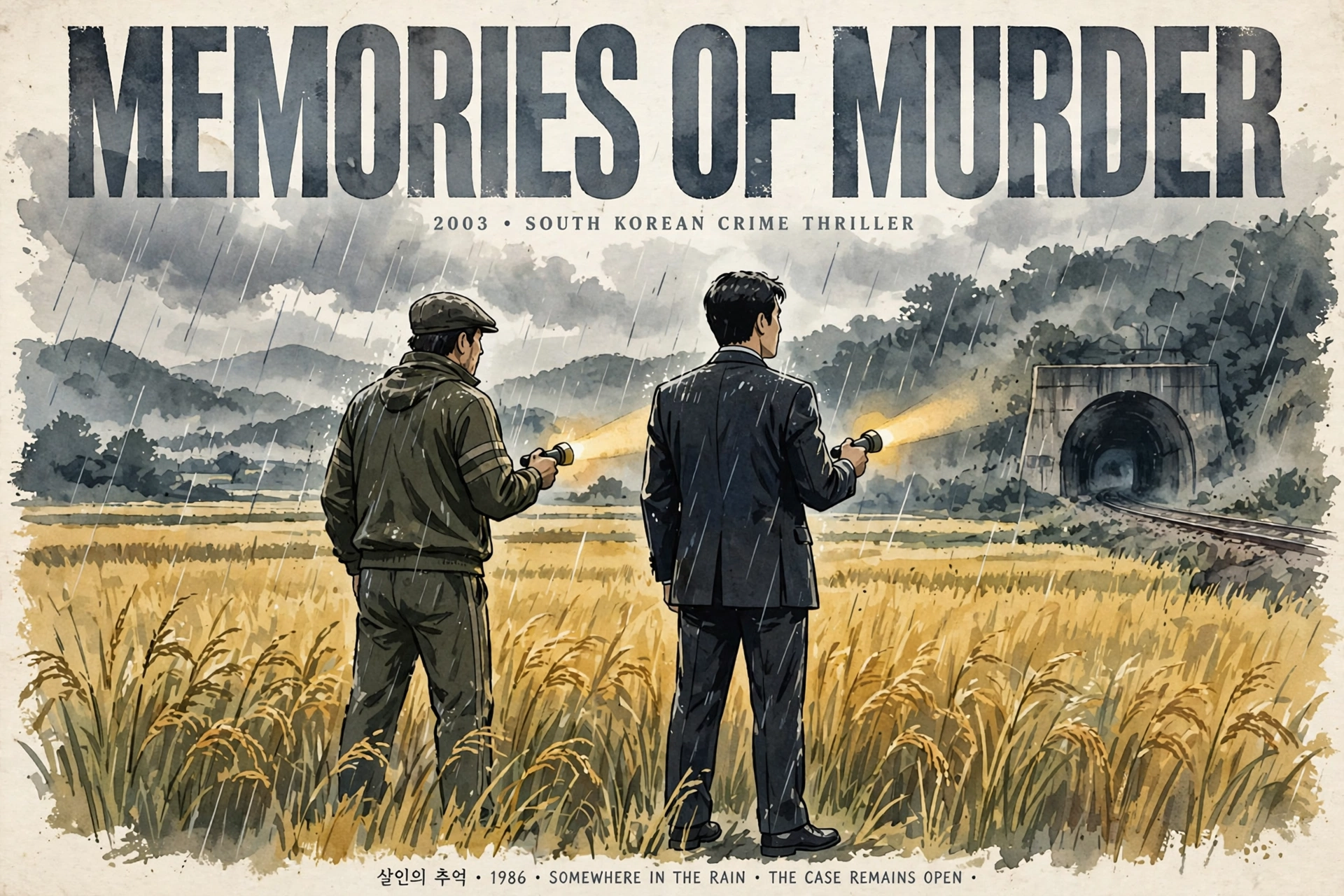
Bong Joon Ho’s direction here announced a major filmmaker, two films into his career. His signature gifts are all present: total control of tone, staging that turns landscapes into arguments, and an ability to make a wide shot do the work of a page of dialogue. Cinematographer Kim Hyung-koo shoots the Hwaseong countryside in greens, greys and mud-browns of almost painterly beauty — and that beauty is the horror. These fields are too big, too open, too rain-washed for a handful of detectives to protect, and Bong keeps returning to vast compositions in which human figures are small against the land where a killer moves freely.
The set pieces are models of construction. A night-time stakeout at a railway site, a frantic chase through fields and factory yards, an interrogation that turns on a single detail of physical evidence — each is staged with Hitchcockian patience and then released at exactly the right moment. Editor Kim Sun-min handles the film’s long time-span with particular skill, letting seasons and years pass through changed details rather than title cards, so the case feels like it is consuming lives in real time. The craft criticisms are minor: at 131 minutes the middle investigation loops are deliberately repetitive — suspects found, hopes raised, hopes destroyed — and viewers expecting a conventional thriller’s acceleration may find that repetition heavy before they recognise it as the film’s very subject. Bong’s tonal daring will also test some audiences: the early comedy is broad, and its collision with genuine horror is a deliberate discomfort not everyone will accept. For this review, both choices are strengths disguised as risks.
Japanese composer Taro Iwashiro provides a score of striking restraint. Rather than hammering the suspense, his music favours mournful strings and sparse, funereal piano figures that make the investigation feel elegiac from early on — as if the film already knows how this ends and is grieving in advance. The dread in Memories of Murder mostly comes from sound design rather than score: rainfall that never seems to stop, distant factory noise, the crackle of police radios, and one recurring popular song, requested on the radio, that the investigators come to dread hearing for reasons the film unfolds carefully. It is a masterclass in how a thriller can be terrifying at low volume — the loudest thing in most scenes is the silence of men realising they have nothing.
What we loved:
What could be better:
By the measure Korean cinema trusts most — admissions — Memories of Murder was a phenomenon. It sold 5,101,645 tickets in South Korea, making it the most-watched film of 2003 in its home market and, at the end of its run, one of the most-attended Korean films ever released up to that point. Its success is widely credited with rescuing one of its backers, Sidus Pictures, from financial trouble, and it swept the Grand Bell Awards, including Best Film, Best Director and Best Actor. The dollar figures require an honest warning, because reports genuinely differ: some standard references cite a worldwide gross of roughly US$12 million, while contemporary trade reporting in Screen Daily described the film passing US$25 million within its first five weeks in Korea alone, on its way to those five-million-plus admissions. The admissions total is the figure every source agrees on; the converted dollar totals vary by source and method, so we present the range rather than a false precision. Either way, on a budget of roughly US$2.8 million, the film was a major commercial triumph, and its international reputation has only grown since, powered by Bong’s later global fame and a acclaimed 2020 restoration and re-release.
Absolutely — this is close to compulsory viewing for anyone who loves crime cinema. If you admire Zodiac, the first season of True Detective, or Bong’s own Parasite, Memories of Murder is the film standing behind all of them in spirit: a procedural in which the mystery that matters most is what failure does to good intentions. Prepare for rain, frustration and a final stretch that will follow you home, and do not let anyone describe the ending to you in advance.
Our rating: 9.5/10 — a flawless-feeling crime masterpiece, and the film that announced Bong Joon Ho as a generational talent.
Is Memories of Murder based on a true story?
Yes. It dramatises the Hwaseong serial murders, South Korea’s first confirmed serial killing case, in which ten women were murdered between 1986 and 1991. The film is adapted from Kim Kwang-lim’s stage play about the case, and its detectives are fictionalised composites.
Does Memories of Murder reveal who the killer was?
No, and intentionally so. The case was unsolved when the film was made, and the movie is about the investigation rather than an answer. Avoid reading about the real case beforehand if you want the film’s own experience undiluted.
Is Memories of Murder the same director as Parasite?
Yes. Bong Joon Ho directed both, and Song Kang-ho stars in both. Memories of Murder was Bong’s second feature and his international breakthrough, years before Parasite won the Palme d’Or and the Academy Award for Best Picture.
How violent or disturbing is the film?
The violence is mostly restrained and off-screen compared with many thrillers, but the subject matter — serial murder, police brutality in interrogations — is heavy and realistic in tone. It is a film for mature viewers.
Where can I watch Memories of Murder?
Restored versions stream on major platforms in many regions, with subtitles. Availability changes over time, so check your local services.