★ LATEST REVIEWS

Our Rating: ★★★★☆ 7.5/10
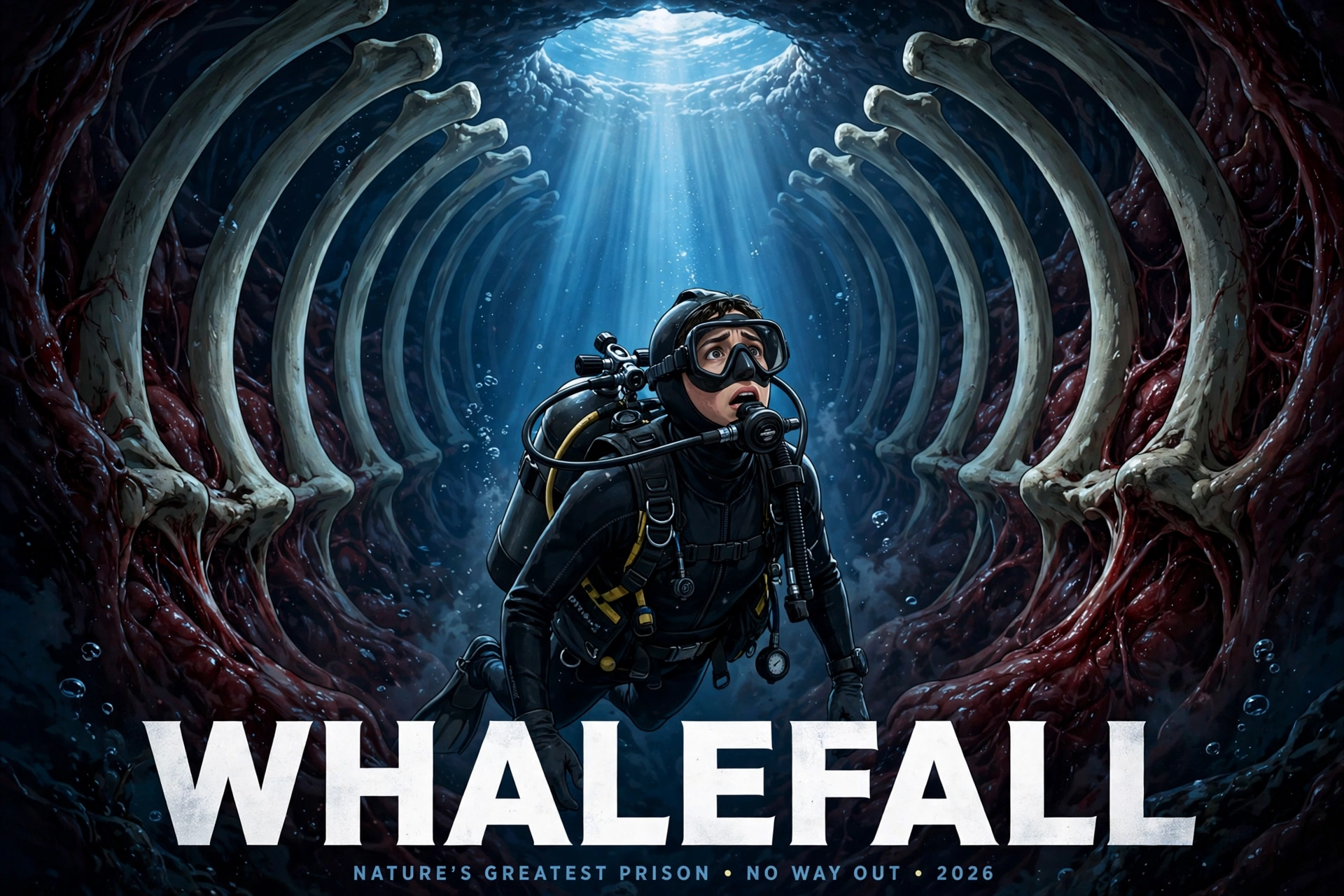
The premise is the pitch, and the pitch is unforgettable: a scuba diver searching for his dead father’s remains is swallowed whole by an eighty-foot sperm whale, and has one hour of oxygen left to escape. Whalefall, Brian Duffield’s adaptation of Daniel Kraus’s 2023 novel, takes that high concept and refuses to treat it as a joke. It is a claustrophobic survival thriller, a father-son drama, and a meditation on grief, all squeezed into the belly of a whale. It does not entirely hold together — its third act reaches for a spiritual dimension that not every viewer will follow — but Austin Abrams’s committed central performance and the film’s genuinely unsettling design make it a thriller that delivers on its promise.
This review is spoiler-free on the film’s later turns. The premise is public knowledge; how Jay escapes, and what he finds inside, is not spoiled here.
| Detail | Information |
|---|---|
| Release date | 16 October 2026 (United States; premiered 5 October 2026 in London; 15 October in Australia) |
| Director | Brian Duffield |
| Writers | Brian Duffield and Daniel Kraus, based on Kraus’s 2023 novel |
| Genre | Survival thriller |
| Language | English |
| Runtime | 106 minutes |
| Lead cast | Austin Abrams, Josh Brolin, Elisabeth Shue, John Ortiz, Jane Levy, Emily Rudd |
| Our rating | 7.5/10 |
Jay Gardiner (Austin Abrams) is a young scuba diver who has never made peace with his father, Mitt (Josh Brolin). After Mitt’s death, Jay dives off the California coast in search of his father’s remains — a dive that is as much about grief as it is about recovery. Then the film’s premise arrives, suddenly and without ceremony: Jay is swallowed by a massive sperm whale, eighty feet long and sixty tons, and finds himself trapped inside its body with roughly one hour of oxygen left.
What follows is a survival story built from the whale’s own anatomy. Jay must navigate the creature’s interior — its chambers, its digestive processes, its sheer indifferent scale — using whatever he has on him and whatever his father’s lessons taught him, while the air runs down. Around that physical struggle, the film weaves the emotional one: Jay’s memories of Mitt, his fraught relationship with his family — his mother Zara (Elisabeth Shue), his sisters Eva (Jane Levy) and Nan (Emily Rudd), and Mitt’s friend Hewey (John Ortiz) — and the question of whether survival is even what Jay wants, or whether the whale has given him the ending he thought he was looking for.
Without spoiling the film’s later turns, it is fair to say the third act moves beyond pure survival mechanics into something more spiritual: an exploration of the relationship between Jay, his father and the whale itself. Some reviewers found that movement muddying; others found it the film’s most interesting choice. Either way, it is the film’s biggest swing, and it divides opinion.
Austin Abrams as Jay Gardiner — Nearly every scene rests on Abrams, and he never runs short of air. After supporting turns in Euphoria and Weapons, he proves himself as a leading man here: frightened, funny, stubborn and vulnerable by turns, playing a young man whose physical struggle is inseparable from his emotional one. His performance is the reason the film works as well as it does — he makes Jay’s guilt, humour and determination feel like one continuous person rather than a collection of survival-thriller beats.
Josh Brolin as Mitt Gardiner, and the supporting cast — Brolin, as Jay’s father, appears largely in memory and flashback, but his presence dominates the film: a gruff, demanding, loving father whose lessons — about breathing, about endurance, about facing what frightens you — become Jay’s survival tools. It is a performance built from authority and warmth in equal measure. Elisabeth Shue, John Ortiz, Jane Levy and Emily Rudd give the family its texture, though the film’s structure means they necessarily appear in fragments beside Abrams’s continuous ordeal.
Duffield, who previously directed No One Will Save You and Love and Monsters, directs Whalefall with a clear sense of its central challenge: how to make a whale’s interior cinematic without making it silly. The solution is physical. The production built a practical whale — twelve feet tall and eighteen feet wide — and shot over 62 days, largely around Los Angeles and the Monterey Peninsula, with Aaron Morton (Duffield’s collaborator on No One Will Save You and Spontaneous) as cinematographer. The result is a whale that feels like a place rather than an effect: wet, dark, fleshy, and genuinely claustrophobic.
The sound design is the film’s secret weapon. The whale’s scale and confinement are conveyed as much through sound — groans, pressure, water, heartbeat — as through image, and the film’s best sequences are the ones where the audience feels the walls closing in. Where the film is weaker is in its geography: several reviewers noted that the whale’s internal layout is not always clear, which softens the problem-solving suspense, and that the flashbacks occasionally over-explain what Abrams’s performance already conveys. The third act’s spiritual turn, too, will lose some viewers — it asks the film to be about reconciliation as much as survival, and not every viewer will make that leap with it.
One production detail worth recording: the film was made with the help of California tax credits — $10.4 million in credits against $48.7 million spent on location. That on-location spend is not a published production budget, and no official budget figure is given here; the two should not be confused.
Joseph Trapanese’s score works in the film’s favour by staying low and tense: drones and pulses that mimic breathing and pressure, rather than big orchestral statements. It is a score that serves claustrophobia, and it pairs well with the sound design’s emphasis on the whale as a living, groaning environment. There is no showpiece musical moment here, and the film is better for the restraint.
What we loved:
What could be better:
Whalefall opened in the United States on 16 October 2026, days before this review was written, and no reliable worldwide total has been published in the sources checked. No official budget figure has been published either — the $48.7 million on-location spend reported in connection with California tax credits is not a budget, and is not presented as one here. Early critical response has been mixed-to-positive: one outlet scored it 7 out of 10, praising its claustrophobic sequences and Abrams’s performance while noting uneven transitions between danger and reflection, and another praised it as a gratifying film that delivers on its premise while finding its third act muddy. That split — admiration for the craft, reservation about the final stretch — feels like a fair summary of where the film stands.
Yes, especially if you like survival thrillers, creature features with brains, or stories about grief disguised as genre films. Whalefall is not a perfect film — its geography wobbles and its ending reaches further than some viewers will follow — but it is an ambitious, committed, genuinely tense piece of work, carried by an excellent Austin Abrams. Go in expecting claustrophobia and emotion in equal measure, and you will have a memorable night at the cinema.
Our rating: 7.5/10 — A harrowing, heartfelt survival thriller: Abrams is superb, the whale is terrifying, and the ending will give you something to argue about.
Who directed Whalefall?
Brian Duffield, who co-wrote the screenplay with Daniel Kraus, adapting Kraus’s 2023 novel of the same name.
Who stars in Whalefall?
Austin Abrams as Jay Gardiner, Josh Brolin as his father Mitt, with Elisabeth Shue, John Ortiz, Jane Levy and Emily Rudd in supporting roles.
What is Whalefall about?
A scuba diver searching for his late father’s remains is swallowed by an eighty-foot sperm whale and must escape from inside the creature before his one hour of oxygen runs out.
Is Whalefall based on a book?
Yes, Daniel Kraus’s 2023 novel Whalefall. Kraus co-wrote the screenplay with director Brian Duffield.
How much did Whalefall earn at the box office?
No reliable worldwide total has been published yet in the sources checked for this review, and no official budget has been published either, so no figures are given here.
Is Whalefall suitable for family viewing?
It is rated PG-13 for intense peril and disturbing bodily imagery, with references to suicide. It is best suited to teenagers and adults comfortable with claustrophobia and intense scenes.