★ LATEST REVIEWS

Our Rating: ★★★★☆ 7/10
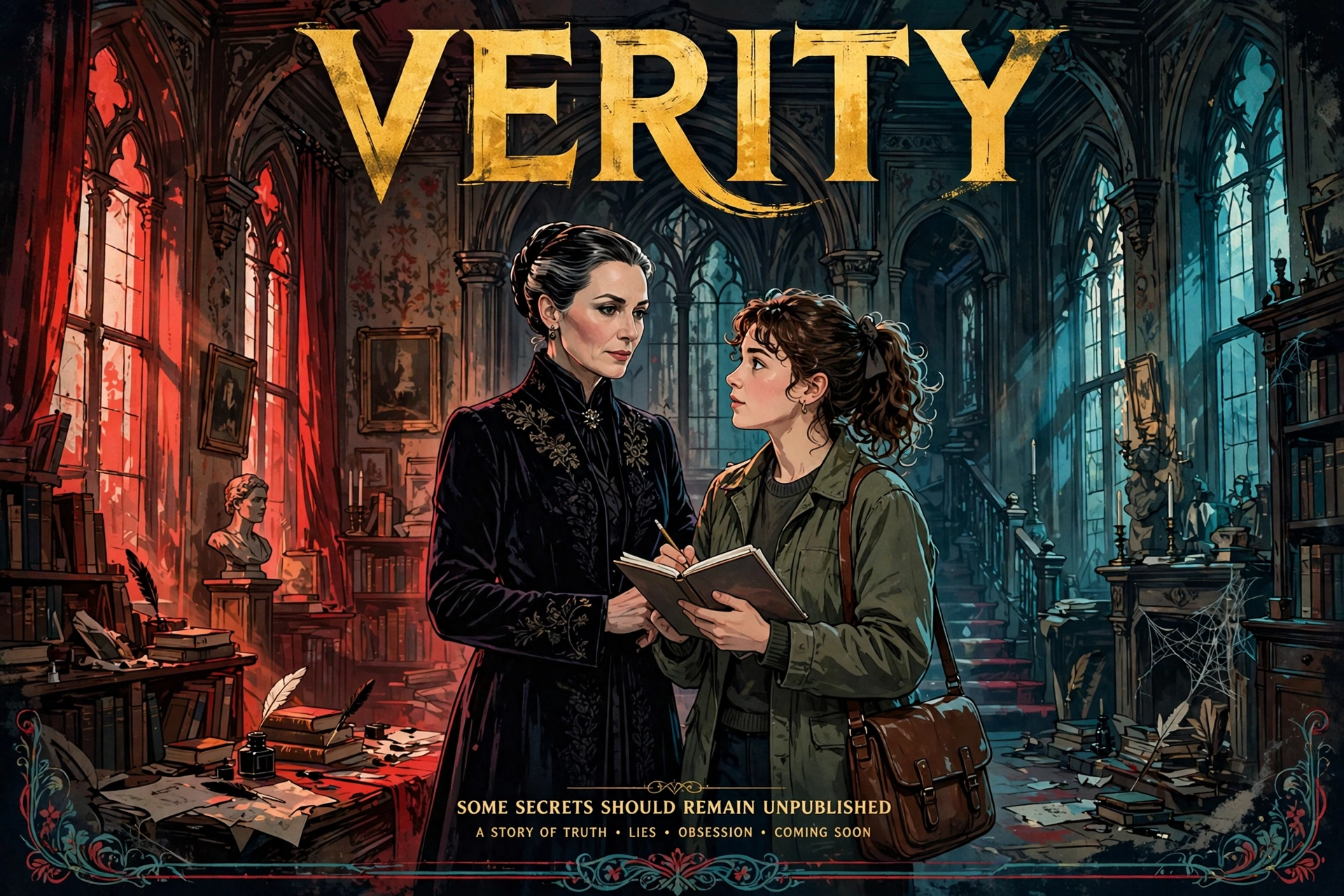
Colleen Hoover’s novels have become a publishing phenomenon, and Hollywood has been quick to follow. Verity arrives as the darkest of the recent Hoover adaptations: a gothic, psychosexual thriller about a struggling writer who takes a job she does not fully understand, in a house she should probably leave, for a family whose tragedy may not be quite what it seems. Directed by Michael Showalter and starring Anne Hathaway, Dakota Johnson and Josh Hartnett, the film leans hard into atmosphere, ambiguity and melodrama. It does not always hold together, but it is rarely dull, and its central question — is the manuscript Lowen finds a confession, a fiction, or a trap? — keeps working long after the credits.
This review is spoiler-free on the film’s ending. The premise itself is the hook, and it deserves to be met fresh.
| Detail | Information |
|---|---|
| Release date | 2 October 2026 (United States; preview screening 24 September 2026, London) |
| Director | Michael Showalter |
| Writer | Nick Antosca, based on the 2018 novel by Colleen Hoover |
| Genre | Gothic psychological thriller |
| Language | English |
| Runtime | 117 minutes (some listings give 118 minutes) |
| Budget | $40 million |
| Lead cast | Anne Hathaway, Dakota Johnson, Josh Hartnett, Ismael Cruz Córdova, Brady Wagner |
| Our rating | 7/10 |
Lowen Ashleigh (Dakota Johnson) is a writer in trouble: broke, grieving, and unsure of her next step when she is offered a job most writers would dream of. Verity Crawford (Anne Hathaway), a bestselling author, can no longer write after a mysterious accident, and her husband Jeremy (Josh Hartnett) hires Lowen to finish Verity’s successful series. Lowen moves into the Crawford home to work through Verity’s notes and outlines — and there she finds something else entirely: pages that read like an autobiography, full of disturbing confessions about Jeremy, about the family’s dead children, and about the woman lying silent upstairs.
The film’s engine is simple and effective. Every scene asks the same question in a new form: can Lowen trust what she is reading? If the manuscript is true, then the man she is growing close to may be in danger, or may be dangerous himself. If it is fiction — a writer’s private exercise, never meant to be read — then Lowen’s suspicions say more about her own loneliness and imagination than about anyone else. And if it is something else, something planted, then Lowen is not a reader at all but a character in someone else’s story.
Showalter stages this as a house thriller first and a literary mystery second. The Crawford home is all long corridors, closed doors, low light and rooms that seem to watch the people in them. Lowen’s investigation is less about detective work than about atmosphere: a door left ajar, a sound from upstairs, a manuscript page that changes everything she thought she knew. The film understands that the best version of this story is one where the audience, like Lowen, keeps changing its mind.
Without spoiling the ending, it is fair to say the film preserves the novel’s famous ambiguity rather than flattening it into a single clean answer. Viewers who want a twist that settles everything may feel frustrated; viewers who enjoy arguing about what really happened on the drive home will find plenty to argue about. That divided response is visible in the critical reception itself, which split sharply on release.
Anne Hathaway as Verity Crawford — Hathaway is the film’s magnetic centre even when her character is, by design, mostly silent and still. Verity is a performance built from looks, timing and presence: a woman who may be a victim, a manipulator, or both, and Hathaway refuses to tip the film’s hand. Even critics who disliked the film singled her out as its saving grace, and it is easy to see why. She gives Verity a glamour that feels dangerous rather than decorative, and the film’s best scenes are the ones where the camera simply watches her watching everyone else.
Dakota Johnson as Lowen Ashleigh — Johnson’s job is harder and quieter: she must be the audience’s way into the house without becoming a mere pair of eyes. She plays Lowen as observant, tired and increasingly unsteady, a woman whose professional ambition and personal loneliness pull in opposite directions. Some of the film’s more positive reviews praised her as the reason the adaptation works at all, and that feels right. Lowen’s uncertainty is the film’s uncertainty, and Johnson carries it without overplaying it.
Josh Hartnett as Jeremy Crawford, and the supporting cast — Hartnett has the trickiest role of the three leads, because Jeremy must remain readable in two opposite ways at once: devoted husband and grieving father, or something far less sympathetic. He plays it with a steady, wounded charm that keeps both readings alive for most of the running time. Ismael Cruz Córdova, as Corey, and Brady Wagner, as the young son Crew, give the household its remaining human texture, though the film keeps its focus firmly on the central triangle.
Showalter, who previously directed Hathaway in the romance The Idea of You, makes a deliberate tonal choice here: he plays the material straight as a gothic thriller but allows its melodrama to breathe. The result is a film that is handsome and moody — Jim Frohna’s cinematography favours shadow, candlelight and the cold beauty of an isolated house — without ever becoming a parody of itself. Volker Bertelmann’s score adds unease without telling the audience exactly what to feel in each scene, which matters in a film built on ambiguity.
Where the film stumbles is in its balance. At times the erotic-thriller elements and the melodramatic twists pull against each other, and the tone wobbles between serious psychological drama and something closer to a glossy page-turner brought to life. Critics noted exactly this split: some found the mix compelling and fun, others found it neither sexy enough nor smart enough to fully commit to either mode. The pacing, too, lingers in its middle stretch, as Lowen reads and re-reads and the film circles the same questions before its final act accelerates.
One honest caveat: this is an adaptation that assumes some familiarity with its own genre. Viewers coming to it cold, expecting a straightforward thriller with a single twist, may find its refusal to settle the central question unsatisfying. Viewers who enjoy gothic stories — Rebecca, Gone Girl, the novels of Daphne du Maurier — will recognise the game being played and enjoy it more.
Bertelmann’s score is restrained and atmospheric, favouring low strings and piano figures over big thriller stings. It works best in the quiet scenes, where a held note can make an empty room feel occupied. The sound design does similar work: footsteps, doors, water and silence are mixed so that the house itself feels like a character. There is no showpiece soundtrack here, and the film is better for it; this is a score that serves mood rather than seeking attention.
What we loved:
What could be better:
Verity was made for a reported $40 million, a sensible budget for a star-led thriller, and it performed strongly on release. Contemporary reporting put its worldwide total at around $162.7 million. That figure should be read as a reported total at the time of writing rather than a final audited number, since the film was still in release in some territories, but the shape of the story is clear: a mid-budget adult thriller that found a large audience, helped by the built-in readership of Hoover’s novel and by its star cast.
Critically, the film divided opinion sharply. Early aggregated scores sat around the 50–54% range, with individual reviews ranging from enthusiastic (one major outlet gave it 8 out of 10 and called it potentially the best Hoover adaptation yet) to hostile (another gave it 2 out of 10 while still praising Hathaway). That split is itself informative: Verity is a film people argue about, and for a thriller built on ambiguity, that may be the most honest reception it could have.
Yes, especially if you like gothic thrillers, twisty mysteries or Hathaway at her most commanding. Verity is not a flawless film — its tone wobbles and its middle sags — but its central mystery is genuinely absorbing, its two lead performances are strong, and its ending gives you something to argue about afterwards. Go in expecting atmosphere and ambiguity rather than a tidy puzzle with one answer, and you will have a good night at the cinema.
Our rating: 7/10 — A handsome, divisive gothic thriller carried by Hathaway and Johnson, best enjoyed as a mystery to argue about rather than a puzzle to solve.
Is Verity based on a book?
Yes. It adapts Colleen Hoover’s 2018 psychological thriller novel Verity, with a screenplay by Nick Antosca.
Who stars in Verity?
Anne Hathaway as Verity Crawford, Dakota Johnson as Lowen Ashleigh and Josh Hartnett as Jeremy Crawford, with Ismael Cruz Córdova and Brady Wagner in supporting roles.
How much did Verity earn at the box office?
Around $162.7 million worldwide against a reported $40 million budget, according to contemporary reporting; treat this as a reported total, not a final audited figure.
Is Verity suitable for family viewing?
No. It is an adult psychological thriller with an R rating, dealing with death, grief, sexuality and disturbing confessions. It is intended for adult viewers.
Does the film explain whether the manuscript is true?
Not cleanly, and that is deliberate. Like the novel, the film preserves the ambiguity at the heart of the story, so viewers are left to judge the manuscript — and Verity herself — for themselves.