★ LATEST REVIEWS

★★★☆☆ Our Rating: 6/10
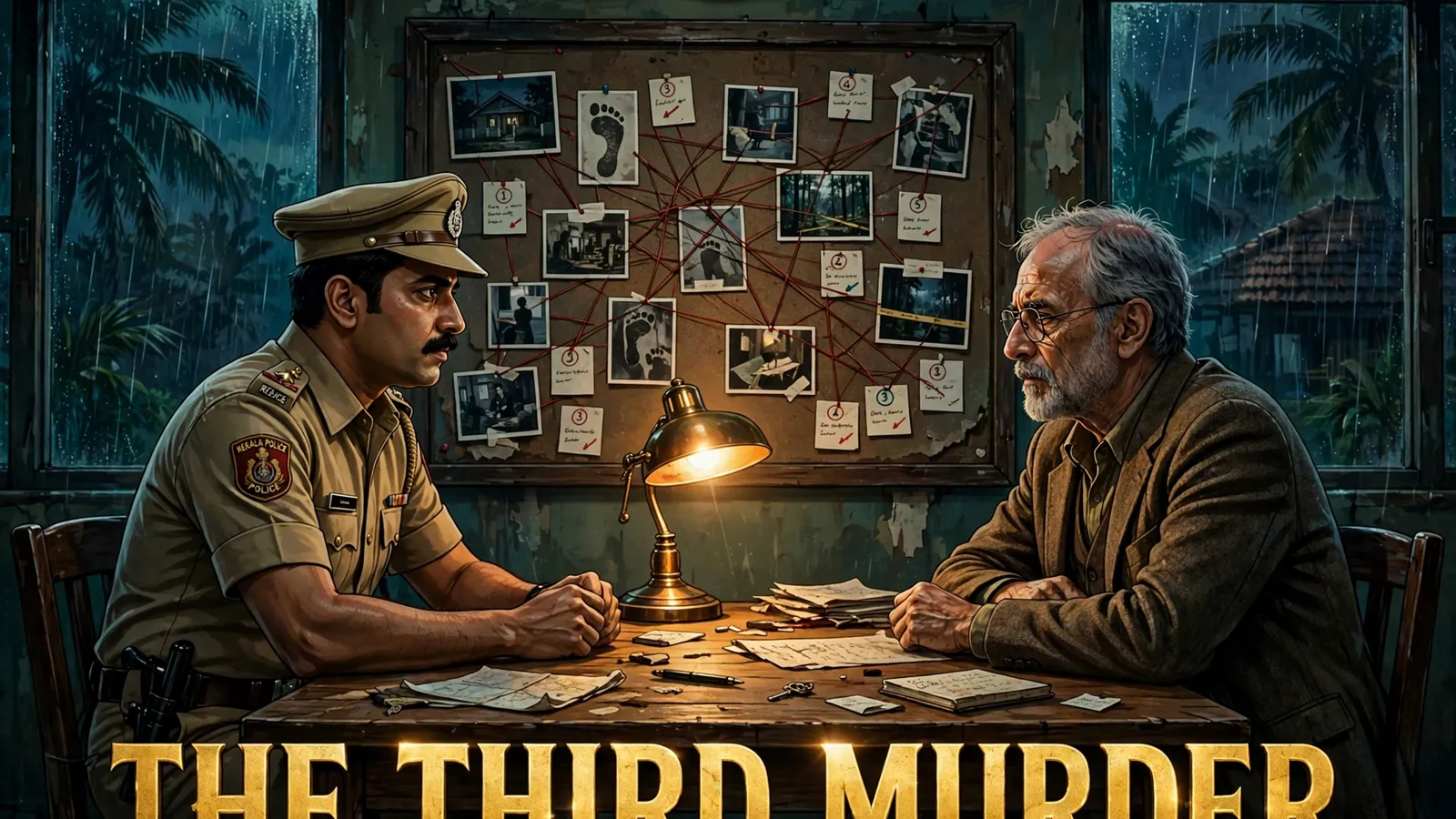
Malayalam cinema has spent the last few years building a reputation for crime thrillers that trust the audience’s intelligence, and The Third Murder arrives carrying that expectation on its shoulders. The film, directed by Sunil Ibrahim and written by M. S. Faizal Khan, opened in theatres on 2 October 2026, and it reached its wider audience this week with its streaming premiere on ManoramaMAX on 13 November 2026, with Simply South carrying it outside India and Amazon Prime Video expected to follow about a week later. It stars Saiju Kurup as a serving police officer and Indrans as a retired officer who understands the minds of serial killers better than anyone still in uniform. The premise is strong, the two central performances have drawn praise, and the film has a genuinely intriguing idea at its centre. What it does not have, by most accounts, is the screenplay to sustain that idea for two hours. This is a thriller that works best in the scenes where its two leads are simply talking to each other, and weakest whenever it has to move its plot forward.
This review is spoiler-free. It is based on the film’s verified release details and on published reviews, and it states plainly where the reported facts conflict or remain unverified.
| Detail | Information |
|---|---|
| Theatrical release | 2 October 2026 |
| OTT premiere | 13 November 2026 on ManoramaMAX (Simply South outside India); Amazon Prime Video expected about a week later — reported as expected, not confirmed |
| Director | Sunil Ibrahim |
| Written by | M. S. Faizal Khan |
| Genre | Psychological crime thriller |
| Language | Malayalam |
| Runtime | 124 minutes |
| Rating | UA |
| Starring | Saiju Kurup (DYSP Christy), Indrans (retired officer Swamy), Vinay Forrt, Ananya, Leona Lishoy, Manikandan Pattambi, Johny Antony |
| Box office | No settled total — reported figures conflict (see Reception and Box Office) |
| Our rating | 6/10 |
The story begins with two deaths that should have nothing to do with each other. Boban, a businessman, is murdered. Justin, a drug dealer, is murdered. The victims come from different worlds, and on the surface there is no connection between them — except that the murders share an identical pattern. That pattern is the film’s hook, and it is a good one: a killer who repeats himself is a killer who can be understood, and a killer who can be understood can be caught. The problem is that understanding him takes a kind of thinking that the serving police, for all their energy and resources, cannot quite manage on their own.
That is where DYSP Christy, played by Saiju Kurup, comes in, and where the film’s most interesting relationship begins. Christy is the officer in charge of the case, and he knows that the pattern points to a particular kind of mind. So he turns to a man who is no longer in the force: Swamy, played by Indrans, a retired officer who is an expert in serial-killer psychology. The dynamic between the two men is the film’s engine. Christy is the man of the present — active, procedural, working the case through the system. Swamy is the man of the past — retired, reflective, reading people rather than files. Together they follow the trail, and the trail points in an unexpected direction: toward a troubled teenager and his eccentric father. The film’s title tells the audience what is at stake. Two murders have already happened. The investigation is a race against time to prevent a third.
The premise has everything a psychological thriller needs: a pattern, a profiler, a ticking clock, and a suspect who does not fit the usual mould. A troubled teenager and an eccentric father are not the villains a conventional crime film would offer, and the film deserves credit for that choice. The question is whether the screenplay does enough with it. The published criticism suggests that it does not, or at least not consistently, and that the film’s best moments are the quiet ones — the conversations between Christy and Swamy — rather than the plot mechanics that surround them.
The film’s strongest asset is the pairing of its two leads. Indrans has had one of the most remarkable second acts in Indian cinema, moving from decades of comic supporting roles into serious, interior performances, and his Swamy is a continuation of that reinvention. Swamy is a man who has spent his career inside the minds of killers, and Indrans plays him as someone who carries that knowledge quietly — not as a showy profiler who announces his insights, but as an older man who has learned to watch and wait. There is a stillness to the performance that makes the character feel real, and the coverage of the film’s streaming release has singled out the mind-game sequences between Swamy and Christy as its best material.
Saiju Kurup’s Christy is the film’s anchor in the present tense. Christy is a competent, serious officer, and Kurup plays him without the swagger that so many screen policemen are given. He is a man who knows the limits of his own methods, which is why he goes to Swamy in the first place, and Kurup makes that humility feel like a professional quality rather than a weakness. The scenes in which the two men work through the case together — one bringing the facts, the other bringing the psychology — are the scenes where the film feels most alive, and they are the reason the film is worth watching despite its flaws.
The supporting cast fills out the world around them. Vinay Forrt, Ananya, Leona Lishoy, Manikandan Pattambi and Johny Antony all have roles in the investigation and in the lives of the victims and suspects, and they give the film a texture that keeps it grounded in Kerala rather than in a generic thriller setting. The film’s world feels like a real place, with real people in it, and that grounding matters in a story that could easily have floated away into abstraction.
Sunil Ibrahim directs with a clear sense of what the film should feel like: austere, slow-burning, and serious. The word “austere” appears in the published criticism of the film, and it is a fair description. This is not a thriller that rushes to its next twist. It lingers on conversations, on the process of investigation, on the way a case wears down the people working it. That patience is a strength when the film is focused on Christy and Swamy, and a weakness when it is not, because the screenplay does not always give the audience enough to hold on to during the slower stretches.
NowRunning, in its review of the film, called it “a dull crime thriller”, and its criticism was specific: the film is austere and slow-burning, but the screenplay lacks the ideas to sustain the momentum across its 124 minutes. That is a harsh judgement, and it is worth saying plainly that it is one publication’s view, not a consensus. But it identifies a real problem. A psychological thriller lives or dies on the quality of its thinking — the deductions, the false leads, the moments when a detail clicks into place — and The Third Murder does not generate enough of those moments. The pattern that connects the two murders is intriguing, and the trail toward the troubled teenager and his eccentric father is promising, but the film does not build on those ideas with the density a two-hour thriller needs.
The direction itself is not the problem. Ibrahim stages the interrogation scenes and the conversations between the two leads with confidence, and the film looks and sounds like a serious piece of work. The problem is structural: a thriller needs its middle to be as strong as its premise, and here the middle sags. The film’s 124-minute runtime is not excessive for the genre, but it feels long when the plot is not generating new questions, and some viewers will find their attention drifting before the race against the third murder reaches its climax.
No composer has been singled out in the film’s published coverage at the time of writing, so this section deals with what the music and sound have to do in a film like this. A psychological crime thriller needs a score that can sustain tension without announcing it — music that sits underneath the investigation and makes the audience feel the clock ticking.
What we loved:
What could be better:
The critical picture is split in a way that tells the story of the film. NowRunning’s review is blunt, calling the film “a dull crime thriller” and arguing that the screenplay does not have the ideas to keep its slow-burn structure moving. The coverage around the streaming release, by contrast, has praised the Indrans–Saiju Kurup sequences, and that praise is consistent: wherever the film is discussed, the two leads are the part everyone agrees on. The honest summary is that this is a film with excellent central performances and a premise that deserves a better screenplay.
The box office is where this review has to be careful, because the reported figures conflict and no settled total exists. One source, BoxOfficeIndia24, reports ₹0.45 crore India nett and ₹0.51 crore worldwide. Another, Filmibeat, reports ₹0.66 crore and ₹0.74 crore. Those are different numbers for the same film, and there is no reliable way to reconcile them from the published material, so this review states plainly that there is no settled total. What can be said is that both figures describe a very small theatrical run, which is consistent with a film that found its real audience on streaming rather than in cinemas.
One more caution is needed. Promotional articles about the film claim an IMDb rating of 8.4. That figure is unverified, and this review does not cite it as a rating. Readers should treat it with the same scepticism as any number that appears in promotional material without a verifiable source behind it.
Yes — if you like Malayalam crime thrillers, and if you are watching for the performances rather than for a twist-filled plot. The Third Murder is at its best when Indrans and Saiju Kurup are on screen together, working through a case that neither of them can solve alone, and those scenes are genuinely good. Go in expecting a slow, austere investigation rather than a fast-paced thriller, and be prepared for a middle act that does not always earn its runtime. The film is streaming now on ManoramaMAX, which makes it an easy watch for anyone curious about the genre. Our rating: 6 out of 10 — a strong premise and two fine central performances held back by a screenplay that runs out of ideas before the film runs out of minutes.
When did The Third Murder release in theatres?
The Third Murder released in theatres on 2 October 2026.
Where can I watch The Third Murder online?
The film premiered on ManoramaMAX on 13 November 2026, with Simply South carrying it outside India. Amazon Prime Video is expected to follow about a week later, but that is reported as expected, not confirmed.
Who directed The Third Murder?
Sunil Ibrahim directed the film. It was written by M. S. Faizal Khan.
Who stars in The Third Murder?
Saiju Kurup plays DYSP Christy and Indrans plays the retired officer Swamy. The cast also includes Vinay Forrt, Ananya, Leona Lishoy, Manikandan Pattambi and Johny Antony.
What is the story of The Third Murder?
Two murders — of businessman Boban and drug dealer Justin — share an identical pattern. DYSP Christy enlists retired officer Swamy, an expert in serial-killer psychology, and the trail points to a troubled teenager and his eccentric father, in a race to prevent a third murder.
How long is The Third Murder?
The film runs 124 minutes and is rated UA.
What did critics say about The Third Murder?
NowRunning called it “a dull crime thriller”, arguing that the screenplay lacks the ideas to sustain its slow-burn momentum. Coverage of the streaming release has praised the Indrans–Saiju Kurup mind-game sequences.
Is there a confirmed box-office total for The Third Murder?
No. Reported figures conflict — BoxOfficeIndia24 reports ₹0.45 crore India nett, while Filmibeat reports ₹0.66 crore — so there is no settled total.
Is the claimed IMDb rating of 8.4 reliable?
No. Promotional articles claim an IMDb rating of 8.4, but it is unverified, and this review does not cite it as a rating.
