★ LATEST REVIEWS

★★★★☆ Our Rating: 8/10
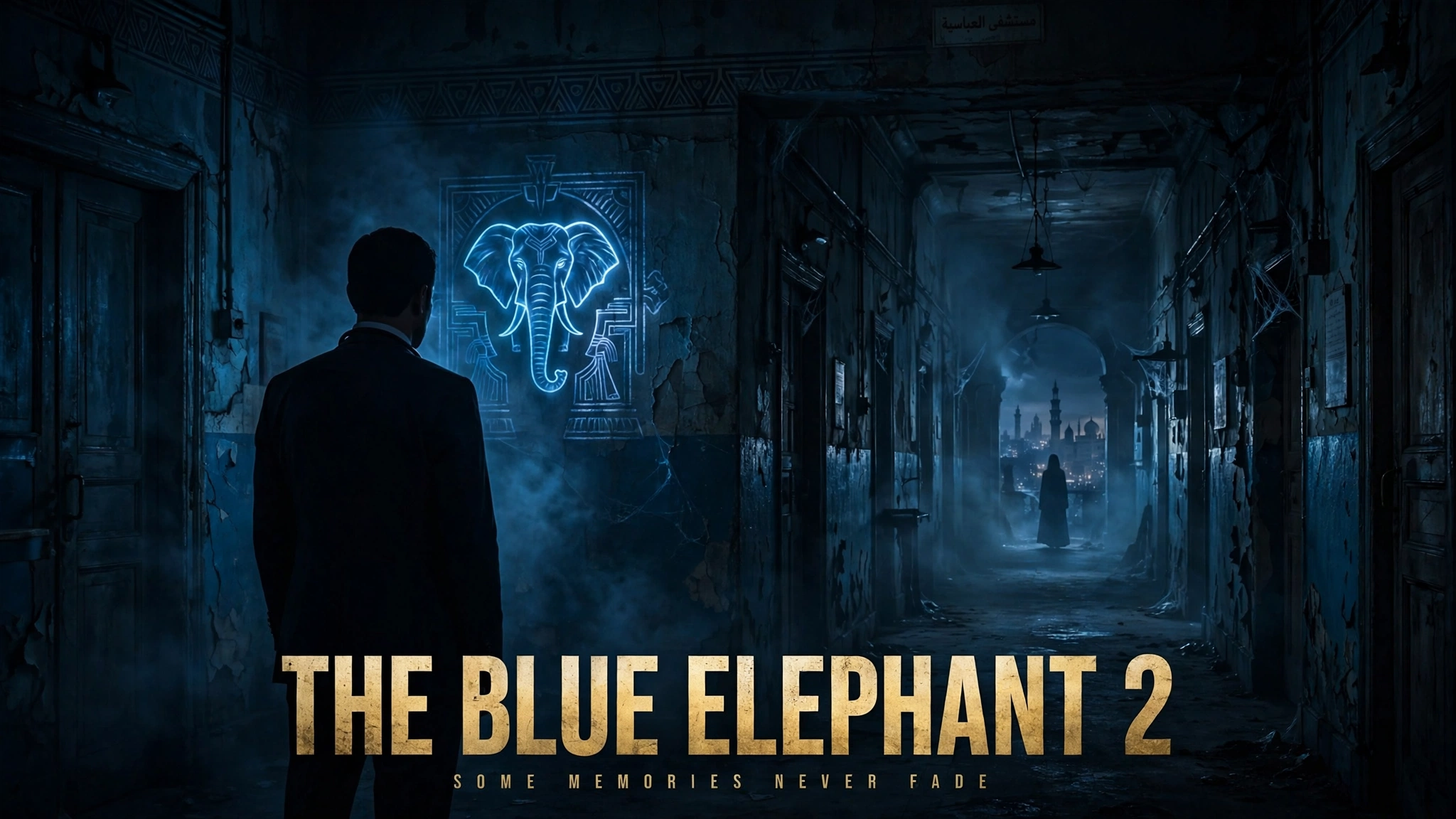
Sequels to beloved thrillers usually arrive smaller: same corridors, weaker chills. The Blue Elephant 2, released in Egypt on 25 July 2019, arrived bigger in every measurable way. Marwan Hamed’s follow-up to his 2014 psychological horror hit The Blue Elephant — which our bank reviews separately — reunited psychiatrist Yehia Rashed with the ward, the pill and the darkness, added one of Arab cinema’s biggest stars to the cast, and proceeded, on reported figures, to become the highest-grossing Egyptian film in history up to that time, the first to pass EGP 100 million at home. Director Hamed would later break his own record again with Kira & El Gin, but for three years this was the summit of Egyptian commercial cinema.
This The Blue Elephant 2 review looks at the film behind that record: a sequel that is slicker, faster and more confident than its predecessor, more purely a genre machine — and, depending on your taste, either thrillingly so or at the cost of some of the first film’s ragged soul. It is spoiler-free for this film’s twists, assumes you may not have seen part one, and gives the box-office claims exactly the sourcing and caution Egyptian figures require, because they come from press and distributor reporting, not independent audit.
| Detail | Information |
|---|---|
| Release date | 25 July 2019 |
| Director | Marwan Hamed |
| Writers | Ahmed Mourad |
| Genre | Drama, Horror, Mystery, Thriller |
| Language | Arabic (Egyptian dialect) |
| Runtime | 130 minutes |
| Lead cast | Karim Abdel Aziz, Nelly Karim, Hend Sabry, Shereen Reda |
| Our rating | 8/10 |
A note on this table: no budget row is included, deliberately. We could not find a reliably verified production budget for this film in dependable reporting, and Egyptian budgets are rarely published on an audited basis — so, following the same practice as our review of the first film, we omit the figure rather than repeat an unverifiable database estimate.
Five years have passed since the events of the first film. Dr Yehia Rashed (Karim Abdel Aziz) has done the thing he once seemed incapable of: he has built a life. He is married to Lobna (Nelly Karim), the love he recovered in the first story; he has a family; the drink, the pills and the self-destruction have receded into a past he manages day by day. It is precisely this hard-won normality that the sequel exists to threaten. Yehia is called back to Abbasseya psychiatric hospital — to the women’s section of Ward 8 West, the unit for criminally insane patients — to evaluate a new inmate: Farida (Hend Sabry), a woman accused of killing her own family, who receives him not with madness but with calm, intimate knowledge she should not possess.
Farida’s message is the film’s ticking clock: she prophesies that Yehia’s family will die, and that he has three days. What follows is structured as a countdown and an investigation at once. Yehia — who knows, better than any doctor alive, how thin the wall is between a disturbed mind and something genuinely supernatural — finds the rational explanations failing one by one, and finds himself reaching again for the instrument he swore off: the blue elephant pill, the drug that lets its user cross into the hidden world where the truth about such patients lives. Faces from the first film return around him, including Deega the tattoo artist (Shereen Reda), whose art once again opens doors, and a guest appearance by Eyad Nassar adds a further layer to the mystery. Whether Farida is a manipulator, a vessel or something worse — and what she actually wants from Yehia — is the film’s to reveal. What can be said is that the sequel plays fairer and faster than its predecessor: the rules established in part one are honoured, extended rather than contradicted, and the final act pivots on knowledge the audience has been given. Viewers who have not seen the first film will follow the plot, but the pill sequences and Yehia’s terror of relapse carry far more weight if you have.
Karim Abdel Aziz as Dr Yehia Rashed had already given his career performance in the first film; here he gives its necessary companion piece — the same man, healed just enough to have something to lose. Abdel Aziz plays Yehia’s rebuilt life with a lightness in the early scenes that makes the countdown genuinely frightening: this is no longer a man with nothing, courting destruction, but a husband and father watching destruction come calling with his family’s name in its mouth. His work in the pill sequences remains the franchise’s engine — terror, wonder and recognition in near-silence — and his scenes of relapse, where professional control cracks into the old desperation, are the film’s most painful material.
Hend Sabry as Farida is the sequel’s masterstroke. Sabry, one of the most respected actors in Arab cinema, plays the new patient as stillness itself: soft-spoken, precise, almost gentle — and absolutely terrifying, because nothing in her performance reaches for effect. Where Khaled El Sawy’s Sherif in the first film was a storm of shifting selves, Sabry’s Farida is a locked room. Her ward conversations with Yehia are the film’s centrepiece duels, played across a table with the tension of interrogation scenes in a great crime film, and she ensures the sequel has its own identity rather than a copy of the original’s possessed-patient dynamic. That the first film’s great supporting performance is missed is true; that Sabry replaces it with a different, equally compelling register is the sequel’s good fortune.
Nelly Karim as Lobna has a harder role than in part one — the spouse who must embody everything at stake — and she gives Lobna more than the script’s function: watch her play a woman who knows her husband’s darkness from the inside and recognises its return before he admits it. Shereen Reda as Deega returns with her unsettling calm intact, and Eyad Nassar, appearing as a guest, brings weight to a strand of the mystery we will not describe. The ensemble is smaller and tighter than the first film’s, and the focus benefits the countdown structure.
Marwan Hamed directs the sequel with the confidence of a filmmaker whose first film changed his industry’s sense of the possible — and with noticeably better resources. At 130 minutes against the original’s 170, the film is leaner and more disciplined: the countdown premise enforces a pace the first film’s investigation never had, and Hamed structures the scares in escalating waves rather than slow accumulation. Ahmed El Morsi’s cinematography again defines the film’s look — the hospital’s drained institutional tones against the saturated nightmare logic of the pill world — but the sequel’s effects work is a visible step up: the sequences beyond the pill are more elaborate, more coherent and better integrated with the actors, the clearest evidence of a bigger canvas being used well. Production design extends the first film’s specifically Egyptian supernatural vocabulary — folk magic, tattoo symbolism, layers of old Cairo — rather than importing generic horror imagery.
Credit listings for this film differ between sources in a way worth flagging honestly: reference listings credit the editing to Mohamed Attia, while MAD Solutions’ production reporting on the sequel names Ahmed Hafez as editor, with Mohamed Attia listed in a production-design capacity — a confusion possibly carried over from the first film’s credits, where Attia’s role also varies by source. We note the discrepancy rather than pretend certainty. What is not in dispute is the result on screen: the cutting sustains clarity across braided timelines and reality levels while keeping the three-day countdown legible — no small feat. The craft criticisms are matters of taste rather than execution. The sequel is a more conventional genre film than its predecessor: its shocks are bigger and better engineered, but the first film’s grubby, improvisational dread — the feeling that anything, including the film itself, might come apart — has been polished away. Some viewers will call that maturity. Others will miss the mess. Both are describing the same choice.
Hesham Nazih returns as composer — some listings also credit Mohamed Elhusseini alongside him — and the score is the sequel’s connective tissue to the first film’s sound world: the same language of breathing low strings, tightening percussion and folk-tinged choral colour, now deployed with a sequel’s confidence and a countdown’s urgency. Nazih understands that his most frightening instrument is restraint; the ward duels between Yehia and Farida are allowed to sit in near-silence, so that a shift in breathing becomes a scare, and the pill sequences then open out into some of the most propulsive scoring in Egyptian genre cinema. His work across this franchise remains the strongest argument that he is his generation’s defining Egyptian film composer — a reputation international audiences later met in Marvel’s Moon Knight. If the sequel’s score is slightly less surprising than the original’s, that is the honest price of a musical world already established. It is doing a different job: not discovery, but dread remembered.
What we loved:
What could be better:
All Egyptian figures in this section are reported figures — compiled from press, distributor and specialist-database reporting — and are not independently audited; dollar equivalents are approximations that vary with the exchange rate and the source, and international trackers capture only a fraction of this film’s Arab-world business, so we do not present any partial tracker total as a worldwide gross. Within those limits, the record story is consistent across sources. Released on 25 July 2019 in around 100 Egyptian theatres, the film was reported by Screen Daily and MAD Solutions’ distribution announcements to have grossed a record sum at home — described at the time as roughly US$6 million — and to have drawn audiences across Iraq, Jordan, Lebanon, Saudi Arabia and the UAE. Egyptian reporting, including Egypt Today coverage carried by The Free Library, marked the milestone precisely: the first film in Egyptian cinema history to pass EGP 100 million in revenues. Esquire Middle East’s later all-time tally gives the film’s Egyptian total as EGP 103,633,291, while Wikipedia’s summary rounds the achievement as collecting around E£100 million. We therefore describe it as a reported EGP 100–104 million range, with the Esquire figure the most specific published tally we found. The context makes the number meaningful: the first film’s EGP 30–35 million, a sensation in 2014, had roughly tripled in five years. The sequel held the all-time Egyptian record until Marwan Hamed broke it himself with Kira & El Gin in 2022 — a neat measure of how completely this director and star defined their industry’s commercial ceiling in that era.
Yes — after the first film, which it needs and rewards. Taken together, the two Blue Elephant films are the essential double bill of modern Egyptian genre cinema: the first for its raw ambition and its great duel of performances, this one for its discipline, its new villain and its demonstration that Egyptian craft could scale up without selling out. Watch it in Arabic with subtitles, expect a leaner and more conventional thriller than part one, and do not be surprised when Farida’s quiet voice stays with you longer than any of the film’s bigger shocks. Egyptian audiences made it a record-breaker; on this evidence, they were rewarding quality, not just loyalty.
Our rating: 8/10 — a leaner, slicker, genuinely frightening sequel that earned its place in Egyptian box-office history.
Do I need to watch The Blue Elephant (2014) before Part 2?
Strongly recommended. The sequel’s plot can be followed alone — it is a new case set five years later — but Yehia’s history, the blue elephant pill and Lobna’s significance all come from the first film, and the relapse story only lands with that knowledge.
Is The Blue Elephant 2 really the highest-grossing Egyptian film?
It was, on reported figures, from 2019 until 2022: the first Egyptian film reported past EGP 100 million, with Esquire Middle East’s tally at EGP 103,633,291. Egyptian figures are reported, not independently audited, and the record was later taken by Kira & El Gin and then Beit El Ruby.
Is The Blue Elephant 2 scarier than the first film?
Most viewers find it more propulsive and polished, with bigger engineered set pieces, while the first film is slower, grubbier and more psychologically unsettling. Both rely on dread and atmosphere more than gore.
Is The Blue Elephant 2 suitable for family viewing?
No. It deals with murder, mental illness, addiction relapse and occult themes, with intense and disturbing sequences throughout. It is firmly an adult thriller.
Where can I watch The Blue Elephant 2?
It has been widely available on Arab-world streaming platforms, including Watch iT and Netflix in Egypt at various times, and appears internationally in some regions with subtitles. Availability changes, so check your local listings.