★ LATEST REVIEWS

★★★★☆ Our Rating: 8/10
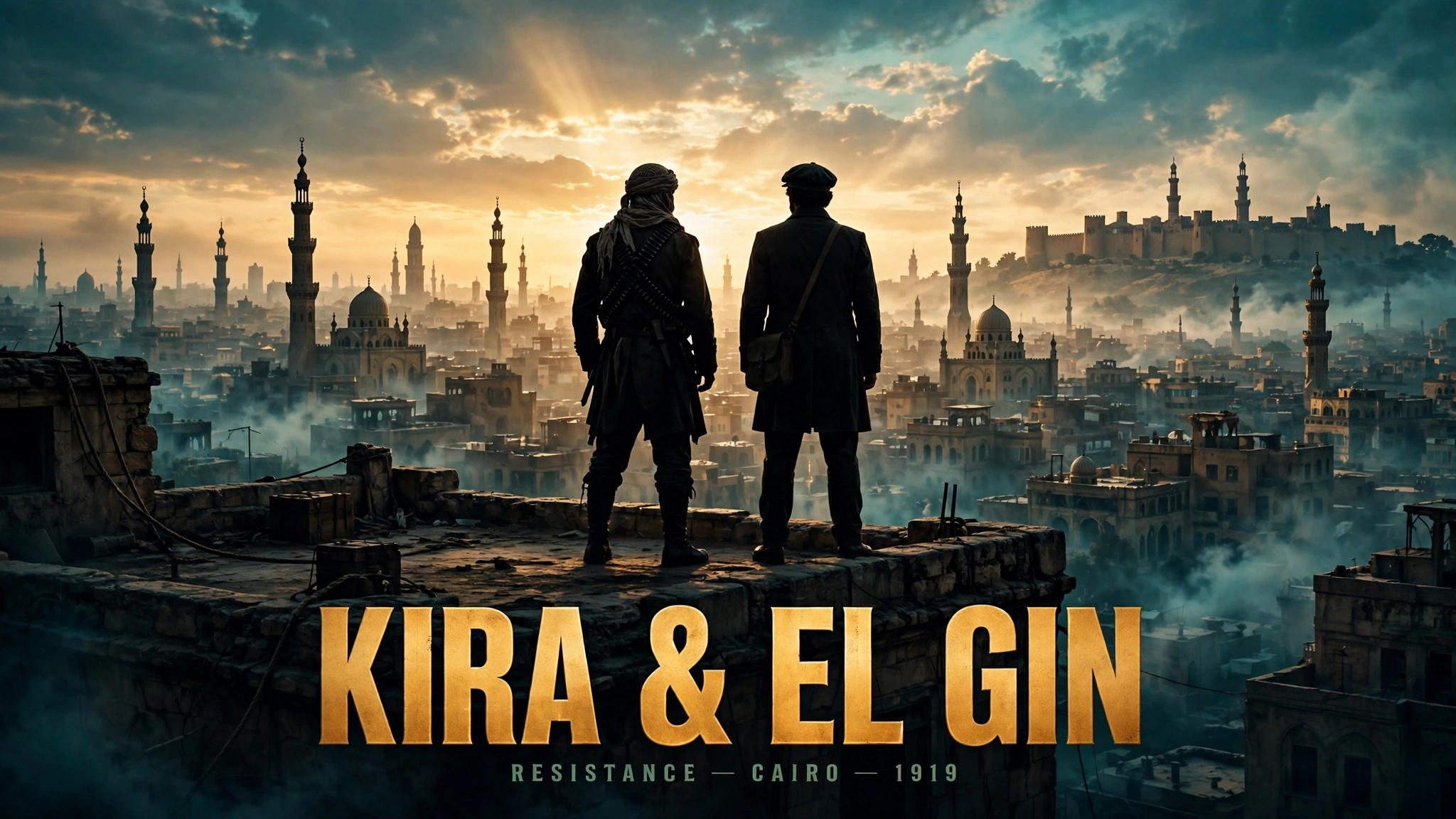
For most of a century, Egyptian cinema has told its own national story back to itself, but rarely at this scale. Kira & El Gin, released in Egypt on 30 June 2022 for the Eid al-Adha season, is a near-three-hour historical epic about the underground resistance to British occupation around the 1919 revolution — built as a commercial star vehicle, headlined by the two biggest male stars of their generation acting together, and directed by Marwan Hamed, the filmmaker who has made a habit of breaking his own box-office records. It duly became, on reported figures, the highest-grossing Egyptian film in history up to that point — breaking the record previously held by Hamed’s own The Blue Elephant 2, which our bank also reviews.
That commercial story matters, and this Kira & El Gin review will give you the Egyptian-pound figures with their proper health warnings attached, because Egyptian box-office reporting is press and database compilation, not independently audited accounting. But the film itself deserves attention beyond the record: it is an ambitious, handsomely mounted attempt to make a popular patriotic epic that mixes real historical figures with invented ones, spycraft with melodrama, and two very different star personas into a single resistance network. It is also long, crowded and occasionally muddled — an epic whose reach sometimes exceeds its grasp, even as its grasp is stronger than almost anything else in modern Egyptian commercial cinema.
| Detail | Information |
|---|---|
| Release date | 30 June 2022 (Egypt) |
| Director | Marwan Hamed |
| Writers | Ahmed Mourad (based on his novel 1919) |
| Genre | Historical Drama, Action, Thriller |
| Language | Arabic (Egyptian dialect) |
| Runtime | 175 minutes |
| Lead cast | Karim Abdel Aziz, Ahmed Ezz, Hend Sabry, Sayed Ragab, Ahmed Malek |
| Our rating | 8/10 |
A note on this table: no budget row is included, deliberately. A figure of around US$10 million was quoted by director Marwan Hamed in pre-release press coverage, when the production was described as the most expensive in Egyptian cinema history. That is a director’s quoted figure reported in entertainment press, not a verified or audited production budget, so we discuss it in the box-office section rather than present it as fact here.
Cairo, in the years around the First World War and the explosion of 1919. Egypt is a British protectorate in name and an occupied country in fact, and resentment is moving from the cafés into organised, secret resistance. The film’s title names its two poles. Ahmed Abdel Hay — known as Ahmed Kira (Karim Abdel Aziz) — is a doctor from a respectable family who leads a double life inside the resistance movement: courier, organiser and assassin when the network demands it, a man whose real historical counterpart genuinely moved through these events. Abdel Qader Shehata, called El Gin — the Jinn (Ahmed Ezz) — comes from the opposite end of the social order: a charming, rootless rogue surviving on his wits, drawn toward the struggle by loyalty, love and the slow discovery that occupation humiliates even those who try to ignore it.
Around these two, screenwriter Ahmed Mourad builds a wide tapestry adapted from his own bestselling novel 1919: the resistance leader Dawlat Fahmi (Hend Sabry), a schoolteacher whose courage costs her more than any of the men; veteran conspirator Naguib El Helbawy (Sayed Ragab); the young idealist Ibrahim Shawkat (Ahmed Malek); British officers, informers, exiles and family members whose private stories intersect with assassinations, arms deals, betrayals and escapes across Egypt and beyond, including filming in Croatia standing in for European locations. The film’s structure is episodic by design — a network story rather than a single mission — cutting between operations, safe houses and drawing rooms as the movement builds toward the mass uprising of 1919 and its aftermath. To say how each thread resolves would spoil both the history and the melodrama; suffice to say the film is interested less in whether Egypt resists — history answers that — than in what resistance does to the people who carry it out in secret: the lies they must live inside, and the selves they lose along the way.
Karim Abdel Aziz as Ahmed Kira gives the film’s most complete performance. Kira is written as the still centre — a man whose patriotism is a discipline rather than a feeling — and Abdel Aziz, by now the defining Egyptian star of his era through the Blue Elephant films and beyond, plays him with banked-down intensity: courteous in drawing rooms, absolute in the field, and increasingly haunted as the double life eats the man maintaining it. It is a performance built on restraint, and the film is at its best when it trusts that restraint.
Ahmed Ezz as El Gin takes the louder, more volatile role and runs with it. El Gin is the audience’s rogue — funny, reckless, improvisational — and Ezz gives him real street energy and comic timing before the film gradually strips the charm down to desperation and loyalty. The pleasure of the pairing is the contrast: discipline against instinct, the doctor against the drifter, and their scenes together have the easy electricity of two stars who understand they are balancing, not competing.
Hend Sabry as Dawlat Fahmi is, arguably, the film’s moral centre. Dawlat is based on a real resistance figure, and Sabry plays her without sentimentality — a woman whose bravery is administrative as much as physical: messages memorised, people hidden, prices paid quietly. Her storyline carries the film’s strongest emotional material. Among the large supporting cast, Sayed Ragab brings gravitas and dry warmth as El Helbawy, Ahmed Malek gives the young generation’s radicalisation a face, Razane Jammal makes an impression as Emily, and Sam Hazeldine leads the British side with more texture than the script strictly requires. The honest reservation is arithmetic: at this cast size, several strong performers get a handful of scenes where the novel clearly gave them chapters.
Marwan Hamed directs Kira & El Gin as a prestige national epic, and the production values are the headline: period Cairo rebuilt and dressed in convincing detail, crowd scenes with real scale, location work that extends beyond Egypt, and Ahmed El Morsi’s cinematography giving the whole enterprise a rich, painterly period glow — lamplit interiors, dusty gold streets, night operations shot for genuine tension. The action is staged as period spycraft — foot chases, raids, assassinations, prison breaks — rather than modern blockbuster spectacle, which suits the material and keeps the film grounded in its era’s textures. Ahmed Hafez’s editing has the hardest job in Egyptian cinema that year: holding a 175-minute, multi-strand narrative together, and for long stretches he succeeds through rhythm and cross-cutting rather than compression.
The criticisms are structural, and they are real. At 175 minutes, the film’s middle sags under the weight of its own tapestry: subplots are introduced with epic emphasis and resolved at sketch length, the sheer number of characters blurs for viewers who do not know the history, and the episodic design means momentum repeatedly resets just as it builds. Production stretched across the COVID-19 interruption — filming began before the pandemic and completed after the industry resumed — and while nothing on screen looks patched, the film’s stop-start sprawl may partly reflect that history. Hamed’s ambition is never in doubt; this is a director trying to give his industry a founding-myth epic with commercial stars. The question the film leaves is whether one film, however long, can carry a whole revolution’s worth of story. Our view: not quite — but the attempt is honourable, and frequently stirring.
The score is by Hesham Nazih, Hamed’s defining collaborator on the Blue Elephant films, and it performs the essential work of an epic score: it makes a crowded, episodic narrative feel like one sweeping historical movement. Nazih blends a full orchestral palette with Egyptian melodic colour and period atmosphere, giving the resistance theme a rising, hymn-like quality that the film deploys sparingly enough to keep its power. His action writing favours momentum and percussion under the period surface rather than modern trailer bombast, and his quieter cues — for Dawlat Fahmi’s storyline in particular — supply emotional continuity where the editing jumps between strands. If the score has a limitation, it is the one the film gives it: with so much story to bind, the music is asked to provide unity almost constantly, and a few transitions lean on it harder than they should. It remains one of the strongest elements of the production, and a major reason the film’s final movement lands as national pageant rather than mere plot resolution.
What we loved:
What could be better:
Egyptian box-office figures are compiled by press reports and specialist databases such as elCinema; they are not independently audited, ticket definitions and run windows vary between reports, and figures should always be read as reported totals rather than certified accounts. Within that system, the record story is clear in outline and specific in its milestones. Released on 30 June 2022, the film was reported by Esquire Middle East and other outlets to have broken the record for the biggest opening phase in Egyptian history, with a reported EGP 26.5 million in its first three days. After six weeks, Esquire reported its total as EGP 104,174,182 — surpassing the previous record of EGP 103,633,291 held by The Blue Elephant 2. elCinema’s week-by-week Egyptian tally for the full run adds up to a higher final figure of EGP 117,186,837. The two numbers are not necessarily contradictory — one is a six-week snapshot, the other a completed-run tally — but the gap between them is exactly why we present both, sourced, rather than one clean total. On budget: as noted above, Hamed was quoted in pre-release coverage describing a budget around US$10 million, which would make it the most expensive Egyptian production of its time; no audited figure has been published, so profitability claims should be treated with the same caution. One update completes the story honestly: the film’s reign at the top was later ended by the 2023 comedy-drama Beit El Ruby, whose elCinema tally stands at EGP 129,846,801 — meaning Kira & El Gin is most accurately described as the highest-grossing Egyptian film of its moment, and still one of the biggest in the country’s history.
Yes — particularly if you want to understand what modern Egyptian popular cinema looks like at maximum ambition. Come for the historic star pairing, stay for Hend Sabry, the period craft and a resistance story told with genuine patriotic passion. Prepare for its length, forgive its crowded middle, and watch it in Arabic with subtitles if you can, where the performances and the period texture are intact. For viewers new to Egyptian cinema, pairing it with The Blue Elephant 2 makes a fine double introduction to Marwan Hamed — the record-breaker and the record he broke.
Our rating: 8/10 — an imperfect but stirring national epic, carried by stars, craft and conviction.
Is Kira & El Gin based on a true story?
It is adapted from Ahmed Mourad’s novel 1919 and mixes real historical figures — including Ahmed Kira and Dawlat Fahmi — with fictional and composite characters, dramatising Egypt’s resistance to British occupation around the 1919 revolution. It is historical fiction, not documentary.
Is Kira & El Gin really the highest-grossing Egyptian film ever?
It was reported as such in 2022, passing EGP 104 million in six weeks on Esquire Middle East’s figures and reaching EGP 117,186,837 on elCinema’s full-run tally. Egyptian figures are reported rather than independently audited, and the record was later surpassed by Beit El Ruby (2023).
Do I need to watch The Blue Elephant films first?
No. This is a standalone historical film. It shares a director, writer, composer, cinematographer and leading man with Marwan Hamed’s Blue Elephant films, but no story connection.
Why is the film nearly three hours long?
At 175 minutes it is adapting a large, multi-character novel about a national uprising, with several interwoven resistance storylines. Most viewers find the length justified in the first and final acts and heaviest in the middle.
Where can I watch Kira & El Gin?
It has been available on Arab-world streaming platforms and in some international territories with subtitles. Availability changes by region and over time, so check your local services.