★ LATEST REVIEWS

★★★★☆ Our Rating: 8.5/10
Most horror films ask you to be afraid of a monster. Talk to Me asks something more uncomfortable: what if the monster only arrives because lonely, grieving teenagers keep inviting it in, filming it, and laughing while it happens? Any honest Talk to Me review has to start there, because that idea — possession as a social-media party game — is what lifts Danny and Michael Philippou’s first feature far above the crowded run of jump-scare releases it competed with. This is a short, sharp, often brutal film, and it understands its generation in a way very few horror films even attempt.
The production history matters, and it needs stating accurately because the dates are often muddled. Talk to Me is a 2022 Australian film: it premiered on 30 October 2022 as the closing-night attraction of the Adelaide Film Festival, then travelled to Sundance in January 2023, where A24 bought the North American rights in a high seven-figure deal. Wide release came much later, on 27 July 2023 in Australia and the following day in the United States. So when you see it labelled both 2022 and 2023, both labels have a reason — 2022 is its production and premiere year, which is the year we use here, and 2023 is when most of the world finally saw it.
It also helps to know who made it. Danny and Michael Philippou are identical twins from Adelaide who built a huge following as RackaRacka on YouTube, making chaotic, effects-heavy comedy-horror videos. Studio executives might once have treated that as a warning sign. Talk to Me treats it as training: the brothers know exactly how teenagers perform for a phone camera, how quickly a dangerous stunt becomes content, and how fast laughter in a room can curdle into panic. Their debut is confident, cruel when it needs to be, and anchored by a superb central performance.
| Detail | Information |
|---|---|
| Release date | 30 October 2022 (premiere, Adelaide Film Festival); 27 July 2023 (Australia); 28 July 2023 (United States) |
| Director | Danny Philippou & Michael Philippou |
| Writers | Danny Philippou, Bill Hinzman |
| Genre | Horror, Supernatural Thriller |
| Language | English |
| Runtime | 95 minutes |
| Budget | $4.5 million |
| Lead cast | Sophie Wilde, Alexandra Jensen, Joe Bird, Otis Dhanji, Miranda Otto, Zoe Terakes, Chris Alosio |
| Our rating | 8.5/10 |
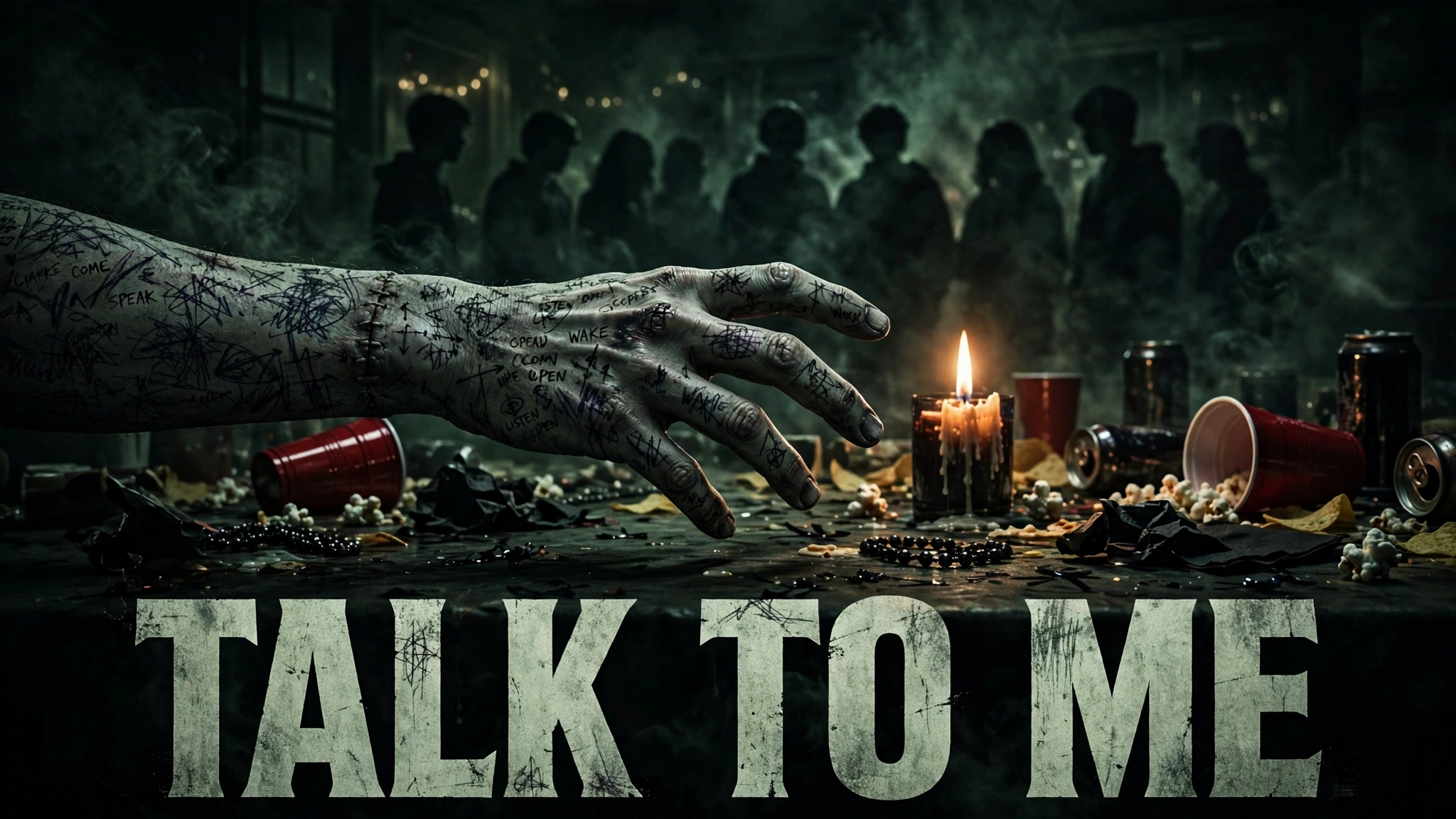
In Adelaide, a rumour is passing from party to party: somebody has an embalmed hand, said to have belonged to a medium, covered in writing and strange marks. Shake it, light a candle, say “talk to me,” and you can see the dead. Say “I let you in,” and a spirit can borrow your body — your eyes blacken, your voice changes, and everyone in the room roars with delight and records it. There is one rule, repeated like the instructions for a drinking game: break the contact within ninety seconds, blow out the candle, or the spirit may not want to leave.
Into this scene walks Mia, a teenager marking the anniversary of her mother’s death and drifting at a distance from her father. She spends most of her time at the home of her best friend Jade, Jade’s younger brother Riley and their mother Sue, who treats Mia as family. Mia is not looking for evil; she is looking for proof that her mother is somewhere reachable, and for one evening when she is not the sad girl everyone tiptoes around. When she volunteers first at a gathering run by Hayley and Joss, the experience hooks her instantly — part terror, part euphoria, part something she will not name.
The group keeps playing. Sessions become a montage of escalating bravery and stupidity, and the film is pitilessly clear about the social mechanics: nobody wants to be the one who says stop. Then Riley, too young and too eager to be included, is allowed to take his turn, and the ninety-second rule is broken in the worst possible circumstances. What follows is not a traditional haunting, with a family besieged in a single house, but a contamination that spreads through hospitals, bedrooms and friendships while Mia’s grip on what is real begins to fail. A voice that claims to be her mother starts offering guidance, and Mia must decide how much of the damage is supernatural and how much is her own refusal to let go. Where that decision leads is the film’s to reveal; we will leave the final movement, which recontextualises the opening scene, completely unspoiled.
Sophie Wilde as Mia delivers one of the great recent horror performances, and the film would collapse without her. Wilde has to play grief without self-pity, recklessness without making Mia stupid, and possession scenes that could easily tip into comedy. She manages all three, sometimes in a single take: watch how her face changes when the spirit enters her — delight, power and a flicker of relief — and you understand why Mia keeps going back. Her later scenes, exhausted and increasingly unreliable, carry a desperation that makes even her worst choices emotionally legible. She rightly won major Australian awards for this role, including the AACTA Award for Best Actress.
Joe Bird as Riley has the film’s most punishing assignment, and it is extraordinary work from a young actor. Riley begins as the classic annoying little brother — funny, attention-seeking, desperate to be treated as older — which is precisely what makes his fate so upsetting. Bird’s physical commitment in the possession aftermath is distressing to watch, and the Philippous reportedly worked carefully around him on set; the result never feels exploitative of the actor, even when it is meant to horrify us about the characters. If Wilde is the film’s heart, Bird is its wound.
Alexandra Jensen as Jade plays the necessary counterweight: the friend who loves Mia but increasingly sees what Mia cannot. Jensen avoids the thankless “sensible one” trap by making Jade’s caution come from loyalty rather than superiority, so their fracture hurts. Otis Dhanji as Daniel, Jade’s boyfriend and a figure from Mia’s own past, brings a quiet decency that complicates the love-triangle hints without the film ever becoming a romance. Miranda Otto as Sue gives the adult world warmth and steel in very limited screen time — her household is the closest thing Mia has to safety, which raises the stakes every time the danger crosses its threshold. Zoe Terakes as Hayley and Chris Alosio as Joss, the hand’s custodians, perfectly embody the breezy confidence of kids monetising a mystery they do not understand.
The Philippous direct like filmmakers who grew up editing their own stunts: nothing is wasted, and every set piece is built around a clear physical idea. The possession sequences are shot to emphasise transformation rather than spectacle — Aaron McLisky’s camera pushes in, sound drops or thickens, and the room’s reaction does the rest. A much-discussed montage of repeated sessions, cut to Édith Piaf’s “La Foule,” is the film in miniature: exhilarating, funny, and already rotten underneath. Geoff Lamb’s editing keeps the film at a lean 95 minutes, and the pacing is a lesson to horror films that pad themselves to two hours; there is one stretch in the middle where Mia’s investigations repeat a beat, but it is a small blemish.
Practical effects deserve special praise. The injuries — and there is one sequence involving Riley that audiences genuinely flinched at in cinemas — are achieved largely in camera, with prosthetics and sound design doing work that CGI would have made weightless. The hand itself is a triumph of production design: an instantly iconic object, plausible as a party prop and deeply wrong the longer you look at it. The brothers also show unusual discipline about rules and mythology. We learn just enough about how the ritual works to follow the danger, and not a page more; there is no helpful occult expert, no ancient book, no exorcism finale borrowed from another film.
The honest criticism is that the mythology’s thinness occasionally shows in the third act, where Mia’s visions arrive with a convenience the otherwise grounded film has not quite earned, and a subplot involving Daniel and a rumour about the night Mia’s mother died is resolved more abruptly than its emotional weight deserves. The opening sequence, involving two brothers named Cole and Duckett, is shocking and effective, though viewers may wish the film returned to it more substantially than it does. These are debut-film faults, and they are visible mostly because everything around them is so assured.
Cornel Wilczek’s score is built from unease rather than themes: low pulses, distorted textures and silences that make ordinary suburban rooms feel contaminated. The Philippous, experienced sound obsessives from their online work, treat audio as a primary scare tool — the wet, wrong noises of possession, the sudden absence of room tone, the way a familiar voice sits slightly off. Wilczek’s music rarely announces itself, which is the point; it seeps. The licensed choices do the expressive heavy lifting, above all the Piaf montage, where a love song’s swelling joy becomes the sound of addiction forming. It is one of the smartest needle-drops in recent horror, and the contrast between that sequence’s euphoria and the score’s later dread maps Mia’s entire arc without a word of dialogue.
What we loved:
What could be better:
The commercial story is one of modern horror’s cleanest fairy tales, and the figures are well documented. Made for about $4.5 million, Talk to Me grossed roughly $92 million worldwide — around $48 million of that in North America — becoming A24’s highest-grossing horror release at the time and earning more than twenty times its production budget before streaming and home entertainment are even counted. That return matters beyond bragging rights: it proved that an Australian genre film with no franchise, no established stars and first-time directors could open globally on the strength of festival heat and word of mouth. At the 13th AACTA Awards it won eight prizes including Best Film, Best Direction and Best Original Screenplay, completing a run that began in Adelaide schoolyards-and-suburbs filmmaking and ended with the twins as two of the most sought-after young directors in horror. A sequel has been discussed ever since; on these numbers, the surprise would be if there were not one.
Yes — especially if you think modern horror has become timid. Talk to Me is frightening in the way that stays with you on the drive home, because its terrors grow out of recognisable behaviour: showing off, filming everything, ignoring the one rule because the room is laughing. It is also, beneath the prosthetics, a sad film about a girl who would rather be possessed than be alone with her grief. First-time directors are not supposed to balance those registers this well.
Our rating: 8.5/10 — a ferocious, emotionally honest debut that turns a party trick into one of the defining horror films of its decade.
Is Talk to Me really a 2022 or a 2023 film?
Both dates are used, for different reasons. It premiered on 30 October 2022 at the Adelaide Film Festival and screened at Sundance in January 2023, but its wide theatrical release came in July 2023. We list it by its 2022 production and premiere year.
What is the 90-second rule in Talk to Me?
In the film’s ritual, a participant holds the embalmed hand, invites a spirit in, and must have the contact broken and the candle blown out within ninety seconds. If the session runs longer, the spirit is said to want to stay — with dangerous consequences.
Is Talk to Me based on a true story?
No. The hand, the ritual and the characters are fictional, created by Danny Philippou and co-writer Bill Hinzman. The emotions underneath — grief, peer pressure and the hunger to contact the dead — are drawn from ordinary teenage life rather than a real case.
How violent is Talk to Me?
It is strong horror. The film contains intense possession scenes, graphic injury detail and themes involving a parent’s death that some viewers will find distressing. It earns its adult rating; this is not a starter horror film for younger teenagers.
Where can I watch Talk to Me?
It is available on streaming, rental and disc in most regions, with availability varying by country and changing over time. Check your local services for the current listing.