★ LATEST REVIEWS

★★★★☆ Our Rating: 8/10
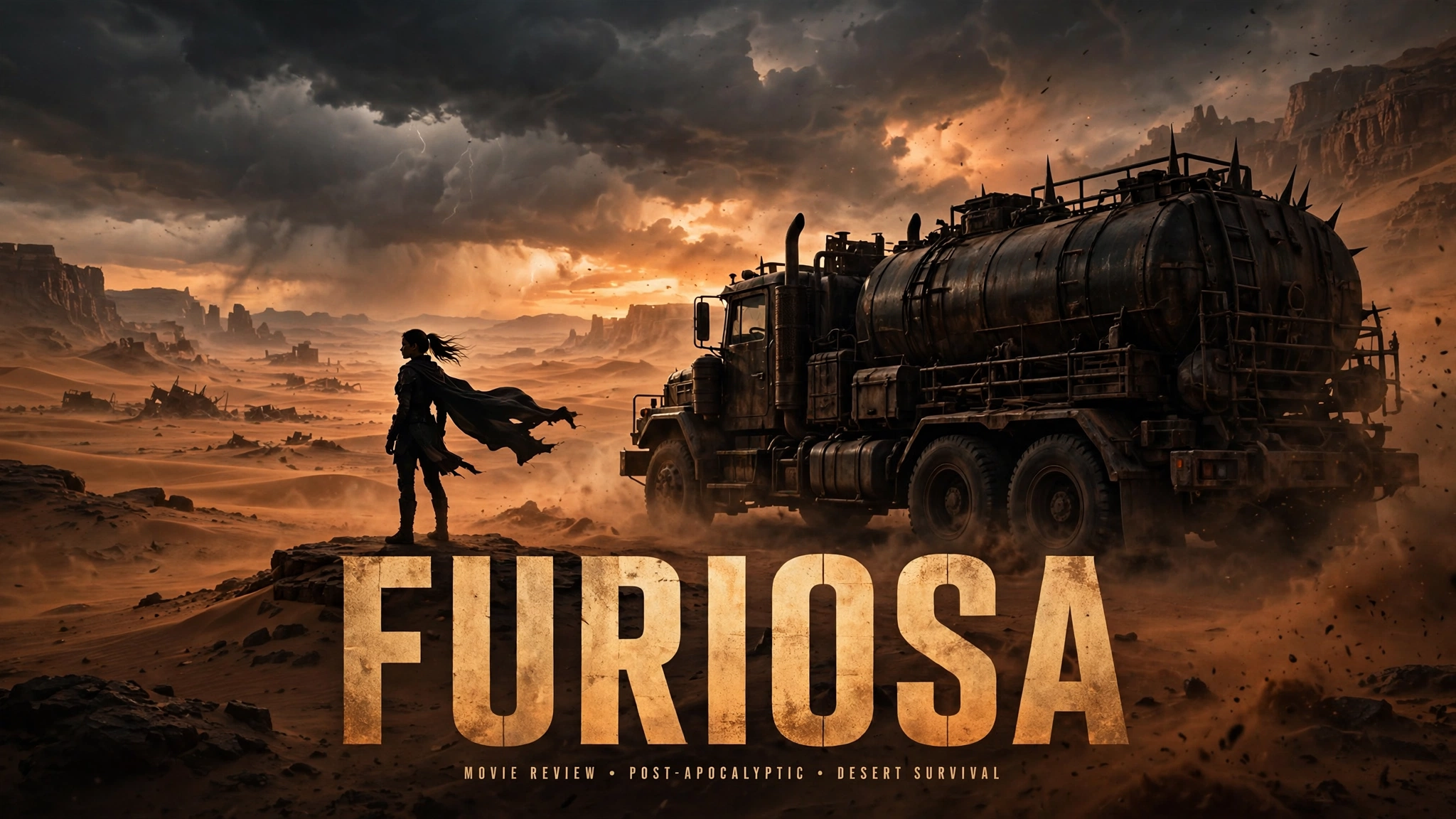
Nine years after Mad Max: Fury Road reset the bar for action cinema, George Miller returned to the Wasteland with a story he had actually written first.Furiosa: A Mad Max Saga is a prequel and spin-off that follows the young Furiosa — the one-armed driver Charlize Theron made iconic in Fury Road, a film our bank already covers — from stolen child to hardened Imperator. It opened at the Cannes Film Festival in May 2024 to strong reviews, holds a score of around 90 percent on Rotten Tomatoes, and then did the one thing nobody predicted: it flopped.
That contradiction is the real story of this film, and any honest Furiosa review has to hold both halves of it at once. As a piece of filmmaking, this is a rich, strange, often stunning revenge epic from a director in his late seventies working at a level most filmmakers half his age cannot touch. As a commercial proposition, it cost a fortune, arrived nearly a decade after its predecessor, and asked general audiences to pay
blockbuster prices for a slower, sadder, more mythic film than the trailer-fuelled chase they remembered. This review covers the story without spoilers, the performances, the craft, the music, and the verified box-office numbers behind one of 2024’s most surprising failures.
Detail | Information |
|---|---|
| Release date | 23 May 2024 (Australia); world premiere 15 May 2024 at Cannes |
| Director | George Miller |
| Writers | George Miller, Nico Lathouris |
| Genre | Action, Science Fiction, Post-Apocalyptic |
| Language | English |
| Runtime | 148 minutes |
| Budget | $168 million |
| Lead cast | Anya Taylor-Joy, Chris Hemsworth, Tom Burke, Alyla Browne |
| Our rating | 8/10 |
The film is structured in five titled chapters spanning roughly fifteen to twenty years, and it begins in the one place Fury Road treated as legend: the Green Place of Many Mothers, a hidden valley of fruit trees in a world of sand. Young Furiosa (Alyla Browne) is picking peaches when raiders from the Biker Horde find the valley. Snatched to protect its location, she is carried across the Wasteland to the horde’s leader, the warlord Dementus (Chris Hemsworth) — a theatrical, wounded, increasingly unhinged conqueror who adopts her as a kind of mascot and trophy after the pursuit costs him the thing he wanted most.
What follows is an odyssey rather than a chase. Traded between powers as the Wasteland’s three strongholds — the Citadel, Gas Town and the Bullet Farm — manoeuvre for oil, water and weapons, Furiosa survives by watching, learning and disappearing into work. She grows into the young woman played by Anya Taylor-Joy, finds a mentor and partner in the Citadel’s finest driver, Praetorian Jack (Tom Burke), and carries one fixed purpose through every humiliation: to make Dementus answer for what he took from her. The film deliberately withholds its payoffs. Where Fury Road was two hours of forward motion, Furiosa is about time — how it hardens a person, what survival costs, and how revenge, when it finally arrives, may not feel the way the avenger dreamed it would. The final movement leads directly into the opening conditions of Fury Road, and viewers who know that film will feel the two stories lock together. We will not spoil how Furiosa loses her arm or how her account with Dementus is settled; both answers are earned on screen.
Alyla Browne as young Furiosa carries close to the first hour, much of it with very little dialogue, and the film would collapse without her. Browne plays watchfulness itself: eyes always measuring distance, adults, exits. It is a remarkably disciplined child performance, and Miller trusts it completely, letting long stretches play on her face.
Anya Taylor-Joy as Furiosa inherits the role under impossible conditions — Theron’s performance is one of the defining action turns of its decade — and wisely does not imitate it. Her Furiosa is quieter on the surface and more feral underneath, a person who has compressed herself down to a single objective. Taylor-Joy reportedly has only around thirty lines in the film, and the economy suits her: grief and resolve come through posture, stare and sudden, decisive violence. If there is a reservation, it is that the script gives her so little verbal texture that some viewers connect with her endurance more than with her as a person.
Chris Hemsworth as Dementus gives the best performance of his career. Buried under a prosthetic nose, a flowing beard and a cape, riding a chariot hauled by three motorbikes, Hemsworth builds Dementus as a showman-tyrant: funny, charismatic, sentimental about himself and casually monstrous to everyone else. The Australian accent he uses — modelled, he has said, partly on his own grandfather and partly on a carnival barker — makes Dementus sound like a dark parody of the cheerful Aussie larrikin, and the film keeps deepening him: his cruelty is real, but so is his damage. He steals nearly every scene he is in, and the film’s final confrontation belongs as much to him as to its heroine.
Tom Burke as Praetorian Jack is the quiet centre. Burke plays the Wasteland’s professional — a driver of honour in a world without any — and his scenes with Taylor-Joy build the film’s only real tenderness without a single big romantic speech. Lachy Hulme, taking over the role of Immortan Joe as well as playing Dementus’s lieutenant, and returning faces including Nathan Jones as Rictus Erectus, fill out a world that feels continuous with Fury Road rather than merely copied from it.
Miller directs Furiosa as an epic in the old sense: chapters, omens, war councils, sieges. The scale is bigger than Fury Road — more locations, more factions, a longer span of years — and the filmmaking, shot by Simon Duggan after John Seale’s retirement, mixes the series’ famous practical stunt work with noticeably more digital assistance. The centrepiece, a roughly fifteen-minute assault on the War Rig built around Furiosa’s first ride as Jack’s second, is a masterclass in legible action geography: every vehicle, weapon and body has a readable purpose, and the sequence keeps escalating without ever confusing the eye. It stands comfortably beside anything in Fury Road.
The honest qualification is that the film’s digital seams show more often than its predecessor’s did. Some backgrounds and composites have a faint weightlessness, and the colour grading pushes certain sequences toward a heightened, almost storybook saturation that divides viewers — some find it mythic, others find it synthetic. The pacing, too, is a genuine talking point. The chapter structure produces a deliberate, novelistic rhythm, but the middle chapters sag slightly under exposition about Wasteland politics, and at 148 minutes — the longest film in the franchise — a tighter second act would have helped. Margaret Sixel, returning as editor alongside Eliot Knapman, keeps the action superb; the connective tissue is where the length is felt. None of this changes the central fact: a director born in 1945 delivered action sequences in 2024 that younger franchises study. The ambition is not the problem with this film. The audience’s appetite for it, at this price, turned out to be.
Tom Holkenborg, who scored Fury Road, returns with a score that is deliberately less percussive and more mournful than its predecessor’s. Where Fury Road ran on drums and a flamethrower guitar, Furiosa is built from low strings, tolling tones and a recurring motif for the lost Green Place that surfaces whenever the heroine’s past presses on her present. Holkenborg has described approaching the film as a darker, more emotional story, and the restraint pays off in two directions: the War Rig attack plays with long, gathering tension rather than constant assault, and the quiet final confrontation is scored with a spareness that lets the dialogue carry the weight. The trade-off is memorability — there is no single cue here with the instant identity of Fury Road‘s Brothers in Arms — but as dramatic underscoring for a revenge tragedy, it is the right score for this film rather than a repeat of the last one.
What we loved:
What could be better:
Here the figures are well documented, and they are stark. Furiosa was produced for $168 million, before marketing. It earned $174.4 million worldwide in total — roughly $67 million to $68 million in North America and the remainder internationally — meaning its theatrical gross barely exceeded its production budget alone and finished at less than half of Fury Road‘s roughly $380 million worldwide total. Industry reporting, including Deadline Hollywood’s annual loss calculations as summarised in reference coverage, put the film’s ultimate loss to Warner Bros. at approximately $119.6 million once marketing, distribution and participations were set against all revenues, ranking it among the biggest box-office bombs of 2024, behind only Joker: Folie à Deux on those tallies. Its North American opening over the Memorial Day weekend was the weakest for a number-one film on that holiday frame in decades.
Why did a film with reviews this strong fail? Analysts pointed to a stack of causes rather than one villain: a nine-year gap since Fury Road; a prequel without the series’ title character in the lead — Max appears only in a blink-and-miss-it cameo; a fanbase that skewed older and male and turned out less strongly for a female-led origin story; and a franchise that, for all its prestige, was never a billion-dollar property even at its peak. The film later performed strongly on premium video-on-demand, which supports the kindest reading of the failure: the audience existed, but not at opening-weekend cinema prices. Its result has cast real doubt over Miller’s long-planned follow-up, Mad Max: The Wasteland. Treat that as the lesson of Furiosa: critical love and commercial survival are different sports.
Yes — on the biggest screen you can still find it on, and with your expectations correctly set. This is not Fury Road 2, and judging it as one is how good films get called disappointments. It is a revenge epic with a child at its centre, a great villain, one action sequence for the history books and a director treating pulp material with Homeric seriousness. Watch Fury Road first if you have somehow missed it, then watch this as the darker, slower first half of a single large story. That it lost money says something sobering about the modern blockbuster market; it says nothing against the film itself.
Our rating: 8/10 — a rich, strange, beautifully made prequel whose only real failure happened at the ticket window.
Is Furiosa a prequel to Mad Max: Fury Road?
Yes. It tells Furiosa’s origin story, beginning roughly fifteen to twenty years before Fury Road and ending where that film’s situation begins. Watching Fury Road first is recommended, though Furiosa works as a standalone revenge story.
Why did Furiosa flop at the box office despite good reviews?
It grossed $174.4 million worldwide against a $168 million production budget before marketing, for a reported loss of around $119.6 million. Reported reasons include the nine-year gap since Fury Road, the absence of Max as lead, the prequel format, and the franchise’s historically modest commercial ceiling.
Does Charlize Theron appear in Furiosa?
No. Anya Taylor-Joy plays the adult Furiosa and Alyla Browne plays her as a child. Miller chose not to use de-ageing technology, and Theron publicly supported Taylor-Joy taking the role.
Is Chris Hemsworth’s Dementus connected to Fury Road?
Dementus is a new character created for this film — the warlord whose horde abducts Furiosa. Immortan Joe, the villain of Fury Road, also appears, played here by Lachy Hulme.
Will there be another Mad Max film after Furiosa?
George Miller has long discussed a further story, often referred to as Mad Max: The Wasteland, but Furiosa‘s commercial result has left its future uncertain. No sequel has been officially greenlit at the time of writing.