★ LATEST REVIEWS

Our Rating: ★★★★☆ 8.5/10
“There are no new steps!” That is the law of the Australian ballroom dancing world in Baz Luhrmann’s Strictly Ballroom — and the whole film is a joyful act of disobedience against it. Luhrmann’s 1992 debut feature, adapted from a stage play he developed while studying at Sydney’s National Institute of Dramatic Art, stars Paul Mercurio as Scott Hastings, a champion dancer who insists on dancing his own steps, and Tara Morice as Fran, the beginner who dares to be his partner. It is a romantic comedy, a satire of competitive snobbery and a celebration of doing things your own way, all at once — and it announced one of the most distinctive directors in world cinema.
The film is the first part of Luhrmann’s “Red Curtain Trilogy”, followed by Romeo + Juliet and Moulin Rouge!, and you can already see the whole Luhrmann toolkit here: the theatrical framing, the saturated colour, the pop music used as emotion, the belief that melodrama played at full tilt becomes truth. It is also, beneath the glitter, a genuinely moving story about conformity, courage and a young woman discovering that she is not the ugly duckling everyone told her she was.
It is not flawless: its early scenes are deliberately garish to the point of discomfort, and some of its comedy is broad enough to divide audiences. But its final dance sequence is one of the great crowd-pleasing climaxes in cinema, and its heart is entirely sincere. In this review we look at the spoiler-free story, the performances, Luhrmann’s direction, the music and the box-office story, and we give an honest verdict.
| Detail | Information |
| Release date | 20 August 1992 (Australia) |
| Director | Baz Luhrmann |
| Writers | Baz Luhrmann, Craig Pearce, Andrew Bovell |
| Genre | Comedy, Romance, Drama |
| Language | English, Spanish |
| Runtime | 94 minutes |
| Budget | A$3 million |
| Lead cast | Paul Mercurio, Tara Morice, Bill Hunter, Pat Thomson, Gia Carides, Barry Otto, Peter Whitford |
| Our rating | 8.5/10 |
Scott Hastings is the brightest young talent in Australian ballroom dancing — and its biggest problem. At a major competition, he dances steps of his own invention instead of the approved routines, and the sport’s governing body, led by the fearsome Barry Fife, is appalled. His regular partner leaves him, his mother despairs, and his career seems over before the Pan Pacific Championships. Then Fran, a beginner from his mother’s dance studio — shy, awkward, Spanish-Australian, and the last person anyone expects — asks to be his partner.
What follows is a rehearsal-room romance and a revolt. Scott teaches Fran to dance; Fran’s family teaches Scott the paso doble, the proud Spanish dance that the ballroom world has no place for; and together they prepare to take their own steps to the Pan Pacific floor, in defiance of everyone who profits from keeping dance exactly as it is. Around them swirl a marvellous gallery of characters: Scott’s ambitious mother Shirley, his gentle father Doug, the scheming officials, and Fran’s warm, watchful family. Without revealing how the championship ends, it is fair to say the film builds to a finale that earns every cheer it gets — and that the real contest is not for a trophy but for the right to be yourself in public.
Paul Mercurio as Scott — Mercurio, a professional dancer making his acting debut, is exactly right as Scott: arrogant enough to be believable as a champion, vulnerable enough to be lovable when the world turns on him. His dancing is superb, and his acting — especially in the quiet scenes with Fran’s family — has a sincerity that anchors the film’s more flamboyant passages.
Tara Morice as Fran — Morice gives the film its soul. Fran begins as the girl nobody looks at — frumpy clothes, downcast eyes, a beginner’s hesitation — and Morice plays that invisibility without a hint of caricature. Her transformation is not a makeover but an awakening: as she learns to dance, she learns to be seen, and Morice lets the audience watch that confidence arrive step by step. It is a beautiful performance, and the film belongs to her as much as to Scott.
The supporting cast — Bill Hunter is gloriously tyrannical as Barry Fife, the federation president who treats ballroom dancing like a police state. Pat Thomson is touching as Shirley, Scott’s mother, whose own ambitions and regrets drive much of the plot. Barry Otto is quietly heartbreaking as Doug, Scott’s father, a man who gave up his own dancing dreams and says almost nothing until it matters most. Gia Carides, Peter Whitford and Antonio Vargas as Fran’s father Rico round out an ensemble with no weak links.
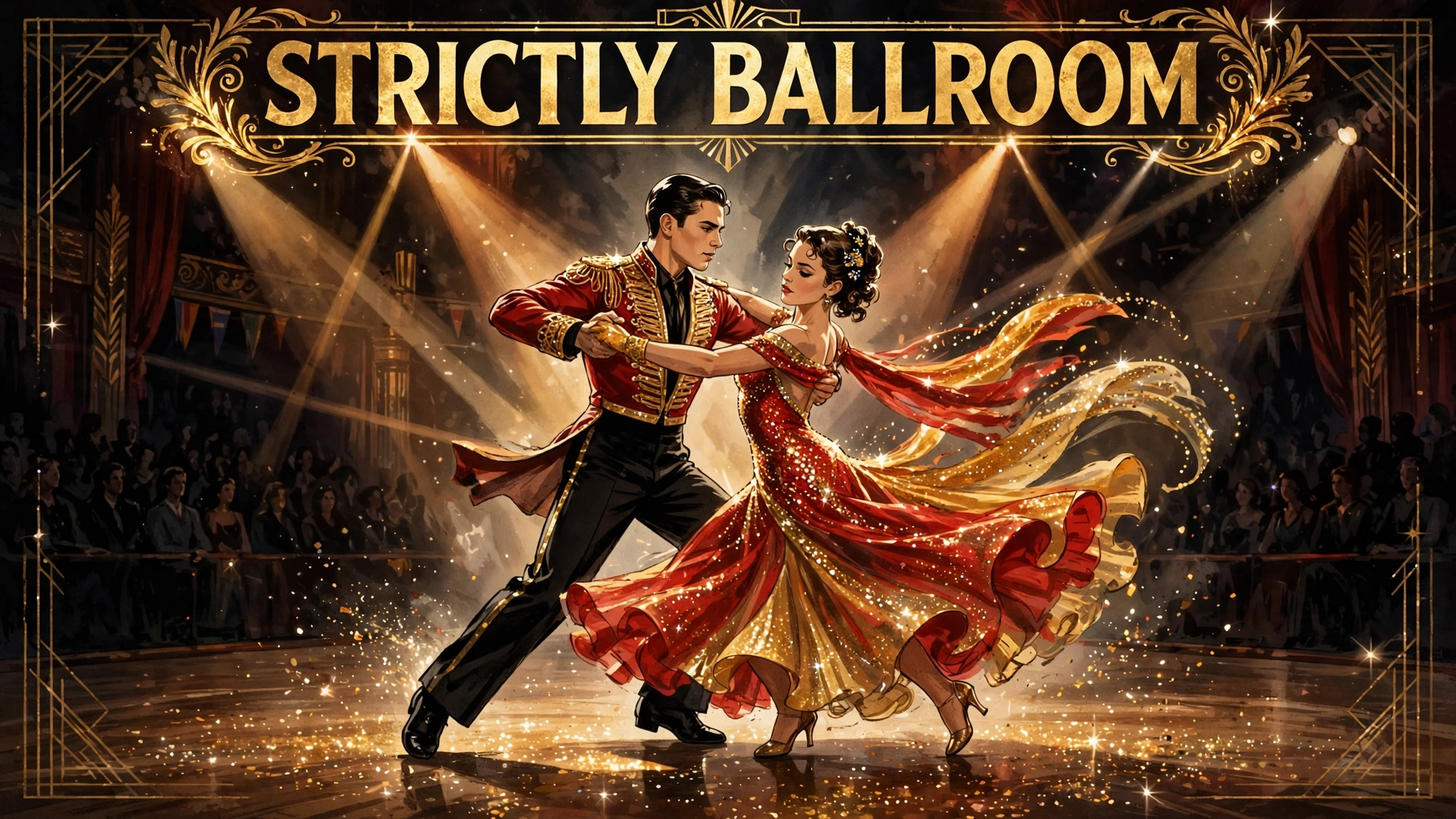
Luhrmann directs as if the camera itself were a dancer: swooping, spinning, pushing into faces and pulling back for full-figure dance shots, all with a theatrical self-awareness that announces itself from the first frame. The film is presented partly as a mock-documentary, with characters speaking to camera, and that device lets Luhrmann have it both ways — satirising the ballroom world while celebrating it. Catherine Martin’s costumes and production design are already unmistakably Luhrmann: sequins, ruffles, saturated reds and golds, a world that looks like a dance hall remembered in a dream.
Steve Mason’s cinematography and Jill Bilcock’s editing serve the dancing above all: the numbers are shot to show the bodies, the footwork and the space, with quick cuts for excitement and long takes when the dancing deserves to breathe. The film’s early stretch is deliberately loud and garish — some viewers find the first twenty minutes hard work — but that garishness is the point: the ballroom world is supposed to look like a cage, so that the paso doble, when it finally arrives, feels like air.
David Hirschfelder’s score is a masterclass in musical storytelling. It moves from competitive ballroom standards to Latin rhythms to a soaring arrangement of Doris Day’s “Perhaps, Perhaps, Perhaps” and the paso doble itself, and each shift marks a shift in the characters’ freedom. The music is not background here; it is the argument of the film, made audible. The soundtrack became a hit in its own right, and the paso doble remains one of the most recognisable dance themes in cinema.
What could be better:
Strictly Ballroom was made for about A$3 million and became a worldwide success. It earned about A$21.76 million in Australia alone, about US$11.74 million in the United States, and a reported worldwide total of around A$80 million — though totals vary by source and territory, so the worldwide figure should be read as approximate rather than exact. Whatever the precise total, the scale of the success is not in doubt: a tiny Australian dance comedy became an international hit, won the Prix de la Jeunesse at Cannes, and launched Luhrmann’s career. A stage musical adaptation followed in 2014, and the film remains a beloved classic in Australia and far beyond.
Yes — and watch it with people, if you can. Strictly Ballroom is the rare film that is both a satire and a celebration, both a comedy and a romance, and it ends with a sequence that will make you want to stand up and applaud in your living room. It is also the perfect introduction to Luhrmann: everything he would later do on a grander scale is here in miniature, with more heart and less budget. If you have ever been told to stop doing things your own way, this film is for you.
Our rating: 8.5/10 — A glittering, defiant, utterly charming dance classic.
Is Strictly Ballroom based on a true story? No, but it is based on a stage play Luhrmann developed with fellow students at the National Institute of Dramatic Art in Sydney in the mid-1980s.
Is Strictly Ballroom part of a trilogy? Yes. It is the first film in Luhrmann’s “Red Curtain Trilogy”, followed by Romeo + Juliet (1996) and Moulin Rouge! (2001).
Who plays Scott and Fran? Paul Mercurio plays Scott Hastings and Tara Morice plays Fran.
What is the paso doble? A dramatic Spanish ballroom dance, modelled on the bullfight, which becomes Scott and Fran’s signature — and their act of rebellion.
How long is Strictly Ballroom? It runs 94 minutes.