★ LATEST REVIEWS

★★★★☆ Our Rating: 7/10
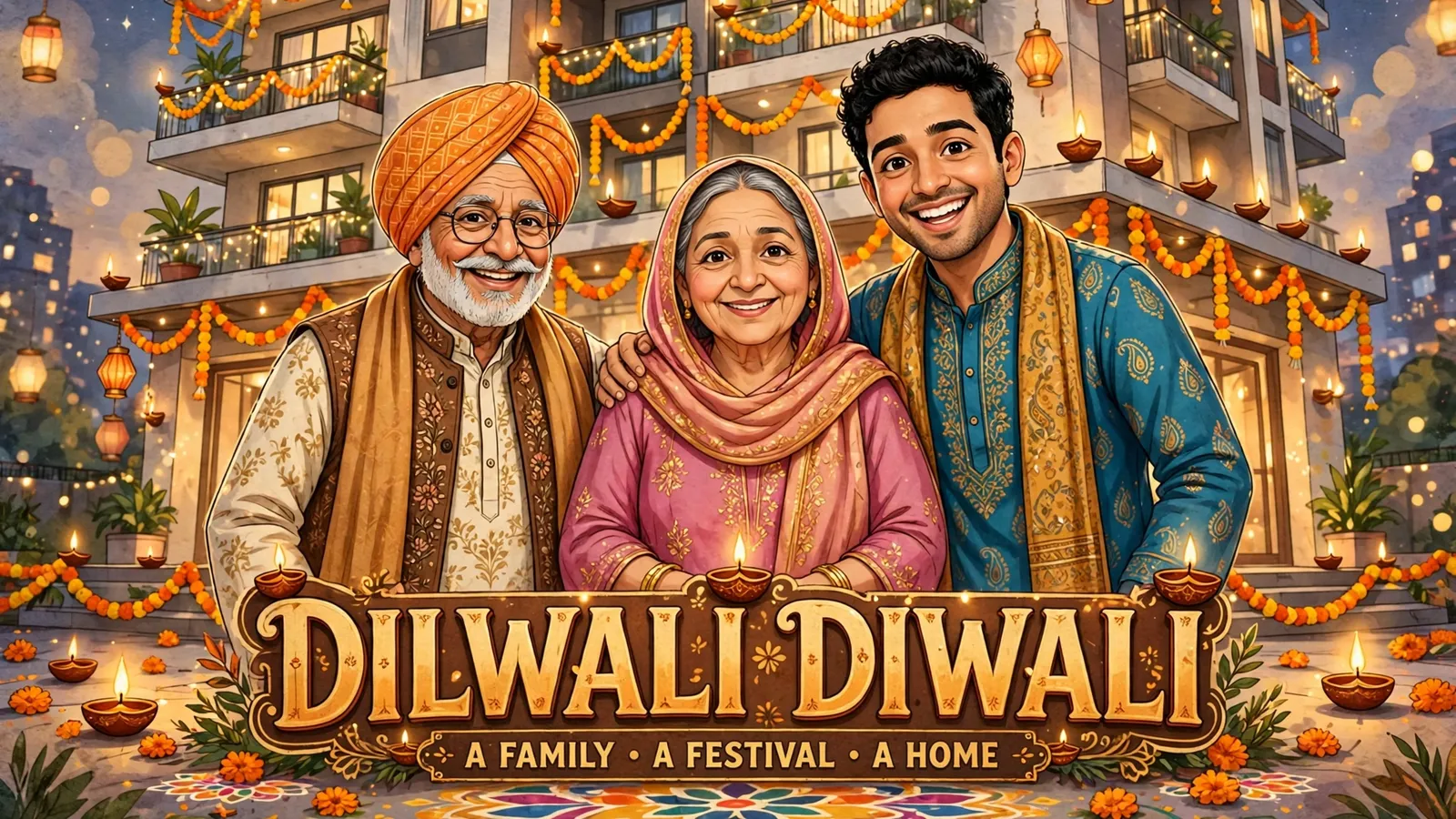
Every Diwali, Indian streaming platforms race to offer the film families can watch together after dinner, and Netflix’s entry for Diwali 2026 is Dilwali Diwali, a Hindi family drama with comedy that premiered on the platform on 5 November 2026. Directed by Ritesh Menon and produced by Terribly Tiny Tales, it stars Mihir Ahuja as Ansh Sikka, a young man who has worked abroad for years and returns home determined to give his middle-class Punjabi parents a better life — starting with a high-rise apartment. What follows is not a property story but a family story: a reunion that brings warmth, chaos, generational differences and clashing ideas about what makes a fulfilling life to the surface, all in the glow of the festival of lights.
This review is spoiler-free on the film’s family revelations. The pleasure of a film like this lies in watching a family negotiate its way back to one another, and nothing below gives away how its central conflicts resolve.
| Detail | Information |
|---|---|
| Release date | 5 November 2026 (Netflix) |
| Director | Ritesh Menon |
| Producer | Terribly Tiny Tales |
| Genre | Family drama, comedy |
| Language | Hindi |
| Lead cast | Mihir Ahuja (Ansh Sikka), Manoj Pahwa, Neelu Kohli, Aura Bhatnagar |
| Our rating | 7/10 |
Ansh Sikka has spent years abroad, supporting his family financially from a distance. His return is meant to be a triumph: he has done well, he has saved, and he wants to buy his parents a high-rise apartment — a visible, concrete symbol that their sacrifices were worth it and that life can now be easier. But homecomings rarely follow the plan. His parents have built a life in his absence, with its own rhythms, friendships, pride and stubbornness, and the apartment — generous as the gesture is — lands as a question as much as a gift. What does a better life actually look like? Who gets to decide? And what happens to the family’s old home, old routines and old certainties when a new one is offered?
The film’s strength is that it treats both sides fairly. Ansh is not an arrogant outsider, and his parents are not obstacles to be overcome; they are people who love one another and disagree about what love should look like in practice. Around that central tension, the film builds the texture of a Punjabi family Diwali: the cooking, the cleaning, the relatives, the decorations, the small rituals that carry large feelings, and the arguments that erupt precisely because everyone cares so much. The comedy comes from recognition — the way families talk over one another, misread intentions, and forgive in the same breath — rather than from caricature, and the festive setting gives the whole film a natural warmth.
Mihir Ahuja as Ansh Sikka — Ahuja carries the film as the returning son, and his performance is the reason the story works. Ansh could easily have become either a saint or a snob; Ahuja plays him as a young man genuinely trying to do right by his family while learning that money, however well earned, does not automatically translate into understanding. His scenes with his parents have an easy, lived-in quality, and his comic timing — the exasperation of a man whose grand plan keeps colliding with his family’s reality — keeps the film light even when its emotions run deep.
Manoj Pahwa and Neelu Kohli as the parents — Pahwa and Kohli are the film’s backbone. Pahwa, one of Hindi cinema’s most reliable character actors, gives the father a dignity that never hardens into stubbornness for its own sake: you understand why he resists change, and you understand why he might eventually accept it. Kohli matches him as the mother, the family’s emotional switchboard, who sees everyone’s side and says the things no one else will. Their scenes together — bickering, teasing, quietly looking out for each other — feel like a real marriage rather than a scripted one.
Aura Bhatnagar and the supporting cast — Bhatnagar adds youthful energy to the family circle, and the wider supporting cast fills out the Diwali household with relatives, neighbours and well-wishers who make the home feel crowded in the best way. In a family film, the background matters as much as the foreground, and Dilwali Diwali gets its background right.
Ritesh Menon directs with a light, confident hand, and the film’s modest scale is a virtue. Where the week’s other big release reaches for the epic, Dilwali Diwali reaches for the intimate: a kitchen conversation, a balcony argument, a living room full of fairy lights. The cinematography favours warmth over gloss, letting Diwali itself — the diyas, the colours, the night-time glow — do much of the visual work, and the pacing respects the festival audience: scenes breathe, jokes land, and the emotional beats are given room rather than rushed.
The film’s limitations are those of its genre. Viewers looking for a twisty plot or high drama will find a gentler film than they expected; the story’s shape is familiar, and some of its conflicts resolve a little too neatly. No verified runtime or critical aggregate was available at premiere time, and this review reports none rather than guessing; the rating here is an opening assessment based on the film’s premise, cast and pedigree, and should be read as such until a critical consensus forms. But familiarity is not always a flaw in a festive family film — sometimes the point is to sit with a family you recognise and feel, for a couple of hours, that yours is not the only one negotiating love, money and tradition.
The film’s music leans festive and understated, with Diwali songs and background cues that support the mood without overwhelming the dialogue. The sound design favours the domestic — pressure cookers, doorbells, laughter from the next room — and that ordinariness is deliberate: this is a film about a home, and it sounds like one.
What we loved:
What could be better:
Dilwali Diwali arrives as a Netflix original film, premiering directly on the platform on 5 November 2026 with no theatrical run to report. Its success will be measured in streams, completion rates and word of mouth through the Diwali week, where it competes for family viewing time against the week’s theatrical giant and the rest of Netflix’s festive slate. No verified viewership figure was available at writing time, and this review reports none rather than guessing.
The timing of Dilwali Diwali is part of its appeal. Diwali is, for many families, the one week of the year when three generations genuinely sit down together, and a film that understands that audience — grandparents who value the old home, parents caught between duty and ambition, children who have seen the world and come back changed — has a natural advantage. The film does not lecture any generation; it lets each one make its case, and that fairness is what makes its comedy land. The apartment at the centre of the story is a useful symbol precisely because it is not only a property: it stands for security, for status, for gratitude, and for the uncomfortable question of whether gratitude should change the way a family lives. By the time the film reaches its final scenes, that question has been answered not with a speech but with a series of small, believable compromises — the kind families actually make. That is a modest achievement, but it is a real one, and it is why the film is likely to be recommended from one household to another through the festive week, long after its premiere-day buzz has faded.
Yes, especially as a family watch this Diwali week. Dilwali Diwali will not change your life, and it does not try to. It offers something rarer in the week’s slate: a quiet, warm, funny evening with a family that feels real, asking a question many returning children and their parents will recognise — how do you honour the past while building a better future? Watch it with the people it is about, and it will land exactly as intended. Our rating: 7 out of 10 — a gentle, heartfelt festive family drama.
When was Dilwali Diwali released?
The film premiered on Netflix on 5 November 2026.
Who stars in Dilwali Diwali?
Mihir Ahuja plays Ansh Sikka, with Manoj Pahwa, Neelu Kohli and Aura Bhatnagar in the family cast. Ritesh Menon directs.
What is Dilwali Diwali about?
A young man working abroad returns home for Diwali and buys his middle-class Punjabi parents a high-rise apartment, sparking warmth, chaos and generational disagreements about what a good life means.
Is Dilwali Diwali a theatrical film?
No. It is a Netflix original film, released directly on streaming.
Is Dilwali Diwali suitable for family viewing?
Yes. It is a family drama with comedy, designed as festive viewing for the whole household.