★ LATEST REVIEWS

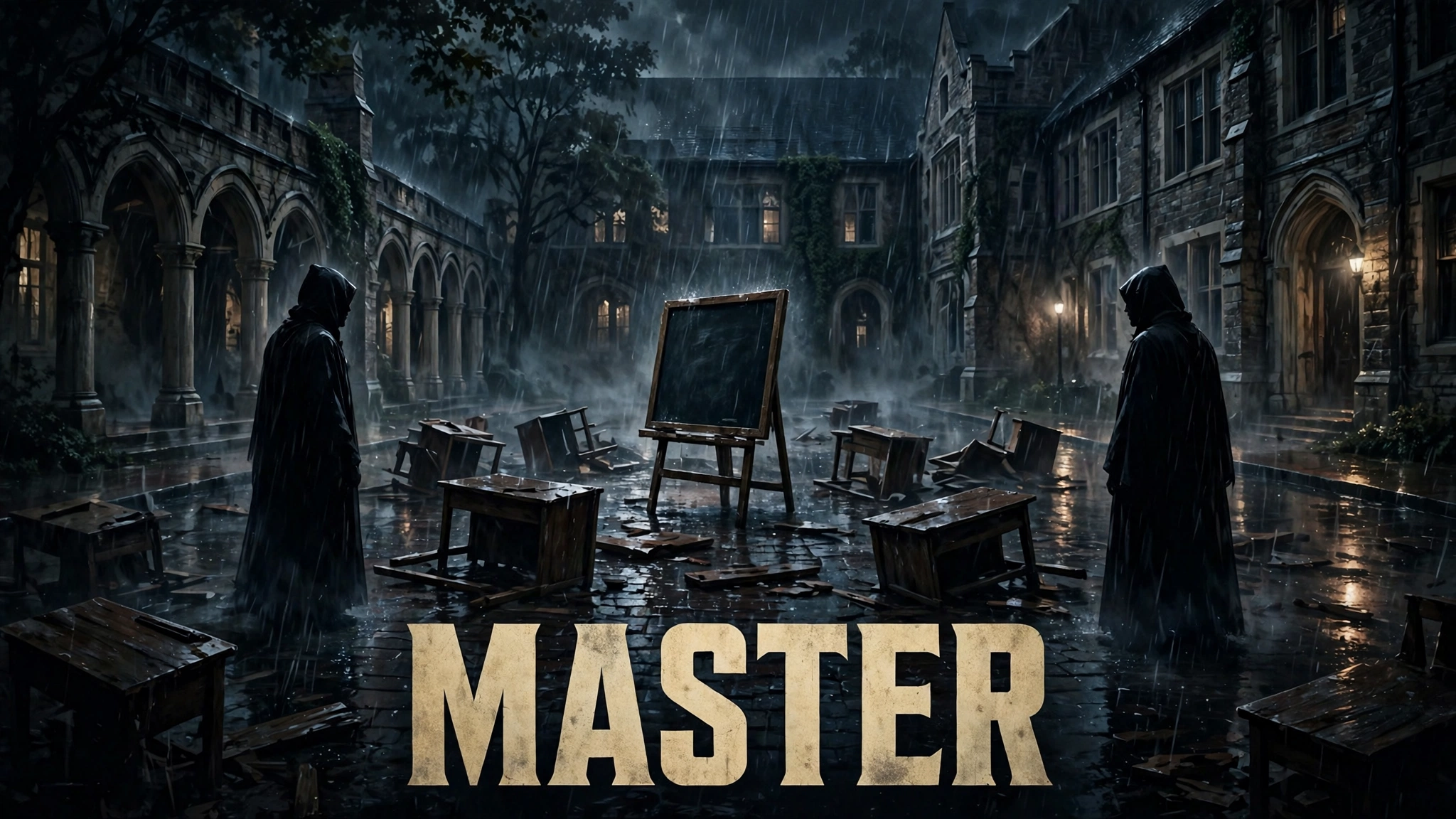
Our Rating: ★★★★☆ 7/10
In January 2021, Indian cinemas were half-empty by law and fully nervous by mood. Theatres had reopened under Covid restrictions, big stars were holding their films back, and the industry was quietly asking whether audiences would return at all. Into that uncertainty walked Master — a Pongal release at fifty per cent seating capacity that played like a full-house celebration anyway. Lokesh Kanagaraj’s third film paired Vijay, one of Tamil cinema’s biggest commercial stars, with Vijay Sethupathi, its most shape-shifting actor, and promised the one thing star vehicles rarely deliver: a villain built to genuinely rival the hero.
The promise is kept — mostly. Any honest Master review has to hold two truths at once. The face-off at the film’s centre is electric, Anirudh Ravichander’s music is a phenomenon in itself, and Lokesh stages mass moments with a young director’s hunger. It is also nearly three hours long, its first half meanders through a college track the story barely needs, and its social subject — children trapped inside a criminal empire — deserves a leaner, braver film than the star format allows. What follows is our spoiler-free look at the story, the two Vijay performances, the craft, the music, and the trade-reported box office, ending with a verdict on who should still make time for it.
| Detail | Information |
|---|---|
| Release date | 13 January 2021 (India) |
| Director | Lokesh Kanagaraj |
| Writers | Lokesh Kanagaraj, Pon Parthiban, Rathna Kumar |
| Genre | Action, Drama |
| Language | Tamil |
| Runtime | 179 minutes |
| Budget | ₹135 crore (trade-reported) |
| Lead cast | Vijay, Vijay Sethupathi, Malavika Mohanan, Arjun Das, Andrea Jeremiah, Shanthanu Bhagyaraj, Gouri G. Kishan |
| Our rating | 7/10 |
John Durairaj — JD to everyone — is a brilliant college professor and a functioning alcoholic whose lectures students adore and whose discipline the management despairs of. After an incident forces the institution’s hand, JD is effectively exiled to a three-month teaching assignment at a juvenile correctional home, the kind of posting designed to be endured rather than performed. He arrives intending to coast. What he finds instead is a closed, frightened world: boys who flinch at questions, rules enforced by fear rather than authority, and a shadow over the institution that clearly does not originate inside its walls.
That shadow has a name. Bhavani, a gangster who rose from the juvenile system himself, has built his criminal operation on the boys inside it, using minors as couriers, shields and scapegoats precisely because the law treats children gently. The home is, in effect, his safest warehouse. JD’s slow awakening — from detached, drink-numbed observer to a man who understands that indifference is its own kind of violence — forms the film’s dramatic spine, while Bhavani’s escalating displeasure at this interfering professor builds toward the confrontation the entire film is constructed around. Two boys at the home, whose fates we will not spoil, give the conflict its emotional cost: Master is at its most serious when it remembers that the men are fighting over children, not turf. The second half narrows into pursuit, exposure and punishment, resolving the duel in broadly the manner the genre requires — though the route there contains the film’s darkest and most effective passages.
Vijay Sethupathi as Bhavani is the film’s headline performance, and it is not particularly close. Introduced through a chilling backstory that explains exactly how a victim of the system became its most efficient predator, Bhavani is played without a trace of camp: soft-spoken, funny in a way that makes rooms go quiet, and patient in a manner far scarier than rage. Sethupathi finds the gangster’s menace in stillness and small courtesies, and he reportedly shaped the character to be a genuine counterweight rather than a speed bump for the hero. He succeeds so completely that stretches of the film tilt toward him — you catch yourself waiting for his scenes.
Vijay as JD gives one of his more interesting star performances precisely because Lokesh writes against the invincible image. JD is a mess: charming, self-destructive, evasive about his own past, and for long stretches deliberately ineffectual. Vijay plays the early self-pity without vanity and lets the character earn his authority back in stages, which gives the mandatory mass moments — the interval block above all — a charge his more formulaic films cannot manufacture. The performance is not flawless; the script’s explanation for JD’s drinking arrives late and thin, and Vijay occasionally slips back into comfortable mannerism. But the effort to stretch is real and visible. Malavika Mohanan as Charulatha, a fellow teacher and JD’s moral compass at the college, is sincere in an underwritten role. Arjun Das, as a young inmate-turned-enforcer, brings haunted intensity to the film’s most uncomfortable scenes, while Andrea Jeremiah and Shanthanu Bhagyaraj make brief, effective contributions and Gouri G. Kishan stands out among the younger cast in the home’s passages.
Lokesh Kanagaraj arrived with a reputation from Maanagaram and Kaithi for interlocking narratives and muscular, grounded action, and Master shows both the strengths and the strain of fitting that sensibility around a superstar. His best decisions are all in the second half and in Bhavani’s material: the juvenile home is shot by Sathyan Sooryan as a place of long corridors, watched doors and permanent dusk, and the action choreographed by Stunt Silva favours weight and consequence over wire-work ballet. Lokesh also has an unusually good ear for withholding: the hero and villain share remarkably little screen time for most of the film, so their meetings detonate.
The strain shows in the first hour. The college portion — student elections, campus comedy, a gentle romance — plays like a different, more conventional Vijay film that has been spliced onto a crime drama, and while individual scenes entertain, they delay the story the audience actually came for by the better part of an hour. Philomin Raj’s editing cannot fully disguise the bloat at 179 minutes; a solid twenty minutes could leave this film without a single plot point noticing. There is also a tonal negotiation the film never quite wins: the subject matter asks for the bleakness of Kaithi, while the star contract demands celebration, and the film alternates rather than blends. When it commits — the home, the investigation, the confrontations — it is gripping. When it compromises, it is merely a good Vijay film instead of the great Lokesh film it keeps threatening to become.
Anirudh Ravichander’s work on Master is the rare soundtrack that functioned as the film’s advance publicity, its emotional engine and its afterlife all at once. The centrepiece is a storytelling folk-pop number sung by Vijay himself, framing JD’s life philosophy as a little tale told to children — catchy, yes, but also thematically loaded, since the film is literally about what adults owe the young. Around it, Anirudh builds a full commercial arsenal: a thunderous campus celebration track that became a genuine dance-floor and social-media wildfire, a tender melody for the film’s softer passages, a raw lament for its darkest turn, and Bhavani’s menacing vocal theme, which gives Sethupathi an entrance sound as distinctive as the hero’s. The background score is where Anirudh truly earns his fee — the JD theme’s swagger and the villain’s theme are set in musical opposition long before the men properly collide, so the score narrates the duel the editing withholds. If anything, the songs are victims of the film’s length: a couple are placed where momentum should be tightening, and they play as intervals rather than storytelling. Judged as an album, though, this is one of the definitive Tamil soundtracks of its decade.
What we loved:
What could be better:
Indian box-office figures are trade-reported and unaudited, and Master is a textbook case for presenting them as a range. The budget is consistently reported at around ₹135 crore. For collections, reference listings give an estimated worldwide gross of roughly ₹220–300 crore — a wide band that reflects how differently trackers treated its pandemic-era run — while specialist Indian trackers such as Sacnilk settled at a final worldwide figure near ₹223 crore. We therefore report the gross as approximately ₹220–300 crore, trade-estimated, and flag the spread rather than picking a favourite. What is not in dispute is the context, which matters more than the decimals: released a day before Pongal, on 13 January 2021, into cinemas restricted to half capacity, after refusing a direct streaming premiere and waiting out the pandemic for a theatrical release, it became the highest-grossing Tamil film of its Covid-shadowed period and the proof-of-concept that Indian audiences would return to theatres for the right event. It then premiered on streaming just sixteen days later, on 29 January 2021 — among the fastest theatrical-to-streaming turnarounds for a major Tamil film at the time.
Yes, with one condition: bring patience for the first hour, and the film will repay it. Come for the duel — two of Tamil cinema’s defining actors working opposite energies, one all stillness and threat, the other rebuilding a hero out of a broken man — and stay for Anirudh’s music and the passages where Lokesh’s darker instincts take over. Star-vehicle purists may actually find JD too flawed for comfort in places; crime-drama purists will find the campus detour too soft. Between those two audiences sits the film’s real one: viewers who enjoy a mass entertainer with a genuine mean streak and something on its mind.
Our rating: 7/10 — an overlong but potent star face-off, elevated by a superb villain, a landmark soundtrack and a second half that delivers what the poster promised.
Is Master part of the Lokesh Cinematic Universe?
No. Although Lokesh Kanagaraj later built his LCU around Kaithi, Vikram and Leo, Master is a standalone film with no narrative connections to that universe. It can be watched entirely on its own.
Why is Master considered important despite mixed reviews?
Because of when it landed. By insisting on a theatrical release in January 2021, at fifty per cent occupancy, and succeeding commercially, it demonstrated that big-screen demand had survived the pandemic — a turning point for the Tamil industry’s recovery.
Is Master suitable for children?
It is certified U/A and contains sustained violence, depictions of children in danger and in criminal exploitation, and frequent alcohol use by the hero. The themes are serious; it is better suited to older teenagers and adults, ideally with parental guidance for younger teens.
How much of the film do Vijay and Vijay Sethupathi share?
Deliberately little until late in the film. Lokesh keeps hero and villain apart for most of the running time, building each in parallel, so their direct confrontations in the latter portion carry unusual weight.
Where can I watch Master?
It premiered on Amazon Prime Video on 29 January 2021, shortly after its theatrical run, and remains widely available on streaming in Tamil with dubbed versions in other languages. Availability varies by region, so check your local services.