★ LATEST REVIEWS

★★★★☆ Our Rating: 8/10
Every film industry has a release that redraws its sense of the possible. For India, on 1 October 2010, that release was Enthiran — released in Hindi as Robot — S. Shankar’s science-fiction spectacle about a scientist, the humanoid robot he builds in his own image, and what happens when that machine learns to love. It was, by a distance, the most expensive Indian film ever made at the time. More importantly, it was the rare most-expensive film that also felt like a genuine leap: Hollywood-level animatronics and visual effects, an Oscar-winning composer, and Rajinikanth — the biggest star in Tamil cinema — playing against himself as both creator and creation.
An honest Enthiran review, fifteen-plus years on, has to separate the landmark from the film inside it. The landmark is unarguable: Enthiran proved an Indian science-fiction film could dominate the national box office, travel across languages and anchor a franchise that would return, even bigger, with 2.0 in 2018. The film inside the landmark is more uneven — a three-hour Shankar entertainment machine in which a genuinely clever, emotionally fertile premise shares space with broad comedy, a thinly written heroine and songs that, however enjoyable, belong to a different movie’s rhythm. Both things are true, and the film is more interesting, not less, for holding them together.
This review covers the spoiler-free story, Rajinikanth’s dual performance, Shankar’s direction and the film’s still-discussed technical craft, A. R. Rahman’s music, what works and what does not, the box office in honestly flagged ranges, and how Enthiran holds up for a first-time viewer today.
| Detail | Information |
|---|---|
| Release date | 1 October 2010 |
| Director | S. Shankar |
| Writers | S. Shankar (story and screenplay); dialogues by Sujatha, Madhan Karky, S. Shankar |
| Genre | Science Fiction, Action |
| Language | Tamil |
| Runtime | 180 minutes |
| Budget | ₹132–150 crore (reported range — see Box Office note) |
| Lead cast | Rajinikanth, Aishwarya Rai Bachchan, Danny Denzongpa, Santhanam, Karunas |
| Our rating | 8/10 |
Dr Vaseegaran has spent a decade building Chitti — a humanoid robot with superhuman strength, encyclopaedic knowledge and, crucially, his creator’s face. Vaseegaran’s dream is practical as much as scientific: a machine that can do the dangerous work humans should not have to, from defusing bombs to serving in the army. But the scientific body that must approve Chitti, led by Vaseegaran’s former mentor and now rival Professor Bohra, rejects the robot for the most human of reasons: Chitti cannot feel, and therefore cannot truly judge. A machine that follows logic perfectly, the argument runs, cannot be trusted among creatures who do not.
Vaseegaran’s response — upgrading Chitti with the capacity for human emotion — is the film’s great what-if, and its trap. An emotional Chitti is a triumph and a catastrophe in the same body. He begins to experience the world the way people do, which means he also begins to want the way people do. And what he wants, with increasing, destabilising focus, is Sana — Vaseegaran’s fiancée, the woman who has been kindest to him and whose affection he has no framework to interpret as anything except love returned. Bohra, nursing his own ambitions and resentments, sees in this confusion an opportunity no honest scientist would take.
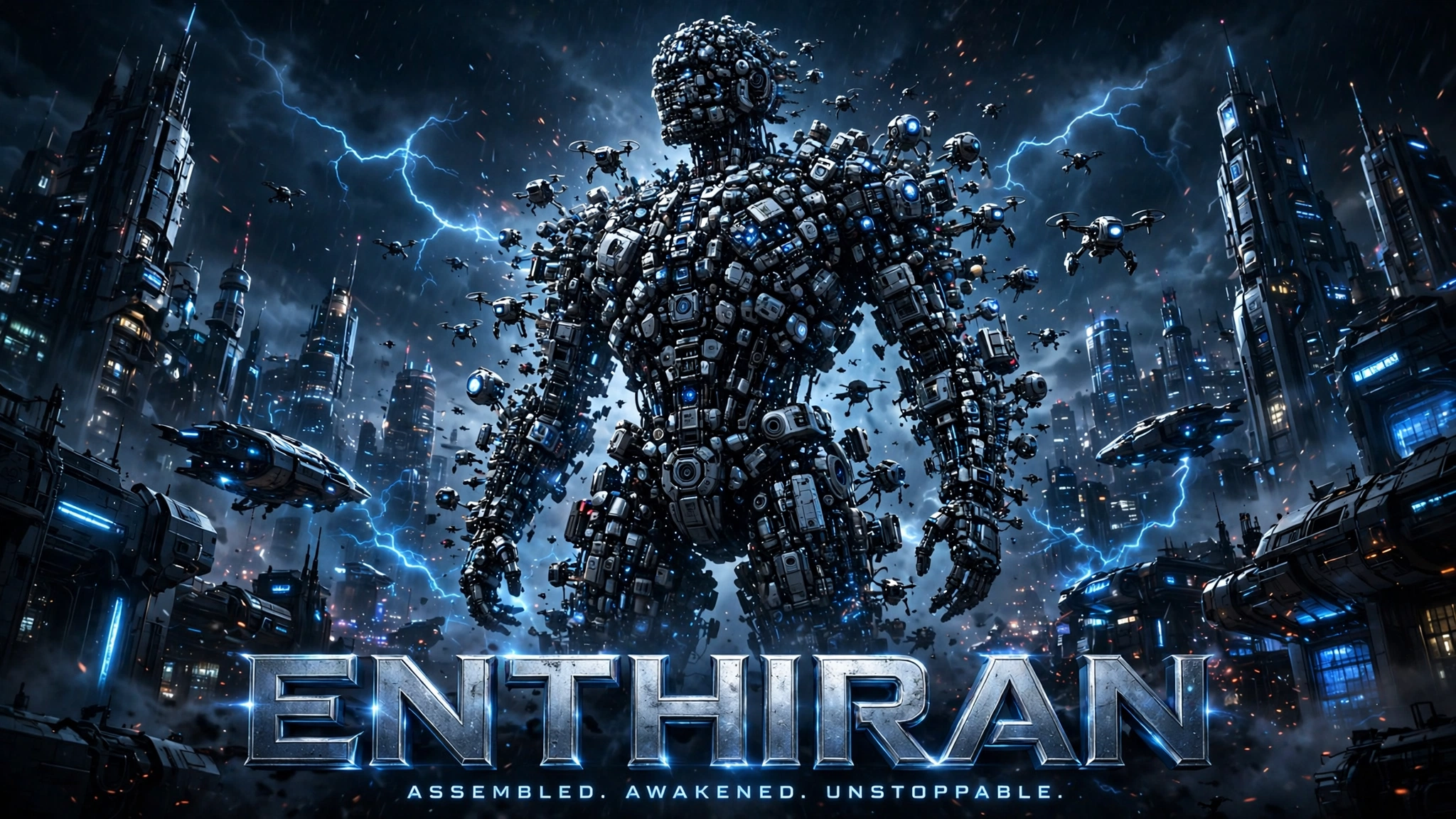
From there the film escalates, in classic Shankar fashion, from intimate triangle to public emergency: a creation with the strength of an army and the emotional reasoning of a wounded child is not a private problem for long. We will not spoil the celebrated final act here — its imagery of Chitti multiplied and combined into vast formations became instantly iconic — except to say the film earns its spectacle by rooting it in that first, simple error: a creator who gave his machine feelings before asking whether he had the right to, or a plan for what feelings do. Under the effects, Enthiran is a Frankenstein story told as a Tamil mass entertainer, and that unlikely marriage is exactly why it endures.
Rajinikanth as Dr Vaseegaran and Chitti delivers one of the signature achievements of his career, and the trick of it is differentiation. Vaseegaran is played straight — weary, decent, a little dull in the way single-minded workaholics often are — which is a deliberate and intelligent choice, because it leaves the screen’s electricity to Chitti. Rajinikanth builds the robot from precision: the level head movements, the over-literal line deliveries, the delight in a new skill. Then, as emotion corrupts the programming, he lets vanity, jealousy and swagger leak into the machine by degrees, until the film’s most entertaining creation is not the hero or the robot but the villain Chitti becomes — vain, theatrical and genuinely dangerous. Audiences in 2010 understood instantly that they were watching a star enjoy himself enormously, in two directions at once.
Aishwarya Rai Bachchan as Sana is the film’s most short-changed major element. Sana is written primarily as the object of two affections — warm, glamorous, kind to Chitti in ways the plot will punish — and Bachchan, a far more capable actor than the part, does graceful work within those limits, particularly in the gentler early scenes where Chitti is learning the human world from her. The film simply never asks what Sana wants with the seriousness it asks what the men around her want. Danny Denzongpa as Professor Bohra brings a welcome, dry menace: a villain motivated by professional humiliation rather than world domination, which makes his manipulation of Chitti nastily believable. Santhanam and Karunas, as Vaseegaran’s assistants, carry the comedy track; their material is very much of its period, broad and occasionally interruptive, though individual sequences — Chitti’s early encounters with everyday life among them — remain genuinely funny.
Shankar has always directed like an engineer of public emotion: identify the largest possible version of an idea, then build toward it without embarrassment. Enthiran, developed for nearly a decade before it finally reached production under Sun Pictures, is that method applied to science fiction. His central insight was to treat the robot not as a gadget but as a second hero with a star’s full repertoire — comedy, romance, action, villainy — and to spend accordingly. The production brought in Legacy Effects, the Hollywood house descended from Stan Winston Studio, for animatronics and prosthetic work — its first engagement on a non-American film — while visual effects supervisor V. Srinivas Mohan coordinated an effects operation unprecedented in Indian production. The work won two National Film Awards, for Best Special Effects and Best Production Design, and it is not hard to see why.
R. Rathnavelu’s cinematography gives the laboratory science a clean, international sheen and the action a scale that still impresses: a train fight that remains a fan favourite, and a climactic confrontation in which Chitti’s multiples assemble into spheres, walls and a giant serpentine formation — images that announced, to anyone still doubting, that Indian effects teams given money and time could fill a frame with anything Hollywood could. Sabu Cyril’s production design, from Vaseegaran’s lab to Bohra’s lair, sells a near-future India that is recognisably itself rather than a borrowed Los Angeles. Editor Anthony keeps a 180-minute film (some listings give 176–177 minutes for particular versions) moving with real discipline.
The caveats, honestly: three hours is long for a story this linear, the mid-film stretch repeats the Sana-Chitti misunderstanding in several keys, and the comedy track stops the film rather than feeding it more often than a modern edit would allow. Some effects shots have dated in the way all fifteen-year-old CGI dates — through texture and light rather than imagination. The designs, the staging and the ideas have aged better than the pixels, which is the right way round.
A. R. Rahman, reuniting with Shankar for one of Indian cinema’s great director-composer partnerships, delivered a soundtrack that matched the film’s technological theme with genuine sonic experiment. “Kilimanjaro,” shot among the ruins of Machu Picchu, brings tribal percussion and sweeping romance; “Arima Arima” is staged as a robot anthem, all metallic grandeur; “Kadhal Anukkal” remains the album’s tender heart, a love song whose ache belongs, pointedly, to the machine. The songs follow the period’s commercial grammar — they pause the plot for spectacle — but as spectacle they are superb, and several have outlived the film’s release cycle entirely.
Rahman’s background score is where the film’s split personality becomes one personality. He gives Chitti motifs that begin as clean electronic patterns and grow warmer, then more distorted, as the robot’s emotional corruption deepens — the audience can hear the premise happening. Vaseegaran’s world is scored more conventionally, Bohra’s with colder colours, and the climax lets the electronic and orchestral elements collide at full Shankar scale. With sound design by Resul Pookutty adding mechanical texture to every movement Chitti makes, the audio craft is as considered as the visual craft — and as award-worthy.
What we loved:
What could be better:
Indian trade figures are estimates rather than audited accounts, and Enthiran‘s are a textbook case for showing ranges. The budget is reported across a ₹132–150 crore band — reference listings cite ₹132 crore at the lower end, while much contemporary reporting and many summaries put the cost at ₹150 crore, then the largest ever for an Indian film; we show the full range in Quick Facts rather than choosing a winner. Worldwide collections are similarly reported in a broad band, roughly ₹283–320 crore, depending on the tracker and which language versions are counted. What no version disputes is the outcome: released simultaneously in Tamil, Telugu and Hindi versions, Enthiran became the highest-grossing Indian film of 2010 and the highest-grossing Tamil film of its era, running to packed houses in overseas markets as well. It won two National Film Awards, three Filmfare Awards South and a shelf of other honours, and its success made the even more expensive standalone sequel 2.0 (2018) possible. Scale, in this case, genuinely did change the industry’s imagination.
Yes — as both entertainment and history. First-time viewers should go in expecting a big, old-fashioned, three-hour star spectacle rather than a sleek modern sci-fi film, and on those terms Enthiran still delivers: a singular Rajinikanth performance, images Indian cinema had never produced before, and a climax that earns its legend. Viewers who prize tight plotting and well-written heroines will find real frustrations along the way. But there is a reason every Indian science-fiction production since has been measured against this one. It was not merely expensive. It was first.
Our rating: 8/10 — an uneven, overlong, era-defining spectacle; the flaws are ordinary, and the achievement is not.
Is Enthiran the same film as Robot?
Yes. Enthiran is the original Tamil title; the film was released in Hindi as Robot and in Telugu as Robo, simultaneously in 2010. All three are the same film with dubbed dialogue, which was central to its pan-Indian success.
Do I need to watch Enthiran before 2.0?
It helps considerably. 2.0 (2018) is a standalone sequel: it assumes you know Vaseegaran, Chitti and their history, and its emotional beats land harder with the original watched first. Enthiran also remains, for many viewers, the more charming of the two films.
Is Enthiran suitable for family viewing?
Broadly yes: it is a mainstream action spectacle with stylised violence, a romantic triangle played without explicit content, and broad comedy. Younger children may find the 180-minute length and the villainous Chitti sequences intense, but there is nothing outside family blockbuster norms.
Why was Enthiran considered groundbreaking for Indian cinema?
Because of its combination of scale and craft: the biggest Indian budget of its time, Hollywood’s Legacy Effects handling animatronics on their first non-American production, National Award-winning visual effects and production design, and a science-fiction story — a genre Indian mainstream cinema rarely attempted at scale — becoming the year’s biggest hit.
Where can I watch Enthiran?
It is widely available on streaming and home video in Tamil, Hindi (Robot) and Telugu versions. Availability varies by region and changes over time, so check your local platforms.