★ LATEST REVIEWS

Our Rating: ★★★★☆ 7.5/10
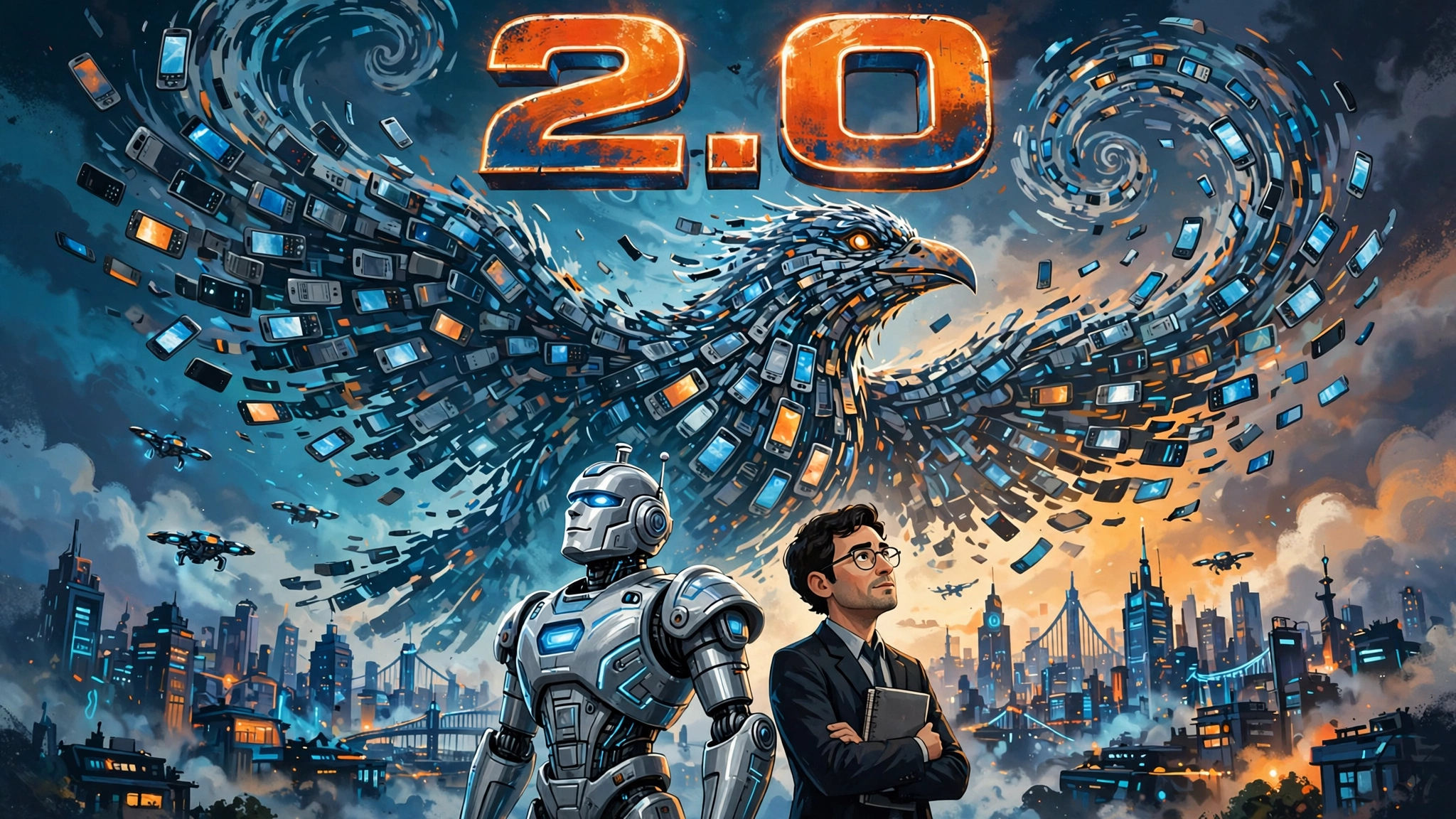
There are films you watch for story, and films you watch for spectacle. 2.0, S. Shankar’s sequel to his 2010 blockbuster Enthiran, is unapologetically the second kind — and on that measure, it is one of the most spectacular Indian films ever made. It is also the most expensive Indian film made up to its time, a film in which a villain made of millions of mobile phones battles an army of robots, and in which Rajinikanth plays a scientist, a robot and a miniature robot army. If that sounds absurd, it is. If it sounds fun, it is that too.
The film is not without problems. Its screenplay is thinner than its visuals, its middle stretch sags, and its message about mobile-phone radiation and birds, while sincere, is delivered with a heavy hand. But as a theatrical experience — huge, loud, colourful and inventive — it delivers what its budget promised, and it remains a landmark for Indian visual effects.
| Detail | Information |
|---|---|
| Release date | 29 November 2018 (India) |
| Director | S. Shankar |
| Writers | S. Shankar; dialogues by B. Jeyamohan, Madhan Karky |
| Genre | Science Fiction, Action |
| Language | Tamil (also Hindi and Telugu dubbed versions) |
| Runtime | 147 minutes |
| Budget | ₹400–600 crore (estimated; sources conflict, see Box Office) |
| Lead cast | Rajinikanth, Akshay Kumar, Amy Jackson, Sudhanshu Pandey, Adil Hussain |
| Our rating | 7.5/10 |
Eight years after the events of Enthiran, Dr. Vaseegaran, the scientist who created the robot Chitti, has built a new humanoid assistant, Nila. Life seems settled — until, one day, every mobile phone in Chennai suddenly flies out of people’s hands and into the sky, forming a vast, swirling cloud. Panic spreads, the city is thrown into chaos, and a strange, giant bird-like creature begins to terrorise the population.
The authorities turn to Vaseegaran, who concludes that only Chitti — the robot dismantled after the previous film’s events — can fight this new threat. This review will not reveal the creature’s identity, its tragic backstory, or how the final battle unfolds, because the film’s reveals are part of its fun. What can be said is that the story is built around a real-world concern: the effect of mobile-phone radiation on birds, and the human cost of technological progress. Shankar takes that concern and turns it into a full-scale fantasy war, with robots, phone-armies and a villain whose powers are as inventive as they are terrifying.
Rajinikanth as Dr. Vaseegaran, Chitti and Kutti — Rajinikanth carries the film in multiple roles, and he is clearly enjoying himself. As Vaseegaran he is warm and authoritative; as Chitti he is precise, witty and heroic, with the robot’s deadpan humour intact; and in the film’s most delightful invention, he plays an army of miniature Chittis, a swarm of tiny robots that fight as one. His screen presence — that walk, that timing, that ability to make the absurd feel inevitable — is the film’s greatest asset, and the film knows it, giving him entrance after entrance.
Akshay Kumar as Pakshi Rajan — Kumar, in his Tamil debut, is superb as the film’s antagonist. His character is given a genuinely tragic backstory, and Kumar plays both the tragedy and the menace with commitment, under heavy prosthetics and effects work. He is not a one-note villain; he is a man driven mad by grief and by a cause he believes in, and Kumar makes that believable even when the character is made of mobile phones. It is one of his most committed performances, and it deserved the praise it received.
Amy Jackson as Nila and the supporting cast — Jackson is graceful as Nila, the new robot assistant, though her role is largely functional: she assists, she explains, she supports. Sudhanshu Pandey and Adil Hussain are solid in supporting roles, and the film’s real supporting star is its visual-effects team, discussed below. The human drama around the robots is thinner than in Enthiran, and that is a fair criticism: the film cares more about its spectacle than about its people.
Shankar’s direction is maximalist in the best and worst senses. The film was the first Indian film shot natively in 3D, and its visual effects — supervised by V. Srinivas Mohan — are genuinely world-class: the phone-cloud, the bird creature, the robot army and the climactic battles are realised with a scale and polish that rival Hollywood blockbusters. Cinematographer Nirav Shah shoots Chennai as a gleaming, futuristic city, and production designer T. Muthuraj builds sets that feel both grand and playful.
The weakness is the screenplay. After a thrilling opening, the film slows for a long stretch of explanation, and the middle act repeats its ideas rather than developing them. Shankar’s message about birds and radiation is sincere, but it is delivered through long speeches that stop the film dead. At 147 minutes, the film is shorter than many Indian blockbusters, but its pacing still feels uneven: spectacular highs separated by talky lows. The climax, however, is worth the wait — a gloriously inventive robot-versus-phone war that justifies the ticket price on its own.
A. R. Rahman’s music is solid rather than classic. The songs, including “Endhira Logathu Sundariye” and “Pullinangal”, are pleasant and well-picturised, but none has become a lasting anthem in the way Rahman’s best work does. The background score is more effective, driving the action sequences with energy and giving the bird creature a suitably ominous musical identity. Rahman’s work here serves the film well without dominating it, which is perhaps the right balance for a film whose real star is its spectacle.
What we loved:
What could be better:
2.0‘s finances are reported as wide ranges, and honesty requires giving them as ranges. Its budget is most commonly estimated at ₹400–600 crore, with individual trade listings citing about ₹543 crore or about ₹570 crore within that range. Its worldwide gross is similarly reported between about ₹655 crore and ₹800 crore, with different trade trackers giving figures around ₹691 crore or ₹700 crore. On any of those figures, it was one of the highest-grossing Indian films of its time and the highest-grossing Tamil film of its era, though its enormous budget meant its profitability was debated: some trade verdicts called it a hit, others an average performer once costs were counted. What is not debated is its scale: released on over 10,000 screens worldwide, it was the widest Indian release ever at the time, and it proved that Indian visual effects could compete with Hollywood’s.
Yes — on the biggest screen you can find, with the sound up, and with your expectations set for spectacle over subtlety. 2.0 is not Shankar’s best film, and it is not Rajinikanth’s deepest performance, but it is a thrilling, inventive, gloriously over-the-top blockbuster that shows Indian cinema at its most ambitious. Its flaws are real, but they are the flaws of ambition: a film that tries to do too much is more interesting than a film that tries to do too little. Watch it for the robot army, for the phone-cloud, and for the sheer joy of seeing a filmmaker swing for the fences.
Our rating: 7.5/10 — A spectacular, uneven blockbuster whose visuals and star power outweigh its thin screenplay.
Do I need to watch Enthiran (2010) before 2.0?
It helps, but it is not essential. 2.0 recaps the essentials: Vaseegaran created Chitti, and Chitti was dismantled after causing destruction.
What is Pakshi Rajan’s power in 2.0?
Without spoiling his backstory, he commands a vast swarm of mobile phones, which he shapes into a giant bird-like creature and other weapons.
Is 2.0 suitable for children?
It is a family-friendly action spectacle in tone, with fantasy violence but no graphic content, and it is popular with younger viewers.
How long is 2.0?
It runs 147 minutes, about two hours and twenty-seven minutes.
Where can I watch 2.0?
It is available on major streaming and digital platforms in many regions, in Tamil, Hindi and Telugu versions, though availability changes by country and over time, so check your local services.