★ LATEST REVIEWS

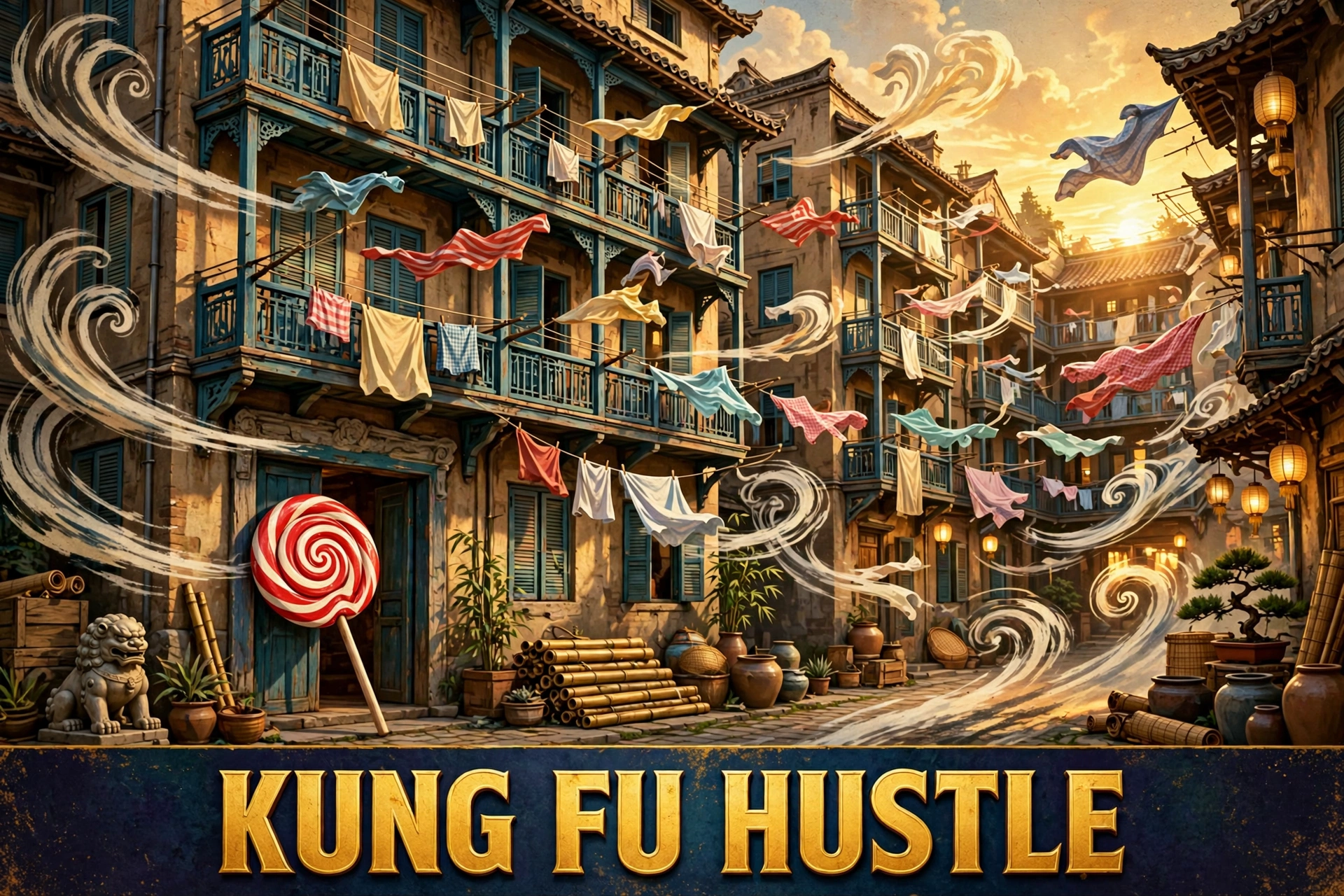
★★★★☆ Our Rating: 8.5/10
Some comedies make you laugh. Kung Fu Hustle makes you laugh while a man is being thrown through a building — and somehow, by the end, it has also made you believe in kindness. Premiering at Toronto on 14 September 2004 and opening in Hong Kong on 23 December 2004, Stephen Chow’s martial arts comedy took his earlier hit formula and blew it up into pure, joyful excess: part wuxia tribute, part gangster picture, part live-action cartoon, held together by a story about a nobody who wants to be a villain because the world once punished him for being good.
It became one of the most successful Chinese-language films of its era internationally, and for many Western viewers it was their first Stephen Chow film. Revisiting it honestly: the gags fly thick and fast, most of them land, and beneath the slapstick sits craftsmanship of a very high order. It is not perfect — no film this manic could be — but its best sequences are untouchable.
| Detail | Information |
|---|---|
| Release date | 14 September 2004 (Toronto premiere); 23 December 2004 (Hong Kong) |
| Director | Stephen Chow |
| Writers | Stephen Chow, Tsang Kan Cheung, Lola Huo (Huo Xin), Chan Man Keung |
| Genre | Action Comedy, Martial Arts |
| Language | Cantonese |
| Runtime | 98 minutes |
| Budget | $20 million |
| Lead cast | Stephen Chow, Danny Chan, Yuen Wah, Yuen Qiu, Eva Huang, Leung Siu-lung |
| Our rating | 8.5/10 |
Shanghai in the 1940s is ruled by fear, and the most feared organisation is the Axe Gang — thousands strong, dressed in black suits and top hats, introduced in a famous opening that tells you everything about their cruelty and the film’s choreographic ambition in a single dance of violence. Into this world stumbles Sing, a petty thief with big talk and no talent for crime, and his loyal, dim sidekick Bone. Sing’s dearest ambition is to join the Axe Gang, because he decided long ago, after a childhood humiliation, that good people finish last.
To prove himself, Sing tries to shake down the residents of Pigsty Alley, a dirt-poor tenement run by a lecherous Landlord and a ferocious, cigarette-smoking Landlady. The residents look like easy targets. They are not. Hidden among the laundry lines and noodle stalls are retired kung fu masters living quiet lives, and Sing’s bluff draws the real Axe Gang down on the alley with catastrophic results. Masters reveal themselves, the gang hires killers of escalating absurdity — including two musicians whose instrument is a weapon and a legendary assassin locked away in an asylum — and Sing finds himself caught between the gang he idolises and the poor people who keep, inconveniently, behaving like heroes. What he chooses, and what he discovers about the small kindness in his own past, we will let the film reveal.
Stephen Chow as Sing directs himself with unusual generosity: for much of the film his star is absent from the best scenes, letting the ensemble shine, and when Sing does take centre stage Chow plays him as a strutting coward whose bravado collapses beautifully under pressure. His physical comedy — the knife gag in Pigsty Alley is a masterclass in timing — is matched by a genuine ache in the flashbacks that explain him. Yuen Qiu as the Landlady is the film’s breakout joy: rollers in her hair, slipper in hand, a roar that can empty a courtyard. Beneath the comedy she builds a character of real pride and buried grief, and her eventual display of skill is both a huge laugh and a genuine thrill.
Yuen Wah as the Landlord matches her step for step, playing a flirtatious layabout whose lightness conceals one of the alley’s greatest secrets — his tai chi elegance makes a perfect marital counterpoint to his wife’s force. Leung Siu-lung (Bruce Leung) as the Beast, the supposedly ultimate killer, is a stroke of casting genius: a genuine 1970s kung fu star playing a slovenly, flip-flop-wearing monster who respects only strength and honours his word in defeat. Danny Chan as Brother Sum, the Axe Gang’s leader, gives the villains a vain, preening menace, while Eva Huang as Fong, the mute ice-cream seller from Sing’s childhood, provides the film’s quiet heart with almost no dialogue at all. The three alley masters — Coolie, Tailor and Donut — each get a showcase fight and a distinct personality, and all three register strongly despite limited screen time.
Chow directs with a cartoonist’s eye and a classicist’s knowledge. The visual effects — a huge team effort overseen to blend digital work with practical stunts — deliberately embrace the unreal: people dent walls like animation characters, run fast enough to overtake bicycles in a sequence that lovingly steals from road-runner cartoons, and leave fist-shaped craters in the ground. Because the film commits to this language completely and cuts the effects with superb comic timing, the artificiality becomes the style rather than a flaw.
The action, choreographed with contributions from Sammo Hung and Yuen Woo-ping — both unmissable influences on the final film — mixes genuine martial arts skill with the digital exaggeration. The night fight between the three masters and the musician assassins, where invisible blades of sound carve through the alley, remains one of the most inventive set pieces in any martial arts film. Cinematographer Poon Hang-sang bathes Pigsty Alley in warm, storybook tones against the gang’s black-and-white world of fear, and the production design turns the real, U-shaped tenement into a place you feel you know. Honest criticisms: the middle section briefly loses Sing and can feel like a relay of guest fights, some digital shots have aged less gracefully than the practical work, and viewers who dislike broad slapstick will find certain gags — a recurring snake joke, for one — pitched too far.
Raymond Wong’s score draws heavily on traditional Chinese music, and the choices are inspired. Melancholy erhu and guzheng melodies give Pigsty Alley an old-world soul that makes the comedy around them funnier and, when the film turns sincere, unexpectedly moving. The musician assassins’ weaponised guzheng turns the soundtrack itself into a combatant — their attacks are literally shaped by the notes being played, one of the cleverest blends of music and action ever staged. Western classical touches in the Axe Gang’s world underline their imported gangster pretensions. It is a score that does far more than accompany; it is part of the film’s storytelling machinery.
What we loved:
What could be better:
Made for a reported $20 million, Kung Fu Hustle grossed about $104.9 million worldwide — tallies vary slightly between roughly $101 million and $105 million depending on source and re-release accounting — including around $17 million in North America, where it became the highest-grossing foreign-language film in the United States in 2005 and one of the top ten foreign-language releases in American history to that point. At home it was a major hit, and it swept awards across Asia, including six Hong Kong Film Awards and five Golden Horse Awards, among them major picture and director honours. A 3D re-release for its tenth anniversary in 2014 introduced it to a new generation. Few comedies in any language have travelled this well, because its best jokes are visual and need no translation.
Yes — especially if you have never seen a Stephen Chow film, because this is the perfect doorway. Kung Fu Hustle is silly and sincere in equal measure, a film that mocks kung fu clichés out of obvious love for them. Its flaws are the flaws of abundance: too many ideas, a hero who wanders off, effects that occasionally wobble. But scene for scene, laugh for laugh, it delivers more invention in 98 minutes than most action comedies manage in a franchise.
Our rating: 8.5/10 — a wild, warm-hearted martial arts delight that still feels one of a kind.
Is Kung Fu Hustle a sequel to Shaolin Soccer?
No. It is a standalone film, though it shares Stephen Chow’s style of mixing comedy, sport-like showdowns and underdog heart that made Shaolin Soccer a hit.
What language is Kung Fu Hustle in?
The original is Cantonese. Dubbed versions exist in Mandarin, English and other languages, though most fans recommend the subtitled original for Chow’s comic timing.
Is Kung Fu Hustle suitable for children?
It contains cartoonish but sometimes bloody martial arts violence and mild language. Older children who enjoy slapstick usually love it, but parents should expect stylised fighting throughout.
Who is the Beast in Kung Fu Hustle?
He is played by Leung Siu-lung, also known as Bruce Leung, a real star of 1970s Hong Kong kung fu cinema. Casting veteran stars in key roles was a deliberate tribute by Chow.
Where can I watch Kung Fu Hustle?
It is available on streaming, digital stores and disc in most regions, though the platform varies by country. Check your local services.