★ LATEST REVIEWS

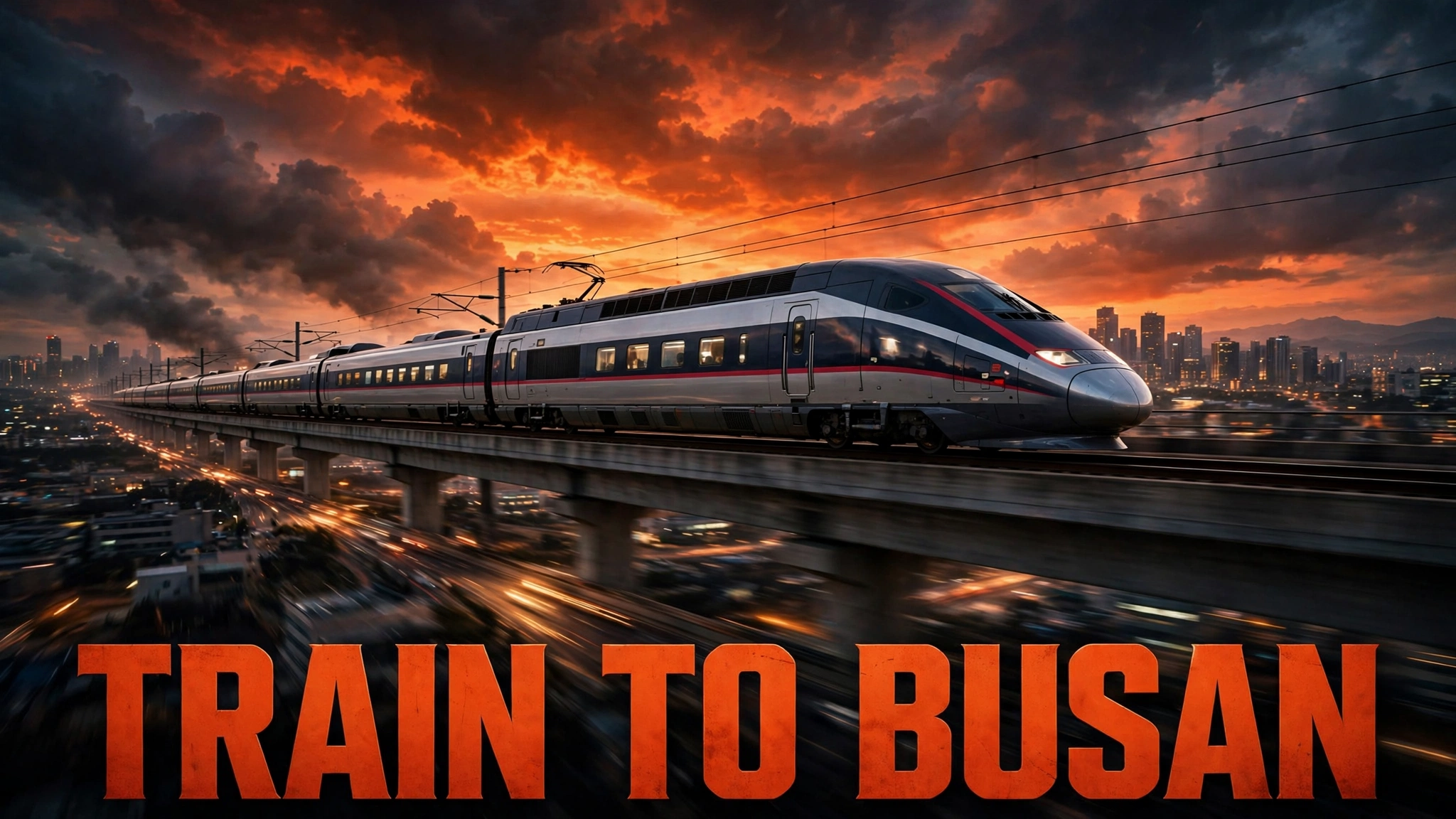
★★★★☆ Our Rating: 8.5/10
Zombie films usually promise gore. Train to Busan promises something else as well: you will probably cry. Released in South Korea on 20 July 2016 after a midnight premiere at Cannes on 13 May, Yeon Sang-ho’s live-action breakthrough traps a cross-section of Korean society inside a speeding train while an outbreak turns the country outside the windows into chaos. It is fast, frightening and, at its best, deeply moving.
The film became the first Korean release of its year to pass ten million admissions at home and went on to earn fans on every continent, many of whom had never watched a Korean film before. Is it really that good, or just a clever setting doing the work? Our honest answer: mostly, it really is that good — with a few familiar genre habits holding it back from perfection.
| Detail | Information |
|---|---|
| Release date | 13 May 2016 (Cannes premiere); 20 July 2016 (South Korea) |
| Director | Yeon Sang-ho |
| Writers | Park Joo-suk |
| Genre | Horror, Action Thriller |
| Language | Korean |
| Runtime | 118 minutes |
| Budget | $8.5 million |
| Lead cast | Gong Yoo, Jung Yu-mi, Ma Dong-seok, Kim Su-an, Choi Woo-shik, Ahn So-hee, Kim Eui-sung |
| Our rating | 8.5/10 |
Seok-woo is a busy fund manager in Seoul whose work has cost him his marriage and, increasingly, his young daughter. Su-an, quiet and painfully polite, asks for one thing for her birthday: to visit her mother in Busan. Reluctantly, Seok-woo boards the early KTX express with her, planning to be back at his desk as soon as decency allows.
The journey begins normally — businessmen, students, an elderly pair of sisters, a high-school baseball team, a pregnant woman and her protective husband, a homeless man who seems to have seen something terrible. News reports flicker about disturbances across the country. Then, just as the doors close, an injured young woman stumbles aboard, and within minutes the train’s orderly world collapses. An infection that turns people violent and ravenous spreads carriage by carriage, and the train becomes a line of shrinking safe spaces hurtling toward a destination that may not be safe at all.
Stops along the way offer hope and take it away. The passengers must cross infected carriages, argue over who deserves protection, and decide — again and again — whether survival means every man for himself or something better. The destination stays Busan. What the journey changes is the people trying to reach it. We will not spoil who does.
Gong Yoo as Seok-woo carries the film’s emotional arc with restraint. His Seok-woo begins as a man who gives his daughter a games console she already owns and calls selfishness honesty. Gong never softens him too early. The change, when it comes, is physical as much as verbal — he starts putting his body between danger and other people — and because the actor has held back, those moments land hard.
Kim Su-an as Su-an is remarkable for a child performer. She plays disappointment rather than cuteness: a girl who has learned not to expect much from her father and is quietly testing whether this trip will be different. Her scenes give the horror stakes that no body count could. Ma Dong-seok as Sang-hwa walks away with the audience’s heart — a working-class husband, all muscle and tenderness, whose improvised heroism alongside his pregnant wife Seong-kyeong provides the film’s warmth and much of its humour. Jung Yu-mi as Seong-kyeong gives that role calm intelligence rather than helplessness.
Kim Eui-sung as Yon-suk, a transport executive who treats other passengers as expendable, is the human antagonist the film needs: recognisable, selfish and frightening in a completely non-supernatural way. Choi Woo-shik as Yong-guk and Ahn So-hee as Jin-hee, the young baseball player and his girlfriend, bring a sweet, fragile thread of first love into the carnage. If there is a weakness, it is that several supporting passengers are written as types rather than people — but the main ensemble more than compensates.
Yeon Sang-ho came to this film from acclaimed animated features, and his sense of visual storytelling shows. He treats the train as a diagram of society — first class and standard, crew and passengers, doors that protect and doors that exclude — and stages the action so you always understand the geography: which carriage is safe, which is lost, and what lies between. That clarity is why the set pieces work. A desperate crossing of zombie-filled cars, a station stop that turns from rescue to catastrophe, a sequence involving a blocked tunnel and the darkness that momentarily blinds the infected — each is built on rules the film teaches you early and then exploits fairly.
The infected themselves are played by performers whose contorted, snapping movement, enhanced by make-up showing spreading veins, feels animal rather than cartoonish. The camera stays close and handheld in the panic and pulls back for the rare wide shots of a country in collapse, glimpsed through train windows. Occasionally the digital effects around the larger crowd scenes show their budget, and the film returns to slow-motion sacrifice a touch too often. But at 118 minutes it rarely wastes a scene, and its mid-film lull is used for character, not padding.
Jang Young-gyu’s score works in pulses and pressure rather than big themes. Strings saw anxiously under the attack sequences, percussion mimics the rhythm of the train itself, and the music keeps tightening the screw during the carriage crossings. Just as importantly, the film uses near-silence — held breath, a child’s muffled sobs, the ordinary clatter of the rails — in several of its scariest passages. The emotional finale is supported by music that swells without tipping into manipulation for most viewers, though those allergic to sentiment may feel the strings working on them a little openly at the very end.
What we loved:
What could be better:
Produced for a reported $8.5 million, Train to Busan grossed about $98.5 million worldwide, including roughly $80.5 million in South Korea alone, where admissions passed eleven million and it finished as the country’s highest-grossing film of 2016. It set records for a Korean film in markets including Malaysia, Hong Kong and Singapore, and built a long second life internationally through streaming, introducing countless viewers to Korean cinema years before that wave peaked. Its success spawned an animated prequel, Seoul Station, released the same year, and a standalone follow-up, Peninsula, in 2020 — neither of which matched the original’s reception, which tells you how high this film set the bar.
Absolutely — whether you are a horror devotee or someone who usually avoids zombie films. Train to Busan understands that the scariest question in a disaster is not how fast the monsters run, but what kind of person you become when the doors are closing. It is not a flawless film: it is sentimental in places and some of its characters are sketches. But its central relationships, its propulsive set pieces and its willingness to earn its tears make it one of the finest genre films of the 2010s.
Our rating: 8.5/10 — thrilling, frightening and genuinely moving; the zombie film to recommend to people who think they do not like zombie films.
How scary is Train to Busan?
It is intense and violent, with sudden attacks and sustained dread, but it focuses more on tension and emotion than on lingering gore. Horror fans will find it gripping; the very squeamish should expect to look away a few times.
Is Train to Busan based on a true story?
No. The outbreak and characters are fictional. The KTX line between Seoul and Busan, however, is real, which adds to the film’s grounded feel for Korean audiences.
What language is Train to Busan in?
Korean, with subtitled and dubbed versions available in many countries, including a wide Indian release in English, Hindi, Tamil and Telugu versions.
Do I need to watch Seoul Station or Peninsula first?
No. Train to Busan stands completely alone. Seoul Station is an animated prequel and Peninsula a standalone follow-up set in the same world.
Where can I watch Train to Busan?
It is widely available on streaming and digital stores, though the exact platform varies by country. Check your local services.