★ LATEST REVIEWS

★★★★☆ Our Rating: 8.5/10
There are comic book films that want to thrill you, and then there is Joker, a film that seems determined to unsettle you and leave you sitting in silence after the credits. When it arrived in 2019, most viewers expected another chapter in the familiar battle between Gotham’s hero and its most famous villain. What they got instead was something far smaller, sadder, and more uncomfortable: a character study about a man whom society keeps pushing aside until there is nothing left to push.
That shift in expectation is exactly why the film sparked such strong debate. Some called it a masterpiece. Others found it troubling and difficult to watch. Both reactions are understandable, because this is not a film designed for comfort. It asks awkward questions about mental health care, public humiliation, and what happens when a city stops listening to its most vulnerable people. It also rests almost entirely on one extraordinary central performance that holds your attention even when the story makes you want to look away.
Whether you love it or resist it, Joker is hard to dismiss or forget. In this review, we give you an honest breakdown of its story, performances, craft, and flaws, so you can decide if this difficult film is right for you.
| Detail | Information |
|---|---|
| Release date | October 4, 2019 (United States) |
| Director | Todd Phillips |
| Writers | Todd Phillips, Scott Silver |
| Genre | Crime, Psychological Drama, Thriller |
| Language | English |
| Runtime | 122 minutes |
| Budget | $55–70 million |
| Lead cast | Joaquin Phoenix, Robert De Niro, Zazie Beetz, Frances Conroy |
| Our rating | 8.5/10 |
The film is set in Gotham City in the early 1980s, a place dealing with rubbish strikes, rising unemployment, and a growing gap between the comfortable and the desperate. In the middle of that pressure lives Arthur Fleck, a man trying to earn a living as a hired clown while privately dreaming of becoming a stand-up comedian. He lives with his mother, Penny, in a cramped apartment, attends appointments that are supposed to help him manage his mental health, and carries a condition that makes him burst into laughter at the worst possible moments, even when he feels distressed or afraid.
Arthur’s daily life is a series of small humiliations. His work is insecure, strangers mock or attack him, and the support services he relies on are stretched thin. At home, his mother is fixated on her past connection to a wealthy Gotham family and on a popular late-night talk show host whom Arthur idolises. He imagines himself being welcomed on that show, recognised at last as someone who matters. That fantasy of being seen becomes one of the most revealing parts of his character.
A violent incident on his way home changes the direction of his life, and the city’s reaction to it surprises even Arthur. Without giving away what follows, it is enough to say that the story is less about a master criminal being born and more about a fragile identity slowly cracking under repeated rejection. There are no superhero battles and no caped figure waiting to restore order. The tension comes from watching how close Arthur is to the edge, and from wondering what the city around him will do — or fail to do — next.
Joaquin Phoenix as Arthur Fleck / Joker: This is the performance the entire film is built around, and it is remarkable for its physical and emotional commitment. Phoenix lost a significant amount of weight for the role, and his thin frame shapes how Arthur moves through the world — hesitant in public, oddly expressive when he is alone. More impressive than the transformation is the control. He can shift from childlike vulnerability to something far more frightening within a single scene without raising his voice. His different laughs, each tied to pain, embarrassment, or a loss of control, become a kind of language for a character who struggles to explain himself in words.
Robert De Niro as Murray Franklin: De Niro plays the polished talk show host Arthur dreams of meeting. He brings an easy, professional charm that looks warm from a distance but feels colder up close. It is a restrained performance, and its restraint matters, because Murray represents the entertainment world Arthur longs to join — a world that can turn private suffering into public material very quickly.
Zazie Beetz as Sophie Dumond: Beetz brings warmth and lightness to the role of Arthur’s neighbour, a single mother who seems to offer him a rare moment of human connection. Her scenes have a gentler rhythm than the rest of the film, which makes them stand out. The character is not given as much independent depth as she deserves, but Beetz makes her presence memorable.
Frances Conroy as Penny Fleck: Conroy gives Penny a fragile, distant quality that helps explain much about Arthur’s upbringing. She is loving in her own way, yet clearly unwell and dependent, and that complicated dynamic sits at the heart of the household. Her performance is quieter than the others, but it adds an important layer of sadness to the family story.
Overall, the supporting cast does solid work, but there is no question that this is Phoenix’s film. Remove his performance and the whole project would feel far thinner.
Todd Phillips directs Joker with far more patience than viewers familiar with his earlier comedy work might have expected. He lets scenes breathe, allows awkward silences to linger, and resists turning Arthur’s decline into a fast montage. That slower approach makes the film feel grounded. Gotham here is not a glossy fantasy city, but a place of stained streets, crowded buses, and tired public offices. The period setting helps, too, giving the story a slightly removed, almost timeless feeling without turning it into a history lesson.
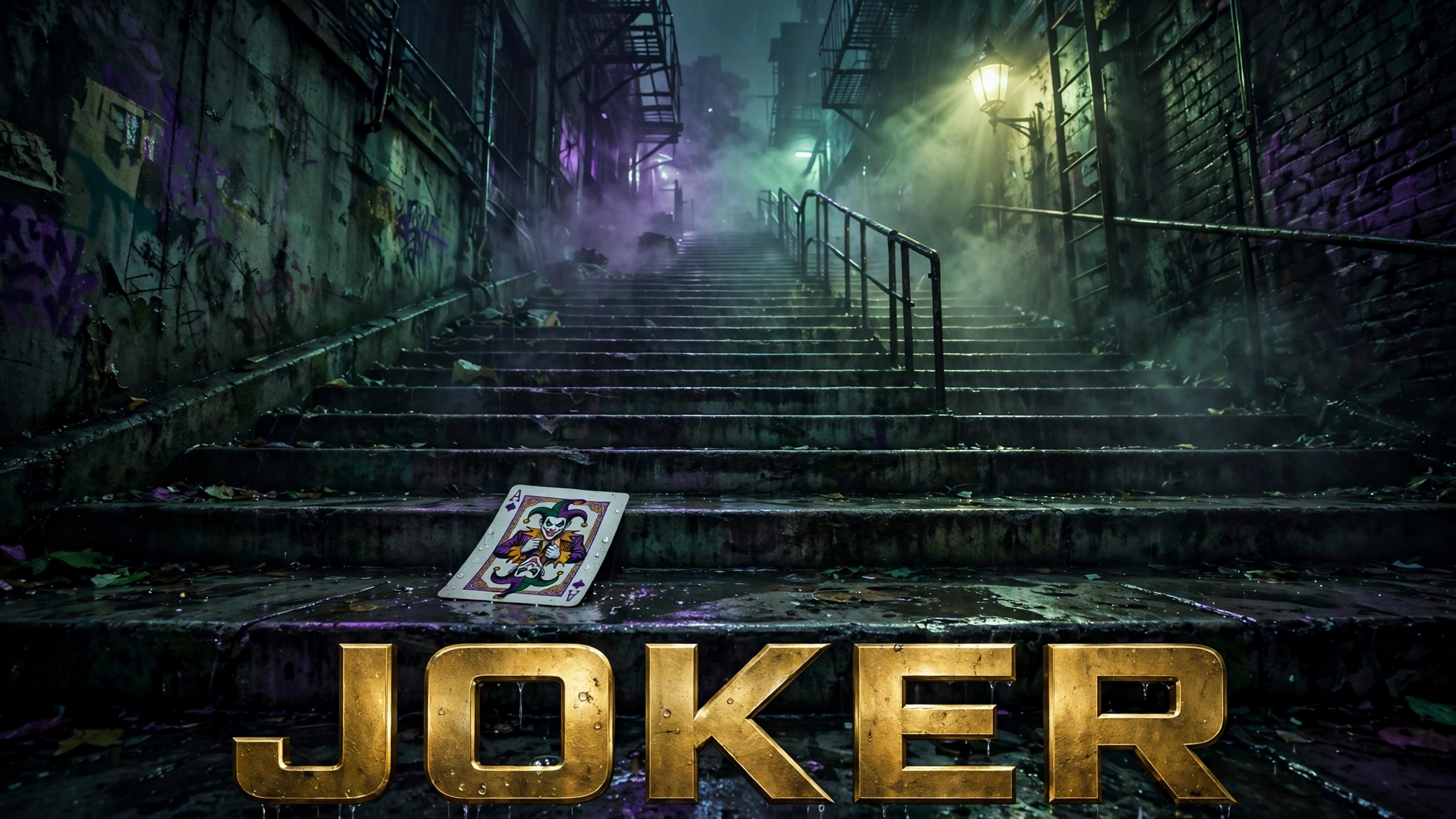
Lawrence Sher’s cinematography is one of the film’s strongest assets. The camera often keeps Arthur small within wide, grimy frames when he is being ignored, then moves closer as his confidence changes. The colour palette leans on dull greens, yellows, and browns early on, reflecting a city that looks unwell. As Arthur’s self-image shifts, the framing and lighting shift with him, and a much-discussed staircase sequence becomes a visual turning point that works because the film has earned it through all the drab, confined scenes that came before.
The editing by Jeff Groth is deliberate rather than flashy. Scenes are allowed to play out in uncomfortable real time, particularly the comedy club and talk show sequences, where the pauses do as much work as the dialogue. Production design and costume also deserve credit. Arthur’s clown outfits and everyday clothes look lived-in rather than styled, which keeps the film rooted in its social drama even when it edges toward comic book iconography.
If there is a technical criticism, it is that the film sometimes leans too heavily on familiar visual references to 1970s New York cinema. The influences are worn openly, and for some viewers that homage will feel derivative rather than fresh. Still, on a modest budget by comic book standards, the craft is consistently strong.
The original score by Hildur Guðnadóttir is central to how Joker feels. Built largely around low, mournful cello lines, it sounds less like traditional thriller music and more like a mood pressing down on the character. The music often enters quietly, almost as if it is growing out of Arthur’s own head, and it gives his private moments a heavy, lonely weight. Guðnadóttir won the Academy Award for Best Original Score for this work, and it is easy to understand why — the score does not simply accompany the film, it helps define its emotional temperature.
Alongside the score, the film uses existing songs in ways that underline Arthur’s fantasies and public image. Those choices are effective, though occasionally a little obvious, pointing at the emotion the scene wants rather than letting it develop on its own. The contrast between the bleak cello score and the brighter, more performative song choices mirrors the gap between Arthur’s inner life and the cheerful entertainer he wishes he could be. Sound design more broadly is also strong, with city noise, crowd sounds, and sudden silences used to keep the audience slightly on edge throughout.
What we loved:
What could be better:
Few box office stories in recent years are as striking as this one. Made for a reported budget of $55–70 million — modest for a film connected to a major comic book character — Joker went on to gross $1.079 billion worldwide. It premiered at the Venice Film Festival on August 31, 2019, where it won the Golden Lion, before opening in the United States on October 4, 2019.
That total made it, at the time, the highest-grossing R-rated film ever released, a remarkable achievement for a slow, adult drama with no superhero action set pieces to sell. Its success demonstrated that audiences would turn out in huge numbers for a darker, character-led story, provided the conversation around it was strong enough. It also sparked a wider industry discussion about whether studios could make profitable comic book films at a fraction of the usual cost — a lesson Hollywood is still absorbing.
Joker is not an easy recommendation for everyone, and it should not pretend to be. If you are looking for a fun comic book adventure, this is the wrong film. If, however, you are interested in a serious, superbly acted study of a man unraveling while the world around him looks the other way, it is one of the most compelling studio films of its year. Its flaws — thin supporting roles and heavy influences — are real, but they do not outweigh the power of Phoenix’s performance, Guðnadóttir’s score, and the film’s willingness to sit with discomfort rather than resolve it neatly.
Watch it when you are in the mood for something demanding, and expect to think about it afterwards, whether you admired it or argued with it.
Our rating: 8.5/10 — A bleak, brilliantly acted character study that lingers long after it ends.
Is Joker connected to The Batman or other DC films?
No. Joker was made as a standalone story outside the main DC film continuity. You do not need to have seen any other Batman or DC film to follow it, and its Gotham is its own separate version of the city.
Is Joker based on a true story?
No. Arthur Fleck’s story is fictional, although the film draws on real concerns about mental health care, inequality, and urban neglect, and it takes visual inspiration from New York in the late 1970s and early 1980s.
Is there a sequel to Joker?
Yes. A sequel, Joker: Folie à Deux, was released in 2024, again starring Joaquin Phoenix, this time alongside Lady Gaga. Its reception was far more divided than the original film’s.
What is the age rating and runtime of Joker?
The film runs 122 minutes and is rated R in the United States for strong violence, disturbing behaviour, and language. It is intended for adult audiences and is not suitable for children.
Where can I watch Joker?
Availability changes by country and over time. Check major streaming services and digital rental stores in your region, as the film rotates between platforms. It is also widely available on Blu-ray and DVD.