
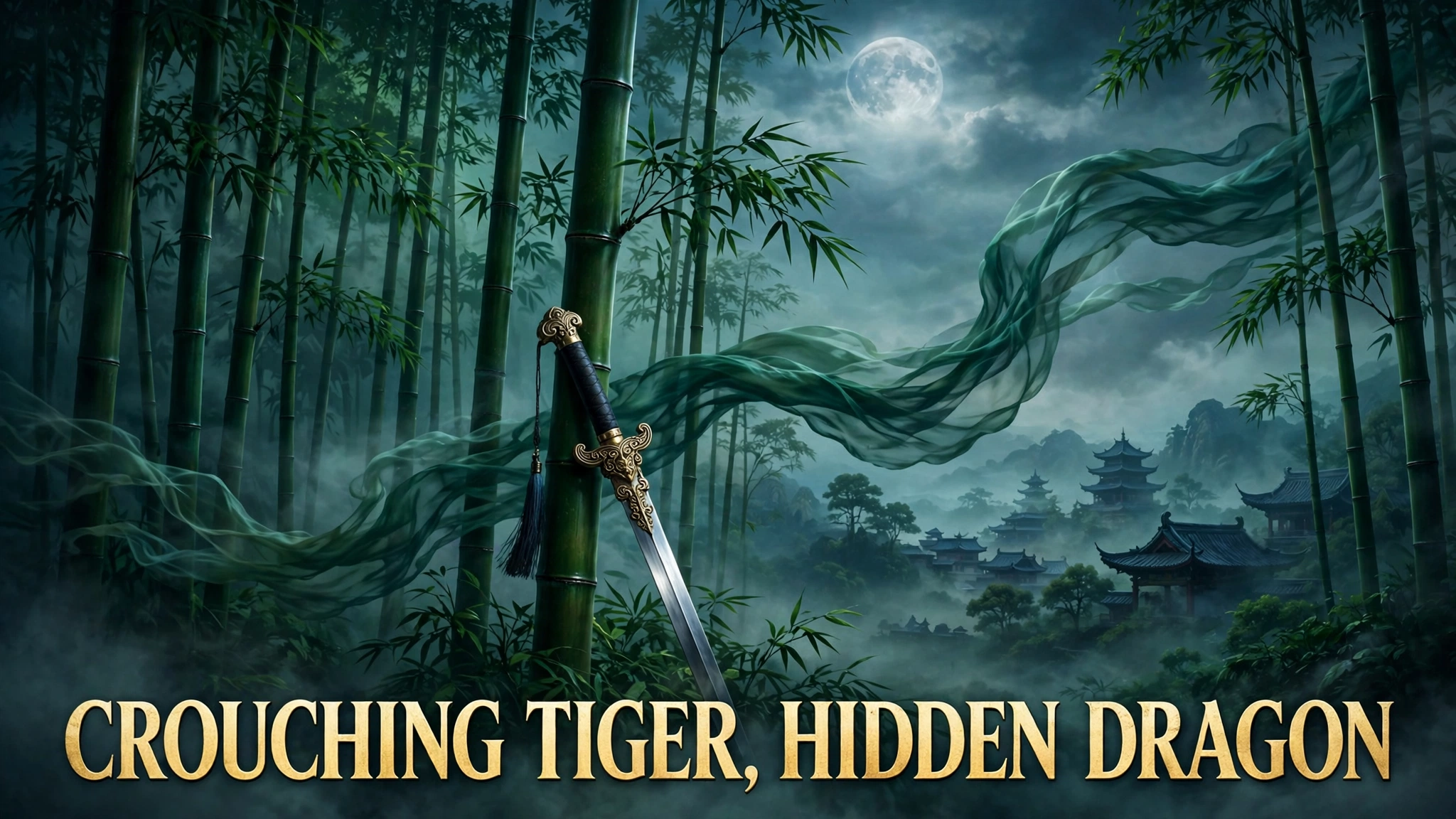

Crouching Tiger, Hidden Dragon (2000) Review – Swords, Secrets, and Love That Arrives Too Late
There are action films, and then there is Crouching Tiger, Hidden Dragon. Premiering at Cannes on 18 May 2000 and reaching audiences across Asia that July before opening in the United States on 8 December, Ang Lee’s wuxia epic did something nobody expected: it turned a Mandarin-language tale of warriors, honour and restrained longing into a global phenomenon, the highest-grossing foreign-language film in American box-office history at the time.
More than two decades on, its fights still float through popular culture — across rooftops, over water, among the bending tops of a bamboo forest. But the film’s real subject was never swordplay. It is about people who have mastered everything except saying what they feel. This is our honest look at a classic that mostly earns its reputation, including the places where its deliberate pace will test modern viewers.
Quick Facts: Crouching Tiger, Hidden Dragon at a Glance
| Detail | Information |
|---|---|
| Release date | 18 May 2000 (Cannes premiere); 7 July 2000 (Taiwan); 8 December 2000 (United States) |
| Director | Ang Lee |
| Writers | Wang Hui-ling, James Schamus, Tsai Kuo-jung |
| Genre | Wuxia, Action, Romance, Drama |
| Language | Mandarin |
| Runtime | 120 minutes |
| Budget | US$17 million |
| Lead cast | Chow Yun-fat, Michelle Yeoh, Zhang Ziyi, Chang Chen, Lang Sihung, Cheng Pei-pei |
| Our rating | 9/10 |
The Story: A Stolen Sword, Two Generations of Longing (Spoiler-Free)
In Qing-dynasty China, the famed warrior Li Mu Bai has decided to lay down his life of wandering and combat. As a symbol of that decision he gives up his legendary blade, the Green Destiny, asking his closest friend and fellow warrior Yu Shu Lien to deliver it to a respected elder in Beijing. Shu Lien runs a security company, moves confidently in a male world, and shares with Mu Bai a love both of them have honoured for years by never speaking it aloud — bound by duty, propriety and an old loyalty to her late fiancé, who was his sworn brother.
In Beijing, Shu Lien meets Jen, the governor’s daughter: intelligent, restless and facing an arranged marriage she dreads. Jen is fascinated by the free life of warriors she has only read about. When the Green Destiny is stolen by a masked thief of astonishing skill, suspicion falls toward an old enemy — Jade Fox, the murderer of Mu Bai’s master, who has hidden in plain sight for years. Mu Bai returns to recover the sword, and the pursuit pulls all four lives together: two older warriors who surrendered their happiness to rules, and a younger pair whose secret romance and hunger for freedom threaten to repeat the pattern in a more reckless key. We will leave the desert flashbacks, the duels and the ending for you to discover.
Performances: Restraint as a Superpower
Michelle Yeoh as Yu Shu Lien gives the film’s finest performance. Yeoh, famous as an action star, here does her most devastating work in stillness: a glance held, a hand almost extended and then withdrawn. Her Shu Lien is capable, dignified and quietly heartbroken, and the famous scene in which she urges Jen not to waste her chance at love is powerful precisely because Yeoh plays it as advice she herself failed to take. It is a masterclass in understatement.
Chow Yun-fat as Li Mu Bai brings gravity and melancholy to a role far removed from his Hong Kong gunplay image. His Mu Bai is a man tired of killing, searching for peace he keeps postponing. Chow’s Mandarin was not his first language and some native-speaking critics noted his delivery at release, but his presence — weary, noble, gentle — carries the character regardless. Zhang Ziyi as Jen, in the role that made her an international star, is electric: spoiled and sympathetic at once, childish and formidably gifted, a girl who wants freedom without yet understanding its price. Her duel using every weapon in a teahouse is both thrilling and characterful.
Chang Chen as Lo, the desert bandit who storms into Jen’s life, brings raw, boyish passion that contrasts beautifully with the older generation’s silence. Cheng Pei-pei as Jade Fox, a legend of earlier wuxia cinema, gives the villainess genuine bitterness — she is not evil for sport but a woman cheated of mastery by a male world, and the film is richer for letting her say so.
Direction and Technical Brilliance
Ang Lee approached wuxia — a genre of flying swordsmen rooted in Chinese popular novels, here adapted from Wang Dulu’s novel — as both a loving homage and a meditation. Working with action choreographer Yuen Woo-ping, he stages fights that are less about impact than about character and physics-defying grace. Warriors run up walls and across rooftops because in this world, mastery lightens the body. Each duel is staged differently: a night chase over tiles, a clash of sword against every weapon in a room, and the justly famous bamboo-forest duel, where two fighters balance on swaying green poles in a scene of impossible beauty that is also, emotionally, a conversation neither can have in words.
Peter Pau’s cinematography, which won an Academy Award, moves from golden desert to misty mountains to that emerald forest with painterly confidence. The editing gives the fights long, readable takes rather than frantic cutting, trusting the performers and wire work. Honest reservations: the deliberate, lyrical pacing that admirers treasure can feel slow in the dialogue passages, the central desert romance is presented in an extended flashback that halts the main plot for a significant stretch, and viewers raised on harder-hitting modern action may find the combat balletic rather than brutal. These are matters of taste, but they are real.
Music and Background Score
Tan Dun’s Oscar-winning score is built around the cello, played by Yo-Yo Ma, and it is the film’s emotional narrator. The cello voices everything the older warriors cannot say — yearning, regret, tenderness — while drums and sudden silences drive the action sequences. Traditional Chinese instrumentation is blended with a Western orchestral sweep in a way that mirrors the film itself: rooted in its own tradition, shaped to travel. The end-credit song, performed by CoCo Lee in its international versions, leans more toward conventional balladry, but the score proper remains one of the great film compositions of its era.
What Works and What Doesn’t
What we loved:
- A love story of rare restraint, anchored by Michelle Yeoh’s superb performance
- Fight choreography that remains beautiful and influential decades later
- Cinematography and score of the very highest level
- Themes of freedom, duty and gender that give the action real weight
What could be better:
- The slow, lyrical pacing will not suit viewers seeking constant action
- The long desert flashback interrupts the main story’s momentum
- Some emotional beats depend on cultural codes of restraint that may be missed without attention
Box Office: A Subtitled Film Conquers America
Made for about US$17 million, the film earned roughly US$214 million worldwide — a figure reported as $213.5–214 million depending on the source — including around $128 million in the United States, where it became the highest-grossing foreign-language film in American history at the time and held that distinction for years. At the 73rd Academy Awards it received ten nominations, then a record for a non-English-language film, and won four Oscars: Best Foreign Language Film, Best Cinematography, Best Art Direction and Best Original Score. It also won four BAFTAs and two Golden Globes, including Best Foreign Language Film. More important than any single prize, it permanently widened the Western audience for Asian cinema and for wuxia in particular.
Verdict: Should You Watch It?
Yes — and ideally on the largest screen you can find. Crouching Tiger, Hidden Dragon is not the fastest or hardest-hitting martial arts film ever made, and it does not try to be. It is something rarer: an action film about the cost of a life lived by the rules, in which the most important battles are fought in glances across a courtyard. If you give yourself to its pace, its beauty and its sorrow will stay with you long after the final, unforgettable leap.
Our rating: 9/10 — a poetic, era-defining wuxia classic that rewards patient viewers.
Frequently Asked Questions
What does the title Crouching Tiger, Hidden Dragon mean?
It comes from a Chinese expression describing a place or situation full of hidden masters and unnoticed talent — people whose true abilities lie beneath an ordinary surface, which describes nearly every character in the film.
Is Crouching Tiger, Hidden Dragon based on a book?
Yes. It adapts Wang Dulu’s novel of the same name, part of his Crane Iron series of wuxia novels written in the first half of the twentieth century.
What language is the film in?
Mandarin, with subtitles in international releases. Its success with subtitles in English-speaking markets was considered revolutionary at the time.
Is there a sequel?
Yes, a follow-up, Crouching Tiger, Hidden Dragon: Sword of Destiny, appeared in 2016 with Michelle Yeoh returning. It is generally regarded as far weaker than the original.
Where can I watch Crouching Tiger, Hidden Dragon?
It is widely available on streaming, digital rental and physical media, though the exact service varies by country. A restored version has also returned to cinemas for anniversary screenings.