★ LATEST REVIEWS

Our Rating: ★★★☆☆ 6.5/10
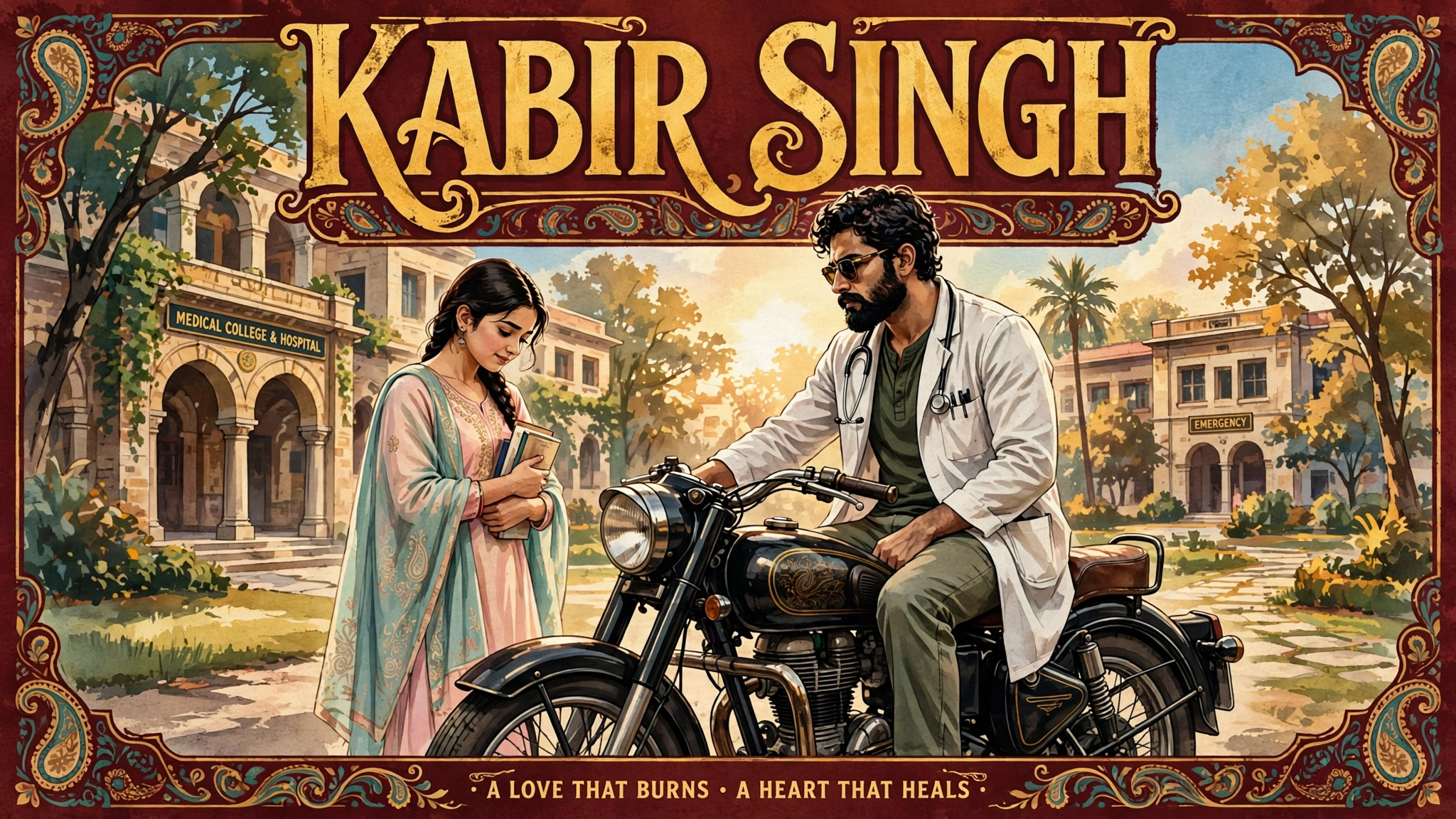
Few Hindi films of the last decade split a room like Kabir Singh. Released on 21 June 2019, Sandeep Reddy Vanga’s remake of his own Telugu hit Arjun Reddy (2017) became one of the year’s biggest earners, made its soundtrack inescapable, and ignited a national argument about what a love story is allowed to celebrate. Admirers saw raw, unfiltered heartbreak and the performance of Shahid Kapoor’s career. Critics saw a film that mistakes possessiveness for passion and asks the audience to swoon where it should worry. An honest Kabir Singh review has to hold both truths at once, because the film genuinely contains both.
That is what this review attempts. Kapoor’s work here is formidable, the songs are among the finest of their year, and Vanga’s direction has a confidence and rhythm that most remakes never achieve. It is also true that the central romance is written so one-sidedly — his obsession framed as devotion, her silence framed as purity — that the film’s considerable craft is placed in the service of an idea many viewers will find, on reflection, hard to defend. Craft and content cannot be separated just because the craft is good.
What follows is spoiler-free on the story’s turns, direct about the controversy rather than tiptoeing around it, and careful with the money figures, where published sources disagree more than usual.
| Detail | Information |
|---|---|
| Release date | 21 June 2019 |
| Director | Sandeep Reddy Vanga |
| Writers | Sandeep Reddy Vanga (screenplay); Siddharth–Garima (dialogues); based on Arjun Reddy by Sandeep Reddy Vanga |
| Genre | Romance, Drama |
| Language | Hindi |
| Runtime | 172 minutes |
| Budget | ₹60 crore (see box office section — some sources report up to ₹68 crore) |
| Lead cast | Shahid Kapoor, Kiara Advani, Soham Majumdar, Arjan Bajwa, Suresh Oberoi, Kamini Kaushal, Nikita Dutta |
| Our rating | 6.5/10 |
Kabir Rajdheer Singh is a senior medical student of exceptional talent and exceptional fury. He tops his college in Delhi, plays football with the same aggression he brings to arguments, and has a management problem his dean states plainly: the institution cannot fault his ability, only his temper. Into this controlled explosion walks Preeti, a quiet first-year student, and Kabir decides — the word is chosen carefully, because the film’s whole debate starts here — that she is his. He announces it more than he courts it, marking his territory around her with a possessiveness the film presents as single-minded romance.
The two do fall into a genuine relationship, intense and largely wordless on her side, and for a stretch the film settles into the rhythms of young love shadowed by his volatility. When Preeti’s conservative father discovers them, the family’s response is swift and absolute: the relationship is forbidden, and Preeti is married to another man. Kabir, by then a qualified surgeon, responds not with grief in any ordinary sense but with a methodical self-destruction — alcohol, drugs, reckless work, cruelty to everyone trying to help him, including his loyal friend Shiva and his increasingly despairing family.
The remaining story follows that spiral and asks whether a man this damaged can be pulled back, and what, if anything, the world owes him when he is. The ending, inherited from Arjun Reddy, is the film’s most argued-over choice of all; we will leave its specifics unspoiled, except to say that whether you find it redemptive or unearned will likely decide your whole verdict on the film.
Shahid Kapoor as Kabir Singh delivers the most committed performance of his career to that point, and this review will not hedge on it. He plays Kabir across several physical and emotional registers — the swaggering topper, the lover, the addict in freefall, the functioning surgeon operating through a haze — and makes each stage legible in posture and eyes before dialogue helps him. The self-destruction sequences are genuinely hard to watch because Kapoor refuses to make them glamorous in his body language even when the camera is tempted to: this is twitching, sweating, humiliating collapse. That he was not able to make the character likeable is not a failure. That the film sometimes wants you to find him romantic anyway is its problem, not his.
Kiara Advani as Preeti has the most thankless role in mainstream Hindi cinema that year. Preeti is written to be looked at, protected, claimed and mourned; she is given very few decisions and almost no interior life that the camera explores on its own terms. Advani does what the script permits — she registers fear, tenderness and resignation with sincerity, and her restraint in the family confrontation scenes is affecting — but the blankness around the character is a writing choice, not an acting limitation, and it is the strongest evidence for the critics’ case. A love story needs two people. This one gives you one person and one symbol.
The supporting cast quietly does excellent work. Soham Majumdar as Shiva, Kabir’s friend, is the film’s moral witness, and his exasperated loyalty provides several of its most human scenes. Suresh Oberoi as Kabir’s father and Kamini Kaushal as his grandmother bring warmth and generational contrast; the grandmother’s scenes, gentle and funny, show the family man Kabir might have been. Arjan Bajwa as his brother Karan and Nikita Dutta in a later subplot do solid work in roles the film does not fully develop.
Vanga directs his own remake with unusual fidelity and unusual assurance. This is not a lazy copy: the Delhi college setting, the Punjabi family texture and the expanded family material give the Hindi version its own surface, while the spine — structure, key scenes, even camera moves — follows Arjun Reddy closely. If you admired the original, the remake will feel like a skilled cover version with a bigger orchestra. If you did not, the remake’s polish will not change your mind, because its problems are inherited at the level of conception.
Technically, the film is strong. Santhana Krishnan Ravichandran’s cinematography favours warm, saturated light for the romance and harsher, emptier frames for the addiction passages, and the editing, by Aarif Sheikh with Vanga, keeps a 172-minute film moving with musical momentum — scenes are built around songs and score swells in a way that carries the audience over thin connective tissue. Sound design deserves mention: the roar of Kabir’s motorcycle and the thudding score during his rages make his inner state physical.
The honest reservations are about proportion and perspective. At nearly three hours, the self-destruction middle is repetitive by design — spiral, rescue attempt, relapse — and repetition that might play as realism at two hours becomes indulgence at three. More importantly, Vanga’s camera almost never leaves Kabir’s point of view. We are never given a scene of Preeti’s life that he does not dominate or haunt, so the film’s sympathy is structurally rigged. Great direction is not only how you shoot a story; it is whose eyes you shoot it through. On that count, this film makes a choice many viewers will reject, and it makes it completely.
Whatever your verdict on the film, the album is close to undeniable. The soundtrack, released by T-Series in June 2019, brought together Mithoon, Amaal Mallik, Vishal Mishra, Sachet–Parampara and Akhil Sachdeva, with lyrics by Irshad Kamil, Manoj Muntashir, Mithoon and Kumaar, and it produced a run of songs that dominated streaming and radio for the rest of the year. The album went on to share the Filmfare Award for Best Music Director with Gully Boy and passed a billion streams across platforms — figures reported widely at the time and consistent with how completely these songs saturated public life in 2019.
“Bekhayali,” composed by Sachet–Parampara, written by Irshad Kamil and sung by Sachet Tandon, with a second version by Arijit Singh, became the defining heartbreak anthem of its year: a slow-building rock-tinged lament that the film uses as Kabir’s interior monologue. “Tujhe Kitna Chahne Lage,” by Mithoon and sung by Arijit Singh, and Vishal Mishra’s “Kaise Hua” carry the romance in its happier phase, while “Tera Ban Jaunga” supplies the tenderness Preeti’s dialogue rarely gets to express. Harshavardhan Rameshwar’s background score, adapted from his work on the original film, binds it together with a recurring intensity that flatters the drama — arguably, at times, more than the drama has earned. It is a great album attached to a contested film, and for many listeners it will outlast the argument entirely.
What we loved:
What could be better:
The commercial story is not in doubt, even if the precise figures wobble between sources, as Indian box-office figures often do. Kabir Singh was made on a budget most commonly reported at ₹60 crore including prints and publicity, though some databases and listings put the figure higher, at around ₹68 crore — we use ₹60 crore in the Quick Facts table as the most widely cited figure and flag the disagreement here rather than hiding it. It grossed, on the most commonly cited totals, about ₹379 crore worldwide, with other published tallies ranging from roughly ₹377 crore to about ₹383 crore depending on the tracker and the point at which collections were frozen. On any of those numbers, it was the second-highest-grossing Hindi film of 2019 and the biggest solo-lead success of Shahid Kapoor’s career to that date.
That success arrived alongside sustained criticism — in reviews, essays and public debate — about the film’s treatment of its heroine and its hero’s behaviour, a debate the director publicly and controversially defended. Both facts belong in the record. The film was a phenomenon audiences paid to see, repeatedly, largely for Kapoor and the music; it was also a cultural flashpoint. Box office can measure the first of those things. It cannot settle the second.
Watch it, if you watch it, for the performance and the songs, and with your critical faculties switched on. Kabir Singh is a technically accomplished, superbly acted melodrama whose central relationship is framed in ways this review cannot endorse: devotion and control are deliberately blurred, and the heroine is denied the personhood the story needed to give her. Some viewers will experience it as a devastating portrait of a broken man and find that enough. Others will find its romantic framing of intimidation impossible to get past, and that response is equally grounded in what is actually on screen. What it is not is boring, or carelessly made — and any film this argued about is, at minimum, a document of its moment worth seeing once and judging for yourself.
Our rating: 6.5/10 — formidable acting and a classic soundtrack in service of a love story whose values we cannot share.
Is Kabir Singh a remake?
Yes. It is the official Hindi remake of the Telugu film Arjun Reddy (2017), directed by the same filmmaker, Sandeep Reddy Vanga, and starring Vijay Deverakonda in the original. The story and most key scenes are closely followed, with a Delhi and Punjabi family setting substituted for the original’s Hyderabad backdrop.
Why was Kabir Singh controversial?
Because of how it portrays its hero’s behaviour toward the heroine — possessiveness, intimidation and physical aggression framed within a romantic story — and the heroine’s limited agency. The debate played out widely in Indian media in 2019 and the director’s defence of the film intensified it.
Is Kabir Singh suitable for children?
No. It carries an A (adults only) certificate in India for strong language, substance abuse and mature themes, and its extended depictions of alcohol and drug use make it unsuitable for younger viewers.
Who sang “Bekhayali” in Kabir Singh?
The main version is sung by Sachet Tandon, composed by Sachet–Parampara with lyrics by Irshad Kamil. A second version sung by Arijit Singh also appears on the album and became hugely popular in its own right.
Where can I watch Kabir Singh?
It is available on major streaming platforms and on home video in most regions. Availability varies by country and changes over time, so check your local services for the current listing.